
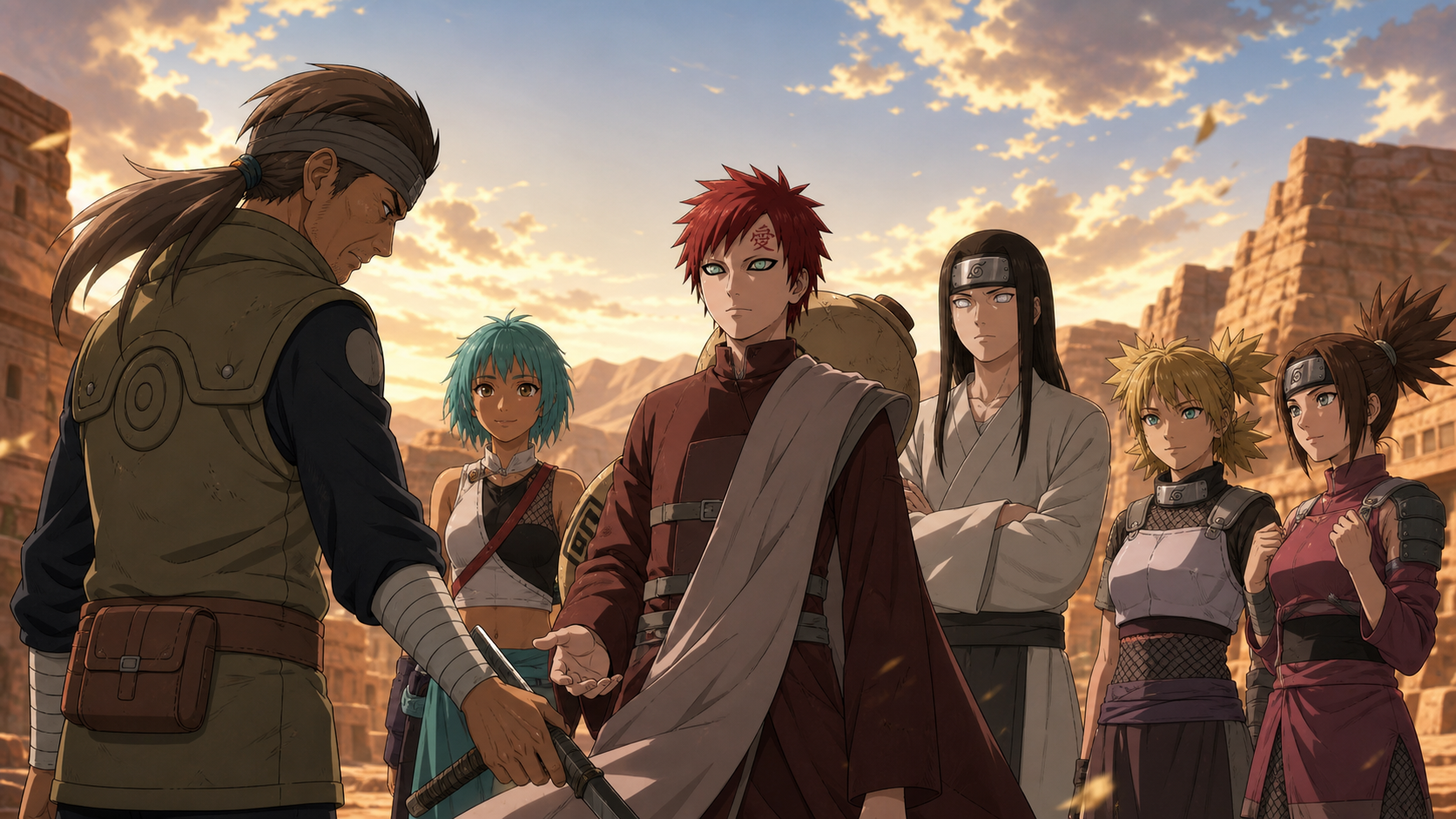
Hopes Entrusted to the Future
Gaara turns an assassination plot into an argument for accountable leadership, and the cancelled exam still reveals who can carry responsibility forward.
Bottom line
“Hopes Entrusted to the Future” closes the second Chūnin Exam by arguing that promotion is a forecast, not a prize for winning the cleanest bracket. Gaara confronts Fūgi without pretending the Sand’s fear of him came from nowhere. He remembers the harm he caused, admits that leadership cannot erase those wounds, and offers his own life if Fūgi will leave the next generation outside their conflict. Fūgi finally recognizes that the Kazekage he planned to remove is already governing through accountability rather than domination. The exam’s formal third stage is cancelled, yet reports from the first two stages provide enough evidence for village leaders to promote candidates according to judgment shown under pressure. Neji becomes a jōnin. Most of Naruto’s Leaf peers become chūnin. Shira joins the Sand’s special forces, while Matsuri and other genin inherit the village Gaara is trying to build. The later montage refuses a completely comforting ending. Ajisai dies on a Rain mission and becomes one of Pain’s bodies. Hidan and Kakuzu eventually capture Fū. Hope does not guarantee safety. The title means adults have an obligation to create a future where young shinobi are treated as people, even when the world they inherit still fails them.
Gaara returns alive
Sand search teams are still looking for their missing Kazekage when he reappears after Neji’s rescue. His survival stabilizes the village command structure.
Relief does not resolve the conspiracy.
The exam cannot resume normally
Fūgi’s barrier, the artificial sandstorm, candidate evacuations, and assassination attempt have destroyed the controlled conditions required for competition.
Rules cannot pretend the field remained fair.
Gaara orders an official outcome
The organizers must decide whether to continue, cancel, or evaluate candidates from the evidence already gathered. Leadership requires a clear decision after disruption.
Administrative closure is part of crisis recovery.
The third stage is cancelled
Candidates do not receive the expected tournament or final test. Safety, compromised security, and unequal exhaustion make another round irresponsible.
No spectacle is worth manufacturing legitimacy.
Cancellation does not erase performance
Observers recorded decisions throughout the first stage, desert survival, rescue operations, and the emergency. Those actions reveal leadership more clearly than a bracket alone.
Evaluation can use behavior under real pressure.
Gaara meets Fūgi directly
The Kazekage confronts the insider who sabotaged village defenses and arranged his death. He does not delegate the moral conversation entirely to interrogators.
Victims may choose to hear the logic used against them.
Fūgi believed Gaara endangered the Sand
His opposition grows from memories of Gaara’s earlier violence, fear surrounding Shukaku, and distrust of a young ruler. Those concerns become justification for assassination.
An understandable fear can lead to indefensible action.
Gaara does not deny his past
He acknowledges the pain he inflicted on the village before becoming Kazekage. Office and good intentions do not retroactively heal every wound.
Accountability begins without self-exoneration.
Gaara questions his right to lead
He admits that his history may make him unworthy in the eyes of people who suffered. The doubt shows awareness rather than a request for automatic absolution.
Authority should remain answerable to memory.
He once considered leaving the village
Gaara believed disappearance might be the only response to harm that could never be repaired. Isolation looked like punishment and protection at once.
Withdrawal cannot rebuild what violence damaged.
Acceptance changed his direction
People who met Gaara without prejudice gave him a reason to stay and serve. Naruto opened that path, while Sand peers and younger shinobi made the path local.
Belonging becomes responsibility rather than comfort alone.
The next generation matters most
Matsuri and other young candidates see Gaara as teacher, Kazekage, and protector rather than only Shukaku’s host. Their trust represents a future not locked to older fear.
New relationships do not erase old wounds, but they can stop repetition.
Gaara offers his own life
If Fūgi insists that removal is necessary, Gaara asks him to target the Kazekage alone and leave young shinobi outside the conflict. The offer refuses to let candidates remain political bait.
Leadership places the leader before the governed.
The offer is not surrender to Fūgi’s premise
Gaara does not agree that extracting Shukaku or staging an accident was justified. He exposes whether Fūgi’s stated concern for the village can survive contact with innocent casualties.
Moral clarity tests the conspirator’s story.
Fūgi recognizes his misjudgment
The Kazekage before him is not the uncontrolled child he feared. Gaara’s willingness to accept responsibility and protect the next generation contradicts the assassination plan’s assumptions.
Evidence arrives through conduct.
Fūgi chooses death as atonement
He moves toward suicide or self-imposed execution rather than living through a public process. The choice reflects the shinobi culture’s harsh treatment of failure and betrayal.
Death closes testimony that accountability still needs.
The episode should not romanticize seppuku
Fūgi endangered scores of candidates, corrupted a barrier, and conspired to kill Gaara. Dying may express remorse, but death prevents restitution, disclosure, and sustained repair.
Remorse is not the same as accountability completed.
Hōichi also requires formal judgment
Neji saved the priest from his own seal, leaving the village responsible for investigation and sentencing. Mercy preserves the possibility of truth.
Survival keeps institutional accountability available.
The episode remains anime-original
This exam, Fūgi’s conspiracy, Gaara’s confrontation, and the promotion framing belong to adaptation-only material. The final React must label that status.
Continuity notes protect readers from false manga attribution.
Promotion reports travel between villages
The Sand cannot unilaterally rank every foreign candidate. Observations and recommendations return to the Kage or leaders with authority over each shinobi.
Joint exams require shared governance.
Tsunade reviews the Leaf candidates
The Hokage receives evidence from exam officials and field conduct. Promotion decisions can account for choices beyond direct wins.
Rank should follow demonstrated responsibility.
Neji is promoted to jōnin
His leadership during the Hōichi rescue goes beyond solving the seal. He coordinates rival groups, accepts exam sacrifice, and chooses mercy after victory.
Technical excellence is matched by judgment.
The promotion fits later continuity
Neji is already a jōnin when Naruto returns to Konoha. This anime-original arc supplies a plausible route without becoming the manga’s stated account.
Compatibility is not identical to canonical proof.
Lee earns chūnin recognition
His willingness to protect Shira, support rescue operations, pressure Hōichi’s barrier, and follow analytical leadership shows growth beyond single-combat intensity.
Taijutsu strength becomes team reliability.
Tenten earns chūnin recognition
Her supplies, sealing knowledge, underground rescue solution, chakra blade, and controlled ranged support repeatedly change outcomes. The arc gives evidence behind the later rank.
Versatility receives institutional acknowledgment.
Hinata earns chūnin recognition
Her Byakugan analysis, terrain reading, and coordination with Team 8 contribute beyond following Kiba’s pursuit. She helps correct the team’s blind spots.
Quiet judgment is still leadership evidence.
Kiba earns chūnin recognition
His persistence against Team Kazami becomes useful when paired with observation and teammate input. He recovers from tactical humiliation rather than collapsing into blame.
Adaptation after failure matters more than flawless confidence.
Shino earns chūnin recognition
His hidden insect marker, patient search, and contingency thinking preserve options when louder tracking channels fail. He repeatedly protects team information.
Methodical preparation deserves rank credit.
Ino earns chūnin recognition
She integrates medical chakra control with Mind Transmission, creates a shared-perception network, and contests Saya’s possession of Chōji while depleted.
Connection becomes battlefield leadership.
Chōji earns chūnin recognition
He controls power, protects exhausted teammates, and works inside unfamiliar team composition without losing loyalty or judgment. Strength is directed rather than merely enlarged.
Reliable protection is a command trait.
Sakura’s status needs precise wording
She participates with Ino and Chōji, demonstrates advanced medical and combat skill, and later holds chūnin rank. The final React should follow the episode’s explicit result rather than assume every promotion detail from montage shorthand.
Metadata should not outrun direct evidence.
Team Guy’s scroll outcome is secondary
They may sacrifice the cleanest path to qualification during Gaara’s rescue. Promotion recognizes why they made that choice.
Rank evaluation rewards priorities the exam objective could not capture.
Matsuri keeps growing under Gaara
Her refusal of Fū’s free scroll, rescue appeal, and participation against Hōichi show the kind of future Gaara describes to Fūgi. She acts from standards rather than blind worship.
Students validate teachers through independent judgment.
Shira’s skill receives Sand recognition
His taijutsu discipline and leadership in the desert earn a place in the village’s special forces or advanced service. The system that once undervalued him begins to change.
Institutional repair should create opportunity, not only praise.
Yome and Sen face their own paths
Shira’s teammates have supported his growth and demonstrated distinct perception and genjutsu strengths. Their futures should not disappear inside his promotion.
Team contributions deserve separate tracking.
Fū remains committed to friendship
Learning about Naruto gives her a person she wants to meet. Her exam experience expands the imagined community beyond the Hidden Waterfall.
Hope becomes a destination.
Yōrō and Kegon carry the village mission home
Their desire for Waterfall recognition remains valid even after Fū abandons the quickest completion. Protecting her becomes part of what village honor should mean.
Prestige needs a human center.
The later montage changes the tone
The episode looks beyond the exam to show what happens to several participants. These scenes are future outcomes, not same-day consequences.
Chronology must remain explicit in publication.
Ajisai returns to the Hidden Rain
Her performance earns recognition, and she continues serving under a village controlled by Pain and Konan. The political system surrounding her remains dangerous.
Promotion does not guarantee institutional care.
Ajisai dies on a later mission
The capable kunoichi who worked with Tenten is killed after the exam. Her death should not be reduced to setup for a familiar design.
A future tragedy does not erase her lived agency.
Her body becomes an Animal Path vessel
Pain uses Ajisai’s corpse as one of the Six Paths. The transformation converts a person into an instrument after death.
The image echoes the arc’s recurring objectification of shinobi bodies.
Fū is later targeted by Akatsuki
Her identity as Chōmei’s jinchūriki continues to attract organizations interested in the beast rather than the host. The friendship-seeking genin remains structurally vulnerable.
One successful rescue cannot repair the wider system.
Hidan and Kakuzu capture her
The montage connects Fū’s hopeful exam appearance to the eventual extraction campaign. The event belongs later in chronology and should be framed with spoiler care.
Retrospective tragedy needs a clear boundary.
Fū’s fate sharpens Gaara’s responsibility
Gaara survives one extraction because people reach him in time. Fū’s later capture shows how unevenly villages protect their jinchūriki.
Shared condition does not produce shared institutional support.
Hope is not a promise of survival
The episode title could sound sentimental if the montage ended with universal success. Ajisai and Fū reveal that entrusted hopes can still be betrayed.
Optimism creates obligation rather than certainty.
Adults remain responsible for the future
Gaara, Tsunade, village leaders, teachers, and exam organizers decide what risks young shinobi face and how their performance is valued. Praising youth cannot excuse adult systems.
Entrustment without protection becomes abandonment.
The second exam produced better evidence than planned
Candidates faced resource shortages, rival teams, rescues, coercion, environmental disaster, and political sabotage. Their choices reveal command readiness more clearly than a staged duel might.
The value came despite organizer failure, not because danger was acceptable.
Gaara’s leadership model rejects domination
He does not preserve office by killing every critic or demanding that younger shinobi worship him. He accepts historical responsibility and protects their right to build something different.
Authority becomes stewardship.
Naruto’s absence still shapes the arc
Naruto never takes this exam, yet his influence appears through Kiba’s persistence, Hinata’s feelings, Sakura’s determination, Neji’s priorities, Fū’s resemblance, and Gaara’s leadership.
The title “In Naruto’s Footsteps” describes effects rather than presence.
The arc returns to present-war continuity next
Episode 414 leaves the flashback and resumes Naruto and Sasuke near death during the Fourth Shinobi World War. The emotional and chronological transition is abrupt by design.
The carrying-forward section must mark that boundary clearly.
The final React should separate promotion from canon status
Later ranks may match manga continuity, but this particular exam narrative remains anime-original. Plausible explanation should not be labeled as the only canonical cause.
Compatibility needs honest wording.
The final React should avoid treating deaths as trivia
Ajisai and Fū are not Easter eggs whose value comes from recognizing later bodies. Their futures reveal the cost of institutions that keep using young women as assets.
Editorial framing should preserve personhood.
Japanese performance requires direct evidence
Claims about Gaara’s remorse, Fūgi’s realization, Matsuri’s pride, Tsunade’s authority, or the montage’s emotional delivery require lawful scene-level Japanese listening.
No invented vocal analysis belongs in publication.
Gaara’s accountability cannot become self-erasure
He acknowledges the violence of his earlier rule and questions whether the village can trust him. That honesty matters, but offering his life risks accepting Fūgi’s belief that one death repairs political harm.
Accountability requires sustained service, transparent review, restitution, and changed systems. Gaara’s future labor can protect more people than his execution.
Fūgi’s death should not close the investigation
His decision may express shame, yet it removes testimony about collaborators, access, barrier manipulation, and failures that let the plot advance. Atonement chosen through death can leave institutions unchanged.
Suna still owes public findings, safeguards, and consequences proportionate to each participant’s conduct.
Cancelling the third stage is responsible governance
The storm, assassination attempt, extraction ritual, missing candidates, and exhausted rescue teams make ordinary competition impossible. Continuing for ceremony would reward spectacle over safety.
Gaara preserves the evidence already produced and refuses to pretend conditions remain fair. Cancellation does not mean every candidate’s work vanished.
Promotion should follow demonstrated judgment
Neji coordinated rival rescuers, interpreted a dangerous sealing system, revised after failure, and preserved the perpetrator’s life at Gaara’s request. Those decisions show responsibility beyond combat strength.
The chūnin promotions also need to reflect communication, care, restraint, logistics, and adaptation witnessed throughout the exam.
Shira’s future tests whether reform survives celebration
Recognition as a shinobi and instructor matters only if Suna protects him from retaliation, funds his discipline, and opens pathways for students whose abilities do not match old standards.
One exceptional promotion cannot become evidence that every barrier disappeared. Policy must outlast Gaara’s personal attention.
Matsuri represents mentorship with room to grow
Her connection to Gaara motivates rescue without making her merely a devoted student. She reports danger, protects teammates, refuses an unearned scroll, and contributes to the response.
The future entrusted to her should include authority and judgment, not permanent dependence on the teacher she admires.
Fū’s hope exposes what the world later fails to protect
She leaves the exam seeking friendship and recognition across village lines. Her later capture by Akatsuki does not make that hope childish.
It indicts institutions that continued isolating jinchūriki after knowing isolation made them easier targets. Future knowledge should deepen responsibility rather than turn her death into trivia.
Ajisai’s later fate demands the same care
Her body becoming a Pain vessel is not a clever continuity prize attached to Tenten’s episode. It is another person absorbed into an institution that treats bodies as usable material.
Remembering her requires preserving the specialist, teammate, and rival who made choices before that violence consumed her.
RaeRae’s verdict
“Hopes Entrusted to the Future” closes the arc by separating worth from victory. The third stage never happens, yet the candidates have already shown who can protect teammates, revise bad plans, coordinate rivals, preserve life, and accept responsibility. Neji’s jōnin promotion is the clearest example, but the wider set of chūnin decisions follows the same logic. Rank becomes recognition of judgment already practiced.
Gaara’s confrontation with Fūgi gives that evaluation a political frame. He does not ask the village to forget who he was. He asks whether the next generation must keep paying for the fear and pain surrounding him. The later montage refuses to claim that one compassionate Kazekage has fixed the shinobi world. Ajisai and Fū still meet systems that value their bodies and beasts over their lives. That is why hope has to be entrusted carefully. The future is not automatically kinder. Somebody has to build institutions worthy of the young people being asked to carry that future.
RaeRae’s call
Gaara closes the exam by accepting responsibility without ruling through domination. Cancelling the third stage protects candidates while promotion reports preserve what they already demonstrated. Neji’s advancement makes sense because his rescue required analysis, coordination, revision, and mercy. Fūgi’s death cannot substitute for an institutional investigation, and Gaara’s offered life cannot become the price of reform. Shira, Matsuri, Fū, Ajisai, and every promoted candidate are not symbols adults can praise and abandon. Hope entrusted to the future creates duties in the present: protect new paths, distribute authority, document failure, and build systems strong enough that one exceptional leader does not carry the whole village.
Episode details and viewing routes
- Official episode reference: Naruto Official episode guide
- Licensed episode route: Crunchyroll licensed episode page
The future deserves more than faith; it deserves adults who fund, defend, and answer to it.
What I am carrying forward
Gaara survived the assassination attempt and confronted Fūgi, acknowledging the harm he once caused while insisting that younger shinobi be left outside the conflict. Fūgi recognized that he had misjudged Gaara. The compromised exam ended without a normal third stage, and village leaders used observed conduct to determine promotions. Neji became a jōnin, while multiple Leaf peers became chūnin.
Shira received greater recognition in the Sand, and Fū left wanting to meet Naruto. Later-fate scenes show Ajisai dying and becoming one of Pain’s bodies, while Hidan and Kakuzu eventually capture Fū for Chōmei. Episode 414 returns to the Fourth Shinobi World War with Naruto and Sasuke on the brink of death.