
RaeRae Reacts · One Piece Episode 133
Sanji’s Curry Lesson
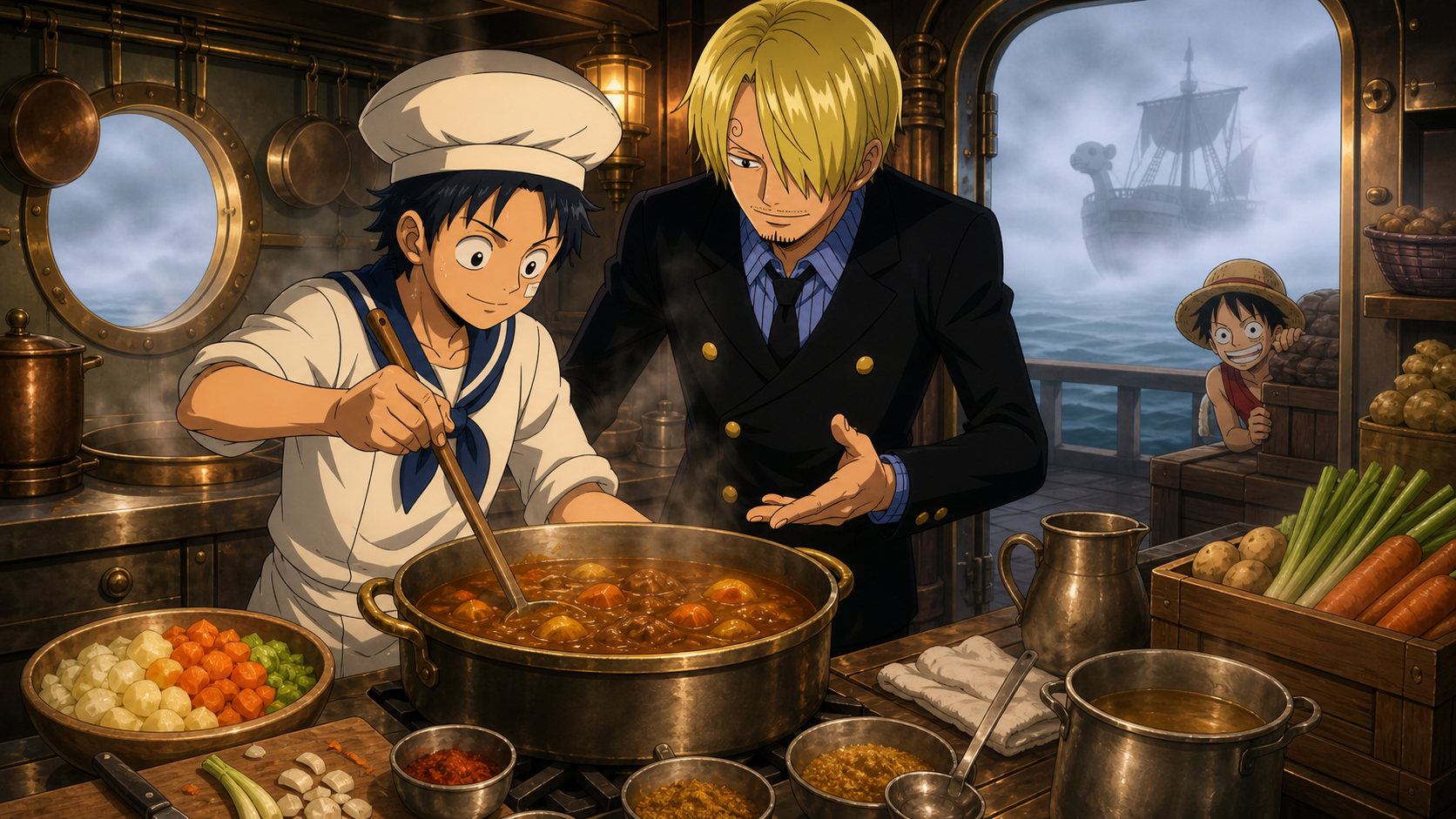
One Piece Episode 133 pairs Sanji with Marine trainee Tajio for a curry lesson about inherited skill, kitchen safety, and the All Blue.
Fog turns a calm route into a collision risk
Episode 133 places the Going Merry inside thick fog with Marine ships appearing at dangerously close range. Usopp tries to see ahead, Nami reads the limited conditions, and Robin notes that the Marines face the same visibility problem.
Shared blindness does not create safety. Both fleets need reduced speed, sound signals, dedicated lookouts, and a collision procedure. A smaller ship such as the Merry carries greater risk because a large warship may never feel the first impact.
Nami’s calm assessment keeps panic from taking control, but reassurance should sit beside active precautions. The crew needs everyone away from unnecessary noise, lines ready for sudden turns, and a clear plan if the fog reveals armed vessels.
Weather can temporarily erase the Marines’ surveillance advantage. Fog also erases the Straw Hats’ escape margin. Concealment and danger arrive together.
Tajio falls before anyone can ask who he is
Sanji spots a young person on a nearby Marine ship. Tajio sees the pirate flag, panics, loses consciousness, and falls toward the sea.
Robin uses her Devil Fruit ability to catch him before Sanji can jump. Her intervention is fast, controlled, and safer than adding another body to the water.
Rescue comes first even though Tajio belongs to an enemy organization. A uniform does not cancel the duty to prevent an immediate death, especially when the person appears young and unarmed.
Once aboard, the crew should check breathing, injuries, temperature, and possible aspiration. Chopper should lead medical assessment while somebody maintains a lookout. Saving a person from the water does not end the emergency.
Soup becomes the first bridge across enemy lines
Tajio wakes frightened and assumes the pirates plan to attack the Marines. Sanji offers warm soup instead of demanding trust. The food gives him a safe action: smell, taste, swallow, and decide whether these strangers match the threat he imagined.
Feeding someone after cold-water exposure can help comfort, but the cook should confirm allergies, consciousness, swallowing ability, and medical instructions first. Chopper’s clearance matters before hospitality.
Sanji does not use the meal as payment for information. That distinction protects dignity. Food given during rescue should never create a debt.
Tajio’s acceptance opens conversation because care arrives before interrogation. The scene captures Sanji’s strongest principle: hunger matters more than affiliation.
A six-month apprentice has never been allowed to cook
Tajio explains that he has served as a probationary Marine cook for six months while washing dishes and peeling ingredients. He has watched the galley without receiving direct responsibility for a finished dish.
Foundational work teaches sanitation, knife control, ingredient recognition, timing, and kitchen rhythm. Repetition can build competence. Repetition without structured progression can also become cheap labor disguised as training.
An apprenticeship needs written goals, supervised practice, feedback, and a clear path toward greater responsibility. Tajio should know what skills he must demonstrate and when another assessment will occur.
Six months of observation may contain enormous knowledge, but the galley has failed if nobody helps him name what he learned. Watching should supplement instruction rather than replace instruction completely.
The spilled soup reveals a dangerous workplace
Tajio recently tripped over a broom while carrying a pot of soup and spilled the entire batch. The mistake threatens a formal lunch for Marine captains.
A broom left in a working path is a preventable hazard. The galley needs designated storage, clear walkways, non-slip flooring, stable pot transport, and verbal warnings when someone carries hot liquid.
Scalding could have injured Tajio or another worker. The episode focuses on the lost meal, but worker safety should come before schedule or rank.
A proper incident review would examine the environment rather than blaming only the apprentice. Discipline cannot fix a layout problem. Corrective action should remove the hazard, document any injury, and change the transport method.
Threatening expulsion turns learning into panic
Tajio believes he will be removed from the ship unless he replaces the soup before lunch. That fear narrows attention at the exact moment he needs patience and recall.
A trainee should not face housing or employment loss over one recoverable mistake, especially when unsafe storage contributed. Proportionate accountability might include cleanup, supervised replacement, and safety retraining.
High-stakes punishment also encourages concealment. Workers who fear expulsion may hide spills, contaminated food, burns, or missing ingredients until harm reaches diners.
The head chef may intend the assignment as a test, but Tajio experiences the message as abandonment. Good supervisors state the goal, available help, safety limits, and consequences clearly.
The All Blue gives Sanji a reason to cross the line
Tajio reveals that he dreams of reaching the All Blue. Sanji recognizes the same impossible-seeming destination that has guided his own life.
Shared ambition lets Sanji see the apprentice as a cook rather than a Marine. The connection is genuine, though a common dream does not automatically authorize infiltration of a warship.
Sanji could offer verbal guidance aboard the Merry or arrange a neutral transfer. Instead, he asks Luffy to launch them back toward the Marine vessel.
The decision combines generosity with reckless exposure. Helping Tajio matters. Protecting the Straw Hats from capture also matters. Ethical intent needs an operational plan that does not place the entire crew at avoidable risk.
Luffy turns transport into unauthorized infiltration
Luffy uses his rubber body to sling Sanji and Tajio across the gap, then joins them. His presence changes a quiet mentoring mission into a security emergency.
A Marine galley contains food for hundreds of people, restricted supplies, knives, fires, and records. Unannounced entry can trigger armed response or contaminate the meal service.
Sanji should establish boundaries before departure: who goes, where they remain, what they touch, how they return, and what signal ends the mission. Luffy ignores every missing rule because nobody made a workable plan.
Captaincy does not mean freedom from consequences. A captain who expands risk without consultation owes the crew an explanation and corrective action.
The Marine galley exposes wealth and scale
Sanji notices expensive equipment and a large, well-stocked workspace. The Marine institution can feed officers through resources most civilian cooks or small pirate crews could never access.
Public resources should serve everyone aboard, not only captains. Junior sailors, kitchen workers, prisoners, and injured people need safe and nutritious meals too.
A formal officers’ lunch can consume labor and premium ingredients while lower ranks receive less. Transparent menus, portions, procurement, and waste records would show whether hierarchy shapes nutrition.
Sanji understands value because he knows starvation. His eye should measure not only luxury but whether scraps, surplus, and usable ingredients become meals instead of waste.
Luffy treats the pantry like personal treasure
Luffy enters storage and begins helping himself to food. The gag fits his appetite, but the pantry supports a planned service with counted supplies.
Removing ingredients can create shortages, break inventory records, and expose diners to contamination if packages or containers remain open. A visitor cannot know which items are reserved for allergy-safe meals or medical diets.
Sanji forces him to empty his pockets, which protects the kitchen and stops theft from becoming another crisis.
The moment also shows why food security requires controlled access. Locks alone cannot replace culture, but every crew member needs to understand that stocked food represents future meals, not unattended abundance.
Sanji remembers learning under Zeff
Tajio’s position reminds Sanji of his own apprenticeship. Zeff assigned chores and expected him to observe professional technique rather than waiting for every lesson to arrive as a lecture.
Observation can teach rhythm, order, sound, texture, and judgment that a written recipe cannot fully capture. Sanji learned to notice when ingredients changed and why timing mattered.
Zeff’s method still depended on an experienced adult watching the learner. Pure sink-or-swim training would be irresponsible around knives, flame, pressure, and foodborne illness.
Sanji carries forward the useful part of the lesson while staying close enough to prevent disaster. Mentorship becomes inheritance through adaptation rather than exact repetition.
Tajio reconstructs the curry from memory
Sanji helps Tajio recall the head chef’s sequence. The apprentice remembers preparation choices because months of apparently minor work trained his attention.
Memory alone needs verification. Tajio should identify ingredients, quantities, temperatures, timing, and the target number of servings before production begins.
Large-batch curry behaves differently from a small pot. Heat distribution, reduction, seasoning, and holding time change with volume. Safe service also requires temperature monitoring and protection from cross-contamination.
Sanji lets Tajio perform the work rather than taking over. That choice turns assistance into learning and ensures the final success belongs to the apprentice.
Indirect hints preserve agency but risk confusion
Sanji pretends to criticize or interfere while steering Tajio toward the correct process. The style protects Tajio’s pride and prevents the Marine cook from openly receiving pirate instruction.
Indirect teaching can encourage problem solving, but hints should never obscure a safety issue. A mentor must speak plainly about undercooked food, contamination, allergens, spoiled ingredients, or dangerous equipment.
Tajio responds well because he already holds much of the knowledge. Another learner might need demonstration, written steps, or repeated practice.
Good instruction adapts to the person instead of treating one method as proof of toughness. Sanji reads Tajio accurately, which makes the unusual approach work.
Curry demands patience the clock refuses to give
Sanji reminds Tajio that cooking cannot be rushed. Curry builds flavor through staged preparation, controlled heat, seasoning, and enough time for ingredients to become one dish.
The captains’ lunch deadline creates pressure, but serving unsafe or unfinished food would be worse than serving late. Kitchen leadership should protect cooks from rank-based demands that compromise safety.
Tajio needs tasting spoons that never return to the pot, clean utensils, stable heat, and documented holding conditions. Approval from one mentor cannot replace food-safety controls.
Patience here means disciplined attention rather than passive waiting. Every interval gives the cook something to smell, watch, stir, measure, or prepare.
Luffy’s discovery threatens everybody aboard
Marine lookouts spot Luffy while Tajio finishes the curry. One unauthorized person can trigger alarms, armed pursuit, ship searches, and suspicion toward the galley staff.
Sanji and Luffy escape before the Marines arrive, but Tajio remains exposed. His supervisors could accuse him of collaboration if evidence appears.
Sanji should consider the risk placed on the apprentice before entering. Helping someone should not leave that person carrying the greater punishment after the helper leaves.
Luffy also owes the Merry an apology for endangering the ship’s concealment. Curiosity cannot keep overriding the safety work Nami and Usopp perform.
Tajio lies to protect the cooks who helped him
When Marines ask whether he saw anyone suspicious, Tajio blames the fog and hides the pirates’ presence. The lie protects Sanji and Luffy from capture.
The choice also places Tajio in conflict with his institution. He has just learned that an enemy pirate treated him with more care than his own chain of command seemed willing to provide.
Gratitude does not require self-endangerment, but Tajio decides that reporting the rescue and mentorship would cause more harm than truth would prevent.
The episode avoids a grand political conversion. He remains a Marine trainee while recognizing that uniform categories cannot explain every person’s ethics.
The captains praise a meal built by invisible labor
The finished curry reaches the officers, who enjoy the result. Tajio receives evidence that he can cook under pressure, yet the broader kitchen workforce made the service possible.
Dishwashers, peelers, stock workers, cleaners, servers, and trainees create the conditions behind every formal meal. Leadership should credit the team rather than treating food as the head chef’s magic.
The head chef’s restrained approval suggests that the assignment was designed to reveal Tajio’s readiness. A direct debrief would make the lesson more useful: what worked, what nearly failed, and what responsibility comes next.
Tajio should receive supervised cooking shifts after this success. Sending him back to endless peeling would waste the growth the test produced.
Episode 133 serves mentorship without stealing the plate
A Recipe Handed Down works because Sanji never turns Tajio’s challenge into a showcase for himself. He could cook the curry faster. He chooses to make the apprentice capable.
The episode deserves criticism for unsafe workplace design, coercive training pressure, unauthorized infiltration, and Luffy’s pantry theft. Those problems sharpen the difference between real mentorship and institutional neglect.
Sanji’s belief in the All Blue gives Tajio a future larger than one lunch. Shared dreams cross enemy lines without pretending political danger vanished.
RaeRae’s verdict: keep this one. Episode 133 treats cooking as skilled labor, shows knowledge passing through observation and care, and understands that the best teacher leaves the learner holding the finished dish.