
RaeRae Reacts · One Piece Episode 132
Nami Draws Her World Map
One Piece Episode 132 puts Nami’s world-map dream to work as crew chaos, damaged charts, and a cyclone test her authority as navigator.
A quiet fishing day produces a stranger
Episode 132 opens with Luffy, Usopp, and Chopper fishing while the rest of the crew settles into a calm day aboard the Going Merry. Chopper catches a respectable fish, Usopp catches a much smaller one, and Luffy manages to pull up a giant sea-snail vehicle instead of lunch.
The discovery introduces Rice Rice, a traveling salesman who says a storm separated him from his delivery route. His arrival plays as comedy, but pulling an unknown person aboard still creates a security problem. The crew should confirm whether he needs medical care, ask about nearby hazards, and keep him away from private spaces until everybody understands the situation.
Rescue should never depend on whether a stranger seems useful. A safe crew can provide water and temporary shelter while maintaining boundaries around weapons, charts, money, and navigation equipment.
Luffy skips every protocol because curiosity wins. Nami quickly notices that the sales inventory may contain something her dream actually needs.
Millennium Paper turns a dream into a material need
Nami asks Rice Rice whether he carries paper strong enough to survive travel at sea. He presents Millennium Paper as durable, flexible, and resistant to ordinary weather. For a navigator building a world map aboard an open-deck ship, material quality is not vanity.
Paper can absorb humidity, buckle under temperature shifts, tear under movement, and lose ink when exposed to salt water. A damaged chart can erase weeks of labor or create a navigation hazard during an emergency.
Nami understands the specification immediately because she knows the conditions. Her expertise lets her distinguish useful equipment from a sales pitch. Nobody else sees paper as infrastructure until she explains why ordinary sheets will not protect the record.
The scene gives her dream a practical foundation. Drawing the whole world requires more than courage. She needs archival materials, accurate instruments, secure storage, time, and a reliable process for revising mistakes.
Rice Rice reads desire and raises the price
The salesman recognizes how badly Nami wants the paper and tries to exploit that information. His enormous opening price does not reflect transparent cost, scarcity, or fair compensation. The number reflects perceived vulnerability.
Nami counters without pretending politeness matters more than the crew’s resources. Her negotiation is sharp because she knows anchoring, urgency, and dramatic discounts can manufacture pressure. A seller who drops millions within seconds has already revealed that the first figure lacked credibility.
Sanji’s offer to pay creates another boundary issue. Generosity should not override Nami’s judgment about price or make him the owner of her work. A gift becomes coercive when the giver expects affection, access, or decision-making power in return.
A fair transaction would include quantity, condition, source, durability claims, replacement terms, and a price both parties can defend. Rice Rice offers performance instead of disclosure.
The crew’s bounty changes the bargaining table
Rice Rice eventually notices the Straw Hat flag and realizes whose ship he boarded. Fear replaces salesmanship. He abandons the negotiation, invents an appointment, and escapes in his strange vehicle.
The crew’s reputation creates power even when nobody directly threatens him. That imbalance matters. A pirate crew cannot call abandoned goods a clean purchase simply because the owner fled after recognizing them.
They should document what remained, preserve the inventory, and make a reasonable effort to return or pay for the goods if Rice Rice can be contacted safely. Salvage rules and emergency rescue do not automatically transfer ownership.
Nami takes the paper because the episode wants her map work to begin, but the ethical debt stays visible. A later payment through a neutral port, delivery company, or escrow system would let her keep the material without benefiting from fear.
Nami finally starts the map she promised to draw
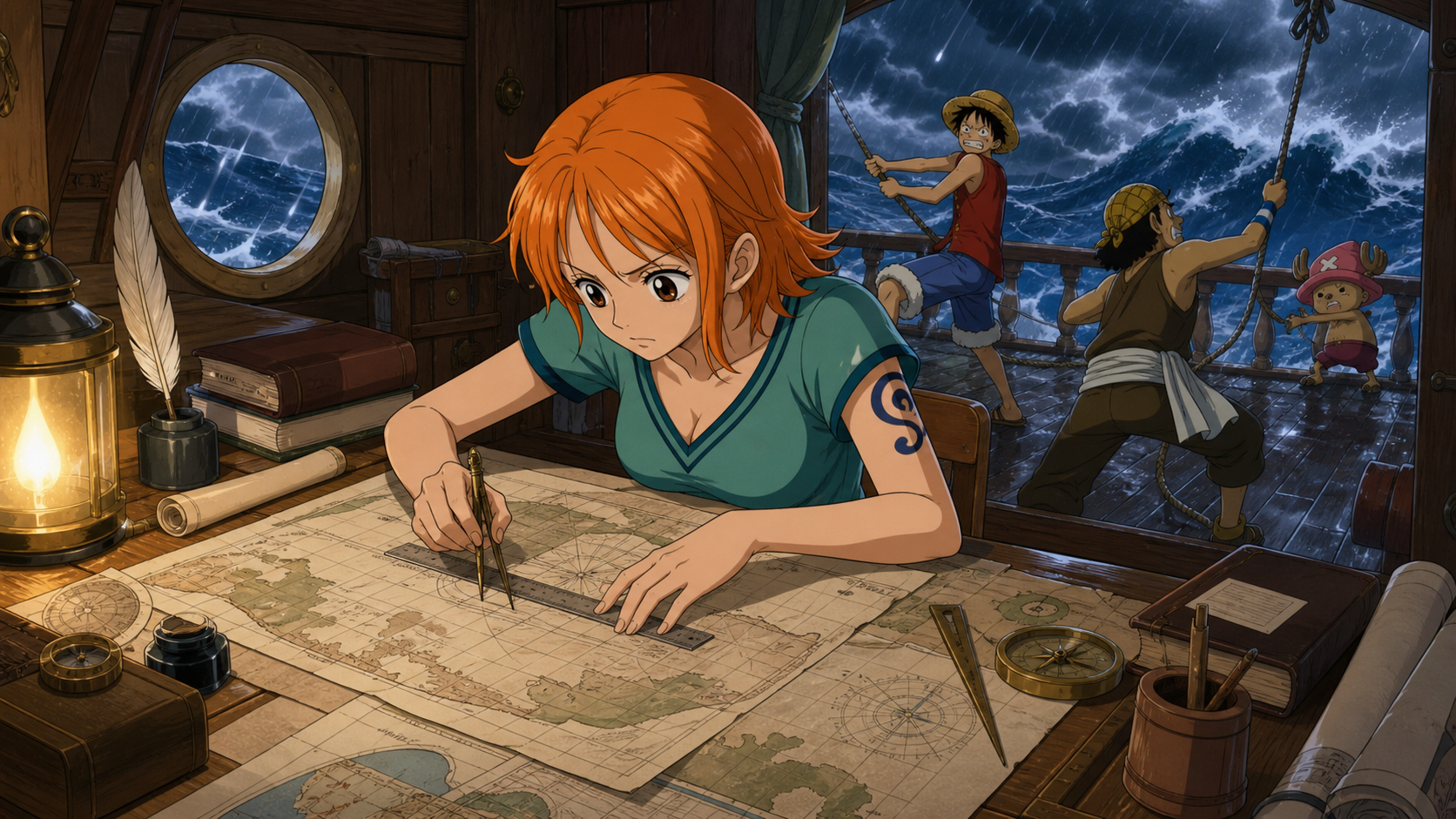
With durable paper in hand, Nami retreats to her cabin and begins translating the crew’s journey into charts. She starts with Little Garden, Drum Island, and Alabasta, places where geography shaped every choice.
This work is not decorative memory keeping. A chart records coastlines, bearings, hazards, currents, distances, landmarks, and uncertainty. Future decisions depend on whether those observations remain accurate and legible.
Nami also converts lived danger into transferable knowledge. A storm survived once can become a warning. A difficult harbor can become a safer approach. A route that nearly killed the crew can help someone avoid the same mistake.
Her dream gains force because she begins before conditions become perfect. The ship lacks a dedicated chart room, quiet policy, archival cabinet, and stable drafting table. She works anyway, while also proving why the crew needs those resources.
Bell-mère gave curiosity somewhere to grow
As Nami draws, memories return from Cocoyasi Village. A younger Nami asks Bell-mère where wind and sea come from and what lies beyond the horizon. Bell-mère does not punish the questions or reduce her future to village boundaries.
Curiosity needs adults who can admit uncertainty. Bell-mère does not know every answer, especially beyond the Grand Line, but she treats the unknown as a reason to learn rather than a reason to stop asking.
Nami’s childhood book theft complicates the memory. Access to education should not depend on stealing, yet lack of money or library access can push a gifted child toward risky choices. A healthy community would provide books, maps, mentors, and a safe place to study.
Bell-mère brings her home for dinner while still taking the dream seriously. Care and ambition do not compete. Food, shelter, affection, and intellectual freedom together allow a child to imagine a larger life.
A world map carries Nami’s history of forced labor
Nami’s cartography cannot be separated from Arlong. He forced her to draw maps for his expansion and used her talent as a tool of control. The same skill now serves a dream she chose for herself.
That transformation does not erase trauma. A drafting room, spilled ink, a locked door, or someone touching a chart without permission could recall years when her work never belonged to her.
The crew should recognize that privacy around maps is not an overreaction. Consent over materials, workspace, schedule, and publication gives Nami control that Arlong denied.
Her new charts also need clear ownership. The crew may rely on them, but reliance does not convert authorship into collective possession. Nami should decide who copies, sells, shares, or modifies the record. Emergency access can exist without stripping creator rights.
Navigation is labor even when the sea looks calm
The others relax because nothing seems urgent. Nami keeps working because a navigator’s job extends beyond holding the wheel during a storm. Observation, charting, instrument care, supply review, and route planning happen before danger becomes visible.
Invisible labor often receives attention only after failure. Nobody celebrates a correct log entry, but everybody suffers if distance, weather, or current data disappears when needed.
The crew should schedule protected charting hours just as Sanji receives kitchen time and Chopper receives medical preparation time. Quiet work is operational work.
Nami also needs compensation or a clear resource share. The ship depends on her technical skill every day. Treating her labor as friendship alone would make responsibility endless while leaving tools and rest optional. A crew budget should include paper, ink, instruments, storage, and replacement supplies.
Zoro and Sanji turn cleanup into another fight
Sanji assigns deck cleaning while Robin continues reading. Zoro objects, Sanji defends her, and the argument quickly becomes physical. Their rivalry shakes the ship and sends Nami’s pen across the paper.
The comedy works because the pattern is familiar. The damage still lands on someone who never joined the argument. Conflict becomes everybody’s problem when fighters use shared living space as an arena.
Chore assignments need a visible rotation rather than gendered favoritism or improvised commands. Robin should contribute according to a fair schedule, and Sanji should not excuse her because he finds her attractive. Zoro should challenge the process without creating a larger hazard.
A ship also needs rules about fighting near medical stores, the kitchen, rigging, navigation work, and sleeping areas. Strength does not excuse careless impact.
The first ruined chart deserves more than a punchline
Nami emerges furious after the shaking destroys her line work. Her anger comes from lost labor, expensive material, interrupted concentration, and the knowledge that nobody else understands how difficult accurate reconstruction will be.
An apology should name the damage and include repair. Zoro and Sanji can replace supplies, create a stable drafting surface, and take over chores while Nami redraws.
The crew also needs to stop framing her reaction as temperament alone. Women are often labeled unreasonable when they defend work that others treat as background. Nami’s volume may be extreme, but the boundary is legitimate.
She returns to the cabin and begins again. Persistence keeps the project alive, though persistence should not become an excuse for repeated disrespect. Resilience is not free permission to keep causing harm.
Cleaning becomes play because nobody set a safe method
Luffy, Usopp, and Chopper turn deck cleaning into a game using Rice Rice’s soap and an Ab-Ab Slider. The activity produces laughter, speed, and a mountain of bubbles instead of controlled maintenance.
Soap on a moving deck creates slip hazards, hides obstacles, and can wash overboard into the sea. A proper cleaning plan needs dilution instructions, protected edges, secured equipment, rinse management, and someone watching conditions.
Chopper joins the fun but remains physically smaller than the others. Safety planning should account for reach, traction, and the possibility that a sudden wave could carry him overboard.
The crew’s problem is not joy. Shared work can be enjoyable. The problem is treating risk as entertainment without assigning anyone to stop the activity when control disappears.
Luffy crashes through Nami’s protected workspace
Luffy slides overboard, catches the figurehead, and rebounds directly into Nami’s cabin. Maps, ink, and tools scatter again. The intrusion crosses a stronger boundary than noise.
A person’s room aboard a shared ship still deserves privacy. Crew membership does not authorize unannounced entry, handling of possessions, or repeated disruption.
Luffy did not plan the crash, but lack of intent does not remove responsibility. He should help recover every item, replace damaged paper, clean spilled ink under Nami’s direction, and support changes that prevent another accident.
The cabin needs a secure door, raised storage, chart tubes, waterproof covers, and a fixed drafting surface. Protective design matters because even a respectful crew will face storms and sudden movement. Boundaries work best when behavior and infrastructure reinforce each other.
Nami’s threat silences the one warning she needed
After the second disaster, Nami orders everyone to stay quiet and threatens a charge for another interruption. The others obey so completely that Chopper becomes afraid to report changing clouds.
This moment exposes the difference between a boundary and a communication shutdown. Nami deserves protected work time. The crew still needs an emergency exception that every member understands.
Chopper sees the weather worsen and struggles between obedience and safety. A junior crew member should never carry that choice alone. Clear protocol should say that fire, flooding, weather shifts, injury, approaching vessels, and rigging failure override quiet hours.
Nami also needs feedback that her threat had an unintended effect. Accountability does not require shaming her for needing space. Accountability requires adjusting the rule so protection never blocks urgent information.
Chopper’s fear shows why hierarchy needs safe escalation
Chopper watches a tornado form while the older crew members sleep. He remembers Nami’s anger, starts crying, and delays the warning. His reaction is not cowardice. The crew taught him that speaking could cause punishment.
Psychological safety matters on any vessel. Every person must be able to report a hazard without ridicule, retaliation, or a bill. The report can later prove mistaken and still deserve respect.
A strong watch system would define who remains awake, what conditions trigger an alarm, and how to wake the navigator. Chopper should have instruments and a checklist rather than relying on fear and visual guesswork.
The captain carries responsibility too. Luffy cannot sleep through operational planning and assume Nami will repair every failure. Leadership includes building systems that let the least powerful person interrupt the most powerful one when danger appears.
Nami responds to the emergency without punishing Chopper
When Nami completes her first chart and finds Chopper distressed, she shifts immediately from anger to reassurance. She does not waste time defending the earlier threat. She wakes the crew and directs the response.
That transition shows professional judgment. During a crisis, blame can wait. The crew needs sails, lines, steering, weight balance, and clear commands.
Nami’s tone with Chopper matters because he needs proof that reporting danger was correct. Reassurance repairs some of the fear her earlier boundary created.
After safety returns, a real debrief should examine why the tornado warning came late. The purpose should be prevention rather than humiliation. Sequence, observations, decisions, obstacles, and equipment gaps can become a better procedure for the next storm.
The cyclone proves the difference between talent and authority
Once Nami gives orders, everybody moves. Her weather knowledge and command of the ship become more important than Luffy’s title or the fighters’ strength.
Functional authority should follow expertise during specialized emergencies. The captain remains accountable, but the navigator directs navigation. The doctor directs medical response. The cook controls food safety. Shared survival depends on respecting those domains.
The crew also needs redundancy. If Nami becomes injured, somebody should understand basic sails, headings, weather signs, and chart use. Backup training does not diminish her expertise. Backup training protects her from becoming a single point of failure.
Her performance during the cyclone confirms that mapmaking and weather reading belong to the same professional practice. Records support action, and action produces better records.
The first finished map is both evidence and promise
After the storm, Nami shows the crew her completed map and restates her goal of charting the whole world. The page represents one finished unit inside a dream that may require a lifetime.
Each chart should include date, sources, scale, orientation, uncertainty, corrections, and version history. A beautiful map without provenance can still mislead future travelers.
Copies matter too. One spilled bottle or shipwreck could destroy the only record. Nami needs waterproof storage aboard the Merry and duplicate deposits with trusted people at safe ports.
Publication raises political questions. Accurate maps can help trade, rescue, migration, colonization, military attack, and resource extraction. Nami should decide what remains private, what reaches ordinary sailors, and what sensitive locations require protection.
Episode 132 gives Nami’s dream the respect she earned
The Navigator’s Mutiny succeeds because the comedy never fully erases the labor underneath. Nami is not angry because the story needs a violent woman gag. She is trying to protect irreplaceable work from a crew that mistakes quiet for leisure.
The episode also lets her childhood dream survive contact with adult logistics. Durable paper, time, storage, instruments, revision, and crew cooperation become part of the promise Bell-mère encouraged.
Some choices deserve criticism. Rice Rice’s abandoned inventory needs repayment, Sanji’s favoritism undermines fair chores, and Nami’s threat accidentally suppresses an emergency warning. Those flaws give the episode something real to examine.
RaeRae’s verdict: keep this spotlight. Episode 132 makes Nami’s intellectual labor heroic, confirms her operational authority, and reminds the crew that supporting a dream means protecting the boring systems that allow the dream to exist.