
RaeRae Reacts · One Piece Episode 131
Chopper’s First Patient
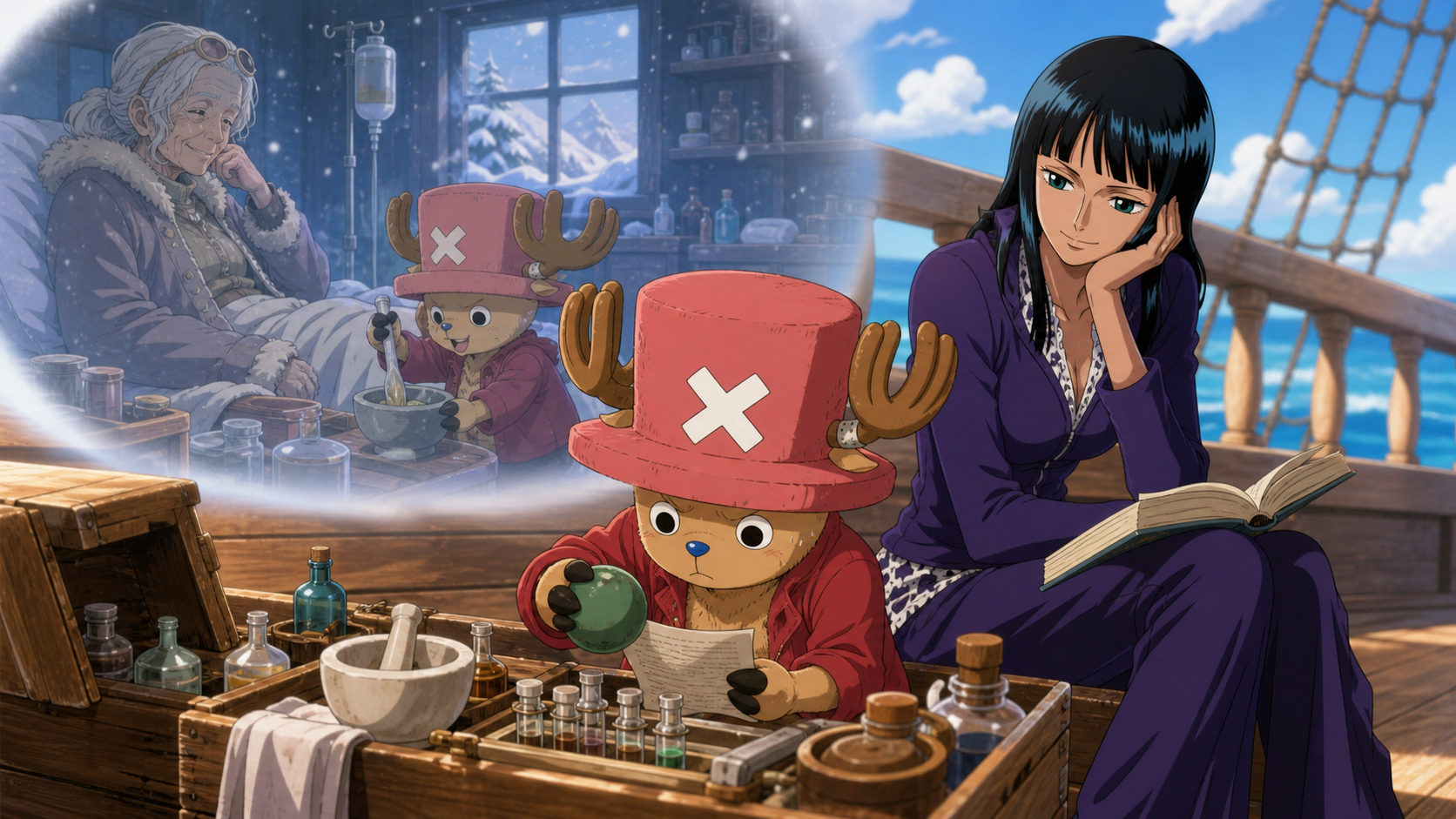
One Piece Episode 131 gives Chopper his first patient, Dr. Kureha, while a quiet day aboard the Merry begins his friendship with Nico Robin.
The Straw Hats finally get a quiet morning
Episode 131 opens after Alabasta with the crew asleep and the sea temporarily calm. Nami wakes on deck, spots an island, and pulls everybody into the practical business of finding food. The pause matters. A crew cannot move from war straight into another crisis without rest, supplies, and some kind of emotional reset.
The island looks generous enough to make that reset possible. Fruit grows everywhere, Sanji sees a chance to replenish the kitchen, and Luffy hears only the promise of eating. Their excitement brings the familiar comedy back without pretending Alabasta never happened.
Recovery often looks ordinary before anyone recognizes recovery. Sleep, food, safe water, clean clothing, and a day without incoming fire are not filler in a survivor’s life. Those basics let the nervous system stop treating every sound as a warning.
Nami still organizes the work because abundance does not eliminate planning. Someone has to survey the island, someone has to gather supplies, and someone has to protect the ship. Her quick division of labor turns a lucky discovery into a usable stop.
Ship watch becomes Chopper’s unwanted assignment
The crew draws lots for ship watch, and Chopper gets stuck aboard the Going Merry. His disappointment lands because the island offers new plants, new smells, and possible medical ingredients. A young doctor with a research habit would naturally want to explore.
Guard duty still counts as real work. The Merry holds their food, medicine, records, tools, and only reliable route away from the island. Leaving one person behind prevents theft, damage, or an unnoticed change in weather from trapping everybody ashore.
The assignment also exposes a weakness in the crew’s safety process. Chopper remains relatively new, and nobody gives him a clear watch protocol. They should identify emergency signals, return times, threats, and what authority he has if strangers approach. Trust should come with useful information rather than a casual goodbye.
Chopper responds by making Rumble Balls. He turns boredom into production, which says plenty about how he handles uncertainty. Work gives him control when social situations do not.
Robin refuses to stay a distant mystery
Robin remains aboard and quietly enters Chopper’s workspace. Her presence changes the scene because Episode 130 left the crew with serious reasons to question her. Here, she does not demand acceptance or perform another dramatic reveal. She sits nearby, reads, listens, and lets Chopper decide how much to share.
That restraint creates the first believable bridge between Robin and the crew. Chopper cannot be impressed by flirtation, treasure, or intellectual status. He responds to calm attention and respect for his medical work.
Robin also understands what exclusion feels like. Both characters spent years treated as dangers before anyone asked what they needed. Their histories are not identical, but the shared experience makes silence less awkward.
The episode wisely avoids forcing instant intimacy. Robin’s gentle manner does not erase her past with Baroque Works, and Chopper’s friendliness does not grant unlimited trust. A relationship starts because she stays present without cornering him.
Rumble Ball research deserves more than a cute reveal
Chopper’s workbench contains medicine he developed to alter the transformations produced by his Human-Human Fruit. That achievement combines observation, pharmacology, repeated testing, and knowledge of his own body.
The invention is impressive, but the process also raises medical questions. A drug that changes strength, movement, cognition, and body form needs clear dosing, storage, contraindications, and emergency planning. Chopper should document effects after every use instead of relying on memory during combat.
Self-experimentation can hide harm because the researcher wants the result to succeed. A trusted clinician such as Kureha could review his notes, challenge assumptions, and help separate a useful effect from an unsafe one. Independent oversight protects both the patient and the discovery.
The crew should know only the emergency information needed to help. They do not need a formula. They do need warning signs, safe handling instructions, and a plan for what happens if Chopper loses control or cannot speak.
Kureha taught through pressure instead of praise
Robin’s questions lead Chopper back to Drum Island and Dr. Kureha. He remembers a mentor who rarely offered soft reassurance. Kureha tested his knowledge, corrected him sharply, and expected him to keep working.
Her standards helped form a capable doctor, but harsh instruction carries a cost. A trainee who hears only criticism may hide mistakes, delay questions, or believe exhaustion proves commitment. Medical education becomes safer when high expectations sit beside psychological safety.
Kureha’s methods make more sense within her world. She practices in an isolated kingdom with limited staff, dangerous travel, political violence, and patients who may arrive near death. She needs Chopper to act under pressure. That context explains severity without making every teaching choice ideal.
A strong mentor should make competence visible. Specific feedback such as correct diagnosis, careful measurement, or good bedside observation gives a trainee something repeatable. General approval feels warm, but precise approval builds skill.
Chopper’s first patient is the doctor who trained him
Kureha becomes feverish, and Chopper suddenly occupies the clinician’s position. The role reversal frightens him because the person who usually carries every answer now needs care.
Treating a mentor creates emotional pressure. Chopper wants to prove himself, fears losing another parental figure, and knows Kureha can judge every decision. Those feelings can distort assessment if he rushes toward reassurance or assumes he understands her condition without asking.
He still examines her, consults medical books, prepares medicine, and monitors her response. The sequence shows a developing clinical method rather than magic competence. He gathers information before treatment and remains close afterward.
Kureha’s illness also reveals a basic workforce truth. The only doctor cannot be the entire health system. Remote communities need backup clinicians, supply plans, transport routes, and records that another qualified person can use. Chopper’s training becomes community resilience, not merely personal growth.
Clinical skill begins with a careful assessment
Chopper does not solve the fever by staring dramatically across the room. He checks Kureha, compares symptoms with references, and works through possible treatment. That process matters more than theatrical certainty.
A fever can come from many causes, and the correct response depends on duration, exposure, hydration, pain, breathing, mental status, and other symptoms. The episode compresses the work for television, but Chopper’s seriousness communicates that diagnosis requires evidence.
He should also ask what Kureha has taken already. A clinician who treats herself may have used medicine before admitting weakness. Drug interactions, allergies, and underlying conditions can turn a reasonable treatment into a dangerous combination.
Documentation would protect both of them. Time of onset, temperature changes, fluids, medicine, dose, and response create a record that supports the next decision. Memory becomes unreliable when fear and fatigue rise.
Consent does not disappear when the patient is a mentor
Chopper prepares a green medicine and offers the treatment to Kureha. Even with urgency, he should explain the purpose, expected benefit, important risks, and alternatives in language she can evaluate.
Kureha chooses to trust him. Her trust carries special weight because she knows his training and understands medicine herself. She is not surrendering judgment. She is recognizing that Chopper has earned a chance to act as her doctor.
Power does not flow in only one direction. Kureha has authority as his teacher, while Chopper temporarily holds clinical responsibility. Both need space to speak honestly without using either role to silence the other.
Consent also remains ongoing. Taking one dose does not authorize every later intervention. If symptoms change, Chopper needs another conversation. A patient can ask questions, refuse, request time, or seek another opinion whenever another clinician becomes available.
Trust is not a substitute for information
Kureha tells Chopper that a sick patient may lack room to interrogate every ingredient and must trust the doctor. The emotional point lands because she places her life in his hands. The medical principle needs qualification.
Trust works best when a clinician earns trust through honest information, competence, privacy, and respect. Patients should never be shamed for questions. A person who asks what a medicine contains may have an allergy, a past medical trauma, a religious concern, or a reasonable fear after previous mistreatment.
Emergency conditions can limit the length of a discussion, but limitation does not justify secrecy. A short explanation still preserves dignity: what the medicine should do, what danger requires immediate action, and what uncertainty remains.
Kureha’s choice validates Chopper as a clinician. A safer lesson is that trust made treatment possible because knowledge and relationship already existed, not because patients owe doctors silence.
The first dose does not produce an instant miracle
Chopper wants immediate proof that his medicine worked. Kureha reminds him that treatment needs time and rest. That correction may be the most useful clinical lesson in the episode.
Doctors can cause harm when they interpret normal waiting as failure. Adding doses too quickly, changing several variables at once, or promising a rapid cure can make symptoms worse and destroy the ability to identify what helped.
Monitoring is active care. Chopper can track temperature, hydration, alertness, breathing, pain, and urine output while Kureha rests. He can prepare escalation steps if her condition deteriorates.
The scene also rejects the fantasy that medicine always fixes suffering on command. Good care combines treatment with time, nutrition, safe shelter, sleep, and observation. A patient who looks unchanged five minutes later has not necessarily received bad care.
Water, rest, and basic nursing carry the recovery
Chopper continues the unglamorous work after preparing medicine. He fetches water, watches Kureha, and keeps the environment functioning while she sleeps.
Those tasks often disappear from heroic medical stories, even though nursing care determines whether many patients recover safely. Clean water, temperature control, hygiene, nutrition, positioning, and repeated checks can matter as much as a dramatic intervention.
A remote clinic must protect water quality carefully. Containers need cleaning, the source needs assessment, and a sick patient should not depend on a trainee making long trips without backup. Stored reserves would reduce risk during storms or outbreaks.
Chopper’s willingness to do basic care shows that he does not view medicine as status. He wants Kureha well, so no task sits beneath him. That attitude deserves protection as his skills grow.
Kureha’s compliment lands because she rarely gives one
When Kureha finally tells Chopper he did a good job, the small sentence becomes a permanent memory. He later tells Robin that the praise was the only compliment he received across years of training.
The scarcity makes the moment powerful, but scarcity should not become a teaching strategy. Trainees need regular, accurate feedback before a crisis. Otherwise, they may chase approval, confuse silence with failure, or keep working past safe limits.
Kureha’s trust says more than a generic pep talk. She accepted his care while vulnerable, which confirms that she believed his judgment had become clinically meaningful. Chopper understands the act even if neither of them speaks sentimentally.
A better training culture can preserve demanding standards while naming growth. Praise should not flatter. Praise should identify sound assessment, careful preparation, honest uncertainty, or respectful care so the learner knows what to carry forward.
Chopper mistakes modesty for self-erasure
Back in the present, Chopper becomes embarrassed after revealing how much Kureha’s approval meant. His reaction fits a character who wants recognition and panics when recognition arrives.
Humility helps a doctor remain teachable, but humility should not require denying competence. Chopper created a sophisticated drug, survived difficult training, treated his mentor, and now protects an entire pirate crew. Those facts can coexist with uncertainty.
Self-erasure creates safety problems if he refuses help, minimizes fatigue, or lets stronger personalities override medical judgment. The crew needs him able to say when a patient cannot travel, when supplies are low, and when a treatment exceeds his experience.
Robin does not mock the contradiction. Her calm response gives him room to feel proud without demanding a performance. That is a quieter form of care.
Robin listens without turning pain into entertainment
Robin invites the story through curiosity, then lets Chopper control the pace. She does not press for the most traumatic detail or use his history to win an argument.
That behavior matters because survivors often become sources of dramatic content for other people. Ethical listening centers the speaker’s boundaries. A listener can ask permission, accept refusal, avoid public repetition, and resist treating disclosure as proof of intimacy.
Robin also reveals a small piece of herself when she says she wishes she had someone to write to. The line does not equal Chopper’s disclosure in volume, but reciprocity prevents the exchange from becoming an interview.
The moment suggests that Robin understands belonging through correspondence and memory before she understands belonging through a crew. Someone waiting for a letter represents continuity, a future conversation, and proof that absence does not erase connection.
The newest crewmates find each other first
Chopper and Robin occupy opposite ends of the crew’s emotional presentation. Chopper broadcasts every feeling while pretending he does not. Robin hides nearly everything behind composure. Their first bond works because neither demands that the other change immediately.
Both also entered the crew after long periods of social exclusion. Chopper was rejected as a monster. Robin survived under a world order that treated her knowledge as a crime. Shared exclusion can create understanding, but nobody should collapse their experiences into the same story.
Chopper offers Robin evidence that this crew can hold vulnerable memories without exploiting them. Robin offers Chopper adult attention that does not infantilize his profession.
Their connection strengthens crew safety. People who trust one another share symptoms earlier, notice behavioral changes, and intervene before isolation becomes crisis. Friendship does not replace formal safeguards, but friendship makes those safeguards easier to use.
The fruit mission exposes the crew’s comic labor politics
While Chopper works and remembers, the others gather fruit with wildly different levels of competence. The final meal turns their results into comedy, especially when Zoro’s success earns him more work.
Nami’s joke about sending him back out all night shows how quickly praise can become exploitation when productive people receive only another assignment. A fair crew should rotate unpleasant work, set stopping times, and recognize contribution without punishing efficiency.
Sanji handles food planning, but food labor should not become invisible because he enjoys cooking. Gathering, washing, checking for toxicity, storage, rationing, and cleanup all need shared responsibility.
The island also requires ecological restraint. A passing crew should harvest what they need without stripping trees, damaging habitats, or taking seeds that local communities depend on. Plenty from a visitor’s view may serve residents or wildlife across an entire season.
Anime-original does not mean emotionally disposable
Episode 131 begins a short anime-original run after Alabasta. The chapter may not advance the manga’s central plot, but Chopper’s spotlight performs useful character work.
The episode lets the audience see him as a practicing doctor rather than a mascot or emergency transformation. Medical identity becomes a daily discipline built from preparation, uncertainty, and care.
The story also slows Robin’s integration into the crew. Immediate acceptance after Episode 130 would feel convenient. A private conversation with another newcomer gives her belonging a believable first step.
Anime-original material earns value when the writing respects established character motives and reveals a relationship the main plot lacks time to explore. This episode succeeds because the smaller scale serves continuity rather than fighting continuity.
Episode 131 earns a gentle but necessary verdict
The First Patient works because nobody needs a villain. The pressure comes from Chopper’s fear of failing Kureha, his uncertainty around Robin, and the crew’s attempt to feel normal after a war.
The medical ethics are not flawless. Kureha’s trust speech risks implying that questions obstruct care, and her near-total refusal to praise creates an unnecessarily harsh training environment. The episode still gives Chopper a credible clinical process and refuses the instant-cure shortcut.
Robin may be the strongest part of the present-day story. She listens, shares one quiet vulnerability, and allows Chopper to discover that time with her can feel safe. No grand declaration could sell her first day aboard as effectively.
RaeRae’s verdict: keep this one. Episode 131 turns a so-called filler slot into a careful story about earned trust, responsible treatment, mentorship, and two outsiders testing whether the Merry can become home.