
The Place Where I Belong
Ino does not have to choose between medical ninjutsu and Yamanaka training when both disciplines sharpen the connection her team needs from her.
Bottom line
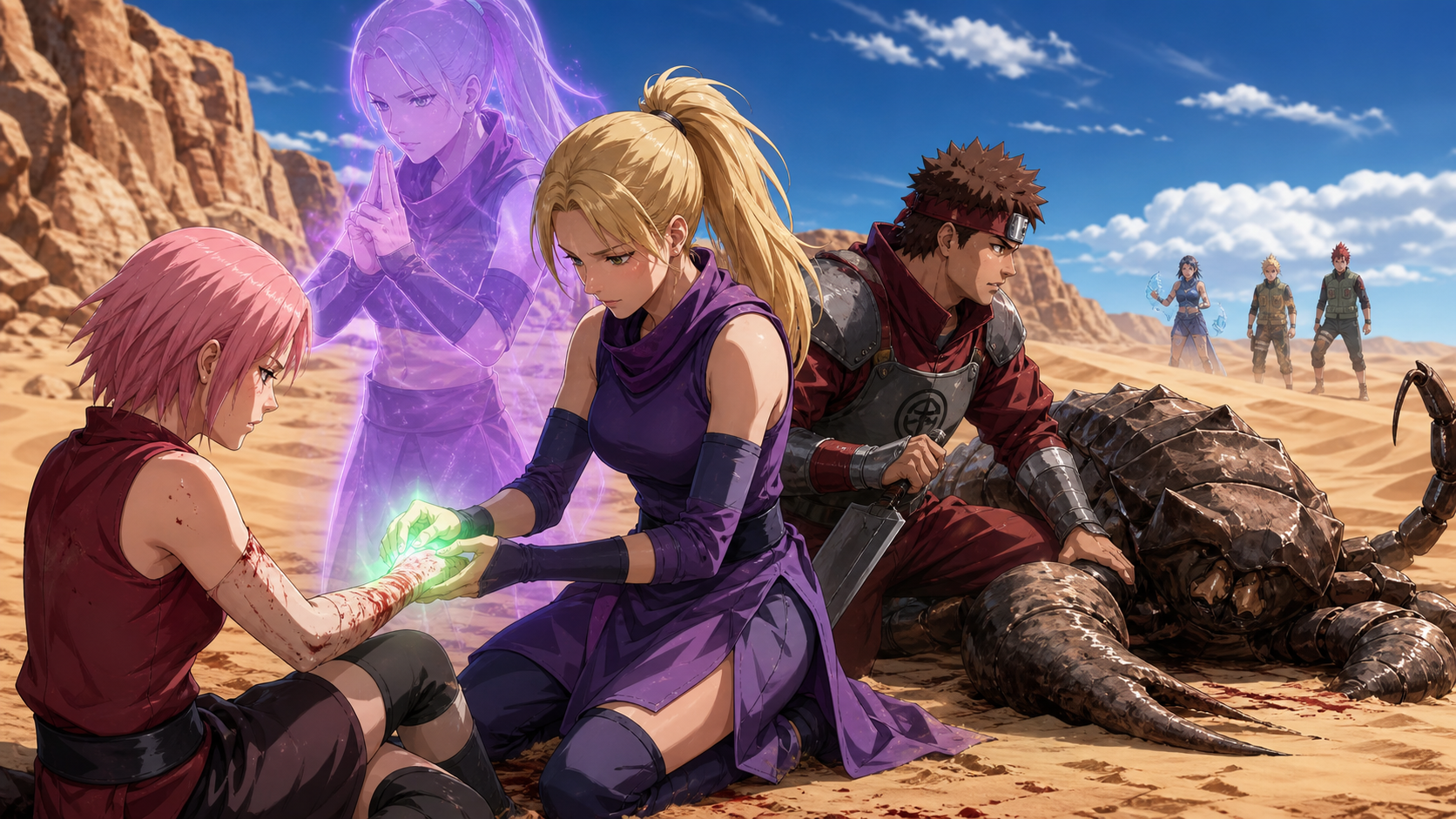
“The Place Where I Belong” catches Ino at the point where two useful paths feel like evidence that she has chosen neither. She avoided the long Yamanaka hiden training her father offered, then pursued medical ninjutsu after Sakura began studying under Tsunade. In the Demon Desert, Sakura’s strength and Chōji’s expansion techniques destroy a giant scorpion while Ino stands outside the finishing exchange. Her answer comes after Sakura injures her hand. Ino cleans and heals the wound, keeps the team moving, and finally sees that medical chakra control does not have to replace her clan inheritance. The discipline can sharpen the delicacy required for Yamanaka techniques. Her place is not behind Sakura, outside Ino-Shika-Chō, or inside a borrowed version of somebody else’s ambition. Her place can hold both systems because both express what she already does best: enter a dangerous situation, understand another person’s condition, and create the connection her team needs. The episode ends before that insight receives a full combat test. Ameno, Kōji, and Shishio detect the Leaf trio, setting up the confrontation where Ino has to prove that her detour built a stronger route home.
Ameno treats a poisoned Sand shinobi
The opening shows Ameno using Medical Water Release: Water Mosquito to extract cactus poison from an injured candidate. Her treatment establishes another medical specialist before Sakura’s team arrives.
Healing skill exists beyond Konoha and Tsunade’s school.
Ameno refuses an easy scroll theft
She will not take an objective from someone receiving medical care. The patient remains a comrade from the Sand even when exam rules would permit competition.
Professional ethics limit tactical opportunity.
Kōji and Shishio support her work
Kōji prepares bandages while Shishio monitors nearby chakra. Their formation protects the medic and patient at once.
Care depends on assigned perimeter responsibility.
Shishio notices an unfamiliar signal
His sensory work detects movement that will later connect to Sakura, Ino, and Chōji. The Sand team gains advance awareness without rushing into an immediate attack.
Information arrives before motive.
Sakura’s team has lost its provisions
The Leaf trio crosses the Demon Desert without adequate food or water after an earlier encounter. Heat turns a manageable personality conflict into a survival risk.
Logistics defines the pace before any enemy appears.
Chōji asks to slow down
His request reflects exhaustion and concern rather than laziness. A team without provisions cannot spend energy as though the route were ordinary.
Endurance planning has to include every body present.
Sakura and Ino begin arguing
Stress revives their familiar rivalry. Each woman reads the other’s decisions through years of competition and unresolved comparison.
Old habits become louder when resources disappear.
Chōji is caught between them
He tries to keep the group moving without choosing one friend against the other. His role demands emotional mediation in addition to physical protection.
Replacement Team 10 needs a new balance without Shikamaru.
The team composition is unusual
Shikamaru is already a Chūnin, so Sakura joins Ino and Chōji for this exam. Their skills are compatible, but their shared rhythm is not inherited automatically from Ino-Shika-Chō.
Capability does not erase formation history.
The episode is anime-original
This second Chūnin Exam, the giant scorpion encounter, and Ino’s linked training flashbacks belong to adaptation-only material. The final React must identify that status.
Useful character work still needs accurate continuity labeling.
A giant scorpion attacks
The desert predator interrupts the argument and forces immediate coordination. Size, armor, claws, and venom turn the creature into both combat and medical danger.
The environment produces its own opponents.
Sakura moves into striking range
Her strength gives the team a direct answer to the scorpion’s armored body. Closing distance exposes her hands to claws and poison.
Frontline power carries contact risk.
Chōji expands against the threat
Akimichi techniques let him match the creature’s scale and control space around Sakura and Ino. His body becomes both weapon and shield.
Size changes the terms of the encounter.
Sakura and Chōji deliver the visible victory
Their combined force defeats the scorpion. Ino watches two teammates use mature versions of recognizable specialties.
The result sharpens her uncertainty about her own lane.
Sakura’s hand is injured
The fight leaves a wound that cannot be ignored in the desert. Even a small injury can become disabling through poison, infection, heat, or continued combat.
Winning creates a new treatment problem.
Ino becomes the active medic
She examines and treats Sakura rather than waiting for Sakura to heal herself. The role keeps their strongest medical ninja from working on her own injured hand.
Redundant care protects the specialist.
Healing makes Ino’s value immediate
She does not need to land the finishing blow to change the team’s survival odds. Restoring Sakura preserves strength for every later encounter.
Support becomes future combat capacity.
Ino still compares herself to Sakura
Treating the wound reminds her that Sakura progressed further under Tsunade. The same act that proves Ino’s competence also activates the rivalry.
Evidence can feel smaller when measured against another person’s mastery.
The flashback returns to the clan memorial
Inoichi brings Ino to the memorial shared by the Yamanaka, Nara, and Akimichi clans. The site represents generations of coordinated service.
Her inheritance is collective as well as personal.
Inoichi explains the long training path
Yamanaka hiden techniques require sustained study, precision, and mental discipline. Mastery cannot be rushed through a few dramatic sessions.
Family knowledge asks for patience before applause.
Young Ino avoids the commitment
The years required make the path feel restrictive. She slips away rather than accepting a future already defined by clan expectation.
Avoidance protects freedom in the moment and delays self-knowledge.
Her reluctance is not hatred of the clan
Ino uses Yamanaka techniques and cares deeply about Ino-Shika-Chō. The resistance concerns being assigned one identity before she chooses the identity herself.
Inheritance becomes meaningful through consent.
Chōji’s recovery changes the group
After the Sasuke Recovery Mission, Chōji survives a battle that demanded everything from him. His return from the hospital reveals how much his friends have changed.
Survival turns childhood teams into people with consequences.
Sakura’s new direction is visible
Sakura responds to her own helplessness by asking Tsunade for training. She converts comparison with Naruto and Sasuke into a demanding apprenticeship.
Her choice gives Ino a nearby example of reinvention.
Ino asks Tsunade for medical training
Rivalry helps push her toward the same field. The decision contains admiration, competitiveness, and a real desire to become more useful.
Mixed motives can still begin serious work.
Medical ninjutsu is not an easy shortcut
Healing requires precise chakra control, anatomical knowledge, judgment, and repeated practice. Choosing Tsunade’s discipline does not spare Ino from lengthy training.
She trades one demanding path for another.
Sakura remains ahead in the field
By the exam, Sakura has completed high-level hospital work and carries Tsunade’s explicit confidence. Ino’s training adds competence without erasing the gap.
The story does not need false equality to respect both women.
The comparison makes Ino overlook integration
She initially treats medical ninjutsu and Yamanaka hiden as rival identities. That framing makes every hour spent on one path look stolen from the other.
False either-or choices can manufacture failure.
Both disciplines require delicate chakra control
Medical treatment depends on exact placement and modulation. Yamanaka techniques also demand fine control when projecting consciousness, sensing, or linking minds.
The training paths share a technical foundation.
Healing can strengthen clan technique
The control Ino develops under medical instruction can make her inherited abilities more precise. A supposed detour becomes cross-training.
Skills compound when the practitioner recognizes the connection.
Clan identity does not forbid expansion
Ino can inherit Yamanaka knowledge without limiting herself to one inherited move. Adding medical expertise makes the tradition more useful to future teams.
Continuity survives through adaptation.
Medical identity does not require becoming Sakura
Ino does not need Sakura’s strength, exact curriculum, or relationship with Tsunade to validate her own healing. She can use the discipline according to Yamanaka needs.
Shared training does not produce interchangeable women.
Ino’s place remains inside Ino-Shika-Chō
Her bond with Chōji and Shikamaru is not cancelled by Sakura joining this exam team. The clan formation remains part of her inheritance and future responsibility.
Temporary composition can reveal permanent commitments.
Sakura has a place beside that history
As the substitute third member, Sakura adds medical depth and frontline force while respecting Ino and Chōji’s established bond. She is not pretending to become Shikamaru.
Good replacements contribute without impersonation.
Chōji recognizes Ino’s maturation
He sees more than the argument or incomplete training. Ino treats Sakura, reflects on her choices, and keeps the team together under pressure.
Longtime friends can measure changes competitors miss.
Sakura also pushes Ino forward
Their rivalry is often noisy, but Sakura’s progress gives Ino a standard that provokes action. The relationship can be both supportive and competitive.
Friendship does not require removing every sharp edge.
The scorpion provides emergency water
The defeated creature becomes a survival resource. The team extracts usable water rather than wasting the body and continuing empty-handed.
Adaptation turns danger into provisions.
Desert survival requires uncomfortable choices
Ino may dislike the source, but refusing available water because the option feels unpleasant can endanger everyone. Preference has to yield to physiology.
Survival competence includes accepting imperfect resources.
The team rests and eats
Food, treatment, and conversation restore more than chakra. The pause gives Ino space to interpret what her actions mean.
Reflection needs a moment outside crisis speed.
Ino chooses Yamanaka training again
She no longer sees returning to the clan curriculum as admitting that medical study was a mistake. The decision joins both paths.
Belonging becomes chosen rather than assigned.
She thanks Sakura for opening her eyes
The acknowledgment gives their rivalry a productive result. Sakura did not design Ino’s answer, but her example made avoidance harder to maintain.
Influence deserves credit without claiming ownership.
Sakura does not become Ino’s destination
Ino’s goal is not to stand where Sakura stands. The insight helps her recognize the particular combination only she can build.
Competition works best as information, not identity theft.
Ameno’s team evaluates the Leaf trio
The Sand candidates recognize Sakura as Tsunade’s apprentice, Chōji’s power, and the unusual presence of two medical ninja. They see a valuable and difficult target.
Reputation changes the next encounter before contact.
Two medics create resilience
Sakura and Ino can treat each other, split patients, and preserve medical capacity if one becomes injured. Their overlap is not wasted duplication.
Independent recovery channels strengthen a field team.
Shishio locates their chakra
His sensory concentration identifies the Leaf trio. Ameno, Kōji, and Shishio begin moving toward them.
The rest period ends under approaching pressure.
Ino detects the incoming team
She senses the three chakra signatures she noticed earlier. Her success surprises Sakura and Chōji because they have not seen this level of sensory development from her.
The new integration begins showing before the next fight.
Combat sensing remains difficult for her
Ino admits that concentration takes time and becomes harder during active battle. The limitation gives Episode 407 a concrete problem rather than declaring mastery complete.
Honest progress includes naming the conditions of success.
The title refers to integration
Ino’s place is not one building, teacher, or team slot. The title points toward a role formed from clan inheritance, medical training, friendship, and personal choice.
Belonging becomes a practice rather than an address.
The episode protects Sakura’s competence
Sakura can be injured without being weakened for Ino’s benefit. She fights at close range, defeats a major threat, and then accepts appropriate treatment from a teammate.
Receiving care is part of professional judgment.
The episode protects Chōji’s growth
His expansion technique and concern for both women show a more capable teammate than the child who once froze under pressure. He contributes without becoming the center of Ino’s decision.
Supporting characters can develop through consistent behavior.
The final React should avoid rivalry shorthand
Reducing Ino and Sakura to jealousy over Sasuke would miss the episode’s actual question about training, inheritance, and professional identity. Their competition has outgrown the childhood trigger.
Editorial framing should follow the present conflict.
Japanese performance requires direct evidence
Claims about Ino’s frustration, Sakura’s fatigue, Chōji’s concern, Inoichi’s expectations, or Ameno’s restraint require lawful scene-level Japanese listening.
No invented delivery analysis belongs in publication.
Belonging does not require choosing one discipline
Ino treats clan technique and medical ninjutsu as competing claims because each comes with a recognizable path and a powerful teacher. Her growth begins when she sees shared chakra precision rather than an identity contest.
Integration lets both fields change her practice. She can remain Yamanaka while becoming a medic whose sensory and mental techniques create different possibilities.
Inoichi offers history without demanding imitation
The clan memorial carries duty, grief, and continuity. Ino’s earlier avoidance does not mean she rejects her family; it shows that inherited responsibility can feel enormous before a child has chosen how to carry it.
Good mentorship explains the path and leaves room for authorship. Belonging built through consent lasts longer than obedience produced through guilt.
Sakura is a catalyst, not Ino’s final shape
Sakura’s medical direction gives Ino a visible possibility and reawakens her appetite for training. Comparison can generate momentum, especially between friends who understand each other’s history.
It becomes harmful when Ino measures every result against Sakura’s pace. She needs a practice designed around her own team, techniques, and judgment.
Healing Sakura reverses the usual comparison
Sakura remains the stronger medical specialist, yet injury makes Ino the active caregiver. Competence is not erased because another person has greater mastery.
Teams survive through available skill at the needed moment. Ino’s treatment proves that partial expertise can be decisive when it is trained, honest, and responsive.
Chōji carries more than comic hunger
He asks for rest, absorbs tension between teammates, joins the scorpion fight, and recognizes Ino’s maturation. His physical needs also reveal how easily the team’s depleted provisions could become a survival emergency.
Emotional steadiness and bodily awareness are leadership contributions. Chōji should not be reduced to the appetite that signals them.
Ameno models medicine without rivalry
She treats a poisoned stranger instead of taking advantage of vulnerability. Her teammates protect the space and accept delay, showing that medical ethics must be supported by the whole formation.
Her choice gives Ino another reference point beyond Sakura. There are many ways to practice care without becoming the same medic.
Two medics create resilience, not redundancy
Sakura’s advanced skill and Ino’s developing practice overlap without becoming wasteful. One can be injured, separated, exhausted, or focused on combat while the other stabilizes a teammate.
Distributed care reduces a single point of failure. The team becomes stronger when expertise is shared at different depths.
The mind technique can deepen medical communication
Yamanaka abilities raise possibilities for locating distress, transmitting urgent information, and coordinating treatment when ordinary speech fails. Those possibilities also demand strict consent and privacy boundaries.
A patient’s vulnerability cannot become open access. Integration is strongest when ethical limits grow beside technical capacity.
RaeRae’s verdict
“The Place Where I Belong” works because Ino’s problem is not lack of talent. She has treated her abilities as competing claims on her identity. The Yamanaka path felt inherited before she could choose. Medical ninjutsu felt chosen, but Sakura’s greater progress made that choice look secondhand. Healing Sakura’s injured hand gives Ino evidence that the discipline matters even when she never becomes another Sakura.
The stronger realization is technical. Medical chakra control can support the precision her clan hiden requires. Ino does not have to discard one education to honor the other. Her place is the junction. The episode wisely ends with an approaching test rather than a graduation speech. Ino can sense Ameno’s team while calm, but active combat still disrupts her focus. Episode 407 now has to show whether the identity she has named can function when three opponents refuse to give her time to concentrate.
RaeRae’s call
Ino’s place is not behind Sakura, outside her clan, or trapped inside a role selected before she understood it. It is the practice she builds by connecting Yamanaka precision, medical chakra control, sensory judgment, and the needs of Ino-Shika-Chō. Sakura opens a door without becoming the destination. Inoichi preserves history without owning every future choice. Chōji sees the growth that rivalry language misses. Ameno proves care can exist as mission judgment rather than weakness. The episode works when belonging means integration: Ino can inherit, expand, heal, sense, compete, and still remain unmistakably herself.
Episode details and viewing routes
- Official episode reference: Naruto Official episode guide
- Licensed episode route: Crunchyroll licensed episode page
The title lands because Ino stops searching for an institution that can certify her identity. Her place is practiced. It appears when she heals Sakura, hears Chōji, remembers Inoichi, studies under Tsunade, and returns to clan training with a question. None of those ties has to erase another. The stronger future is not choosing which woman, family, or team gets to define her. It is building technical and ethical confidence to decide how every inheritance will serve the people beside her.
What I am carrying forward
Sakura, Ino, and Chōji lost their provisions in the Demon Desert, then defeated a giant scorpion. Sakura injured her hand during the fight, and Ino used medical ninjutsu to treat the wound while reconsidering her earlier choices.
Ino had avoided the lengthy Yamanaka hiden curriculum and later pursued medical training after Sakura became Tsunade’s apprentice. She now recognizes that medical chakra control can strengthen her clan techniques and intends to resume that training. Ameno, Kōji, and Shishio have located the Leaf team. Ino senses their approach, though she still needs concentration that may be difficult to maintain in combat. Episode 407 begins the confrontation.