
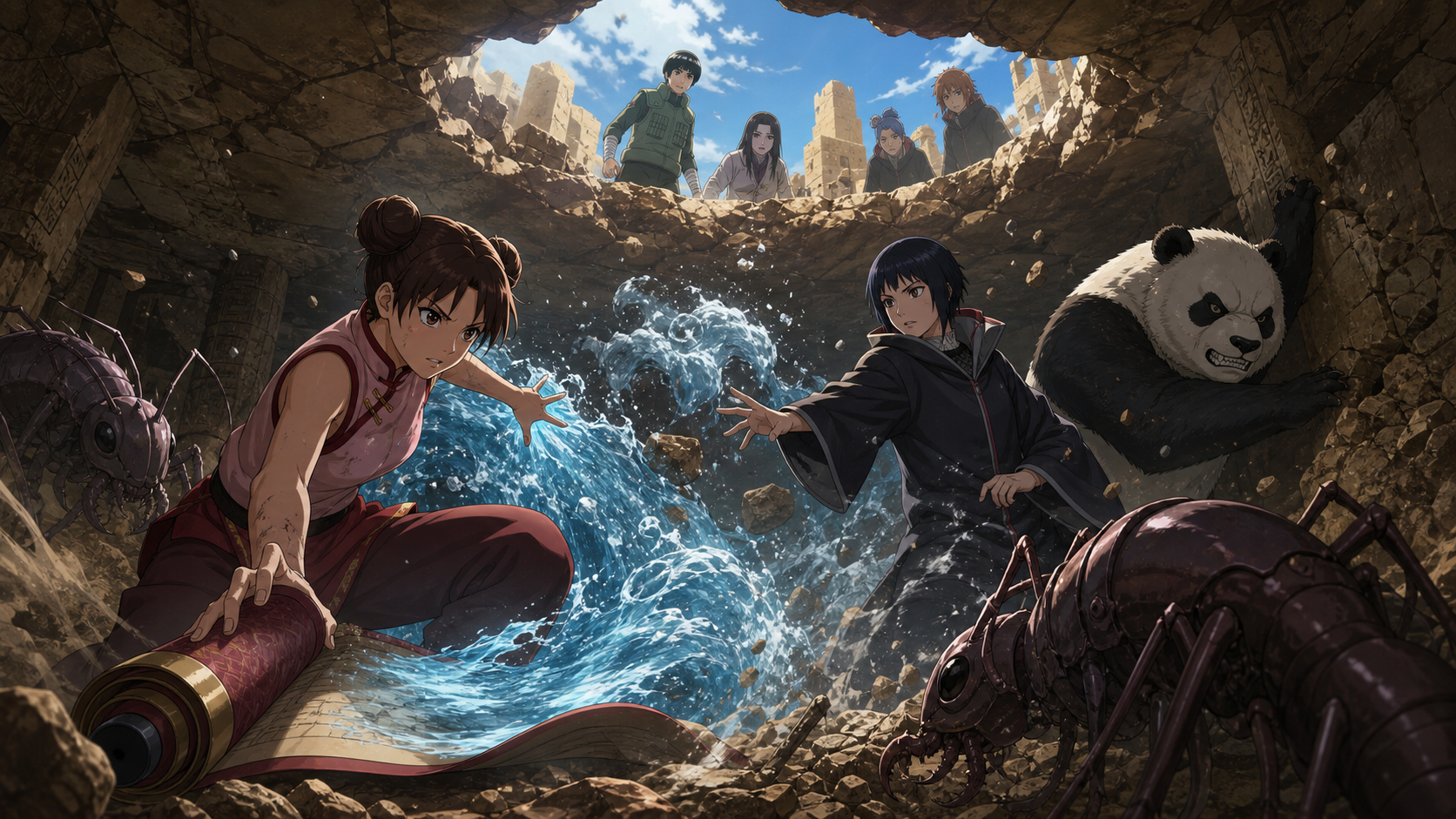
The Imprisoned Pair
Tenten and Ajisai do not need instant friendship to cooperate; shared technical literacy and a limited truce are enough to get two people out alive.
Bottom line
“The Imprisoned Pair” gives Tenten the recognition she was asking for without handing her a new bloodline, teacher, or miracle technique. Trapped beneath the Demon Desert ruins with Ajisai, she has to negotiate with an enemy, read an unfamiliar structure, conserve supplies, fight giant ants, and combine two sealing systems under pressure. Ajisai’s panda summon can move rubble but cannot clear the final barrier. Tenten answers with stored water, using preparation made long before the collapse to create the force both teams need now. The release breaks the obstruction, drives back the ants, and reconnects the separated candidates. That solution is not convenient in the dismissive sense that hurt Tenten at dinner. The solution is planned capacity deployed with judgment. Ajisai recognizes the difference because she understands the same kind of work. Above ground, Lee, Neji, Suiren, and Fuyō also suspend competition to protect missing teammates. Nobody abandons village loyalty or exam goals. Both groups simply prove that a scroll is not worth more than a person, then part with a promise to settle the contest in the third exam.
Tenten approaches Ajisai with water
Episode 404 ended with Ajisai appearing unconscious while Tenten offered help. The gesture puts Tenten within striking distance.
Care begins before trust exists.
Ajisai is ready to defend herself
The Rain kunoichi has no reason to assume that a rival’s approach is harmless. Her concealed readiness protects her if the offer is a trap.
Survival training makes generosity difficult to read.
Tenten states the immediate problem
Both women are underground beneath unstable ruins. Continuing their duel would consume chakra, damage the structure, and reduce the chance of reaching either team.
The environment has changed the mission hierarchy.
A temporary truce is rational
Neither kunoichi needs to surrender a scroll or reveal every technique. They only need enough cooperation to locate an exit.
Limited agreements can be honest without becoming friendship.
Their matching specialties make negotiation easier
Tenten and Ajisai understand seals, prepared inventories, and summoning-based deployment. Each can estimate what the other might contribute.
Technical literacy creates a narrow foundation for trust.
The ruins demand exploration
The direct route back is blocked by collapse. Moving deeper may look counterintuitive, but air flow, insect movement, and structural paths can point toward another opening.
Escape begins with reading the space.
Tenten keeps practical supplies available
Water and stored tools remain useful beyond combat. Her scrolls let two trapped candidates carry more survival capacity than their clothing suggests.
Preparation expands the choices available after disaster.
Ajisai contributes summoning knowledge
Her techniques can move material and call specialized help. The same discipline that made her Tenten’s rival now complements Tenten’s inventory.
Similarity becomes coordination rather than comparison.
The episode remains anime-original
This underground partnership, Ajisai’s exam role, and the giant-ant sequence belong to the adaptation-only second Chūnin Exam arc. The final React must say so plainly.
Clear continuity labeling protects reader trust.
Lee and Neji search from above
Team Guy’s remaining members stop treating the Rain candidates as immediate targets. Finding Tenten becomes the priority.
Teammate recovery outranks scroll acquisition.
Suiren and Fuyō make the same choice
Ajisai’s partners also suspend the fight. Their secret Rain mission does not erase their responsibility to one another.
Covert orders still depend on a functioning team.
The surface ceasefire mirrors the underground truce
Both pairs reach the same conclusion without communicating across the rubble. Survival produces parallel decisions.
Shared ethics can appear before shared allegiance.
Neji’s Byakugan helps map the obstruction
His vision can inspect buried spaces and search for chakra, but thick debris and the sprawling ruins complicate a direct extraction.
Seeing the problem does not automatically remove the wall.
Lee supplies force and persistence
Lee can move rubble and protect the search group, yet uncontrolled strength risks another collapse. The rescue requires restraint alongside effort.
Power must respect structural danger.
The Rain team contributes local technique knowledge
Suiren and Fuyō understand Ajisai’s habits and capabilities. Team Guy understands Tenten’s likely inventory and decision-making.
Rescue planning improves when both sides share what they know.
A giant ant reveals a living route
Tenten and Ajisai encounter an enormous ant moving through the underground passages. The creature represents danger, but also proof that paths connect to a larger nest and possibly the surface.
A threat can carry navigational information.
Following the ant is calculated risk
Avoiding the creature might leave both women wandering through sealed corridors. Tracking the ant offers a route at the cost of approaching its colony.
Escape choices rarely arrive without exposure.
The nest confirms an exit network
The ants need access to food, air, and the desert above. Their tunnels create the most plausible route out of the ruins.
Animal behavior becomes environmental evidence.
One ant becomes a swarm
The apparent guide leads into a nest filled with giant ants. Tenten and Ajisai trade one uncertain passage for immediate pursuit.
Useful information can arrive inside a worse problem.
The pair has to fight while moving
Stopping for a complete battle would let the swarm surround them. Their techniques must create space without trapping them deeper underground.
Mobility becomes the real victory condition.
Tenten’s ranged control protects the corridor
Released weapons can interrupt ants approaching from several angles. Her accuracy buys movement through spaces too narrow for careless attacks.
Precision matters more than spectacle in a tunnel.
Ajisai’s summons change the terrain
She can introduce force and mass where ordinary tools are insufficient. Her prepared techniques expand the pair’s options against oversized creatures.
Sealing disciplines become physical infrastructure.
Cooperation requires timing, not affection
The women do not need instant emotional intimacy. They need reliable signals, complementary targets, and confidence that neither will abandon the other mid-attack.
Trust can begin as repeated correct timing.
The ants also reach the surface teams
Lee, Neji, Suiren, and Fuyō face the colony outside. Rescue work and defense now happen at the same time.
The hazard connects both sides of the rubble.
The ceasefire survives pressure
Either surface team could exploit the distraction and attack the other. Both keep focusing on the ants and their trapped teammates.
An agreement proves real when betrayal becomes possible.
The final wall blocks Tenten and Ajisai
They reach the correct general route but find a mass of debris separating them from the surface. Navigation alone cannot finish the escape.
The problem changes from finding to moving.
Ajisai summons a panda
Her large summon applies direct force against the obstruction. The attempt demonstrates why Ajisai’s transportation and summoning skill impressed Tenten.
Prepared power becomes excavation equipment.
The panda cannot clear enough rubble
The barrier’s mass and compression exceed what the summon can safely move. Ajisai’s signature method reaches a real limit.
A specialist can fail without becoming fraudulent.
Ajisai asks Tenten for help
The request matters because Ajisai understands the discipline behind Tenten’s scrolls. She is not asking a convenient pack mule to produce a random object.
She is asking another specialist to solve the shared limit.
Recognition reaches Tenten through competence
Ajisai’s confidence gives Tenten what Lee’s compliment missed: acknowledgment that selection and deployment require judgment.
Being needed feels different when the skill is named.
Tenten considers the stored-water option
Water carries enormous weight, creates pressure, and can move loose material. Releasing a large volume underground also risks flooding the wrong chamber.
Inventory is only useful when consequences are calculated.
The water was prepared before the emergency
Tenten did not receive a new technique because the plot required escape. Her earlier storage work created an option the crisis later revealed.
Preparation is delayed action.
Tenten releases a massive volume
The summoned water strikes the blockage with force beyond individual weapon impacts. Quantity becomes a deliberate environmental tool.
Her scroll controls scale as well as variety.
Water breaks the final obstruction
The surge dislodges debris and opens the route toward the surface. Tenten’s solution succeeds where brute force alone stalled.
Different tools answer different kinds of resistance.
The surge also sweeps away ants
The same release controls the swarm and clears space for escape. One planned action answers both the structural and combat problems.
Efficiency comes from understanding the whole scene.
Ajisai and Tenten reach their teams
The separated candidates reunite after both groups contribute to the rescue. No single person can claim the entire extraction.
Coordination crosses the rubble before anyone crosses villages.
Lee’s concern confirms Tenten’s place
His earlier wording was clumsy, but his rescue effort makes clear that Team Guy values Tenten as a teammate rather than an equipment source.
Action repairs part of what language damaged.
Neji respects the truce outcome
He does not insist on restarting combat the moment Tenten returns. Preserving chakra and honoring the rescue agreement demonstrate Chūnin-level judgment.
Discipline includes ending a fight.
Ajisai’s team also declines a rematch
The Rain trio could use exhaustion to seek an advantage, but the shared escape has changed the immediate relationship. They choose separation.
Mercy does not require surrendering future competition.
Both teams promise to meet in the third exam
The agreement moves rivalry into a controlled setting. Each side can pursue qualification without cheapening what happened underground.
Competition survives because respect sets a boundary.
Scroll status remains unresolved between them
Neither team takes the other’s objective during the rescue. Both still have work to do before reaching the next stage.
Ethical choices carry practical costs.
Tenten does not need a new identity
Her answer comes from the same sealing and storage practice she questioned in Episode 404. The episode changes interpretation rather than replacing the skill set.
Growth can reveal value already present.
Versatility is her signature
Tenten reads needs, retrieves the right resource, controls range, and adapts stored material to terrain. No single weapon captures that system.
Her defining trait is prepared possibility.
Ajisai is a mirror, not a cure
Another specialist can recognize Tenten, but lasting confidence cannot depend entirely on an opponent’s approval. Tenten still has to claim her own standard.
External recognition can open a door without finishing the work.
The rescue models Chūnin judgment
Both teams suspend combat, share information, allocate roles, protect injured or missing teammates, and leave without wasting resources on revenge.
Leadership appears through priorities rather than rank announcements.
The giant ants test logistics under pressure
The creatures are less important as villains than as a moving constraint. They force both teams to fight, search, excavate, and communicate simultaneously.
Complex missions rarely offer one problem at a time.
The final React should avoid body-count framing
The meaningful result is not how many ants fall or how much rubble moves. Tenten’s choice, Ajisai’s request, and the maintained ceasefire define the episode.
Action needs an editorial center.
Ajisai’s later continuity needs careful wording
Readers may recognize her connection to Pain’s Animal Path, but this episode occurs earlier and treats her as a living Rain genin. Future context should be separated from scene-level knowledge.
Chronology prevents accidental spoilers and false motivation.
Japanese performance requires direct evidence
Comments about Tenten’s hesitation, Ajisai’s respect, Lee’s relief, or Neji’s restraint require lawful scene-level listening in Japanese.
No invented vocal analysis belongs in publication.
The truce begins with a shared threat, not sudden friendship
Tenten and Ajisai remain competitors with incomplete trust. Rubble, injury, limited air, and an unknown route make immediate cooperation rational before either woman has changed her opinion of the other.
That limited agreement is strong because it is specific. They can suspend combat, share survival information, and preserve boundaries without pretending conflict disappeared.
Tenten’s water proves preparation has a timeline
The decisive resource was sealed before the collapse, before the ants, and before Ajisai asked for help. Tenten’s victory begins in planning that the audience could easily mistake for background routine.
Preparedness turns future uncertainty into available choices. The water is not a lucky object pulled from nowhere; it is stored labor arriving at the moment it becomes visible.
Ajisai has to recognize a system she cannot replace alone
Her panda summon brings force, scale, and protection, but strength does not clear the final barrier. Tenten’s stored volume changes pressure across the whole obstruction.
The solution works because their methods are complementary rather than ranked. Ajisai’s request acknowledges Tenten as the person with relevant authority.
Asking for help is part of specialist judgment
Ajisai does not become less capable when she admits her summon is insufficient. She identifies the limit and invites another expert into the plan.
That decision protects both women from wasting energy on pride. Chūnin leadership should reward accurate escalation before a failed method becomes catastrophe.
Tenten controls deployment, not merely possession
Carrying water is only one part of the answer. She evaluates quantity, direction, seal release, structural pressure, Ajisai’s position, and the danger of creating a flood underground.
Her specialty is judgment under constraints. Anyone could own a container; not everyone could turn it into a controlled extraction tool.
The flood creates secondary risk that deserves acknowledgment
Water breaks rubble and clears ants, but it can also strike injured bodies, destabilize the chamber, reduce visibility, and create a new drowning hazard.
Tenten’s plan succeeds because timing and the panda’s force produce a route. The story should credit risk management rather than suggesting more volume automatically means a better solution.
The surface teams model reciprocal responsibility
Lee and Neji search for Tenten while Suiren and Fuyō search for Ajisai. Each pair understands that recovering a teammate outranks obtaining the opposing scroll.
The mirrored ceasefire proves cooperation is not a favor granted by one morally superior side. Both teams contribute labor and accept uncertainty.
Neji’s vision needs everyone else’s physical access
Byakugan information can map bodies and obstructions, yet sight cannot lift every stone or create an underground corridor. Lee supplies force while the Rain team contributes its own knowledge.
The rescue rejects a hierarchy where sensing alone becomes command. Information earns value when the group can act on it safely.
The ants turn the ruins into an ecosystem
The underground space is not an empty arena waiting for shinobi. Following one creature reveals a route, while disturbing the nest creates a swarm that threatens everyone above and below.
Environmental observation becomes tactical intelligence. It also warns that intervention changes the conditions being studied.
Leaving together protects the meaning of the ceasefire
Once Tenten and Ajisai reach their teams, either side could exploit exhaustion and resume the scroll fight. Both decline.
That restraint honors the temporary agreement and prevents rescue from becoming bait. A promise to meet later restores competition under conditions where participation can be chosen again.
Ajisai is a mirror, not Tenten’s validation machine
Her recognition matters because she understands related craft, but Tenten’s worth did not begin when an opponent noticed it. Team Guy already survived through her systems.
The encounter gives Tenten language for what she does. It should not make another woman responsible for curing years of narrative neglect.
RaeRae’s verdict
“The Imprisoned Pair” resolves Tenten’s insecurity by making preparedness decisive. The water stored before the exam is neither a lucky prop nor a comic convenience. Tenten has to recognize the wall’s structure, measure the danger of flooding, trust Ajisai’s request, and deploy enough force to breach the obstruction without abandoning everyone to the ant swarm. That chain of judgment is the technique.
Ajisai’s failed panda summon strengthens the point. Her respected specialty reaches a limit, and asking Tenten to complete the solution does not diminish either woman. Their systems combine. Above them, two teams make the same mature choice by keeping a ceasefire through real pressure. The promise to meet again preserves rivalry without pretending that stealing a scroll during rescue would prove superiority. Tenten leaves the ruins with no new bloodline and no renamed identity. She leaves with evidence that versatility, preparation, and judgment already form a signature worth seeing.
RaeRae’s call
Tenten and Ajisai survive because neither mistakes specialization for self-sufficiency. Ajisai’s summons create options, Tenten’s stored water changes the final barrier, and both surface teams protect a ceasefire long enough to bring their missing people home. The water matters because Tenten prepared it before anyone applauded. Its release requires judgment, not just inventory. Ajisai’s request finally names the authority Team Guy has benefited from all along. Tenten does not emerge with a borrowed identity. She emerges with proof that versatility, sealing, logistics, range, and deployment form one authored discipline. The truce holds because rescue is treated as shared work rather than leverage for the next attack.
Episode details and viewing routes
- Official episode reference: Naruto Official episode guide
- Licensed episode route: Crunchyroll licensed episode page
What stays with me is the order of the solution. Tenten does not discover value because the panda fails. The panda’s limit creates a moment when everyone must see the value packed inside her scroll. Ajisai names the need, Tenten evaluates the risk, and they commit to the release. Teammates choose recovery over advantage. Nobody earns ownership of the rescue, and nobody has to become harmless before receiving help. The episode gives Tenten recognition through decisions, preparation, and consequence. That is more satisfying than handing her a power designed to imitate the men beside her.
What I am carrying forward
Tenten and Ajisai agreed to cooperate after becoming trapped beneath the desert ruins. They followed a giant ant toward a possible exit, encountered its colony, and fought through the underground passages while Lee, Neji, Suiren, and Fuyō maintained a rescue ceasefire on the surface.
Ajisai’s panda summon could not clear the final rubble barrier. At Ajisai’s request, Tenten released a large volume of stored water, broke through the obstruction, and swept away the ants. Both teams reunited, declined to resume their scroll battle, and promised to meet in the third exam. Episode 406 shifts attention to Sakura, Ino, and Chōji.