
Tenten’s Troubles
Tenten can solve almost every practical problem Team Guy faces, but versatility becomes an insult when praise reduces the person doing the work to convenient storage.
Bottom line
“Tenten’s Troubles” understands the insult hidden inside a compliment that reduces a capable woman to convenience. Tenten carries food, water, weapons, shelter supplies, and the sealing expertise that makes those resources available on demand. Lee means to praise her after she produces an entire okonomiyaki meal from a scroll, but calling her “convenient” makes her sound like another tool in storage. That word lands harder because Tenten already fears that Team Guy’s visible identities leave no equally dramatic place for her. Lee owns taijutsu and the Eight Gates. Neji owns the Byakugan and Gentle Fist. Guy’s certainty fills every room. Tenten can answer almost any practical problem, yet versatility does not give her the single signature she thinks a great shinobi needs. Ajisai becomes an uncomfortable mirror: another weapons-and-summoning specialist whose assignment from Konan has a purpose larger than the exam. Their clash at the ruins ends before either can prove superiority, dropping both women underground while their teammates call a ceasefire. The episode leaves Tenten beside an enemy who shares her skill language and may understand why being useful is not the same as being seen.
Team Guy stops for dinner
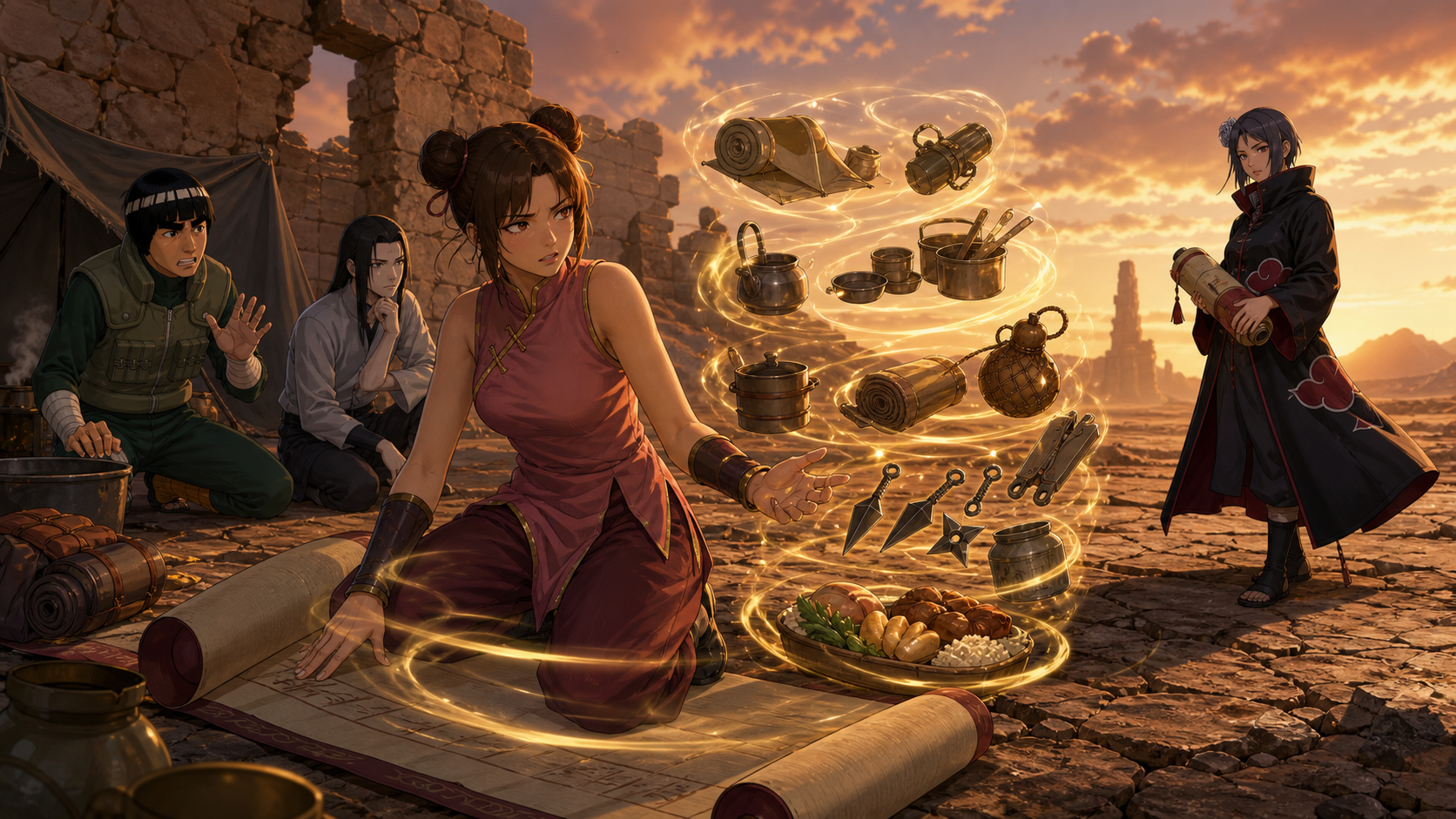
The Demon Desert forces candidates to ration energy and supplies as carefully as chakra. Tenten turns a scroll into a complete cooking station and brings out ingredients for okonomiyaki.
Her preparation makes an unforgiving campsite livable.
Tenten’s sealing work supports ordinary survival
Stored weapons receive most of the attention during fights, but food, cookware, water, and camp equipment matter across a seventy-two-hour exam.
Logistics is a combat capability with a quieter timetable.
Lee calls Tenten convenient
Lee intends admiration. He sees a teammate who can produce whatever the group needs and says having her around is convenient.
Good intent does not decide how a limiting description feels.
Tenten rejects being treated like a tool
She distinguishes between carrying convenient tools and being a convenient tool herself. The correction names the exact problem before she walks away.
Tenten refuses praise that erases the person doing the work.
Lee misses the distinction
His repeated reassurance only makes the injury worse. Lee hears “convenient” as pure usefulness and cannot understand why more enthusiasm does not repair the wording.
Sincerity still needs listening.
Neji also fails to translate the moment
Neji recognizes that something went wrong but does not immediately give Lee the language to understand why. Team Guy knows Tenten’s value without always articulating her ambition.
Familiarity can conceal what teammates have never asked.
Tenten wants a recognizable specialty
Lee has a vow built around taijutsu, while Neji carries a celebrated clan art. Tenten’s broad inventory looks less impressive to her because no single technique summarizes the whole practice.
Brand clarity and actual competence are not the same measure.
Her childhood model was Tsunade
Tenten once wanted to become a legendary kunoichi like Tsunade. That early dream tied greatness to a woman whose strength, medical knowledge, summoning contract, and authority were impossible to dismiss.
The aspiration was never merely about carrying weapons.
Medical ninjutsu did not become her path
Tenten’s chakra control and interests led elsewhere. Failing to reproduce Tsunade’s exact profession did not make the original ambition childish.
A role model can guide direction without producing a duplicate.
Guy recognizes her weapon accuracy
Her teacher sees precision, preparation, and unusual command of tools. He encourages the strengths Tenten already demonstrates rather than forcing her into somebody else’s discipline.
Good mentorship notices evidence before assigning identity.
Praise still leaves Tenten searching
Being reliable with weapons does not answer her desire for a defining technique. She wants a contribution that feels unmistakably hers beside two teammates with famous systems.
Competence and belonging can remain separate questions.
The episode belongs to an anime-original arc
This second Chūnin Exam, Tenten’s encounter with Ajisai, and the underground-ruins sequence are adaptation-only material. The final React must label that status clearly.
Continuity notes protect readers from false manga attribution.
Ajisai’s team represents the Hidden Rain
Ajisai travels with Suiren and Fuyō. Their village enters the joint exam under political conditions far different from the Leaf and Sand alliance.
Every candidate carries a village story into the desert.
Konan gives the Rain team an additional mission
Promotion is not their only objective. Ajisai’s group must gather intelligence about other villages’ capable shinobi and investigate a jinchūriki.
The exam becomes reconnaissance conducted under legitimate cover.
The target introduces darker stakes
Fū is not simply another candidate with an unusual chakra signature. As the Seven-Tails’ jinchūriki, she is valuable to powers working beyond the exam rules.
Friendly competition sits beside covert exploitation.
Team Komugi is beneath Ajisai’s threshold
The Rain trio avoids spending time on opponents they do not consider useful. Their hidden assignment rewards information and efficiency rather than unnecessary domination.
Choosing not to fight can reveal priorities.
Team Guy becomes worth observing
Neji’s Byakugan, Lee’s taijutsu, and Tenten’s sealing techniques make the Leaf trio a stronger intelligence target. Contact promises useful evidence even before scroll compatibility is known.
Reputation attracts examination.
Neji detects the Hidden Rain team
The Byakugan prevents Ajisai’s group from passing unseen. Team Guy gains the first clean positional advantage.
Observation turns a chance crossing into a deliberate confrontation.
Neither team can assume the other scroll
Second-stage combat always carries an information problem. Defeating a team with the same scroll may consume chakra without advancing qualification.
Every clash needs a reason beyond pride.
Ajisai specializes in summoning and transport
Her techniques move objects and create attacks through prepared seals. Tenten recognizes a familiar combat language across village lines.
Similarity creates rivalry faster than difference.
Tenten reads Ajisai as a direct comparison
Ajisai appears to possess the signature identity Tenten has been seeking: a kunoichi whose transportation techniques look coherent, forceful, and named.
The opponent touches an insecurity before landing a strike.
The rivalry is professional before personal
Neither woman needs a long history to care about the comparison. Their techniques overlap enough that each result feels like evidence about who uses the discipline better.
Parallel skills can make a stranger feel uncomfortably close.
Ajisai uses Summoning: Rainwater Gate
Her sealed arsenal opens through a distinctive summoning method associated with the Hidden Rain team. The technique turns preparation into immediate battlefield pressure.
Storage becomes offense when deployment is fast.
Paper fills the fight space
Ajisai’s team uses paper-based techniques to obstruct, misdirect, and attack. The material links their combat style to the visual language surrounding Konan without making every user identical to her.
Village influence appears through technique design.
Tenten answers with her own scrolls
She releases weapons at range and controls angles that direct hand-to-hand fighters cannot easily cover. Her method is not a lesser version of Lee or Neji’s work.
Different ranges create different responsibilities.
Lee presses the close fight
Lee’s speed forces the Rain team to react while Tenten manages projectile pressure. The combination demonstrates why Team Guy needs both specialists.
Versatility supports the teammate who looks more spectacular.
Neji protects the formation
The Byakugan tracks threats and Gentle Fist technique punishes anyone who enters his range. His vision also helps the team understand the ruins around them.
Defense depends on reading space before impact.
The ruins are part of the danger
Ancient structures in the Demon Desert are unstable, enclosed, and poorly mapped. Explosive force can change the battlefield faster than either team expects.
Environment refuses to remain background scenery.
The structure begins to collapse
Damage from the fight destabilizes the ground and walls. Both teams lose control of where the contest can safely continue.
Winning an exchange means little if the arena falls away.
Tenten and Ajisai fall together
The two specialists drop beneath the ruins while their teammates remain above. The pairing isolates the rivalry from both formations.
The comparison Tenten wanted becomes unavoidable.
The collapse interrupts the scroll fight
No team earns a clean victory. Survival and recovery replace the attempt to overpower opponents.
Mission priorities change when a teammate disappears.
Lee and Neji call a ceasefire
Suiren and Fuyō face the same loss, so the remaining candidates suspend combat. Cooperation becomes rational before trust becomes possible.
Shared danger creates a narrow agreement.
The ceasefire has clear limits
Both sides still need scrolls and still serve different villages. Searching together does not erase the exam or Ajisai’s secret orders.
Temporary alignment deserves precise boundaries.
Tenten wakes in the underground chamber
She finds rubble, limited routes, and an apparently unconscious opponent. The fight above has become an extraction problem below.
Her stored supplies may matter more than weapon volume.
Ajisai appears injured or unconscious
Tenten cannot know whether the condition is genuine. Approaching creates risk, but abandoning a potentially hurt person conflicts with her instincts.
Compassion requires situational awareness.
Tenten offers water
Her first response is practical care. The same preparedness dismissed as convenience becomes exactly what an underground survivor needs.
Usefulness carries moral choice when resources are scarce.
Ajisai prepares to exploit the opening
The Rain kunoichi remains ready to strike while Tenten approaches. Secret orders and exam pressure make generosity difficult to trust.
One person’s aid can look like another person’s opportunity.
The cliffhanger tests both women
Tenten must decide how to help without surrendering defense. Ajisai must decide whether mission advantage matters more than cooperation inside unstable ruins.
Their mirrored skill set now meets a difference in immediate judgment.
Tenten’s inventory is not the source of her insecurity
The problem is not that she carries too many kinds of tools. The problem is that teammates and viewers can consume her support without naming the expertise behind selection, sealing, maintenance, timing, and retrieval.
Invisible labor needs attribution.
A signature technique can be a system
Tenten does not need one bloodline move to deserve a clear identity. Her system combines preparation, space control, resource access, and adaptation across mission types.
Breadth can be distinctive when the story explains the craft.
Team Guy benefits from her before every fight
Meals, equipment, water, shelter, and replacement weapons keep Lee and Neji capable of performing their celebrated roles. That support is not separate from the victory conditions.
The fight begins during packing.
Lee’s mistake can become a better compliment
He needs to identify what Tenten did, why the work mattered, and what skill made the result possible. “Your sealing plan kept us supplied” respects agency better than “you are convenient.”
Specific praise sees a person.
Ajisai may offer recognition through opposition
Because Ajisai understands transport and summoning, she can evaluate Tenten’s work at its technical level. Respect from a rival may reach the insecurity Team Guy’s casual gratitude missed.
Being understood can matter before being liked.
The episode avoids changing Tenten into Tsunade
Her childhood dream remains important without redirecting her into medical training or superhuman punches. Growth should strengthen the path she actually chose.
Development does not require replacing the character.
The final React should center Tenten
Konan’s orders and Ajisai’s future matter, but the emotional line begins with Tenten’s reaction at dinner and ends with her vulnerable act underground.
Context should support the named lead rather than consume her page.
Japanese performance requires direct listening
Any publication claims about Tenten’s anger, Lee’s confusion, Ajisai’s calculation, or Konan’s authority need lawful scene-level Japanese audio verification.
No invented delivery notes belong in the article.
Convenience is a result, not an identity
Food, water, shelter materials, weapons, and emergency supplies appear when Tenten combines sealing knowledge with disciplined preparation. Her teammates experience ease because she completed difficult work before they needed it.
Calling her convenient erases planning, inventory, weight, access, maintenance, and judgment. The better compliment names the system and the person who built it.
Invisible labor becomes visible only when it stops
Team Guy eats and camps because Tenten anticipated ordinary needs. That support can look automatic until an item is missing, a seal fails, or she refuses to perform the role everyone assumed.
A fair team discusses supply labor, shares decisions, and recognizes expertise before a crisis. Gratitude after breakdown is too late.
Tenten is allowed to want a legible specialty
Her frustration is not vanity. Lee has the Gates, Neji has the Byakugan and Gentle Fist, and both receive stories that translate their disciplines into recognizable achievement.
Tenten wants language for her own mastery. Telling her she is useful does not answer the desire to be understood as a shinobi with authored technique.
Her path away from medical ninjutsu is not failure
Tsunade gave Tenten an early model of powerful womanhood, but admiration does not create obligation to reproduce another woman’s career. Aptitude, interest, instruction, and opportunity shape a different route.
The story should let her release the dream without treating weapons as second choice. Discovery can include learning what is not yours.
A signature can be an integrated system
Tenten’s specialty includes sealing, storage, rapid deployment, trajectory, tool selection, range, timing, resupply, and battlefield adaptation. No single pose contains all of it.
That complexity may be harder to package than one bloodline technique, but it is not less distinctive. Her signature is reliable access to the right option under pressure.
Ajisai offers recognition through technical rivalry
Ajisai immediately understands transport, summoning, paper, stored objects, and spatial control. She challenges Tenten inside a related discipline instead of treating weapons as background decoration.
Being studied by a capable opponent can feel more validating than vague praise. Ajisai recognizes enough to build a counter.
The collapse changes the ethical frame
Once both women fall beneath the ruins, the scroll contest is no longer the first problem. Structural instability, injury, water, air, and extraction determine whether either team leaves alive.
Lee and Neji’s ceasefire is correct because the environment has changed. Mission judgment includes knowing when rivalry must pause.
Offering water is not tactical stupidity
Tenten wakes with resources and sees another injured person. Sharing water recognizes immediate bodily need without erasing the fact that Ajisai remains an opponent.
Care can include boundaries: maintain distance, watch hands, preserve an exit, and state temporary terms. Compassion does not require surrendering awareness.
Ajisai’s attempted exploitation tests the ceasefire
If she uses Tenten’s aid to create an opening, responsibility belongs to her choice. The lesson should not be that mercy itself was foolish.
Tenten can revise trust, protect supplies, and defend herself without becoming ashamed that she offered help. Accountability should target betrayal rather than train people out of care.
Konan’s hidden mission compromises informed participation
The Rain candidates enter the exam with objectives the other teams cannot evaluate. Ajisai may be acting under command, but secrecy does not erase the risk transferred to unsuspecting competitors.
Leadership above her owns responsibility for scope, proportionality, and extraction. Young operatives should not carry all moral blame for institutional orders.
RaeRae’s verdict
“Tenten’s Troubles” gives Tenten a conflict that fits the way the series has used her. She solves practical problems so reliably that the work becomes scenery. Lee’s compliment is affectionate, but “convenient” collapses sealing knowledge, preparation, judgment, and care into easy access. Tenten’s anger is not vanity. She wants her teammates to recognize a shinobi, not only the supplies that appear when she opens a scroll.
Ajisai is the right opponent because she makes the same family of skills visible as a combat identity. Their confrontation does not finish before the ruins collapse, which keeps the comparison unsettled and moves both women into a problem where inventory, restraint, and cooperation may matter more than a flashy win. Tenten offering water while Ajisai considers an ambush captures the episode’s strongest question: when usefulness is your reputation, who notices the judgment behind how you choose to help?
RaeRae’s call
Tenten’s trouble is not that she lacks a specialty. It is that everyone enjoys the results without naming the intelligence that makes them possible. Her scrolls are logistics, weapons control, emergency planning, range management, and survival infrastructure. Ajisai sees that system because she works in a related language, which makes their rivalry more honest than Lee’s accidental compliment. When the ruins collapse, Tenten’s water offer shows judgment with humanity, not weakness. If Ajisai exploits it, the betrayal belongs to Ajisai. Tenten does not need a copied Tsunade path or one enormous finishing move. She needs the story and her team to recognize the complete discipline already in her hands.
Episode details and viewing routes
- Official episode reference: Naruto Official episode guide
- Licensed episode route: Crunchyroll licensed episode page
The episode becomes stronger when Tenten’s frustration is treated as professional knowledge instead of a confidence problem. She knows Team Guy depends on her, and she knows dependence can coexist with invisibility. Lee and Neji can repair that gap by asking how her system works, sharing the labor around it, and trusting her to direct situations where storage, tools, or terrain decide survival. Ajisai’s presence matters because technical recognition arrives from somebody capable of challenging the work. Tenten can offer water, set terms, defend herself, and still refuse the lesson that kindness caused the betrayal. What she needs is authorship, resources, and narrative space for preparation to count as action before everybody notices the moment it is gone.
What I am carrying forward
Tenten argued with Lee after he described her as convenient for producing an okonomiyaki meal and other supplies from scrolls. She remains uncertain about her defining specialty beside Lee and Neji, despite Guy’s recognition of her weapon and sealing ability.
Ajisai, Suiren, and Fuyō entered the exam under Konan’s orders to collect intelligence and investigate a jinchūriki. Team Guy encountered them at desert ruins, where Tenten and Ajisai’s clash triggered a collapse. Both women fell underground, while Lee, Neji, Suiren, and Fuyō suspended their fight to search. Tenten awakened and approached Ajisai with water, unaware that Ajisai was preparing to strike. Episode 405 continues their confinement.