
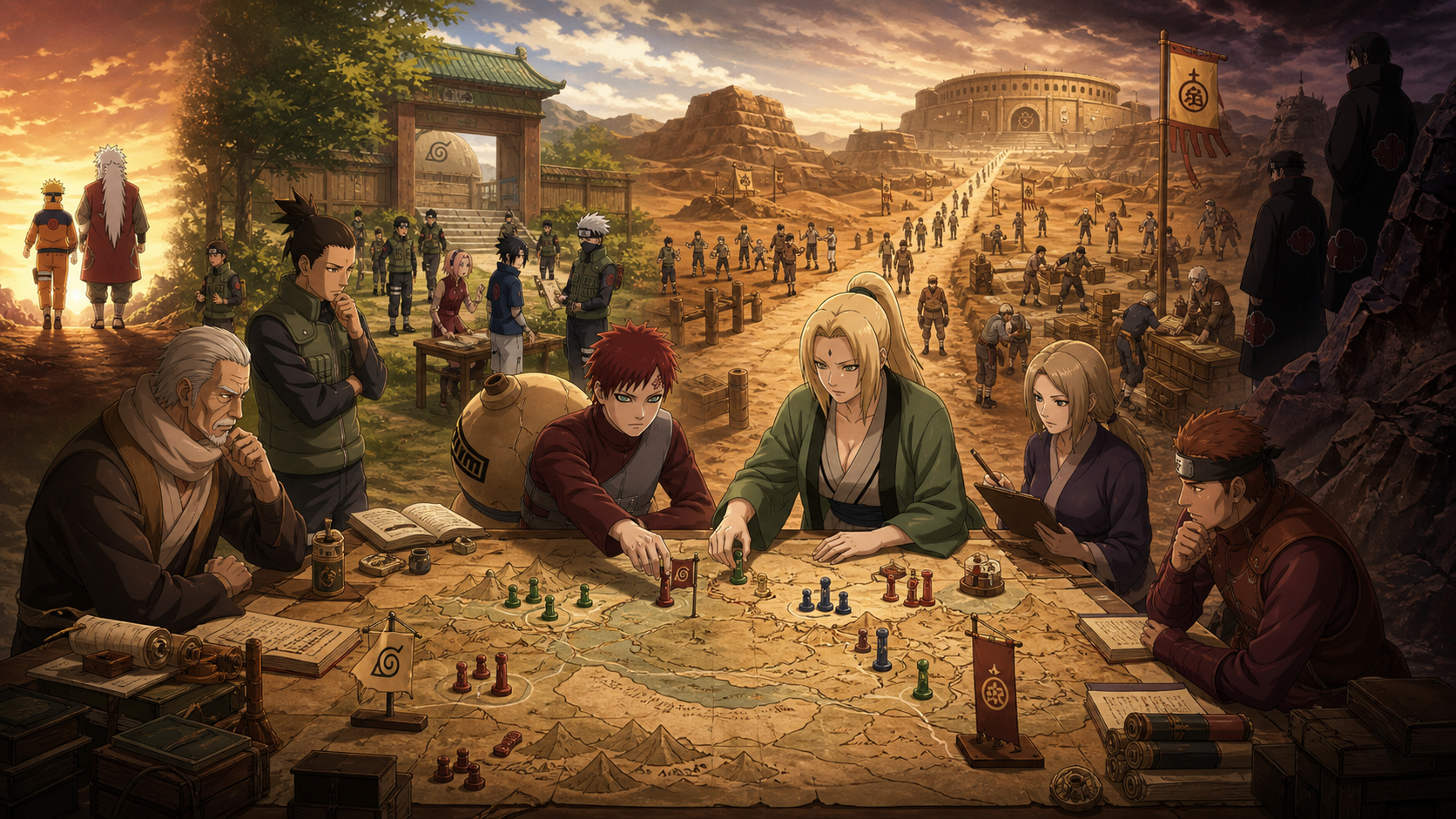
The New Chunin Exams
Promotion becomes diplomacy and security planning as Gaara and Tsunade build a joint exam around the peers who kept growing while Naruto trained away.
Bottom line
“The New Chunin Exams” pauses Naruto and Sasuke at death’s door for a long anime-original look at everyone who kept growing while Naruto trained with Jiraiya. That interruption is rude. Let us say that plainly before pretending the placement does not matter. The actual idea has value: Naruto’s friends did not freeze when he left Konoha, and Gaara’s first major act as Kazekage turns an exam into diplomacy, security planning, and a public test of whether Suna accepts his leadership. Tsunade wants new chūnin because the village needs field leaders. Gaara wants the joint event held in the Sand despite Akatsuki activity and threats against him. Young shinobi see promotion; adults see alliances, intelligence, village reputation, and risk. The episode works when the exam exposes that political machinery. The weakest frame treats Naruto as the source of everybody’s development even while he is absent. His example matters. Their labor still belongs to them.
The episode opens beside Naruto’s failing body
Kurama has been extracted, and the people around Naruto understand that his life is disappearing. Their fear creates the bridge into memory.
The flashback begins because they remember what his persistence meant to the village.
The timing is intentionally brutal
Episode 393 left Naruto and Sasuke near death. Episode 394 refuses immediate resolution and moves into an extended side story.
Viewers are allowed to resent the broadcast interruption.
The arc is anime-original
The second Chūnin Exam story expands events during Naruto’s training absence rather than adapting a manga storyline. Every directory and React should label that continuity honestly.
Anime-original does not mean worthless. Anime-original means the source boundary matters.
Time moves back after Sasuke’s defection
Naruto has left with Jiraiya because he could not bring Sasuke home and needs greater strength. Konoha continues functioning without either original Team 7 boy.
Their peers inherit missions, training, and village expectations.
That continuity deserves more than a montage. Promotion changes who can issue orders, carry responsibility for younger teammates, and represent a village during joint operations. The exam therefore measures an evolving institution as much as individual skill.
Absence changes the ensemble
Naruto no longer occupies every room with noise and urgency. Sasuke no longer serves as the genius benchmark inside their generation.
Other relationships gain room to develop.
Training continued offscreen
Hinata, Kiba, Shino, Ino, Chōji, Lee, Tenten, Neji, Sakura, and other young shinobi have not waited for the protagonist’s return. Each carries separate goals and limits.
The exam gives the anime a reason to show that work.
Tsunade needs more field leadership
Genin can perform important missions, but chūnin are expected to make decisions, coordinate teams, and carry responsibility under pressure. Promotion addresses an operational need.
The village turns youth development into staffing policy.
Rank is not a simple power scale
A stronger fighter may still lack judgment, communication, or the ability to protect a team. The Chūnin Exams should evaluate leadership rather than reward spectacle alone.
Naruto’s generation repeatedly exposes the gap between combat strength and formal rank.
Shikamaru already changed the comparison
He earned promotion during the previous exam despite forfeiting his match. Evaluators valued tactical judgment and responsibility over a clean victory.
His example proves the institution can recognize more than force when adults pay attention.
The previous exam became an invasion
Orochimaru and the Sand operation turned a promotional event into Konoha’s destruction, Hiruzen’s death, and political crisis. Nobody planning another exam can treat security as routine.
Ceremony carries recent trauma.
A joint exam is diplomatic theater
Konoha and Suna can demonstrate cooperation after conflict. Visiting teams, shared rules, and public coordination make the alliance visible to other villages.
Young competitors become representatives whether they asked for that burden or not.
Gaara wants the Sand to host
He proposes holding the event in Sunagakure as an early major act of his Kazekage tenure. The choice asserts competence and offers material proof of the renewed alliance.
Leadership requires more than wearing the hat in a guarded office.
Hosting also increases his exposure
Akatsuki is hunting jinchūriki, and suspicious actors want Gaara dead. Bringing foreign teams into Suna creates movement, confusion, and security gaps.
Public leadership makes a former weapon easier to see and harder to hide.
Gaara accepts risk for political legitimacy
The village once feared him and his father used him as military infrastructure. A successful international event could show that he governs through coordination rather than terror.
Legitimacy grows through service that residents can witness.
Risking his life is not automatically responsible
A leader’s courage can become recklessness when an attack would endanger visitors and residents. Gaara must protect more than his reputation.
Bravery needs contingency planning.
Tsunade has reasons to agree
The exam can strengthen Suna relations, promote Konoha candidates, gather information, and demonstrate that the alliance survived the previous invasion. Refusal could signal distrust.
Diplomacy often requires accepting managed risk rather than waiting for perfect safety.
Every village brings a separate agenda
Participants seek rank, intelligence, prestige, alliances, or opportunities to assess rivals. The exam format places cooperation and surveillance in the same arena.
Friendly competition is never politically neutral among military villages.
Children perform adult strategy
Genin take tests while village leaders calculate strength and intent. Their bodies generate the information adults want.
The series keeps finding new ways to make adolescence serve national security.
The Chūnin Exams reward adaptability
Written tests, team problems, survival conditions, and combat can reveal how candidates respond when rules change. Real missions rarely preserve the plan students prepared.
Flexibility matters more than memorizing one impressive technique.
The system also manufactures danger
Previous candidates faced lethal forests, enemy infiltration, curse marks, and fights that adults allowed to continue too long. Calling danger an assessment does not make every design ethical.
Training institutions remain responsible for preventable harm.
Naruto’s absence becomes motivational shorthand
His friends remember his refusal to quit and want to improve before he returns. That influence fits established relationships.
The writing should not make every private ambition an extension of Naruto’s journey.
Sakura’s growth belongs to her choices
She seeks Tsunade’s training, studies medical practice, develops chakra control, and confronts her earlier dependence. Naruto and Sasuke matter to her motivation, but she performs the work.
Competence needs named labor.
Hinata’s growth belongs beyond romance
Naruto’s courage inspires her, yet Team 8 missions, Hyūga training, Neji’s history, and her own moral commitments also shape development.
Admiration should not consume a woman’s full biography.
Neji faces the meaning of rank after fatalism
He has already changed his understanding of destiny and his father’s death. The new exam tests whether exceptional skill can develop into leadership that protects teammates.
Personal revelation needs practice under responsibility.
Lee’s path challenges the exam’s assumptions
His taijutsu discipline proves that narrow talent categories can miss extraordinary capacity. Injury and recovery also reveal the physical cost of proving worth inside a combat institution.
Effort deserves support, not endless bodily sacrifice as entertainment.
Ino and Chōji face a team problem
Shikamaru’s earlier promotion changes their original formation. The exam structure expects three-person teams while one member already holds higher rank.
Administrative rules force relationships to adapt.
Team composition is part of leadership
Finding a third member is not a clerical nuisance. Trust, communication, compatible abilities, and willingness to accept a temporary arrangement affect performance.
Teams are social systems before they become tactical combinations.
Suna candidates carry Gaara’s reputation
Their conduct will be read as evidence about the young Kazekage and village stability. That burden can encourage discipline while creating pressure to perform politics through combat.
No teenager should have to embody an entire government.
Akatsuki changes every security calculation
The organization targets jinchūriki and exploits movement across village boundaries. Gaara’s public role and known status make the exam a possible opening.
Threat intelligence belongs inside planning, not as a late dramatic surprise.
Hidden attackers target Gaara
The official guide signals suspicious figures moving against his life. Their presence turns the tournament into a security operation before competitors understand the stakes.
Candidates enter an event whose true risks exceed the published rules.
Gaara’s first major task becomes a trap opportunity
An enemy can attack his body and undermine confidence in his leadership at the same time. Political assassination aims beyond one death.
Failure would be narrated as proof that the village chose the wrong Kazekage.
The elders’ acceptance remains complicated
Some residents support Gaara because his conduct changed. Others may accept him because his power protects Suna or because formal leadership already decided.
Public approval contains trust, fear, pragmatism, and unresolved memory.
Temari and Kankurō provide essential support
Gaara’s siblings understand his history and the village’s internal politics. Their experience can translate between personal danger and official responsibility.
Leadership is less lonely when family stops functioning as surveillance.
The exam can repair relations without erasing history
Konoha and Suna cooperation matters after the invasion. A successful event should not pretend the earlier attack, manipulated orders, and deaths never happened.
Reconciliation needs memory plus changed conduct.
The flashback frame calls Naruto hope
People at the battlefield remember him as somebody who changed their expectations and kept reaching across village lines. The title of hope reflects genuine influence.
Hope should remain distributed among everyone acting because of that influence.
Naruto does not know this exam is happening
He is away training and cannot direct his peers’ choices. Their development offers clean evidence that inspiration can travel without control.
Connection survives absence when other people retain agency.
The episode has to rebuild lower stakes carefully
After godlike war combat, written tests and promotion politics may feel small. The arc becomes valuable when lower scale reveals character and institutions the giant battles overlook.
Smaller stakes are not trivial to the people living them.
The visual return should signal time clearly
Costumes, ranks, village conditions, and character relationships need to anchor viewers before the exam plot expands. A flashback this long cannot rely on one caption.
Continuity clarity is part of storytelling craft.
Japanese performance claims require direct viewing
The final publication should verify Japanese cast and staff credits for the featured characters. Descriptions of Tsunade’s worry, Gaara’s resolve, or the genin’s anticipation require lawful scene-level listening.
No broad vocal praise should fill an evidence gap.
The flashback is about everyone who kept moving
Naruto left to train with Jiraiya, and Sasuke had already abandoned the village. Their absence changes the emotional weather without freezing the classmates who remained.
Skills, friendships, resentments, injuries, and ambitions continued. A credible ensemble story must treat that growth as lived work, not filler waiting for the central boys to return.
Sakura’s development is not a response metric
She chooses medical training, studies under Tsunade, strengthens chakra control, and confronts how unprepared she felt during Sasuke’s departure. Naruto’s absence may sharpen context, but it does not perform the labor.
Her progress belongs to decisions, teachers, patients, failures, and hours the narrative previously kept offscreen.
Hinata trains for a life larger than admiration
Naruto’s persistence matters to her, but clan pressure, team responsibility, Byakugan practice, and her own desire to act all shape the path. Romance cannot become the universal explanation for effort.
The exam should reveal what Hinata can observe, decide, and contribute when Naruto is not present to validate the result.
Promotion is a labor assignment, not a medal
A Chūnin may lead teammates, interpret incomplete orders, manage retreat, protect civilians, and answer for choices under pressure. More rank means more institutional responsibility and exposure to danger.
Treating promotion as a simple power level would ignore why Shikamaru advanced after losing his match while stronger fighters remained Genin.
The first exam’s invasion should change procedure
Orochimaru infiltrated, candidates were attacked outside intended risks, and the public finals became cover for coordinated assault. Running another exam without structural review would be negligence dressed as tradition.
Security planning should include identity verification, evacuation, medical capacity, intelligence sharing, and authority to stop an event before spectacle outranks children’s lives.
A joint exam turns children into diplomatic symbols
Leaf and Sand cooperation can build trust, create shared standards, and move relations beyond the invasion. It also places young candidates onstage as proof that adult governments now get along.
The political value is real. Leaders owe participants honesty about the stakes and protection from being used as public-relations material without meaningful consent.
Gaara’s hosting offer carries personal and public risk
As Kazekage, he wants the Sand recognized as a reliable partner after betrayal and regime change. Hosting can demonstrate institutional capacity and his commitment to the alliance with Tsunade.
It also concentrates candidates and makes Gaara a visible target. Courage does not excuse weak contingency planning or force siblings and subordinates to absorb avoidable risk.
Temari and Kankurō are governing partners
They understand Sand security, Gaara’s vulnerabilities, candidate preparation, and the political cost of failure. Their work should not be reduced to supporting a younger brother’s inspiring reform.
Gaara’s leadership becomes more credible when their expertise can challenge his plans instead of merely carrying them out.
Sand elders need more than reluctant acceptance
Some adults who once feared, controlled, or tried to eliminate Gaara now benefit from his diplomatic legitimacy. Allowing him to serve as Kazekage does not automatically repair the institution that harmed him.
The exam can test new policy, but accountability requires records, changed protections, and recognition of who paid for the old security model.
Team composition reveals how villages value people
Three-person units combine specialties, personalities, and clan resources, then ask adolescents to compensate for one another under pressure. A missing member can jeopardize promotion regardless of individual readiness.
That rule encourages teamwork and can punish candidates for circumstances outside their control. Fair evaluation must distinguish leadership from access to an ideal roster.
Akatsuki makes the event a predictable target
Gaara remains a jinchūriki, and every village knows organized hunters are pursuing tailed beasts. Gathering him, foreign candidates, officials, and spectators creates an obvious intelligence and security problem.
Preparation should center Gaara’s life and Shukaku’s personhood, not treat capture risk as useful drama that proves the host can protect everyone.
Exams cannot ethically manufacture arbitrary danger
Adaptability matters, but institutions often defend harmful tests by claiming hardship reveals character. Some danger measures judgment; other danger merely injures children and rewards whoever had hidden privilege or luck.
Good design establishes learning goals, rescue thresholds, medical support, transparent rules, and evaluators willing to admit when the test itself failed.
Every village arrives with different incentives
Some leaders want intelligence, prestige, promotion slots, commercial contracts, deterrence, or evidence about rivals. Candidates may want recognition, family approval, pay, or a chance to protect teammates.
Calling the event cooperation should not erase those interests. Diplomacy becomes durable when different motives are negotiated rather than hidden under cheerful ceremony.
Anime-original continuity needs explicit boundaries
This arc fills a useful gap between Part I and Shippuden by showing peers advance and the Leaf-Sand relationship develop. Its events remain an anime construction rather than manga chronology.
Labeling that status is not dismissal. It lets readers appreciate the added character work without confusing adaptation expansion with the original publication record.
The new exam should prove institutions can learn
A different location and another roster are not enough. The measure is whether Tsunade, Gaara, proctors, medics, and security teams respond to evidence from the previous disaster.
Growth belongs to governments too. If only the children are expected to improve while adults repeat the same design, promotion becomes another way to privatize institutional failure.
The candidates deserve a way to challenge evaluation after the event. A promotion system with no appeal lets bias, clan politics, village favoritism, and incomplete observation harden into truth. Review does not weaken authority. It forces evaluators to explain which behavior demonstrated leadership, which risks were imposed by the exam itself, and whether two similarly situated candidates received the standard. Transparency would make the rank more useful and the institution less dependent on reputation.
RaeRae’s verdict
“The New Chunin Exams” makes a strong political premise arrive at the worst possible time. Naruto and Sasuke are dying, so a multi-episode flashback feels like somebody changed channels during an emergency. The frustration is earned.
Once the episode settles into the past, Gaara gives the arc a reason to exist. Hosting a joint exam in Suna lets him prove leadership, strengthen the Konoha alliance, and show residents that the child once treated as a weapon can govern through cooperation. The danger is equally real. Akatsuki wants jinchūriki, hidden actors want Gaara dead, and every genin walks into adult strategy disguised as promotion. Naruto’s example matters across the village. The interesting work belongs to the people who kept training while he was gone.
RaeRae’s call
The new Chūnin Exams are not a school tournament with better scenery. They are a leadership pipeline, diplomatic performance, intelligence target, and test of whether two governments learned anything from an invasion staged through the last exam. Gaara and Tsunade need field leaders. Candidates need fair standards, medical protection, and honesty about political risk. Most importantly, Naruto’s absence cannot turn everybody else into a progress report about him. Sakura, Hinata, Shikamaru, Gaara, Temari, Kankurō, and every team kept building lives of their own.
Episode details and viewing routes
- Official episode reference: Naruto Official episode guide
- Licensed episode route: Crunchyroll licensed episode page
What I am carrying forward
The story moved back to the period after Naruto left with Jiraiya and before his return to Konoha. Tsunade pursued another Chūnin Exam so the village could develop new field leaders and strengthen relations with Suna.
Gaara proposed hosting the joint exam as a major early responsibility of his Kazekage tenure despite Akatsuki activity and a hidden threat against his life. Episode 395 moves from political planning into team formation and the formal start of the exam process.