
Frozen Character Profile · Water Spirit · Dark Sea · Partner, Not Royal Mount
The Nokk
Water-horse folklore, drowning, the ice bridle, consent, Ahtohallan, and the partnership that helps save Arendelle.
Profile
| Name | The Nokk |
|---|---|
| Nature | Water spirit |
| Form | Translucent water horse |
| Domain | The Dark Sea and route to Ahtohallan |
| First appearance | Frozen II (2019) |
| Communication | Water, movement, resistance, approach, and cooperation |
| Relationship | Tests Elsa, carries her, and helps her save Arendelle |
| Canon boundary | Elemental partner, not a domesticated horse |
Bottom line first
The Nokk nearly drowns Elsa before carrying her home fast enough to save Arendelle. That is not a contradiction the story needs to smooth away. The water spirit is dangerous because the Dark Sea is dangerous, and partnership matters because it arrives after Elsa proves she can endure power without assuming she owns it.
The visual language complicates the relationship. Elsa forms an ice bridle, wrestles the spirit, and rides. Those images borrow from horse mastery even though the Nokk is not livestock. The strongest reading treats the struggle as negotiated recognition that evolves into chosen cooperation, while still admitting the film uses domination imagery to get there.
Profile and identity
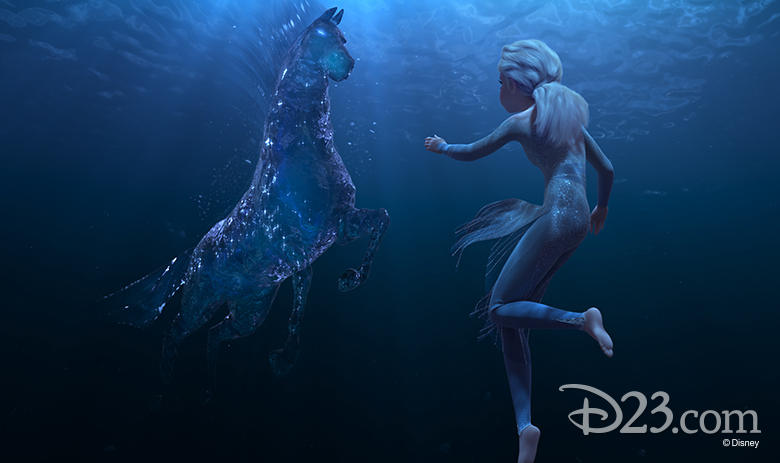
The Nokk is the water spirit of the Enchanted Forest mythology in Frozen II. It usually appears as a translucent horse made from moving water and guards or inhabits the Dark Sea route to Ahtohallan. Official English materials commonly use “the Nokk,” treating Nokk as both name and being type.
The film does not assign spoken dialogue, a credited voice performer, conventional age, sex, fixed biological body, or clear population count. Masculine pronouns appear in some official descriptions, but the elemental form should not be given reproductive biology the screen never establishes.
Dashboard: confirmed and unknown
Confirmed: the Nokk embodies water, attacks or tests Elsa in the Dark Sea, can dissolve and re-form through waves, resists her ice, accepts an ice bridle during their struggle, carries her to Ahtohallan, returns with her, and helps her reach Arendelle before the dam’s flood destroys it.
Unknown: whether the spirit intended to kill Elsa, whether every traveler faces the same test, whether it knows Runeard’s full history, whether the bridle remains necessary after trust forms, and whether it can leave the sea indefinitely. The film demonstrates partnership without publishing stable rules.

Before the horse appears
Elsa reaches the Dark Sea alone after sending Anna and Olaf away. Waves, wind, rock, cold, and distance establish the water as an obstacle before any face emerges. The Nokk first functions as the sea’s agency rather than a separate animal waiting to be discovered.
The horse shape gives Elsa something she can confront physically, but the danger begins in the environment. Water does not need a villain motive to drown a human body. Elemental personification makes relationship possible without making nature safe.
Why a water horse
Northern European folklore contains water-horse beings under related names such as nøkk, näcken, näkki, and kelpie traditions, though histories and regional details differ. Such beings are often alluring, dangerous, shape-shifting, musical, or associated with drowning and waterways.
Disney adapts rather than documents those traditions. The film chooses a majestic translucent horse and removes much of the darker sexual, predatory, or trickster material. A profile should name the broad lineage while avoiding the claim that one pan-Nordic myth has one fixed canonical version.
The name and spelling file
Official franchise materials render the name as Nokk, often with an article. Real-world source traditions use diacritics and different spellings depending on language. Marketing simplifies the term for international circulation.
That simplification makes the character searchable but can flatten cultural specificity. Editorial coverage should distinguish the Disney identifier from Norwegian, Swedish, Finnish, Scottish, and other water-being traditions rather than treating every aquatic horse as interchangeable.
The Dark Sea as threshold
The sea separates Elsa from Ahtohallan and from the historical truth she has pursued. Crossing requires more than raw magical output. She must survive repeated failure, adapt ice to moving water, and engage a spirit that refuses passive transport.
Threshold stories make knowledge costly. Elsa cannot reach the archive through royal title, ancestry claim, or a comfortable bridge. The route tests whether she can continue when the element does not welcome her immediately.
First assault
The Nokk drags Elsa underwater, disrupts her ice path, and uses wave force to keep her from advancing. The sequence is genuinely lethal. Elsa loses breath and control, and the audience has reason to believe the sea can kill her before the truth is reached.
Calling the encounter playful taming diminishes the risk. Calling it simple attempted murder assigns a human legal motive the film never states. “Lethal elemental test or resistance” stays closer to what is visible.
Water against ice
Elsa’s power can freeze water into solid structures, but the Nokk embodies water that moves, breaks, surrounds, and re-forms. The fight prevents ice from becoming an automatic victory button. State change does not equal total ownership of the element.
The sequence also shows creative adaptation. Elsa makes platforms, shields, restraints, and the bridle while responding to motion. Her strength matters, but flexibility is what turns repeated defeat into passage.
The ice bridle
Elsa forms an ice bridle around the Nokk’s head during the struggle and uses it to stay mounted. The image borrows unmistakably from human control of horses. It gives the audience a visual grammar for mastery even though this being is an elemental spirit.
The bridle creates an ethical tension the film does not discuss. If the Nokk consents after testing her, the restraint may become symbolic connection. If not, partnership begins through coercion. Later relaxed riding is needed to show that the relationship changes beyond the original force.
Mastery versus mutual recognition
Promotional language often says Elsa “tames” the Nokk. Taming suggests a wild being reorganized for human use. The narrative’s bridge ethic points toward a better interpretation: Elsa proves capability, the spirit recognizes her, and both choose a shared route.
The visuals do not make that interpretation automatic. Critical reading should hold the friction rather than pretending ice tack is neutral. Mutual recognition becomes convincing only when the Nokk later acts as partner outside immediate restraint.
Relationship file: Elsa
Elsa and the Nokk begin in violent opposition and end in coordinated movement. He carries her to Ahtohallan, appears after she returns from freezing, and races with her toward Arendelle. Their bodies move as one force without eliminating the difference between rider and water.
Elsa’s fifth-spirit role does not make her owner of the water spirit. She earns access through courage and relationship. The future of the bond should allow refusal, separation, and purposes that do not involve royal transport.
Ahtohallan arrival
Once the struggle resolves, the Nokk carries Elsa across the Dark Sea to the glacier. The spirit cannot complete the archive work for her. It provides passage to a place where Elsa must listen, investigate, and confront limits alone.
The division of labor matters. Water brings her to memory. Ice and song let her enter. Human ancestry supplies the crime. No one element owns the truth.
Why the Nokk does not enter the archive
The film leaves the spirit outside Ahtohallan’s inner chambers. That may reflect geography, elemental boundary, narrative focus, or simple staging. It prevents the partnership from turning into constant accompaniment during Elsa’s most private identity revelation.
A profile should not invent prohibition or ignorance. The supported fact is separation at the threshold. Elsa continues alone and later reconnects with the spirit after she thaws.
Elsa freezes beneath the truth
Elsa goes too deep into Ahtohallan and freezes after sending the dam’s secret to Anna. The Nokk is not shown rescuing her from that consequence. The fifth spirit still has limits, and the water spirit does not override the archive’s warning.
Partnership therefore does not mean immunity. Each force maintains its own boundary. Elsa’s return depends on Anna acting in the world, not on a magical mount solving the moral work.
The return from Ahtohallan
After the dam falls, Elsa thaws and reunites with the Nokk. They race across water toward Arendelle as the released flood moves downriver. The relationship now reads less like conquest and more like urgent cooperation around shared consequence.
The Nokk could remain at sea after the test. Choosing to carry Elsa toward the kingdom suggests participation in restoration. Water that threatened to drown her becomes the route through which she saves people.
Saving Arendelle
Elsa rides the Nokk ahead of the flood and raises an ice barrier that redirects the water. The spirit supplies speed and access; Elsa supplies shaped ice. Neither could perform the exact rescue alone within the time available.
The scene transforms the dam’s released water from punishment into consequence managed through relationship. Anna accepts the kingdom’s possible loss. Elsa and the Nokk preserve life after that ethical choice rather than allowing rescue to excuse the dam.
Water does not forgive Runeard
The Nokk helping save Arendelle should not be read as nature deciding the kingdom was innocent. The dam still had to fall. The forest still endured decades of harm. Cooperation protects people without erasing accountability.
That distinction matters in environmental narratives. Disaster prevention and justice can happen together. Saving a city does not require preserving the structure that caused the crisis.
Relationship file: Anna
Anna never forms the same direct relationship with the Nokk. Her action makes the final ride possible by breaking the dam and releasing Elsa. The human without elemental power changes the conditions under which the water spirit and fifth spirit can act.
The Nokk’s rescue therefore depends on a chain of agency. Anna chooses truth, earth giants break stone, water moves, Elsa returns, and the spirit carries her. No single hero owns the ending.
Relationship file: Bruni
Bruni embodies fire at intimate scale, while the Nokk embodies water across an ocean threshold. Elsa calms one through cooling contact and meets the other through sustained physical struggle. The differences prevent “talking to spirits” from becoming one repeated trick.
The film does not stage a direct Bruni-Nokk relationship. Elemental opposition exists symbolically, but no canon rivalry or friendship should be invented from fire-versus-water logic alone.
Relationship file: Gale
Gale first draws Elsa toward the forest and interacts through air, leaves, and objects. The Nokk guards the later route to Ahtohallan. Air initiates movement; water tests whether she can complete it.
Both spirits refuse ordinary dialogue and communicate through force. Elsa learns to read response rather than waiting for human explanation. Their shared role is pedagogical without making them teachers in robes.
Relationship file: the earth giants
The earth giants physically destroy the dam, releasing the water through which the Nokk moves. Earth and water become connected in the climax through Anna’s plan, even though the spirits do not hold a meeting or receive human orders as a council.
The sequence shows systemic consequence. Breaking stone changes water. Water threatens a city. Ice redirects it. Elemental categories remain distinct while actions cross boundaries.
Relationship file: the Northuldra
Northuldra tradition recognizes the water spirit among the elemental symbols. The feature does not show community members riding, controlling, or regularly approaching the Nokk in the Dark Sea. Knowledge of a spirit does not imply routine access.
That limit protects cultural relationship from fantasy ownership. Northuldra people can understand the water’s place in balance while respecting danger and distance.
Horse form and animal expectations
The Nokk’s equine body invites viewers to apply assumptions about domesticated horses: riding, tack, training, loyalty, and partnership with a human. Water folklore complicates those expectations because the horse shape may lure, test, or transform rather than indicate animal domestication.
A spirit that looks like a horse is not automatically a horse with a magical coat. The form is communicative and culturally loaded. Careful language uses “water-horse form” without shrinking elemental agency into royal transportation.
No saddle, but still tack
Elsa rides bareback, which makes the image feel more intimate and less commercially equipped than conventional cavalry. The ice bridle remains a control device. Removing a saddle does not settle consent by itself.
Later scenes can show change through body language: lowered tension, voluntary approach, coordinated direction, and absence of struggle. Those signals matter more than whether equipment remains visible in every shot.
Can the Nokk leave water
The spirit rises from and travels across water, with a body that appears liquid even when holding equine shape. The film does not map exact terrestrial limits. Promotional images may place the Nokk beside Elsa in shallower settings, but primary screen behavior remains tied to water.
Claims about permanent residence in the forest, stable floors, evaporation, or thirst belong to speculation unless demonstrated. Elemental form follows narrative physics rather than a zoological care sheet.
Gendering an elemental spirit
Some official English copy uses “he,” while the feature itself relies on image and action rather than gendered dialogue. Fandom also projects mare, stallion, god, goddess, or genderless force onto the form. None of those readings should quietly become biological fact.
A horse silhouette encourages sex classification because audiences know ordinary animals. A body made from ocean complicates that expectation. Using the franchise pronoun for readability is compatible with stating that the screen does not document reproductive sex, gender identity, or a species system.

Horse-welfare imagery and fantasy distance
Real bridles apply pressure to sensitive parts of a horse’s head and require skilled humane use. The Nokk is not a domestic horse, yet the image borrows that history. Viewers understand the ice construction as control because tack already carries a human-animal power relationship.
Fantasy distance does not forbid the image. It makes critical attention useful. If later scenes show voluntary approach and responsive riding, the relationship moves beyond force. If every appearance requires restraint, the language of partnership becomes harder to defend.
Water sovereignty
The Nokk guards a route no kingdom built and no crown owns. Elsa’s ancestry and fifth-spirit role give her reason to seek Ahtohallan, but they do not convert the sea into royal territory. Passage remains subject to an elemental authority beyond human borders.
That idea matters after Arendelle repairs the dam. Water governance cannot mean simply replacing Runeard’s control with Anna’s kinder control. Rivers, sea, Northuldra community, spirits, and downstream lives all belong in decisions. The Nokk gives nonhuman water agency a face without making that agency easy to administer.
Is the Nokk one being or water itself
The Nokk acts as an individual recognizable spirit while emerging from a vast body of water. It can dissolve into waves and reassemble. That behavior blurs the boundary between person and element without eliminating identity.
The film does not say every drop is conscious or that the entire ocean shares one mind. The safest description is a water spirit capable of taking equine form and moving through the sea as both body and environment.
Danger without villainy
The Nokk attacks a protagonist with enough force to kill her, yet the film does not cast the spirit as evil. This distinction is central to the sequel’s worldview. Nature can oppose human desire without becoming morally corrupt.
Elsa’s courage is not proof she deserves automatic passage. The spirit’s resistance gives the journey weight. Relationship begins after she accepts that the crossing has terms not written by a queen.
Drowning imagery and emotional stakes
Elsa’s underwater struggle carries primal fear: loss of breath, orientation, and bodily control. For a character whose magic usually makes space around her, water surrounds every direction. The sequence forces vulnerability without returning her to childhood helplessness.
The danger also echoes her parents’ death at sea. The film does not explicitly state she thinks of them during the fight, but the audience knows the Dark Sea is connected to their final journey. Emotional resonance should remain interpretation rather than fabricated inner monologue.
Folklore danger softened for family fantasy
Traditional water-horse stories can involve seduction, abduction, drowning, and death. Disney retains the lethal water test while removing much of the horror and moral ambiguity. The Nokk becomes majestic partner after conflict rather than a predator permanently opposed to humans.
Adaptation is not theft-free merely because it becomes beautiful. Production can be admired while sources are named and regional differences preserved. “Inspired by” is more honest than “the exact myth.”
Animation and water simulation
The Nokk requires animators to maintain readable horse anatomy inside constantly moving transparent material. Mane, muscles, joints, foam, refraction, and wave behavior must communicate weight while never becoming solid flesh. The technical design turns simulation into performance.
Elsa’s ice adds another material layer. Restraint, platform, and splash need to interact coherently so the audience can follow tactics. Craft makes the philosophical conflict visible through texture.
Sound without speech
The Nokk communicates through water impact, breath-like sound, equine movement, and storm scale rather than dialogue. Sound design makes the spirit feel both animal-adjacent and oceanic. Silence would reduce the body’s intention; ordinary neighing would reduce the element’s strangeness.
No credited voice actor means performance is distributed across animation, effects, Foley, music, and Elsa’s reactions. Character exists through the whole audiovisual system.
Merchandising and the beautiful mount problem
A translucent horse beside Elsa is immediately marketable through figures, dolls, playsets, and game mounts. Products often emphasize elegance and companionship while minimizing the drowning fight. The spirit becomes an accessory that completes Elsa’s transformed look.
That commercial framing can erase the test and consent problem. The Nokk matters because partnership was not available on demand. A toy can celebrate the bond; editorial coverage must preserve the resistance that gave it meaning.
Parks, games, and ride mechanics
Interactive media naturally convert the Nokk into transportation, summon, or collectible companion. Those mechanics prioritize player control and may define powers more rigidly than the film. Attractions may use the water-horse image for spectacle without narrative danger.
Each branch should be labeled. A game ability is not automatic film canon, and a ride image does not prove the spirit enjoys permanent service. Adaptation can reveal reception while changing agency.
What the film gets right
The film lets water remain lethal, gives Elsa repeated failure, draws from northern folklore, and transforms combat into partnership without making the spirit chatty or domesticated. The Nokk contributes materially to the ending rather than disappearing after the test.
It also makes elemental balance collaborative. Elsa cannot save Arendelle through ice alone. She needs movement through water and a spirit willing to carry her.
What the film leaves unfinished
The Nokk receives no life outside Elsa’s journey, no direct relationship with Northuldra characters, no clarified consent around the bridle, and no post-rescue choice. Majesty fills gaps that story could have used for elemental interiority.
A continuation should show the spirit approaching or refusing Elsa when no emergency forces movement. Voluntary reunion would make the partnership clearer than any promotional adjective.
What Wikipedia has that this page must exceed
The encyclopedic floor includes water-spirit identity, equine form, Dark Sea battle, Elsa’s successful ride, transport to Ahtohallan, return after the dam falls, and role in saving Arendelle. Folklore inspiration is also essential context.
CVM Sekai adds regional naming boundaries, drowning stakes, bridle ethics, mastery versus recognition, water governance, technical animation, merchandising, system-level climax analysis, and the difference between an elemental partner and a royal mount.
Future file
The Nokk needs a scene where Elsa asks rather than seizes passage. The spirit can approach, refuse, redirect, or carry someone else. Choice would convert the sequel’s implied respect into explicit relationship without requiring human speech.
Northuldra knowledge should also enter directly. A water-spirit story belongs to the community whose history is tied to the forest and dam, not only to the royal descendant who crossed the sea once.
Artwork responsibility
The featured artwork is original CVM Sekai fan art designed for a wide hero and directory crop. It presents an intelligent translucent water-horse spirit rising above a storm-dark Nordic sea, using indigo and purple site colors without copying the official animated model.
The generated design deliberately omits saddle and bridle so the directory image emphasizes freedom rather than possession. Local metadata records source, alt text, rights note, and lack of Disney endorsement. The same attachment serves featured image, hero, and future card.
Sources and certainty
Primary evidence includes Frozen II, official Disney character material, published credits and production sources, and reputable folklore scholarship capable of distinguishing regional water-being traditions. Licensed games and products remain separate branches.
Consent, environmental, disability-adjacent, and political analysis is interpretation grounded in visible action. The profile does not invent age, sex, speech, a fixed bridle requirement, or a universal folklore canon.
The final read
The Nokk is not Elsa’s horse waiting beyond the waves. The spirit is the Dark Sea saying no until she demonstrates enough strength, adaptability, and purpose to continue. Even then, the ice bridle leaves a tension the film cannot solve through beauty alone.
The ending improves the relationship because the Nokk returns when water threatens human life and carries Elsa toward repair. Partnership becomes credible through shared action. The spirit remains dangerous, free, and necessary. That is far more interesting than taming, ownership, obedience, or another royal fantasy about nature waiting to serve.
Frozen coverage
Return to the Frozen hub for every character, review, React, rant, and guide.