
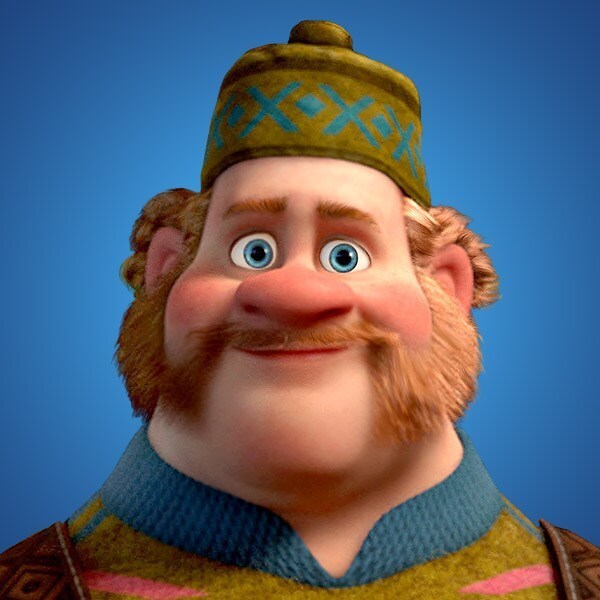
Frozen Character Profile · Mountain Merchant · Sauna Proprietor · Boundary Setter
Oaken
Big summer blowout, crisis pricing, hospitality, family, queer readings, body comedy, and the business behind the greeting.
Profile
| Name | Oaken |
|---|---|
| Business | Wandering Oaken’s Trading Post and Sauna |
| Region | Mountains outside Arendelle |
| Role | Merchant, proprietor, host, and local information source |
| English voice | Chris Williams |
| First appearance | Frozen (2013) |
| Family | Visible in the sauna; exact relationships not stated |
| Signature greeting | “Yoo-hoo” |
Bottom line first
Oaken has about enough screen time to sell carrots, throw a man into snow, advertise a sauna, and become one of the most quoted people in the franchise. That efficiency is why “Yoo-hoo, big summer blowout” survives. The performance turns a retail greeting into a complete rhythm of warmth, calculation, boundary, and comedy.
He is also more than the punchline. Oaken operates a remote business during an impossible weather emergency, recognizes scarcity, refuses intimidation, protects his space, helps Anna and Kristoff after conflict, and appears connected to a large family. The film lets a merchant be generous without requiring him to surrender the right to charge for his work.
Profile and identity
Oaken owns and operates Wandering Oaken’s Trading Post and Sauna in the mountains outside Arendelle. Chris Williams voices him in English in Frozen and subsequent screen appearances. He sells winter goods, summer supplies, food, equipment, lodging-related amenities, and access to the sauna attached to the business.
The feature does not state his surname beyond the business name, age, birthplace, spouse’s identity, children’s names, or whether every person shown in the sauna is legally or biologically related. Official credits and franchise materials identify him simply as Oaken.
Dashboard: confirmed and unknown
Confirmed: Oaken is a merchant, speaks with a distinct friendly cadence, owns the trading post and sauna, has family visible during a sauna greeting, charges Kristoff for supplies, ejects him after an insult, later assists with the journey, and remains part of the wider Frozen world.
Unknown: exact family structure, sexuality, nationality within the fictional setting, inventory suppliers, pricing policy before the storm, business ownership documents, and full relationship with Arendelle. Queer readings of the sauna family are culturally important, but the film never labels him or another adult as his husband.

The trading post as a story crossroads
Anna and Kristoff meet at Oaken’s business because an unnatural winter makes the mountain store the only plausible source of clothing, food, rope, tools, and information. The shop is not decorative. It converts the magical crisis into material scarcity and forces two strangers to reveal how they behave under pressure.
Anna enters with royal urgency but little practical knowledge. Kristoff enters as an experienced worker watching his livelihood collapse. Oaken sits between them with inventory, local awareness, and rules. The scene makes economics part of character introduction without stopping the comedy.
The big summer blowout
Oaken advertises a summer sale during a blizzard because the business stocked for the actual season before Elsa’s magic changed the climate. The mismatch creates the joke: sun balm and bathing goods are cheap while winter survival supplies become scarce and expensive.
The sale also shows that he is not improvising every price after the crisis. His store contains marked seasonal inventory and a promotional system already in place. The sudden winter changes value, demand, and replacement risk. Comedy rests on a recognizable retail problem.
Is the pricing exploitation
Kristoff objects to the cost of carrots, rope, and a pickaxe, accusing Oaken of taking advantage of the storm. Oaken notes that supply and demand have changed. The film does not provide normal-season comparison prices or wholesale costs, so neither a full gouging verdict nor complete innocence can be proved from the exchange.
What can be analyzed is power. Oaken controls scarce goods, while Kristoff’s income has vanished because summer ice no longer sells. A fair merchant still operates inside a crisis market where customers have less choice. The scene lets sympathy move in both directions.

Kristoff’s collapsing livelihood
Kristoff needs the supplies to reach the North Mountain, but he also arrives after learning that the winter has destroyed demand for harvested ice. His anger at Oaken contains fear about work, money, and survival. The negotiation is not simply one stubborn man refusing a price.
Oaken does not create that economic collapse. He sees the same storm threatening transport, resupply, customers, and his family business. Two working men absorb a royal magical crisis at different points in the supply chain, then fight over who should carry the immediate cost.
The insult and the boundary
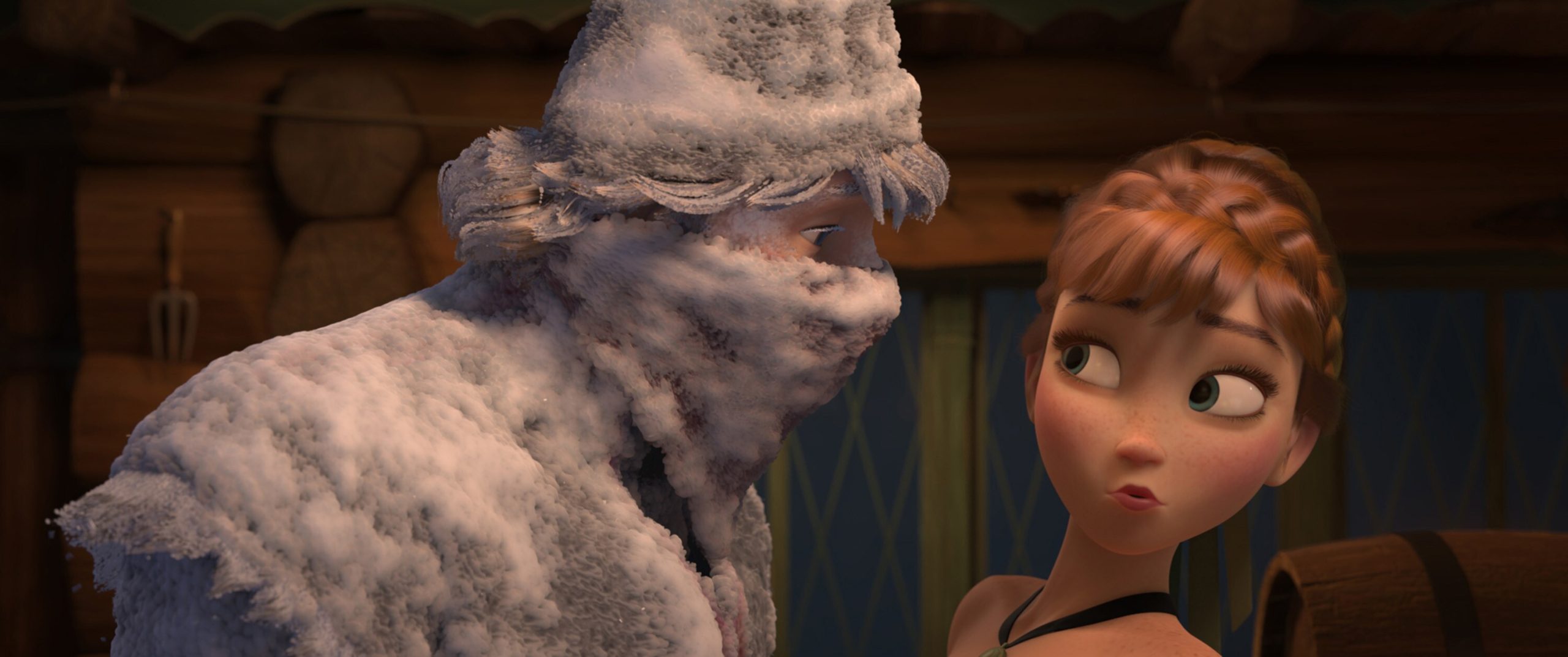
Kristoff calls Oaken a crook. Oaken’s friendliness stops, he rises to his full size, and he throws Kristoff out. Physical ejection is played as comic surprise because the warm shopkeeper is much stronger than expected. It is also enforcement of a boundary inside his own workplace.
The response is disproportionate by ordinary customer-service standards, but the film frames the insult as the line rather than bargaining itself. Oaken accepts questions about price. He rejects being personally accused of dishonesty after explaining the conditions.
Body, size, and the reversal joke
Oaken’s large body initially supports an image of softness, warmth, and comic hospitality. The ejection reverses assumptions by revealing extraordinary strength. The joke is not that a fat man exists. It is that the person speaking in the gentlest register can physically remove Kristoff in one motion.
Still, animation has a long history of treating large bodies as shorthand for appetite, simplicity, or spectacle. Oaken avoids some of that harm because he is competent, employed, socially connected, decisive, and never ashamed. A profile should credit those choices while watching where size carries the gag.
“Yoo-hoo” as character architecture
The greeting works because Chris Williams stretches friendliness into a musical pattern. Oaken can say the same words as welcome, sales pitch, family call, warning, or comic reset. Voice and gesture make repetition feel like a stable social ritual rather than a catchphrase pasted onto an empty character.
That ritual tells travelers what space they entered. The store has an owner, a rhythm, and an expectation of mutual civility. Oaken sounds informal, but he remains in command of the transaction from the first greeting.
Relationship file: Anna
Anna treats Oaken respectfully and purchases winter clothing after Kristoff is ejected. She also obtains information about the North Mountain, making him one of the practical links in her search for Elsa. Oaken does not recognize or exploit her royal identity during the encounter.
Their exchange shows Anna learning how to operate outside palace service. Money, directions, weather, and local relationships matter. Oaken helps because she behaves as a customer and traveler rather than demanding goods by title.
Relationship file: Kristoff
Oaken and Kristoff clash over price, scarcity, and insult, yet the relationship does not remain pure hostility. The merchant later provides what the journey needs, and franchise appearances treat them as familiar members of the same regional world rather than enemies.
The scene’s pleasure comes partly from two kinds of expertise colliding. Kristoff knows mountains, ice, and field survival. Oaken knows inventory, margins, customers, and the risk of maintaining a remote outpost. Neither man understands the full magical emergency yet.

Relationship file: Sven
Sven waits outside or near the shop while Kristoff negotiates, then benefits from the carrots and supplies acquired for the trip. Oaken treats reindeer goods as ordinary inventory and does not make the animal a spectacle.
The feature gives them no personal bond, but the store’s mountain location implies regular contact with sled teams, animals, and travelers. A merchant selling carrots in that setting understands reindeer demand even if he does not share Kristoff’s intimate relationship with Sven.
Relationship file: Olaf
Oaken’s major first-film scene occurs before Anna and Kristoff fully understand Olaf’s role, so the snowman is not central to the transaction. Later franchise material brings Oaken into the wider ensemble’s holiday and community spaces.
Their comic styles would seem compatible: Olaf overexplains wonder while Oaken delivers calm repetition. The limited direct relationship is a reminder that sharing a franchise does not automatically create a documented friendship.
The sauna family image
During the shop scene, Oaken calls to his family in the sauna. Viewers see several people, including an adult man and children, wave back. The image is brief, warm, and presented without explanation. It became one of Disney animation’s most discussed pieces of possible queer family coding.
The film does not identify the adult man as Oaken’s husband, brother, friend, employee, or another relative. Saying “the scene can be read as a husband and children” is accurate. Saying “Disney confirmed Oaken is gay and married” exceeds the evidence available in the feature.

Why the queer reading matters
For queer viewers in 2013, a large affectionate family greeting centered on two adult men could feel like rare visibility inside a major animated release. The lack of ridicule mattered. The sauna group appears happy, ordinary, and integrated into Oaken’s life rather than framed as scandal.
Ambiguity also protects the studio more than the audience. A deniable image can generate progressive credit in one market while allowing a conservative reading elsewhere. Recognizing resonance should coexist with criticism of how little the film commits to naming.
The limits of representation by implication
If Oaken is read as queer, the character is lovable, competent, physically powerful, family-centered, and economically independent. Those are strong traits. He also receives a few minutes of comedy and no explicit relationship dialogue, leaving viewers to build identity from one silent wave.
That is not the same as sustained representation. Coding can open a door, but it cannot carry every need placed on it. A character profile should preserve the possibility without turning audience hope into corporate evidence.
Hospitality and commerce together
Oaken welcomes travelers, shares local information, provides a warm interior, and runs a sauna, but hospitality does not mean unlimited free goods. The film allows care and commerce to coexist. His business supports a family and remote infrastructure, so generosity has material limits.
This balance gives him dignity. Working characters are often divided into greedy merchants or saintly helpers who abandon livelihood for the hero. Oaken helps while remaining a merchant. The protagonist’s emergency does not erase his labor.

A crisis merchant is not automatically a crisis villain
Stories often make the person holding scarce supplies morally suspect because the hero experiences price as obstruction. Oaken complicates that shortcut. He did not cause the winter, cannot know when roads will reopen, and must preserve enough stock for the next stranded traveler as well as the loud customer already at his counter.
Rationing, price, and generosity can all fail in different ways. Selling everything cheaply to Kristoff might feel kind while leaving a later family without food or rope. Charging too much can exploit desperation. The film gives no ledger capable of settling the balance, which is exactly why the scene remains worth arguing about.
Family privacy is also representation
The sauna greeting reveals that Oaken’s life continues beyond the service he provides protagonists. His family does not step forward to explain itself for Anna, Kristoff, or the audience. That ordinary privacy contributes to the scene’s warmth, especially for viewers who recognize a possible same-gender household. Nobody in the room treats the family as unusual or asks it to justify belonging.
Privacy should not become the permanent excuse for never naming queer relationships. It can still be respected as a character value. Oaken owes customers a fair transaction, not a family tree. Future storytelling can offer clarity through natural affection and dialogue without turning the household into a lesson staged for outsiders.
The remote outpost economy
A mountain store requires transport, storage, seasonal forecasting, preservation, maintenance, fuel, and enough varied inventory for unpredictable travelers. The location magnifies the cost of every replacement. Elsa’s sudden winter likely interrupts deliveries at the exact moment demand shifts toward scarce stock.
None of that makes every price automatically fair. It does explain why a city-based expectation cannot be imported into the scene without context. Oaken manages risk before, during, and after customers arrive.

Sauna as business and social space
The attached sauna is both commercial feature and family setting. In Nordic contexts, sauna culture carries ordinary social, hygienic, and communal meaning rather than automatic sexuality. The film uses the space for a quick sight gag and a glimpse of Oaken’s life beyond the counter.
Responsible analysis should avoid treating communal bathing as inherently exotic. The queer reading comes from the family composition and framing, not from the mere existence of people in a sauna.
Nordic coding without exact nationality
Oaken’s accent, greeting, clothing, sauna, and mountain business draw from generalized Nordic and Alpine comedic references. Arendelle itself mixes Norwegian inspiration with fantasy invention. The film does not assign him a real-world nationality within canon.
Calling him specifically Norwegian, Finnish, Sámi, or another identity requires care. Production inspiration can be discussed, but fictional geography does not become a passport. “Nordic-coded merchant in Arendelle’s mountain region” stays closer to what the screen supports.
Accent and comedy
The performance uses a stylized accent and elongated phrasing to make Oaken instantly recognizable. Accents in animation can provide regional texture, but they can also reduce supporting characters to ethnic sound. Oaken survives the risk because the joke usually belongs to timing and authority rather than inability to speak.
He understands every negotiation perfectly. Kristoff is not tricking a simple foreign shopkeeper. Oaken calculates, explains, and reacts with precision. The accent marks character; it does not mark incompetence.

Chris Williams’s performance
Chris Williams gives Oaken warmth, patience, salesmanship, wounded pride, and sudden force through a small number of lines. The famous greeting works because the voice never sounds like a performer reaching for a meme. It sounds like a merchant who has said the phrase ten thousand times and still means it.
The switch after “crook” is especially clean. Volume and bodily scale change, but the character does not become chaotic. Oaken enforces the boundary, then returns to business. The performance makes control funnier than rage would be.
Design and visual storytelling
Oaken’s rounded silhouette, mustache, winter layers, open gestures, and bright shop environment communicate welcome before dialogue. His size fills the frame only when Kristoff crosses the line, turning a design associated with softness into controlled physical authority.
The store around him supplies biography the script does not verbalize: seasonal goods, shelves, signs, sauna access, family presence, and a remote road network. Environment performs the work of a longer backstory.
The store after the eternal winter
Once Elsa thaws Arendelle, winter demand should collapse as suddenly as it rose. Oaken may be left with disrupted stock, damaged routes, angry customers, or profit from an emergency nobody predicted. The film does not revisit the business consequences.
That omission is normal for an ending montage, but it matters to a deep profile. Royal magical crises distribute costs into ordinary lives. Repair could include roads, compensation, resupply, and acknowledgment of local businesses that kept travelers alive.

Olaf’s Frozen Adventure
Holiday material brings Oaken back into the franchise’s community life and gives the trading post a role beyond the original emergency. His presence helps make Arendelle feel populated by recurring residents rather than a castle surrounded by anonymous extras.
Extensions often lean on the greeting because audiences expect it. Repetition becomes thin when catchphrase replaces new decision. The best appearances show how his family, business, and hospitality operate under a different seasonal problem.
Once Upon a Snowman and continuity
Short-form material can revisit the period around the first film and place familiar supporting characters alongside Olaf’s unseen movements. Such appearances expand comic continuity without necessarily adding major biography.
Every short should remain labeled by title and timeline. A gag that fits between feature scenes may be canon-compatible, but it does not automatically answer the family, sexuality, or business questions the original leaves open.
Broadway adaptation changes
Stage adaptations redistribute scenes, songs, and supporting roles to suit live performance. Oaken may receive altered material, expanded comedy, or different staging around the shop and sauna. A theatrical version is an adaptation branch, not footage missing from the animated film.
Comparing versions can show what creators think is essential: greeting, merchant negotiation, size reversal, and regional warmth. Differences should be documented rather than blended into one character timeline.
Merchandise and catchphrase survival
Oaken appears less frequently in merchandise than the royal sisters, Olaf, Sven, or Kristoff, yet his greeting remains culturally durable. Supporting characters often survive through quoted rhythm when the franchise’s product system does not grant them extensive visual presence.
Catchphrase fame can flatten the person. A proper directory card should not stop at “big summer blowout.” It should identify a merchant, family figure, local information source, and boundary-setter whose business makes the mountain journey possible.
Is Oaken generous
He does not hand Kristoff everything for free, but he allows Anna to shop, provides information, keeps travelers warm, and remains available within the regional community. Generosity here means functioning fairly within relationship, not performing self-erasure for protagonists.
The question becomes clearer when separated from price. A person can charge during scarcity and still be hospitable. A person can smile and still exploit. The film gives enough ambiguity to discuss market ethics without reducing him to either saint or crook.
Is Oaken violent
Throwing Kristoff from the store is physical force. Animation exaggerates the motion for comedy and does not show serious injury. Oaken responds after a personal accusation rather than an immediate threat, so viewers can reasonably find the reaction excessive even within the joke.
Naming that excess does not require turning him into a dangerous brute. The scene communicates a hard workplace boundary through cartoon physics. Critical reading can hold tone and action together instead of pretending only one exists.

What the film gets right
Oaken is memorable without being incompetent, helpful without being servile, large without being ashamed, possibly queer without being mocked, and commercially minded without becoming the villain. He owns his space and remains part of the world after the protagonists leave.
The scene also respects labor enough to make price a real conflict. Anna cannot solve the journey through royal command. Kristoff cannot obtain supplies through indignation. Everybody has to engage another person’s rules.
What the film leaves unfinished
The family remains unnamed, the queer possibility remains deniable, the business disappears from the crisis aftermath, and Oaken never receives a goal beyond operating the store. Those limits are understandable for a supporting role but should not be mistaken for complete representation.
A future appearance could give him a decision with stakes: protecting travelers during another emergency, negotiating with the crown, expanding trade after the forest opens, or defending family privacy when the outpost becomes famous.
What Wikipedia has that this page must exceed
The encyclopedic floor includes the trading post and sauna, Chris Williams credit, summer blowout, pricing dispute, ejection of Kristoff, family glimpse, and later franchise appearances. Those facts establish why the character is remembered.
CVM Sekai adds scarcity economics, labor, crisis pricing, body representation, queer coding and its limits, sauna context, accent analysis, adaptation boundaries, and the difference between hospitality and free service. Depth follows the joke into the world that makes it work.
Future file
Oaken should become the commercial bridge between Arendelle, the Enchanted Forest, and mountain travelers after the mist opens. New routes create opportunity and responsibility. He can sell supplies without turning Northuldra culture into merchandise or the forest into a theme park.
His family also deserves one explicit, ordinary scene. Naming relationships would do more than another wink. The character already proved audiences remember him. The next step is letting the life behind the counter become visible.
Artwork responsibility
The featured artwork is original CVM Sekai fan art designed for a wide hero and directory crop. It presents a warm, observant mountain merchant inside a stocked timber outpost, using purple, cream, and amber tones without copying Oaken’s official animated model or storefront signage.
Local metadata records generation provenance, alt text, rights language, and lack of Disney endorsement. The same attachment serves the featured image, hero, and future directory card so the character retains one consistent visual identity.
Sources and certainty
Primary evidence includes Frozen, official shorts and specials where applicable, published credits, Disney character material, and documented stage adaptation sources. Each extension remains labeled by medium and title.
Economic, queer, body, and cultural analysis is interpretation grounded in visible scenes. The profile does not promote Oaken’s possible husband to confirmed canon or assign a real-world nationality the film never states. Fan databases can index appearances but do not settle ambiguity.
The final read
Oaken welcomes everyone until welcome is mistaken for surrender. He sells what the mountain needs, protects his workplace, supports a visible family, and gives the story one of its most durable vocal rhythms. The joke works because a competent adult exists underneath it.
A complete profile does not drain the fun by explaining the receipt. It shows why the receipt matters. Scarcity, labor, body expectations, queer possibility, and hospitality all pass through one tiny shop scene. “Yoo-hoo” is the doorway, not the whole building.
Frozen coverage
Return to the Frozen hub for every character, review, React, rant, and guide.