
Frozen Character Profile · King of Arendelle · Builder of the Dam · Architect of the Lie
King Runeard
Fear of magic, infrastructure as violence, diplomatic murder, inherited propaganda, and the project that outlived its king.
Profile
| Name | King Runeard |
|---|---|
| Realm | Arendelle |
| Family | Agnarr, son; Elsa and Anna, granddaughters |
| English voice | Jeremy Sisto |
| First appearance | Frozen II (2019) |
| Public project | The dam presented as a peace gift |
| Hidden purpose | To weaken the Enchanted Forest and Northuldra |
| Status | Dead; exposed through Ahtohallan’s memory |
Bottom line first
King Runeard is not frightening because he loses control. He is frightening because control is the whole plan. He calls a dam a gift, uses diplomacy to position soldiers inside Northuldra territory, murders the leader who recognizes the threat, and leaves his descendants a patriotic story sturdy enough to bury the crime for more than thirty-four years.
Frozen II reveals him in fragments, but the political anatomy is clear. Fear of magic becomes fear of a people who live differently. Infrastructure becomes covert warfare. Monarchy converts private prejudice into state violence, then lets official memory clean the blood off the portrait. He is the franchise’s most institutionally dangerous villain.
Profile and identity
Runeard was King of Arendelle, father of Agnarr, grandfather of Elsa and Anna, and the royal architect of the dam project in the Enchanted Forest. Jeremy Sisto voices him in English. He appears through memory in Frozen II, including the account preserved by water in Ahtohallan.
The feature does not provide his age, parents, spouse’s identity, reign dates, childhood, or a detailed record of earlier policy. It confirms enough to establish motive and action without supporting every elaborate royal genealogy found in fan databases.
Dashboard: confirmed and unknown
Confirmed: Runeard feared magic, distrusted the Northuldra relationship with nature, presented the dam as a gift, intended it to weaken the forest, brought armed forces to the celebration, murdered the Northuldra leader, died during the resulting battle, and left Agnarr with a false understanding of what happened.
Unknown in feature canon: his exact path to the throne, whether prejudice shaped other policies, who designed the dam’s engineering, how many officials knew the hidden purpose, what he told his wife, and whether he planned full removal or long-term domination of the Northuldra after the structure weakened their land.

Fear dressed as royal judgment
Runeard describes magic as a threat because it cannot be controlled by a ruler. His objection is not simply that supernatural power can harm people. He fears a source of authority and relationship outside monarchy. The Northuldra listen to nature rather than treating the king as the final interpreter of the world.
That fear becomes ideology. Difference is translated into disloyalty, spiritual relationship into manipulation, and independence into danger. Once the king defines control as safety, any community refusing control can be framed as an enemy before it commits an act.
The Northuldra as a political problem
The Northuldra live in the forest with their own leadership, knowledge, economy, and relationship to the elemental spirits. Runeard views that autonomy as intolerable. His private words reveal contempt for the idea that people might believe nature has agency rather than existing for a king’s use.
The conflict therefore exceeds personal prejudice. A sovereign community occupies land and follows an order Arendelle does not command. Runeard’s solution is to make dependency look like generosity, weakening both the environment and the people while preserving diplomatic deniability.
The dam as a false gift
Runeard invites the Northuldra to celebrate a dam supposedly built to strengthen waters and symbolize peace. The structure’s public meaning is cooperation. Its private purpose is deprivation. The gap between those meanings is the central evidence that the later battle was not a tragic misunderstanding.
A gift creates social pressure to trust, welcome, and reciprocate. Runeard exploits that pressure. He does not attack from the border with an announced declaration. He enters through ceremony, makes resistance look ungrateful, and uses engineering to continue violence after the banquet ends.
Infrastructure as a weapon
The dam blocks water and damages the forest’s natural balance. Runeard understands that ecological harm can reduce Northuldra power because their life and the spirits are connected to the land. Stone performs the work of occupation without requiring soldiers to patrol every riverbank forever.
That strategy makes the villainy painfully modern. Roads, dams, borders, maps, schools, and resource projects can be described as development while redistributing control. The movie does not need a lecture to show the principle. It puts a monument to “peace” over a choked river and lets the contradiction speak.
Diplomacy as staging
The celebration gathers Northuldra leaders, Arendellian officials, soldiers, and young Agnarr in one place. Runeard uses the appearance of peace to control proximity and timing. His private conversation with the Northuldra leader becomes an ambush once the leader challenges the dam.
Diplomacy is not inherently false, but Runeard makes it theater surrounding a decision already made. The other side is invited to consent to its own weakening. When consent fails, violence was waiting behind the pageantry.
The murder of the Northuldra leader
Ahtohallan shows Runeard drawing a concealed blade and striking the unarmed Northuldra leader from behind during private discussion. The act removes any ambiguity about who initiated the decisive violence. It is betrayal at the personal, diplomatic, and state level at once.
The victim remains unnamed in the feature, a choice that concentrates attention on Runeard and the royal mystery. Editorial coverage should resist repeating that imbalance. The murder is not merely a dark secret in Elsa’s family. It is the killing of a leader whose people then endure confinement and historical blame.
Why the ambush matters
Runeard does not defeat an attacking enemy in combat. He weaponizes the expectation that leaders can speak during a peace ceremony. That method reveals fear beneath authority. He cannot win legitimacy through argument, so he arranges the moment when trust creates vulnerability.
The attack also exposes how prejudice and cowardice work together. Publicly, he performs the strong ruler protecting a kingdom. Privately, he kills before the other leader can rally resistance or warn the community fully. Control matters more than honor.
The battle he creates
Runeard’s murder triggers open fighting between Northuldra and Arendellian forces. The elemental spirits react, the forest is engulfed by mist, and everyone inside becomes trapped. Later Arendellian memory records confusion rather than the king’s initiating crime.
Calling the event a battle without naming the ambush can flatten responsibility. Combat follows, and individuals on both sides may act violently, but the initiating state plan belongs to Runeard. Historical complexity should not become moral fog.
His death in the conflict
Runeard dies during the chaos near the waterfall after the confrontation. The film does not offer a final confession, remorse, or direct conversation with Agnarr. His body disappears from the political story while the structure he built remains standing.
That is thematically exact. Individual death does not end institutional harm. The dam continues weakening the forest. Soldiers remain trapped. Northuldra families lose decades. Arendelle inherits a myth. Removing the man without dismantling his project leaves the project in charge.
Relationship file: Agnarr
Agnarr is a child when he accompanies the royal expedition. He sees fragments of conflict, is struck unconscious, and escapes through Iduna’s rescue without learning that his father committed murder. He later repeats a story in which the Northuldra attack without clear cause.
Runeard’s most durable influence on his son is therefore informational. Agnarr inherits a throne, a trauma, and a false history. He can love his children and still carry fear shaped by a father whose crime remains hidden. Personal decency does not automatically dissolve inherited ideology.
A child used as dynastic witness
Bringing Agnarr to the ceremony makes the dam part of royal succession. The boy sees his father perform diplomacy, celebrate Arendelle’s engineering, and embody legitimate authority. Even before the battle, Runeard is teaching him what kingship looks like.
After the disaster, Agnarr’s incomplete memory becomes the kingdom’s usable account. He did not consciously invent the lie, but monarchy elevates his perspective over Northuldra testimony. A traumatized child’s fragment becomes national history because he grows into the crown.
Relationship file: Elsa
Elsa never meets Runeard alive. She encounters his preserved words and actions in Ahtohallan, discovering that her magical existence contradicts the fear at the center of his reign. The granddaughter he would likely have viewed as dangerous becomes the witness who exposes him.
Their relationship is historical rather than interpersonal, yet it drives Elsa’s identity crisis. She must accept that being Northuldra through Iduna and royal through Agnarr connects her to both the harmed people and the state that caused harm. Power does not exempt her from ancestry’s responsibility.

Relationship file: Anna
Anna receives Elsa’s message about the dam after Elsa freezes in Ahtohallan. She acts on truth without possessing magic, choosing to destroy the structure even when the released water appears likely to erase Arendelle. Runeard’s ordinary human granddaughter becomes the person who rejects his definition of royal protection.
The contrast matters. He treats sacrifice by others as necessary for his kingdom. Anna risks her own kingdom to end an injustice it inherited. Her later coronation makes that decision the moral foundation of a different reign, though actual repair must continue beyond one heroic act.
Relationship file: Iduna
Iduna is a Northuldra child who saves Agnarr from the battle Runeard causes. Her action preserves Runeard’s dynasty even as his violence imprisons her people. She later becomes Queen of Arendelle while hiding or suppressing her origin within the kingdom’s fearful culture.
The irony is brutal. Runeard believes Northuldra relationship with magic threatens Arendelle. A Northuldra girl saves his heir, mothers the next queens, and gives Elsa the ancestry tied to the fifth spirit. The future he fears enters the royal family through an act of mercy.
Relationship file: the Northuldra leader
The feature gives the murdered leader no spoken name in its main narrative. He recognizes the dam’s harm and confronts Runeard during what should be protected diplomatic space. His perception confirms that Northuldra leaders are not fooled by the structure merely because ceremony surrounds it.
Runeard’s decision to kill rather than negotiate reveals the political equality he refuses. He cannot allow another leader to name the truth publicly. Murder becomes an attempt to destroy both a person and the authority from which that person speaks.
Relationship file: Mattias
Mattias serves Arendelle and remains loyal to Agnarr’s memory for decades. He does not know Runeard’s hidden act. When Anna reveals the truth, he chooses to help destroy the dam rather than protect the monument or the comforting version of his king’s history.
That choice demonstrates the difference between loyalty and obedience. Runeard builds a system where patriotic duty should preserve his project. Mattias eventually decides that service to Arendelle requires refusing the founder’s lie. The kingdom survives moral correction, not denial.
The soldiers who did not know
The film does not establish that ordinary Arendellian soldiers understood the dam’s covert purpose or anticipated Runeard’s murder. Many appear to enter the celebration as guards and then become trapped in a conflict whose initiating truth they never witness.
That uncertainty prevents collective blame from becoming lazy. Institutions distribute knowledge unevenly. Runeard can make soldiers instruments of a plan they do not fully understand, while their presence still supplies the force that makes betrayal possible. Lack of knowledge changes culpability without erasing consequence.
Official memory after the forest closes
With Runeard dead, Agnarr rescued, and everyone else sealed behind mist, Arendelle lacks public access to the crime scene. The surviving royal account centers an unexplained Northuldra attack and elemental rage. Portraits, ceremonies, and dynastic continuity can preserve Runeard as a respected ancestor.
A lie does not require every citizen to hear a fabricated speech. Silence, missing witnesses, royal authority, and repeated partial memory can do the work. The absence of Northuldra voice outside the barrier lets the kingdom mistake one perspective for the whole archive.
The portrait on the wall
Runeard’s image remains inside the royal visual lineage. Even when descendants do not repeat his ideology consciously, the palace presents succession as continuity and legitimacy. Portraiture turns a person into an ancestor worthy of display before the viewer asks what his reign cost.
After the truth, leaving that presentation unchanged would become a choice. Arendelle must decide whether to remove, contextualize, relocate, or confront the image. Memory work is not iconoclasm versus ignorance. It is the honest design of what a state teaches when it displays power.
The title “good king” and its collapse
Runeard understands the public grammar of benevolent monarchy. He builds, hosts, gives, and speaks about protection. Those actions produce the appearance of a good king because subjects usually cannot inspect private motive, environmental consequence, or diplomatic murder.
The film asks viewers to separate royal aesthetics from ethical rule. A polished ceremony and useful-looking structure can hide domination more effectively than an obvious villain cape. Goodness must be measured by who has consent, whose knowledge counts, and who bears the cost.
Colonial logic without a colonial lecture
Runeard’s strategy follows recognizable colonial logic: define autonomous people as threatening, frame their land relationship as irrational, offer development that creates dependency, use diplomacy to enter, deploy military force, remove leadership, and control the surviving story.
The Northuldra are fictional and should not be mapped lazily onto one real nation. The structure still invites historical comparison. Editorial analysis can name the pattern while respecting differences among real dam projects, Indigenous communities, Nordic history, and settler states.
Water, power, and consent
A dam changes more than scenery. It reorganizes water access, fish movement, vegetation, travel, settlement, and authority over future use. Runeard chooses that reorganization for people who did not consent, then calls it help. Control over nature becomes control over community life.
The story’s elemental framework makes the consequence visible through angry spirits, but no magic is required to understand the politics. Infrastructure has owners, decision-makers, beneficiaries, and displaced costs. The question is always who was allowed to decide.
Fear of magic and fear of limits
Runeard says magic makes people feel too powerful and entitled. The accusation projects his own behavior. He uses crown, army, engineering, secrecy, and murder to decide another community’s future. His real objection is that nature imposes a limit on royal command.
Elsa’s later fifth-spirit role does not prove all magic is automatically good. It proves relationship matters more than domination. Runeard cannot imagine power as reciprocal, so any force he cannot order becomes an enemy to weaken.
Prejudice as policy, not attitude
The film gives Runeard contemptuous private language, but his importance lies in what he builds from it. Bias moves into budget, engineering, diplomacy, troop movement, education, and inherited memory. Personal hatred becomes durable because the state can turn it into material reality.
That is why defeating him retroactively requires more than condemning a dead man. The dam must fall. Records must change. Northuldra people must regain movement and political voice. The kingdom has to repair systems created by a prejudice no living ruler personally chose.

Why there is no redemption arc
Runeard receives no sympathetic childhood, late regret, or noble intention corrupted by accident. The film shows a ruler who understands that his gift will cause harm and proceeds because harm is the purpose. Murder follows when the target sees through the plan.
A lack of redemption does not make him shallow. It shifts depth from emotional excuse to political mechanism. The audience learns how he justifies control, how he stages violence, and how his power outlives him. Some villains need accountability more than an origin wound.
Jeremy Sisto’s performance
Jeremy Sisto gives Runeard a controlled, patriarchal authority that fits remembered monarchy. The voice can sound ceremonial in public and contemptuous in private without turning into theatrical snarling. That restraint helps the reveal feel like exposure of an institution rather than the arrival of a different personality.
The performance’s most important move is certainty. Runeard speaks as though his fear is reason and his control is duty. He does not need rage to become dangerous because the crown already converts conviction into action.
Design and visual authority
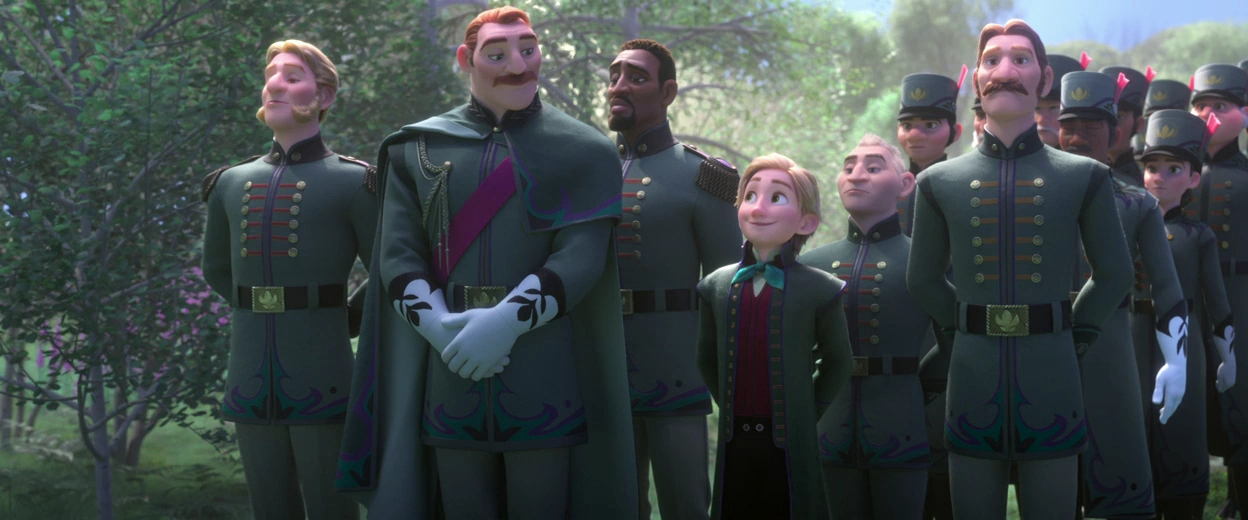
Runeard’s design places him inside Arendelle’s royal lineage through formal clothing, age, bearing, and visual continuity with Agnarr. He looks like a respectable ancestor before the story reveals the private act behind the image. The contrast turns conventional authority into evidence rather than reassurance.
A villain designed as visibly monstrous would let the institution escape. By making him recognizably kingly, the film asks whether the symbols viewers trust can conceal violence. Evil does not always advertise itself through ugliness. Sometimes it commissions a monument.
The earth giants as delayed consequence
The earth giants help destroy the dam after Anna draws them toward it. They are not Runeard’s intended weapons, yet the natural force his project tried to control becomes the means of ending it. The structure falls through the agency of the world he considered subordinate.
The moment works as consequence rather than simple revenge. Runeard is long dead. What breaks is the material expression of his policy. Justice targets the continuing harm, not a body already beyond punishment.
Why Arendelle is saved
Anna acts knowing the flood may destroy Arendelle, but Elsa returns and redirects the water. Some viewers read the rescue as letting the kingdom avoid the cost of repair. Others see it as proof that accepting accountability allows a future beyond annihilation.
Runeard’s worldview assumes protecting Arendelle requires harming Northuldra. The ending rejects that zero-sum logic. The kingdom can survive only after Anna stops treating its physical preservation as more important than justice. Elsa’s rescue follows the moral choice rather than replacing it.
What repair should do with his legacy
Arendelle should publicly name the murder, the dam’s purpose, the false official account, and the trapped decades. Northuldra testimony must shape archives, schools, memorials, maps, and any site interpreting the dam. A royal confession without shared authority would center the dynasty again.
Runeard’s reign should not become a single bad-apple chapter that proves the current monarchy good. His power worked through ordinary institutions and inherited assumptions. Repair requires examining which of those habits survived after the man died.
The problem of crediting Anna alone
Anna deserves credit for acting on the truth at enormous personal cost. Still, a repair story can accidentally praise Arendelle’s heroine more loudly than the Northuldra people who endured the harm and preserved the knowledge that something was wrong.
Runeard’s legacy is fully defeated only when Northuldra agency exceeds being rescued by better royals. Yelena, Honeymaren, Ryder, and unnamed community members need authority over land, history, cultural representation, and the terms of future relationship.
Licensed prequels and expanded history
Licensed novels and guides expand the royal family, Iduna’s youth, Agnarr’s memory, and the history surrounding the forest. They can add useful context for how Runeard’s actions shaped the next generation, but their details belong to the publishing branch unless the feature confirms them.
Expansion should never soften the central record through unnecessary speculation. Whatever earlier fears or pressures existed, the film shows that Runeard knew the dam would weaken the forest and chose murder when challenged. Context can explain method without manufacturing innocence.
Reception and thematic importance
Runeard is often discussed less than Hans because he appears briefly and operates through backstory. Yet his choices shape the entire sequel, the sisters’ family history, the Northuldra confinement, the spirits’ withdrawal, and the dam Anna must destroy. His screen time is small; his institutional footprint is enormous.
Viewers who find him less charismatic may be responding to the point. He does not perform villainy for the heroes. He has already won control over memory before they are born. The plot becomes an investigation into how to recognize and dismantle that victory.
What Wikipedia has that this page must exceed
The encyclopedic floor includes his kingship, relationship to Agnarr, fear of magic, dam plan, deception, murder of the Northuldra leader, death in battle, Jeremy Sisto credit, and eventual exposure through Ahtohallan. Every complete profile must cover those facts accurately.
CVM Sekai adds infrastructure politics, consent, colonial logic, military knowledge boundaries, dynastic memory, portraiture, water governance, performance, repair, and the difference between punishing a man and dismantling his project. Depth comes from following consequence across generations.
Artwork responsibility
The featured image is original CVM Sekai fan art built for a wide hero and directory crop. It depicts a polished older ruler beside a depleted river and monumental dam, using CVM purple tones without copying a film still or official character design.
The artwork emphasizes concealed institutional violence rather than cartoon evil. Local metadata records its generation source, editorial rights note, and lack of Disney endorsement. The same attachment serves featured image, hero, and future directory card so the visual identity remains consistent.
Sources and certainty
Primary evidence includes Frozen II, Ahtohallan’s preserved memory, published credits, official Disney and D23 descriptions, and production interviews. Licensed novels and guides remain labeled when they extend royal history beyond the feature.
Colonial, ecological, and institutional analysis is interpretation grounded in the film’s actions and imagery. It is not presented as dialogue Runeard never speaks. Fan databases can point toward sources, but they do not replace the actual scene record.
The final read
Runeard builds a weapon that looks like generosity, commits murder inside diplomacy, and leaves his son a kingdom unable to tell the difference between its history and his cover story. He proves that the most durable villains do not need to survive the opening act. Their structures keep making choices for everyone else.
Anna defeats him when she accepts that Arendelle has no moral right to preserve the dam. Elsa defeats his fear when magic becomes relationship rather than domination. Northuldra freedom defeats the future he planned. The remaining question is whether the kingdom tells that truth after the cheering stops.
Frozen coverage
Return to the Frozen hub for every character, review, React, rant, and guide.