
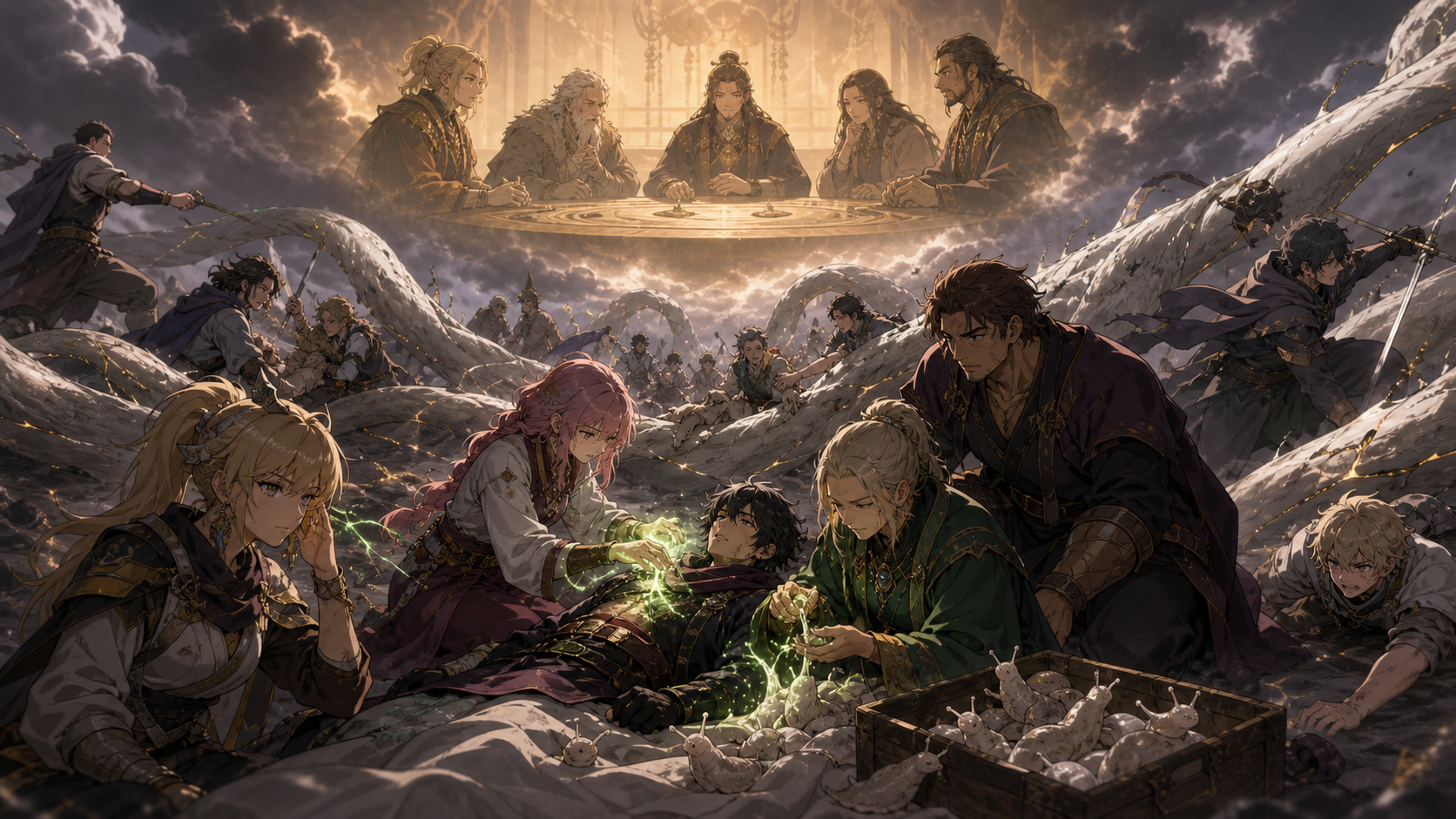
A Shinobi’s Dream
The Divine Tree makes exhaustion and grief visible, while medics, teammates, villages and ordinary fighters prove that survival cannot depend on one hero refusing fatigue.
Bottom line
“A Shinobi’s Dream” lets exhaustion become visible without treating despair as cowardice. The Divine Tree drains fighters faster than medics can reach them, and Shikamaru nearly dies in front of the friends who already lost their fathers and Neji. Sakura works to keep him alive. Tsunade arrives with the other Kage and adds the experience and chakra needed to stabilize him. Hashirama warns the alliance that the tree’s flower may bloom soon, then shares his memory of the first Five Kage Summit and the imperfect dream of villages cooperating. Sasuke cuts through a root and asks Naruto whether he has reached his limit. The challenge is harsh, but Naruto has indeed reached a physical and emotional edge. He stands again because other people are still carrying parts of the fight. The episode’s dream is not one hero refusing fatigue. The dream is a system where villages, teams, medics, summons, tailed beasts, and ordinary shinobi keep one another from becoming fuel.
The Divine Tree turns the ground against everyone
Roots travel beneath and across formations, targeting chakra rather than military rank. Familiar terrain no longer offers stable routes or safe rear positions.
Every unit has to watch the soil while fighting the enemy above.
Chakra drain kills quickly
The roots do not merely tire victims. They strip the energy required for bodily function and leave people collapsed before help can arrive.
The speed makes prevention more reliable than rescue after full contact.
Named and unnamed casualties matter equally
The episode gives viewers a personal focus through Shikamaru, but many shinobi are drained beyond recovery. Their lack of long character histories does not make the deaths background texture.
The alliance is losing particular people everywhere.
Shikamaru is caught by a root
The strategist who helped interpret Shikaku’s final plan becomes physically unable to direct anyone. Intelligence offers no protection when the extraction system reaches his body.
Support roles remain exposed to the same war.
His recent grief compounds the injury
Shikamaru lost his father when headquarters was destroyed and continued functioning because the battle demanded immediate decisions. The tree attack arrives before that loss has any room to settle.
Trauma accumulates even when the person stays competent.
Ino feels another threatened bond
She lost Inoichi in the same headquarters strike and now watches a teammate near death. Her sensory and communication strengths cannot guarantee the body beside her survives.
Connection creates information and helplessness at once.
Choji faces the possible loss of his teammate
Team 10’s trust was built through childhood, clan formation, missions, and Asuma’s death. Shikamaru is not only the unit strategist.
He is a friend whose absence would change ordinary life after the war.
Sakura begins emergency treatment
She responds with medical skill rather than a speech about hope. Chakra control, assessment, and sustained intervention create the only immediate path back.
Care is action under pressure.
Medical training meets an extreme depletion case
Shikamaru’s body needs more than wound closure because the tree removed life-sustaining chakra. Sakura has to support systems already close to stopping.
The case tests the limit of what one medic can supply.
Sakura’s emotional connection does not replace technique
She cares about Shikamaru and the people around him. The treatment works through years of study and practice, not love converted into unexplained power.
Feeling motivates labor. Skill performs the labor.
Naruto senses Shikamaru fading
The chakra network lets him register the condition of allies across the field. That connection exposes him to losses far beyond his line of sight.
Leadership by connection can become emotional overload.
Naruto cannot personally refill everyone
His chakra has already supported the alliance and enabled mass evacuation. The Divine Tree is designed to consume the same distributed energy.
Trying to answer every drained body alone would feed exhaustion into the enemy’s scale.
Shikamaru imagines a future role
His desire to support Naruto as Hokage gives him a reason tied to unfinished work and chosen friendship. The thought is personal rather than a demand that every wounded person produce a grand destiny.
Wanting a future can help without making survival morally earned.
Nobody should need usefulness to deserve care
Shikamaru’s strategic value is enormous, but medics would owe the same effort to a less famous fighter with equal need. Human worth exceeds projected service.
The future role deepens character without setting a triage rank.
Tsunade reaches the battlefield
The Five Kage arrive after surviving Madara’s attack and receiving emergency care. Tsunade moves from patient back into medical leadership.
Her return connects the separated Kage front with the alliance’s central crisis.
A recovering medic can still have limits
Tsunade has endured catastrophic injury and spent enormous chakra. Her ability to help Shikamaru does not mean her body has finished recovering.
Leadership should account for the caregiver’s condition.
Teacher and student combine medical capacity
Sakura brings continuous treatment and direct knowledge of Shikamaru’s decline. Tsunade brings deeper reserves and decades of experience.
The handoff works because both contributions matter.
Shikamaru stabilizes through collective care
His survival comes from Sakura’s immediate response, Tsunade’s intervention, support around the team, and his body’s remaining capacity. No motivational line alone restores him.
The scene respects medical labor when read honestly.
The Five Kage return as living leaders
Their arrival adds authority, power, and proof that Madara did not end the coalition. They rejoin an alliance that continued without them.
Returning leaders should integrate with the structure that survived their absence.
Gaara brings evidence of changed village relations
The former jinchūriki once targeted by his own village now stands as Kazekage inside a multinational force. His trajectory shows that institutions can change through people and policy.
Progress remains possible without pretending the earlier abuse was necessary.
The Kage cannot simply take over
Shikaku is dead, local commanders have adapted, Naruto and Kurama created new networks, and units hold current battlefield knowledge. Rank does not replace information accumulated during absence.
Effective return begins with listening.
Hashirama distributes the deadline
He tells the alliance that the Divine Tree’s flower may bloom soon and that they must stop Obito or cut the tree before then. People need the truth to judge risk.
Withholding a terrifying deadline would only preserve obedience, not coordination.
A countdown can focus and crush
Some fighters respond to a clear time limit with sharper priorities. Others see proof that their exhaustion cannot matter enough.
Command must provide tasks, not only doom.
Hashirama shares the first Kage Summit memory
He recalls a time when leaders from rival villages sat together to discuss an international order. The memory shows cooperation was once unlikely too.
History offers precedent without guaranteeing repetition.
The first summit was politically compromised
Hashirama’s desire for peace existed alongside tailed-beast distribution, military bargaining, unequal power, and his brother’s practical intervention. The meeting did not create an innocent system.
Imperfect beginnings can still contain useful commitments.
Hashirama once bowed for cooperation
His willingness to lower himself before rival leaders reflected urgency about ending child warfare. The gesture challenged the expectation that the strongest man should demand submission.
Humility helped open a political conversation.
Tobirama supplied limits and structure
Hashirama’s emotional appeal needed negotiation rules, resource questions, and attention to how other villages would respond. The brothers represented different necessities.
Dreams survive better when feeling and procedure work together.
The tailed-beast bargain carried future harm
Distributing captured beasts created deterrence and village power while treating sentient beings as assets. Jinchūriki across nations inherited the cost.
Peace among leaders was partly built through coerced bodies.
The current alliance improves on the old room
Shinobi from five villages now share danger directly rather than bargaining only through Kage. Ordinary fighters have formed relationships and witnessed one another’s losses.
Cooperation has moved below the leadership table.
A shared dream needs more than shared enemies
The Ten-Tails unites villages through survival pressure. Lasting peace will require fair institutions after the enemy disappears.
Emergency coalition is evidence of capacity, not proof of permanent trust.
Morale reaches a dangerous low
People have seen headquarters destroyed, comrades drained, Naruto exhausted, and a global deadline announced. Despair matches the evidence before them.
Calling everyone weak would be dishonest.
Sasuke cuts through a root
He protects space through immediate force and reminds the field that the Divine Tree can be physically interrupted. The action provides a task where speeches cannot.
Cutting one root does not solve the system, but one route opens.
Sasuke challenges Naruto
He asks whether Naruto has reached his limit. The tone is competitive and unsentimental, consistent with their long relationship.
The challenge works because Sasuke is also acting, not demanding effort from safety.
The question risks treating exhaustion as failure
Naruto has already protected thousands, distributed chakra, identified senjutsu, and helped teleport the alliance. Reaching a limit would not erase that work.
Bodies deserve acknowledgment before another demand.
Naruto responds to the rival he knows
Sasuke’s provocation can reach him differently from generic encouragement. Their rivalry has long converted irritation into motion.
Useful motivation remains relationship-specific.
Rivalry should not become the whole support system
Naruto also needs Kurama’s partnership, medical care, allied planning, and room to recover. A sharper challenge cannot supply chakra or repair injury.
Emotional spark and practical capacity must meet.
Kurama helps Naruto balance power
Tailed Beast Mode and Sage Mode require cooperation across internal and environmental energy. Kurama creates space for Naruto to gather natural energy more effectively.
The opening against Obito becomes sustainable through partnership.
Naruto stands with Sage and tailed-beast power
His renewed form combines a confirmed vulnerability with the scale needed for the main fight. The transformation follows evidence rather than arriving as decorative escalation.
Power answers a specific mechanism.
Sasuke prepares his own combined role
His Susanoo and flame control can provide structure and offense around Naruto’s senjutsu. Sasuke cannot create the natural energy solution alone.
Cooperation makes distinct strengths compatible.
The alliance receives a task again
Roots can be cut, drained fighters can be rescued, the tree can be targeted, and senjutsu can harm Obito. The deadline remains terrifying.
Specific work gives morale somewhere to go.
Dream language can hide coercion or invite cooperation
Obito’s dream removes everyone’s choice. Hashirama’s remembered dream asks villages to negotiate, though his methods included serious coercion toward tailed beasts.
The ethical difference depends on who may refuse and who shares power.
A shinobi’s dream should include life after service
Shikamaru imagines helping Naruto govern. Others may want family, rest, farming, teaching, travel, or no military role at all.
Peace cannot mean keeping everyone useful to the village forever.
Shikamaru’s collapse is not a failure of will
He has been thinking, coordinating, grieving, and fighting since headquarters vanished with his father inside it. The Divine Tree reaches a body carrying more than anyone has measured.
Calling him strong does not make the accumulated cost disappear. Competence can hide injury until one more demand turns survival into an emergency.
Ino and Choji are not supporting scenery
They recognize the stakes around Shikamaru before any commander can assign meaning to the moment. Team 10 carries shared childhood, Asuma’s death, clan expectations, and the fresh loss of Inoichi and Shikaku.
Their fear has history. Their presence reminds us that every casualty tears through a network of people who will have to live afterward.
Sakura’s first response is disciplined care
She does not promise a miracle or convert friendship into magic. She assesses, supplies chakra, stays with the patient, and works inside the limits of a battlefield where the threat is still moving.
That is heroism without spectacle. Sakura protects the future through technical labor performed while everyone else is looking toward the largest explosion.
Tsunade arrives as a survivor and a medic
She has only recently been reassembled and healed after Madara nearly killed the Kage. Returning to work does not mean her body is untouched or that recovery somehow finished during the trip.
Her intervention matters because experience joins Sakura’s continuous effort. The scene becomes a medical relay, not a master arriving to erase the student.
Shikamaru’s dream belongs to him
He wants to advise Naruto as Hokage because that role fits the friendship and political responsibility he has chosen. Nobody standing over him invents a destiny to justify saving him.
The distinction matters. A future can call a wounded person back without becoming the price they must pay for care. He deserves treatment even if his dream changes tomorrow.
Hashirama’s memory is useful because it is imperfect
The first Kage summit shows leaders attempting cooperation before trust had become ordinary. It also shows power bargaining, tailed-beast commodification, uneven interests, and Tobirama limiting his brother’s emotional promises.
History offers tools, not saints. The alliance can inherit the courage to negotiate while refusing the coercive system those founders accepted.
Bowing is not the same as sharing authority
Hashirama’s humility opened a difficult conversation, and that gesture deserves recognition. A sincere bow still could not give tailed beasts representation or ordinary villagers power over decisions made in that room.
Respectful leadership needs structures after the emotional moment. Otherwise one extraordinary man remains the person deciding what everyone else receives.
The Kage return to an alliance that outgrew them
While the five leaders were absent, commanders died, soldiers improvised, Naruto and Kurama distributed chakra, and cross-village relationships deepened under pressure. The coalition did not freeze until authority came home.
The Kage can add strength and experience, but responsible return means listening to people who possess knowledge. Rank should reconnect with the living network, not overwrite it.
Sasuke knows exactly where to place the needle
His question about Naruto’s limit is sharp because their rivalry has always mixed recognition, irritation, competition, and care neither boy expresses cleanly. Naruto hears a challenge from the one person whose judgment still reaches that nerve.
It works in this relationship. It would be cruelty as a universal leadership policy for exhausted people who need rest, medicine, or permission to admit fear.
Naruto’s limit deserves to exist
He has shared chakra with thousands, protected bodies he could not see, fought a transformed Obito, processed his father’s return, and felt friends fading through the network. Exhaustion is the honest consequence.
The episode does not need Naruto to be limitless. It needs other people to keep the world standing long enough for him to gather himself and choose another action.
Kurama creates recovery inside partnership
Kurama helps Naruto balance tailed-beast chakra with natural energy and makes room for the next attack. That assistance is strategic, bodily, and emotional all at once.
Naruto’s renewed form is not solitary determination wearing brighter clothes. It is the visible result of trust between beings whose relationship began with imprisonment and grew through difficult mutual recognition.
Morale requires tasks people can actually perform
Hashirama’s warning alone could crush the alliance. Roots that can be cut, patients who can be moved, information that can be relayed, and formations that can be protected give frightened people reachable work.
Hope becomes credible when it has verbs. Cut. Carry. Heal. Warn. Shield. Coordinate. Nobody needs to pretend the danger is small in order to act against it.
The episode argues for a wider definition of strength
Sakura sustaining treatment, Ino remaining connected, Choji staying beside his team, Tsunade returning carefully, Hashirama distributing information, Sasuke cutting a route, and ordinary shinobi protecting one another all belong inside the answer.
Strength is not one exhausted hero producing endless power. It is a community refusing to let any single body become the entire plan.
A dream worth keeping must allow different futures
Shikamaru wants public service beside Naruto. Another survivor may want to leave military life, raise children, build homes, teach, farm, travel, or sit somewhere quiet without ever becoming strategically useful again.
Obito’s dream makes one answer compulsory. A humane shinobi world has to protect the freedom to imagine many answers, including lives the village cannot convert into weapons.
RaeRae’s verdict
“A Shinobi’s Dream” understands that morale is not a speech floating above bodies. Shikamaru almost dies. Sakura and Tsunade use trained medical labor to keep him alive. The Five Kage return because other people first kept them alive. Hashirama gives the alliance a deadline and a memory of leaders attempting cooperation. Sasuke gives Naruto the blunt challenge only Sasuke would deliver.
Naruto stands because the fight has become shared enough for him to stop carrying every function alone. The dream worth defending is not the shinobi world exactly as Hashirama built that system. That world still exploited tailed beasts and children. The worthwhile dream is a future where cooperation distributes protection, truth, and authority without turning people into fuel for a village, a tree, or one man’s perfect reality.
RaeRae’s call
Shikamaru survives because Sakura begins the work, Tsunade joins it, Team 10 refuses to reduce him to a strategist, and a whole medical network keeps functioning under attack. Naruto stands again for the same reason: other people carry parts of the fight while he reaches a real limit. That is the dream worth defending. Not one flawless hero. Not one compulsory paradise. A world where care, authority, knowledge, and hope are shared widely enough for human beings to remain human.
Episode details and viewing routes
- Official episode reference: Naruto Official episode guide
- Licensed episode route: Crunchyroll licensed episode page
What I am carrying forward
The Divine Tree drained many allied shinobi and left Shikamaru near death. Sakura began treatment, and Tsunade’s arrival with the Five Kage helped stabilize him.
Hashirama warned the alliance about the approaching bloom and shared his memory of the first Five Kage Summit. Sasuke challenged the exhausted Naruto, who returned to the fight using Sage Mode with Kurama’s power. Episode 383 follows Naruto’s influence across the alliance as fighters turn personal memories and shared purpose into a coordinated counterattack.