
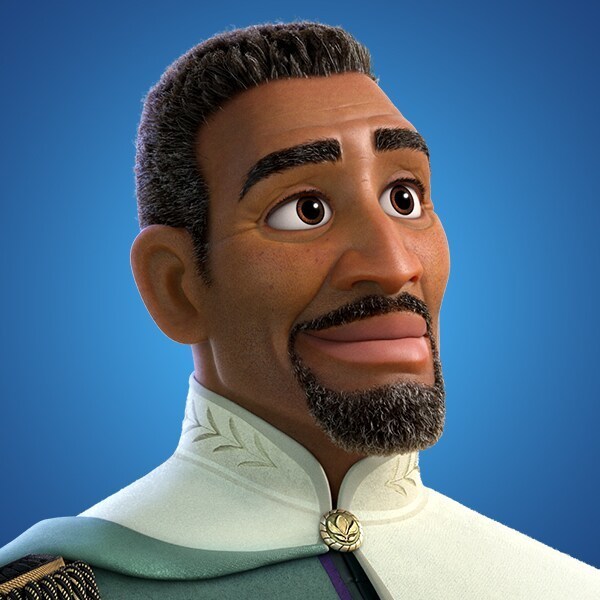
Frozen Character Profile · Arendellian Guard · Forest Survivor · General under Queen Anna
Lieutenant Mattias
Duty, propaganda, grief, representation, military ethics, and the officer who chose Arendelle’s future over its oldest lie.
Profile
| Full name | Destin Mattias |
|---|---|
| Ranks | Lieutenant; later General |
| Kingdom | Arendelle |
| Royal charges | King Runeard, Prince Agnarr, later Queen Anna |
| English voice | Sterling K. Brown |
| First appearance | Frozen II (2019) |
| Defining displacement | More than thirty-four years in the Enchanted Forest |
| Current status | Returned to Arendelle and promoted to General |
Reading standard
This profile treats military rank, racial representation, colonial history, grief, and loyalty as connected parts of one life rather than isolated trivia. It does not assume that dignity means emotional simplicity, that service makes an institution innocent, or that changing one decision erases decades of belief. Every interpretation returns to a scene, an official production statement, or a clearly labeled question the franchise has not yet answered.
The psychological cost of a war that never officially ends
Mattias does not spend thirty-four years after a war. He spends them inside a conflict with no treaty, demobilization, mail, promotion system, funeral record, or verified chain of command beyond the soldiers who remain. The enemy lives nearby, the barrier never opens, and the reason for confinement stays unresolved. A nervous system cannot neatly distinguish temporary readiness from a lifetime when no institution declares the emergency over.
The film gives him composure, but composure is not evidence that the lost decades had no psychological cost. Hypervigilance, grief, suspended identity, survivor guilt, loyalty to dead leaders, and difficulty imagining a changed home would all be reasonable areas for future storytelling. A profile can identify those pressures without assigning a diagnosis the character never receives.
Command without replenishment
Leading trapped soldiers means managing more than combat readiness. Food, clothing, injuries, equipment wear, shelter, disputes, morale, aging bodies, and dwindling certainty all require decisions without resupply. The enchanted forest provides an unusual environment, but the film does not establish that it magically replaces every material need.
Mattias’s authority survives because the soldiers continue to recognize it. Rank on paper cannot enforce itself for three decades without an institution behind it. His leadership therefore depends on trust, routine, competence, and a shared belief that Arendelle still matters. That record strengthens the later promotion while making the absence of individual soldiers’ stories more noticeable.
The ethics of believing Anna
Anna arrives with royal status, personal grief, incomplete evidence delivered through Elsa’s magic, and a plan that appears capable of destroying Arendelle. Mattias must decide quickly whether her account is credible enough to reverse a lifetime of military belief. The choice is not blind obedience because Anna’s order runs against the monument associated with his old king.
He has several pieces of corroboration: Iduna’s Northuldra identity, the spirits’ response, Elsa’s demonstrated magic, the continued curse, the dam’s position, and Anna’s willingness to accept loss rather than gain power. None functions like a modern courtroom record. Together they make the inherited explanation less plausible than the new one. Moral action often begins before perfect certainty arrives.
Reconciliation is larger than opening the mist
Destroying the dam corrects a material harm and releases the forest, but it does not automatically reconcile soldiers and Northuldra who spent decades regarding one another as enemies. They need testimony, burial practices, shared history, decisions about land and water, and acknowledgment from Arendelle beyond the private understanding of its new queen.
Mattias can become a bridge because he is trusted by soldiers and has lived beside Northuldra long enough to know that propaganda does not describe them. He can also become an obstacle if royal promotion is treated as proof that the work is finished. The character’s future value depends on whether he helps move power, not merely sentiment.
Veteran return and the kingdom that aged without him
Mattias comes home to people who may have memorialized him, descendants who know his name only from old stories, and institutions that have classified his unit as missing or dead. Property, pay, rank, family obligations, and citizenship records would all require reconstruction. Halima’s survival offers personal continuity, but the kingdom around her is not the one he left.
Return can be joyful and destabilizing at the same time. He has lived under forest conditions for more than half an ordinary adult lifetime while Arendelle experienced rulers, funerals, a coronation, magical winter, reopened gates, and another queen. General rank does not substitute for time to learn what home now means.

Why Mattias needs scenes outside the uniform
The bakery memory and Halima reunion hint at appetite, humor, romance, and ordinary community. Those fragments are essential because dignified Black supporting characters are often permitted responsibility more readily than mess, pleasure, desire, or interior contradiction. Mattias deserves more than being the safest adult in the room.
A complete future portrayal could show friendship with Northuldra peers, arguments with Anna, grief over Agnarr, discomfort with promotion, love that has aged differently on each side of the mist, and the absurdity of learning three decades of social change. Representation becomes fuller when the character can be wrong, funny, tired, selfish for a moment, and loved beyond usefulness.
Bottom line first
Mattias is what happens when loyalty survives longer than the story that justified it. He enters the Enchanted Forest as Agnarr’s guard, spends more than thirty-four years trapped with an enemy his kingdom taught him to distrust, and leaves only after the next queen accepts that Arendelle caused the conflict.
His arc is not a sudden conversion from bad soldier to good ally. He is already humane, disciplined, funny, homesick, and capable of listening. The change is epistemic: the facts underneath his duty shift, and he has to decide whether loyalty means defending an old story or serving the kingdom honestly.
Profile and identity
Destin Mattias serves Arendelle as a lieutenant and personal guard to young Prince Agnarr during King Runeard’s visit to the Enchanted Forest. He becomes trapped behind the magical mist with fellow soldiers and the Northuldra for more than thirty-four years.
Sterling K. Brown voices Mattias in Frozen II. By the end, he returns to Arendelle and is identified in later official reference material as General Mattias under Queen Anna. His exact birth date and complete pre-forest biography are not supplied by the feature.
Dashboard: confirmed facts and limits
Confirmed: Mattias serves Runeard’s Arendelle, protects Agnarr, survives the battle, remains trapped for decades, believes the Northuldra began the conflict, meets Elsa and Anna, accepts Iduna’s identity, follows Anna’s dam plan, returns home, and advances to general.
Not confirmed: his exact age, birthplace, military academy, family tree, complete service record, every event during the trapped years, or prior knowledge of Runeard’s murder plan. A romantic connection to Halima is implied through his longing and reunion, while expanded material gives more detail.
Before the forest
Mattias enters the story already trusted with the safety of Arendelle’s young heir. The assignment implies competence, discipline, and proximity to royal power.
The film offers almost no private life before deployment. That absence makes his memories of Arendelle especially valuable. Bakeries, photographs, streets, and one particular person become fragments of a home frozen in his mind.
Guarding young Agnarr
During the visit, Mattias watches Agnarr and responds quickly when danger begins. His duty is personal as well as military because the prince is a child inside an unstable diplomatic event.
He succeeds in protecting Agnarr only partially. The boy survives through Iduna’s rescue and Gale’s intervention, while Mattias becomes separated behind the mist. Protection is distributed across supposed enemy lines before either side knows it.

Serving under Runeard
Mattias wears Runeard’s uniform and follows the expedition without knowing that the king designed the dam as a weapon and intends violence.
The distinction between serving a criminal ruler and sharing his private intent is essential. The film gives no evidence that Mattias knows about the planned weakening of the forest or the murder of the Northuldra leader.
The dam ceremony
Arendelle frames the dam as cooperation. Mattias participates in the official event as a soldier assigned to security and royal protection.
Because the gift narrative is false, his presence becomes part of colonial theater even without conscious complicity. Institutions can use decent people to make harmful policy look safe and legitimate.
The battle
Violence erupts after Runeard attacks the Northuldra leader. Mattias experiences the conflict from the public chaos rather than the private initiating act.
He sees attacks, loses command structure, and becomes trapped. The incomplete viewpoint hardens into a durable belief that the Northuldra caused the disaster.
The mist closes
The spirits seal the forest, trapping Arendellian soldiers and Northuldra together while stopping ordinary passage and visible aging of the landscape around them.
More than thirty-four years of containment turns a military incident into an entire life phase. Mattias loses career, home, family time, political change, and any ability to verify what Arendelle believes happened.
Thirty-four years without home
The number is easy to hear and hard to imagine. Mattias misses Agnarr’s reign, marriage, fatherhood, death, Elsa’s coronation, the eternal winter, and every ordinary social change outside the mist.
Homesickness survives through memory rather than updates. He cannot know which people remain alive or whether the kingdom still recognizes soldiers officially lost decades earlier.
Life beside the Northuldra
Mattias and the Northuldra coexist in sustained tension. They are close enough to know one another’s patterns and far enough to preserve competing stories.
The film does not depict nonstop battle across decades. Survival requires boundaries, resource negotiation, restraint, and some functional knowledge of the other group even while formal trust remains absent.

Why nobody resolves the history
Neither side witnessed Runeard’s private murder in a way that supplies shared proof. The mist prevents outside archives, testimony, and political change from entering.
Conflict can persist without daily hatred when every available fact supports a different inherited conclusion. The forest becomes an information prison as much as a physical one.
Meeting Elsa
Mattias initially understands Elsa as Agnarr’s daughter and Arendelle’s queen, then confronts the fact that she possesses immense magic.
Official Disney description emphasizes that her power challenges his long-held beliefs. His response matters because he does not treat loyalty to Arendelle as permission to attack its magical ruler. He watches, questions, and adapts.
Meeting Anna
Anna identifies herself as Agnarr’s daughter and later becomes the royal figure Mattias follows into the dam plan. Her lack of magic makes their connection politically different from his response to Elsa.
He recognizes resolve beneath her grief and uncertainty. The later promotion under Queen Anna suggests the relationship grows from crisis cooperation into institutional trust.
Olaf’s recap
Olaf delivers an accelerated version of the first film, informing Mattias that Agnarr and Iduna died, Elsa ruled, Anna nearly married Hans, and the kingdom survived an eternal winter.
The comedy hides emotional violence. Mattias receives decades of royal history in minutes, including the death of the child he protected. Sterling K. Brown’s reactions let grief and disbelief register under the recap’s speed.
Learning Iduna was Northuldra
Elsa and Anna reveal that their mother was the Northuldra girl who saved Agnarr. The information collapses the clean enemy boundary Mattias has maintained.
Arendelle’s royal family is already joined to the people he was taught to oppose. The revelation does not prove who began the battle, but it makes dehumanizing certainty harder to sustain.
The temporary truce
Mattias and Yelena accept a pause while the sisters investigate. The truce is not reconciliation. It is a decision to create enough safety for new evidence to emerge.
That distinction matters. Trust built under uncertainty often begins with procedural restraint rather than emotional unity. Nobody must pretend the past is healed before listening.

Agnarr’s death lands twice
Mattias lost Agnarr physically when the mist separated them, then learns decades later that the king survived, ruled, became a father, and died at sea.
Grief includes the life he did not witness. Agnarr is simultaneously the child he remembers and an entire adult monarch whose years are inaccessible to him.
Memory of Arendelle
Mattias holds on to Blodget’s bakery, portraits, familiar places, and Halima. These details keep home specific rather than abstract.
National loyalty becomes personal through ordinary pleasures and people. The strongest reason he wants to return is not the flag. It is the life beneath it.
Halima
The film’s ending shows Mattias joyfully reunited with Halima. His earlier longing suggests a relationship that survived in memory through the trapped years.
The feature does not provide a complete label, courtship history, or account of her life while he was missing. A profile can honor the emotional importance without inventing a marriage certificate.
Anna reveals the truth
After Elsa sends evidence from Ahtohallan, Anna tells the forest that Runeard built the dam to weaken the Northuldra and murdered their leader.
Mattias has to evaluate a claim that condemns the king he served and requires destruction of an Arendellian monument. He cannot verify every memory personally, but he can assess Anna’s credibility, the spirits’ behavior, and the dam’s effects.
The dam decision
Anna concludes that the dam must fall even if the resulting flood destroys Arendelle. Mattias initially understands the structure as part of his kingdom’s legacy.
Following her requires a mature definition of duty. Protecting Arendelle cannot mean preserving a wrong that continues to harm others, especially when Arendelle’s queen accepts the cost of correction.
Turning the giants
Anna provokes the earth giants and guides their thrown boulders toward the dam. Mattias and his soldiers assist despite lethal risk and the apparent destruction of home.
The action is military skill redirected toward accountability. They do not defeat the Northuldra. They help destroy the weapon that made coexistence impossible.

Watching the dam fall
The collapse releases the river and breaks the forest’s curse. Mattias sees physical proof that the old structure was tied to the spirits’ anger.
Repair is not symbolic alone. Stone, water, land, and power change. The story insists that an apology without removing the harmful structure would be insufficient.
The flood toward Arendelle
Mattias believes the water may destroy the kingdom he waited decades to see again. He acts anyway because Anna has made the moral and royal decision.
Elsa ultimately diverts the flood, but Mattias cannot count on rescue when he commits. His choice has weight because he accepts that justice may cost the home he loves.
Return to Arendelle
The mist opens and Mattias returns to a kingdom transformed by time. The reunion with Halima provides emotional release, but reintegration must be larger than one embrace.
He faces new technology, institutions, generations, and rulers. Soldiers returning after decades would need care, records, housing, identity restoration, and space to grieve people who aged without them.
Promotion to general
Later official character records identify Destin Mattias as a general under Queen Anna. The promotion recognizes experience, loyalty, and his decision during the dam crisis.
Rank also gives him responsibility for changing what military loyalty means in Arendelle. A general who knows how propaganda trapped a generation should build systems that permit ethical refusal and historical scrutiny.
Relationship file: Agnarr
Agnarr is Mattias’s protected prince and the emotional anchor of his early duty. Mattias remembers the boy while missing the man.
The relationship humanizes service but can also narrow judgment. Personal love for an heir does not make the dynasty’s inherited history correct. Mattias grows when he can keep affection and accept truth.
Relationship file: Anna
Anna becomes the ruler whose ethical courage redirects Mattias’s military loyalty. She asks him to help destroy an Arendellian structure, not simply fight an external enemy.
Their alliance suggests a healthier command relationship because she explains the truth and accepts responsibility for consequences. He follows evidence and conscience, not only title.
Relationship file: Elsa
Elsa challenges Mattias’s assumptions about magic while embodying Arendelle’s royal continuity. Her power initially complicates categories he used to interpret the forest.
She also saves the kingdom from the flood, demonstrating that magic and protection are not opposites. Mattias must revise belief through witnessed action rather than abstract tolerance.
Relationship file: Yelena
Mattias and Yelena represent opposing communities trapped by one lie. Both carry responsibility for protecting people under prolonged uncertainty.
Their truce models leadership that does not require instant friendship. Each can remain loyal to community while creating room for evidence that changes the conflict.
Relationship file: his soldiers
Mattias leads men whose lives have also been consumed by the mist. His decisions carry their survival, identity, and hope of returning home.
The film gives them little individual development, so his leadership becomes the main lens. He cannot make the dam decision as private self-discovery alone. Others follow him into the possible loss of Arendelle.
Military loyalty
Mattias begins with a conventional oath to protect homeland and crown. The forest tests whether the oath belongs to a ruler, a structure, a people, or a moral purpose.
His best decision interprets loyalty as service to Arendelle’s future rather than preservation of Runeard’s reputation. That distinction turns obedience into judgment.
Propaganda and incomplete knowledge
Mattias is not foolish for believing the story available to him. He witnessed violence and lacked access to the hidden initiating crime.
He becomes morally responsible when credible new evidence arrives. The character demonstrates that being deceived is not the same as choosing deception after the truth becomes costly.
Colonial history and the uniform
His uniform represents Arendellian order inside a forest harmed by Arendellian policy. A Black soldier wearing that uniform complicates any simple visual equation between race and political innocence.
Representation matters, but casting a character of color does not automatically solve the colonial framework. The writing must give him agency to confront the institution he serves, and the dam decision begins that work.

Black presence in Arendelle
Sterling K. Brown has spoken positively about a character of color existing in Arendelle. Mattias expands who visibly belongs in the kingdom beyond the first film’s central cast.
The film does not explain racial history through exposition, and it should not require Mattias to justify existence. Critical analysis can celebrate presence while asking whether the franchise gives Black characters interior lives beyond dignified service.
Sterling K. Brown’s performance
Brown gives Mattias authority, warmth, comic reaction, grief, and an ability to make listening active. Director Chris Buck noted that the actor invested much of himself in the character.
The dignity of the performance prevents a supporting soldier from becoming exposition furniture. Small reactions during Olaf’s recap and the Halima reunion create a life larger than available dialogue.
Into the Unknown documentary record
Brown appears in the production documentary Into the Unknown: Making Frozen II, placing voice work inside the film’s late-stage creative process.
Behind-the-scenes evidence belongs beside character analysis because performance choices emerge through direction, revisions, and a production still solving story structure close to release.
Design and aging
Mattias’s design must communicate military identity, decades of survival, authority, and physical age without making the enchanted forest appear to have frozen his body completely.
Uniform wear, face lines, posture, hair, and color distinguish him from young Agnarr’s era while maintaining recognizable Arendellian insignia. Design carries the missing years his dialogue cannot narrate.
Once Upon a Studio cameo
Mattias appears among Walt Disney Animation characters in the centennial short Once Upon a Studio.
The appearance is a studio celebration cameo, not evidence that every animated world shares one literal chronology. It belongs in the Easter-egg file with the boundary clearly stated.
Books, games, and continuation branches
Mattias appears or is referenced in licensed books and franchise material that explore post-film Arendelle and the new political order.
Each branch can add rank, relationships, or duties. A reference profile attributes those additions instead of silently blending them into the feature.
What the film leaves unexplored
The movie resolves the mist but barely addresses aging, trauma, bereavement, veteran reintegration, or the Northuldra-Arendellian relationships formed under confinement.
Mattias is positioned to carry those stories. His life spans old propaganda and new accountability, making him more than the kind guard who recognizes Anna’s authority.
Reception and criticism
Mattias is often praised for dignity, humor, representation, and readiness to follow the truth. His limited screen time is also a common frustration because the premise implies decades of interior history.
The character succeeds as a moral hinge and remains underwritten as a person. Both conclusions can be true. A strong profile uses available evidence without pretending the film supplied a complete life.
The encyclopedia floor
A complete profile must cover name and ranks, performer, service to Runeard and Agnarr, the battle, thirty-four trapped years, relationships with Northuldra, meeting the sisters, dam decision, return, promotion, cameo, and expanded media.
CVM Sekai adds propaganda, military ethics, colonial structures, Black representation, veteran reintegration, grief, institutional reform, and the distinction between being deceived and refusing truth.
Future file
Under Queen Anna, General Mattias can help reform the military, document Runeard’s crime, support returning soldiers, and build relations with Northuldra leaders.
Future stories should also give him private life. Halima, aging, grief, homecoming, friendship, and a world that moved on deserve narrative space beyond another assignment to protect the crown.
Sources and certainty
Primary sources include Frozen II, official Disney and D23 character material, published credits, production interviews, and Into the Unknown: Making Frozen II.
Encyclopedic and specialist sources catch omissions. Official continuation labels, interpretation, representation critique, and unknown biography remain distinct so the page can be deep without manufacturing canon.
Frozen coverage
Return to the Frozen hub for every character, review, React, rant, and guide.