
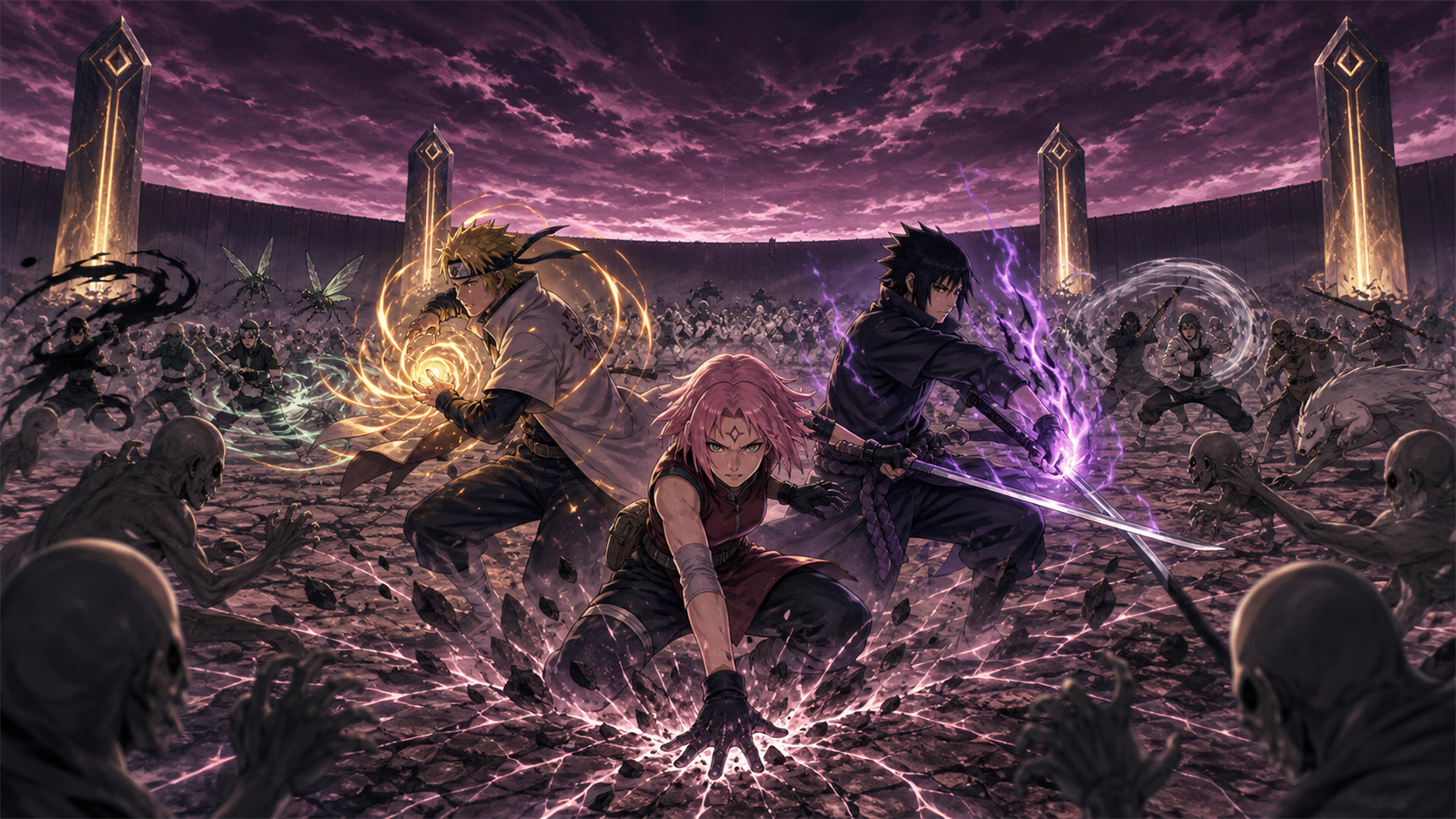
Team 7, Assemble!
Naruto, Sakura and Sasuke finally share a battlefield again, but Sakura’s breakthrough and the wider generation refuse to let reunion become a two-rival spectacle.
Bottom line
“Team 7, Assemble!” finally puts Naruto, Sakura, and Sasuke on the same battlefield and makes Sakura fight for her place in the frame. The Ten-Tails creates waves of smaller bodies while the Hokage maintain the containment barrier. Naruto and Sasuke charge forward with spectacular inherited power. Sakura remembers being the teammate protected from behind, releases the chakra seal built through years of precise training, and shatters the ground beneath the enemy. Her breakthrough matters because she earned strength through medical discipline while serving a war full of injured people. The episode also lets the other Konoha teams contribute their own formations instead of becoming applause for Team 7. Reunion creates tactical capacity and emotional electricity. Reunion does not erase Sasuke’s violence, Sakura’s fear, Naruto’s obsession, Kakashi’s absence, or the work required before this group can call itself repaired.
The Hokage open a route into the barrier
Containment limits the Ten-Tails, but the alliance still needs a way to attack. Hashirama creates controlled openings so units can enter without collapsing the whole structure.
Good defense should create safe opportunities for coordinated action.
The Ten-Tails produces smaller bodies
The creature answers confinement by generating numerous divisions across the interior. The threat changes from one enormous target to a crowded field of differently sized enemies.
The alliance must shift from siege tactics to close combat quickly.
Numbers disrupt the clean heroic charge
Naruto and Sasuke can aim for the main body, but the divisions block routes and threaten every unit entering behind them. Raw focus on the largest target would leave allies exposed.
Battlefield success depends on clearing space together.
Team 7 stands without Kakashi
Naruto, Sakura, and Sasuke recreate the familiar three-student formation. Their teacher remains in the Kamui dimension confronting Obito.
The reunion is visually real and structurally incomplete.
That absence keeps the image from becoming a simple restoration of childhood. Kakashi is doing separate moral work with Obito while his students assemble through choices made beyond his supervision. Team 7 returns as adults carrying different wars, not children reset to the bell test. The familiar triangle therefore marks continuity without pretending the missing teacher or damaged trust can be edited out.
Kakashi’s lessons remain in the formation
Teamwork, protection of comrades, and distrust of rule-bound abandonment shaped their earliest missions. The students carry those lessons even while the teacher is absent.
Legacy can operate through conduct rather than physical presence.
Sasuke’s return shocks the alliance
He arrives with almost no public explanation after being classified as an international threat. Konoha shinobi remember the retrieval mission, Akatsuki affiliation, and Five Kage Summit attack.
One statement about protecting the village cannot instantly reorganize that evidence.
Naruto accepts the opportunity quickly
His long commitment to Sasuke makes cooperation feel possible before other people catch up. Naruto sees the person he has kept trying to reach.
Hope is valuable, but teammates harmed by Sasuke retain the right to move more carefully.
Sakura watches both boys move ahead
The old team pattern threatens to return immediately: Naruto and Sasuke take the visible front while Sakura is expected to stay behind. Her frustration carries years of training and earlier helplessness.
She refuses to let reunion restore an outdated role.
The Chunin Exams promise returns
Sakura remembers cutting her hair and deciding that she would stop watching teammates from their backs. That earlier courage was emotional and physical, but her combat options remained limited.
The promise becomes more credible now because years of disciplined work support Sakura’s resolve.
Tsunade’s training required restraint
Sakura stored chakra with extraordinary precision while continuing missions and medical duties. The seal represents delayed use, control, and patience rather than a sudden gift.
Power accumulated through routine can look invisible until release.
Medical expertise is part of her strength
Sakura learned anatomy, diagnosis, antidote work, healing, battlefield triage, and the consequences of damaged bodies. Her devastating punch comes from the same control that lets her preserve life.
Care and force share technical discipline without becoming the same moral act.
The seal becomes visible
The mark on Sakura’s forehead signals that she has reached a level associated with Tsunade. The moment links teacher and student while preserving Sakura’s separate history.
Inheritance should expand a student rather than turn her into a copy.
Sakura changes the terrain
Her strike destroys a huge area and removes multiple Ten-Tails divisions at once. The impact gives Naruto and Sasuke a reason to reassess the teammate they assumed needed protection.
The battlefield recognizes evidence faster than old habits do.
Shock from the boys is satisfying and revealing
Naruto’s nervous reaction provides comedy grounded in long familiarity with Sakura’s temper and strength. Sasuke’s attention confirms that her ability exceeds his outdated picture.
Their surprise also proves how little they know about her recent work.
Sakura does not need identical powers
Naruto carries Kurama and Sage training. Sasuke carries Sharingan development and Orochimaru-linked experience. Sakura’s path runs through chakra control, medicine, endurance, and stored strength.
Equality means meaningful agency and capacity, not matching techniques one for one.
The story still owes her sustained space
One enormous strike cannot compensate for every arc that centered her feelings about Sasuke while limiting her decisions. The episode creates an opening.
Future action must keep treating Sakura as a participant rather than a reaction shot.
Healing labor should remain visible
Sakura’s war contribution began long before this attack. Medical units kept fighters alive, identified enemy infiltration, managed poison, and returned people to duty.
Combat spectacle should not become the only evidence that she matters.
Naruto and Sasuke acknowledge a third front-line member
The old assumption that both must shield Sakura no longer fits the person beside them. Protection can still move among teammates as conditions change.
Mutual support works better than fixed protector and protected roles.
Team 7 gains complementary coverage
Naruto provides distributed chakra and high-output techniques. Sasuke provides precision, ocular perception, and dangerous firepower. Sakura provides terrain control, medical judgment, and concentrated strength.
The team becomes useful through differences.
The Konoha teams refuse spectator status
The wider group enters with clan techniques and formations developed through their own teachers and families. Team 7’s reunion may carry the brightest emotional spotlight.
The war still belongs to more than three people.
Hinata fights after Neji’s death
She remains present inside fresh grief and continues contributing through the Gentle Fist. Her ability to act should not be read as completed mourning.
Function during crisis can coexist with pain that has barely begun.
Team Guy carries an absence
Neji’s death changes the formation and the emotional weight of every familiar technique. Lee and Tenten fight without the teammate who should have stood beside them.
The group’s contribution includes a visible missing place.
Shikamaru and Ino keep working
Both lost their fathers when headquarters fell. Their clan skills remain necessary before either receives private time to grieve.
Competence is survival behavior, not proof that the loss has settled.
Choji brings force shaped by trust
His expansion techniques support group control and clearing. Years ago, insecurity and ridicule limited his confidence.
Team history turns personal growth into practical battlefield value.
Clan techniques show institutional inheritance
Shadow possession, mind transfer, expansion, insects, fang techniques, and Gentle Fist carry family knowledge across generations. That inheritance provides community and can also impose roles.
The strongest teams adapt tradition rather than merely repeat inherited technique.
Coordinated teams distribute risk
No fighter needs to solve every enemy body alone. Capture, detection, disruption, force, and support can move through assigned specialties.
Distributed roles reduce dependence on one exhausted hero.
Sai occupies an uncertain place
He became part of Team 7 during Sasuke’s absence and built relationships through awkward, genuine effort. The original trio’s reunion risks treating him as temporary furniture.
Replacement language would disrespect the teammate who actually stayed and worked.
Teams can change without invalidating old bonds
Sasuke’s return matters. Sai’s contribution also matters. A living team may hold several histories instead of forcing one member to disappear so an earlier picture looks complete.
Belonging is not a single occupied slot.
Sasuke’s conduct remains under observation
He fights the common enemy, which provides the first public evidence of his new direction. Allies still need to see whether he shares information, protects others, and accepts coordination.
Trust should respond to repeated action.
His Hokage claim hangs over the reunion
Sasuke has declared an ambition to lead the same people who know him as a criminal. The battlefield is not an election and combat power is not consent.
Service now may begin a case, not settle one.
Naruto’s Hokage dream has a different history
He first wanted the title to force recognition, then learned that protection and acknowledgment must come before office. Years of relationships changed the meaning of the goal.
Sasuke is beginning that political lesson much later.
Sakura has standing in the argument
The two boys discuss leadership while Sakura and countless others have carried the village through their absence. People who did the daily work deserve a voice in what Konoha becomes.
Leadership cannot remain a private rivalry between powerful men.
Team 7 nostalgia has sharp edges
Fans can feel the satisfaction of the three standing together without pretending their childhood bond was always healthy. Sasuke left, Naruto pursued him beyond reasonable personal cost, and Sakura’s needs were often sidelined.
Affection and criticism belong in the same reading.
Reassembly is an action, not a restoration
The team forms around the immediate mission of fighting the Ten-Tails. They are older people with new teachers, loyalties, wounds, and ambitions.
The next version must be negotiated rather than recovered unchanged.
The battlefield rewards clear contribution
Sakura’s strike opens space. Konoha formations hold divisions back. Naruto and Sasuke advance toward the central threat.
The episode works when capability answers the question of belonging.
Power does not settle relationships
Sakura becoming stronger does not make Sasuke’s attempts on her life less serious. Naruto’s strength does not make his pursuit automatically healthy. Sasuke’s strength does not grant leadership.
Combat achievement and interpersonal accountability are separate ledgers.
A new era needs different team rules
The old structure placed Kakashi over three children and sent them into state missions. These fighters now make decisions with consequences for the whole alliance.
Maturity should bring more consent, transparency, and shared authority.
Sakura enters the reunion through earned power
She does not receive equal space because Naruto and Sasuke generously make room. Sakura stored chakra for years, mastered Tsunade’s discipline, led medical work, and chose the precise moment when releasing the seal could change the field.
Her arrival is evidence of preparation nobody could see while it accumulated. Quiet labor becomes undeniable without becoming newly valuable only after spectacle.
The Strength of a Hundred is not decorative symbolism
The seal represents chakra control, patience, medical knowledge, physical endurance, and the ability to delay personal display for a larger objective. Sakura’s punch is the visible result of an entire training architecture.
Reducing the moment to keeping up with two boys erases Tsunade, Shizune, hospital labor, triage decisions, and Sakura’s own professional route into power.
Healing and combat belong to one tactical system
Sakura’s medical role does not make her less of a frontline shinobi. It gives her information about injury, survival windows, anatomy, resource allocation, and what happens after fighters spend their bodies carelessly.
Her attack matters because protection sometimes requires removing the threat. Her healing matters because victory means little if nobody survives to inhabit it.
Tsunade’s mentorship reaches the battlefield
Sakura’s breakthrough carries instruction from a woman who built protocols, changed team composition, and fought for medics to become essential rather than optional support. The student’s power is personal and relational.
Mentorship succeeds here because Tsunade expanded Sakura’s agency instead of asking for imitation. Sakura uses inherited methods through her own judgment and context.
Naruto’s surprise should become recognition
He has not witnessed every hour Sakura spent training, storing chakra, and carrying medical responsibility. Surprise is reasonable. The next step is revising his understanding without turning her achievement into a joke about fear.
Teammates respect growth by updating roles, sharing information, and trusting demonstrated competence under pressure.
Sasuke’s acknowledgment does not certify her worth
His attention may matter emotionally because of their history, but Sakura was powerful before he noticed. She does not need approval from the teammate who left to make her training legitimate.
Recognition is useful when it changes cooperation. It becomes limiting when audiences treat a male rival’s reaction as the final measure of a woman’s accomplishment.
Team 7 returns with unresolved relationships
Battlefield formation restores tactical possibility, not childhood innocence. Sasuke has harmed teammates and remained absent through years of change. Sakura and Naruto developed lives, loyalties, and boundaries while pursuing him.
They can attack a shared enemy now and address trust later. Cooperation does not require emotional debts to disappear for the scene to count.
Kakashi’s absence remains visible
The title announces Team 7 while their teacher is still inside Kamui with Obito. His lessons shape the formation, but his missing body prevents the reunion from becoming complete.
A team includes the person who taught them and the history pulling him away. Their success should increase the urgency of bringing Kakashi back, not make him narratively replaceable.
The Konoha generation refuses background status
Hinata, Shikamaru, Ino, Chōji, Kiba, Shino, Lee, Tenten, and Sai bring skills the battlefield still needs. Team 7’s spectacle should not turn their comrades into an applauding crowd.
The alliance survives through formations, sensory work, communication, defense, sealing, medicine, and individual decisions distributed far beyond three central fighters.
Sai’s place complicates the original-team celebration
Sai served on Team 7 during Sasuke’s absence, learned connection after Root, and took risks beside Naruto and Sakura. Sasuke’s return does not erase that membership.
Teams can gain people without treating later members as temporary furniture. Recognition should include the person who helped hold the structure together while reunion remained uncertain.
Summoning power extends each specialist’s reach
Gamabunta’s line, Aoda, and Katsuyu do more than enlarge the visual scale. Summons carry distinct relationships, abilities, consent, and tactical purposes. They are partners rather than equipment appearing from nowhere.
Katsuyu especially connects Sakura’s power to mass survival. One person’s stored chakra becomes distributed medical capacity across a battlefield.
Sakura turns individual achievement outward
The seal could function as proof that she finally arrived beside Naruto and Sasuke. Its larger value is what she can do for everyone else through healing, communication, and force.
Power becomes editorially meaningful when achievement changes who receives protection. Sakura’s breakthrough belongs to her and immediately expands the alliance’s options.
The boys’ rivalry still creates operational risk
Naruto and Sasuke can motivate each other, but competition can also narrow attention toward proving whose attack is larger. A coordinated team needs objectives, timing, and respect for Sakura’s plan rather than parallel performances.
Kakashi’s original lesson remains relevant: individual excellence fails when teammates become obstacles or audiences.
A reunited team needs explicit command
Who calls targets, protects medics, relays barrier changes, and coordinates with the alliance? Nostalgia does not answer those questions. The three need roles based on current skill and battlefield information.
Shared history can speed trust, but clarity keeps that trust from becoming dangerous assumption. Teamwork is a practiced structure, not a pose.
Assemble means more than stand in one frame
Naruto, Sakura, and Sasuke become a functioning unit when their choices protect a shared objective and one another. Physical proximity is the invitation, not the proof.
The episode earns celebration because their developed skills can interlock. The next test is whether the relationship can hold truth, boundaries, and accountability after the dramatic attack ends.
Sakura’s declaration that she has reached them should be heard as a claim to participation, not a request for ranking. She does not need identical abilities to hold equal value. Naruto’s chakra network, Sasuke’s ocular power, and Sakura’s seal solve different problems. A team becomes stronger when difference determines coordination instead of hierarchy. The reunion succeeds when nobody has to shrink so another member can remain exceptional, and when every contribution is judged by what the shared mission actually requires.
RaeRae’s verdict
“Team 7, Assemble!” earns the reunion by letting Sakura interrupt the visual hierarchy. Naruto and Sasuke arrive with powers tied to legendary teachers, bloodlines, and enormous narrative attention. Sakura arrives with chakra stored through years of work while she learned to keep damaged people alive. Her strike tells both boys that standing behind them is no longer the assignment.
The wider Konoha teams make the episode better because they refuse to become a cheering section. Their clan techniques, grief, teamwork, and training help clear a battlefield no trio could manage alone. Team 7 can be exciting without owning everybody else’s war. The formation is back. The trust is not. That difference gives the next phase somewhere honest to go.
RaeRae’s call
Sakura does not catch up because the boys notice her. Years of control, medicine, mentorship, and stored chakra arrive on schedule. Team 7 can celebrate reunion without erasing Sai, Kakashi, Tsunade, or the wider generation holding the war together. Assembly is not absolution. It is three changed teammates coordinating power now while trust, harm, and political claims remain open for honest work later.
Episode details and viewing routes
- Official episode reference: Naruto Official episode guide
- Licensed episode route: Crunchyroll licensed episode page
What I am carrying forward
The four Hokage maintain a barrier around the Ten-Tails while the creature releases numerous divisions. Konoha’s teams enter the contained battlefield and use coordinated clan techniques to clear a route toward the main body.
Sakura released her stored chakra seal and demonstrated front-line strength beside Naruto and Sasuke. Episode 374 expands the Team 7 parallel with their giant summons and tests how Naruto, Sakura, and Sasuke combine distinct inherited disciplines against the Ten-Tails.