
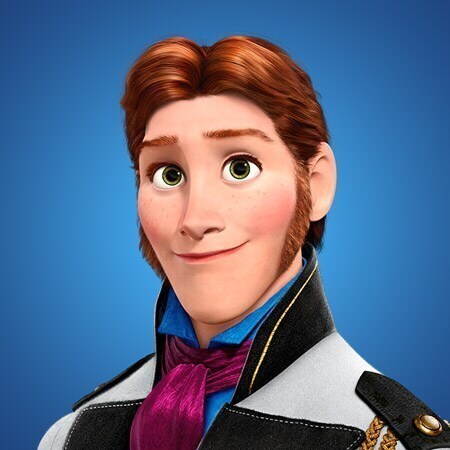
Frozen Character Profile · Southern Isles Prince · False Hero · Open Door with an Agenda
Hans
Charm, mirroring, political ambition, coercive intimacy, public competence, and the prince who understood every story rule except sisterly love.
Profile
| Name | Hans |
|---|---|
| Title | Prince of the Southern Isles |
| Family position | Youngest of thirteen sons |
| English voice | Santino Fontana |
| First appearance | Frozen (2013) |
| Primary role | False romantic lead and political antagonist |
| Known crimes | Fraud, coercive manipulation, attempted murder, abuse of emergency authority |
| Last confirmed location | Returned to the Southern Isles |
Dashboard: what is confirmed and what is not
Confirmed by the released film: Hans is a Southern Isles prince, the youngest of thirteen sons, socially skilled, politically ambitious, willing to deceive Anna, willing to leave her to die, willing to fabricate a marriage and deathbed account, and willing to kill Elsa. He is defeated, detained, and returned home for punishment. Those actions do not depend on a diagnostic label.
Not confirmed by the feature record: a surname spoken onscreen, an exact age, the identities and personalities of all twelve brothers, a specific mental-health diagnosis, magical control by the trolls, sincere love that suddenly disappears, a completed redemption, or the precise Southern Isles sentence. Those ideas can be discussed as adaptations or theories only when named as such.
Bottom line first
Hans is frightening because the performance he gives Anna is not an obvious villain costume. He listens, mirrors, laughs at the right rhythm, accepts her disclosures, produces matching vulnerability, and turns a princess starved for connection into the easiest route toward a crown.
The reveal does not mean every earlier kindness was secretly performed with a sneer. It means kindness can be used as a tool, competent public service can coexist with private predation, and a person can behave heroically when heroism improves the story others will tell about him.
Profile and identity
Prince Hans comes from the Southern Isles and identifies himself as the youngest of thirteen sons. He arrives in Arendelle for Elsa’s coronation, meets Anna, proposes within hours, receives temporary authority during the crisis, and attempts to convert royal instability into succession.
Santino Fontana voices Hans in Frozen and the brief continuation in Frozen Fever. The feature gives no verified surname in spoken canon, no exact age, and no complete family roster. Licensed material sometimes adds detail, but a reference profile keeps those branches labeled.
The thirteenth-son problem
Hans explains that twelve older brothers stand between him and a throne at home. The family position supplies motive without excusing conduct. Inheritance culture has taught him that birth order can make a person politically invisible, and he responds by searching for another monarchy’s vulnerability.
His anecdote about brothers ignoring him, including for years, is delivered during “Love Is an Open Door.” It may contain truth, manipulation, or both. Effective deception often uses real injury because real injury is easier to perform and harder for a listener to challenge.
Arrival and the collision with Anna
Hans meets Anna when her horse and his horse create a physical accident near the harbor. He helps her recover, accepts awkwardness without ridicule, and lets the encounter feel spontaneous.
Nothing proves he planned that collision. What matters is how quickly he recognizes opportunity. Anna is royal, isolated, emotionally open, and visibly delighted by attention. He does not need supernatural insight. He needs social skill and a willingness to treat trust as leverage.

Love Is an Open Door
The duet matches movement, language, rhythm, grievances, and imagined future. Hans allows Anna to complete thoughts and then presents coincidence as proof of destiny.
On first viewing, the song imitates mutual discovery. After the reveal, it can be read as active mirroring. His claim that he has been searching for his own place fits Anna’s loneliness while preserving a second meaning: Arendelle may literally become the place where he gains power.
The proposal
Hans proposes after one evening, and Anna accepts. The speed is the mechanism, not a side effect. Time would allow her to compare performance with behavior across disagreement, boredom, responsibility, and frustration.
He asks for marriage before Elsa can evaluate him and before Anna has any independent knowledge of his home, relationships, finances, obligations, or history. The romance offers certainty precisely where verification is absent.
Elsa’s refusal
Elsa refuses to bless the marriage and points to the fact that Anna has just met Hans. Her reaction is emotionally clumsy and substantively correct.
Hans does not challenge Elsa aggressively before the room. He lets the sisters’ conflict escalate, preserving the appearance of calm while learning exactly where the royal family is fractured. Anna becomes more committed because refusal feels like another closed door.
After the magic is exposed
When Elsa’s power erupts and she flees, Hans follows concern into public action. He organizes search and relief rather than immediately announcing a claim.
This competence is one reason the twist works for many viewers. A useless schemer would not earn trust. Hans can manage resources, speak to frightened officials, distribute cloaks, and appear compassionate because governance is both a useful skill and the stage on which he wants to be seen.
The blankets and the public image
Hans provides blankets and support to people affected by the winter. The acts materially help them even if political calculation motivates him.
Moral analysis becomes harder when good consequences emerge from self-serving performance. The film does not require residents to detect private intent through magical intuition. They see a visiting prince doing the work their absent rulers cannot currently do.
Authority during the crisis
Anna leaves Hans in charge when she goes after Elsa. The transfer gives him access to the palace, officials, foreign representatives, and the narrative of emergency leadership.
He does not seize power from nothing. Anna gives him authority because she believes the engagement and because Arendelle lacks visible succession planning. The institutional failure is larger than one predator: a stranger can become acting ruler after a single night.
The Duke and the expedition
The Duke of Weselton presses for violence and suspicion. Hans presents himself as the moderate alternative, leading the expedition while insisting Elsa must be approached carefully.
That contrast builds credibility. He does not need to be the loudest hostile man when another visitor is eager to occupy the role. Hans gains power by looking reasonable beside somebody worse at hiding his agenda.
Saving Elsa from the crossbow
Hans redirects a weapon aimed at Elsa, causing the bolt to strike the chandelier rather than her body. The action saves her in the immediate moment.
The rescue is compatible with strategy. Elsa alive and contained can legitimate a controlled transfer of power; Elsa murdered by a foreign soldier could create chaos and blame. It may also show that Hans improvises rather than following one fixed plan from the harbor.
The dungeon conversation
Hans tells the imprisoned Elsa that Arendelle needs her to end winter. He performs concern and frames himself as the person attempting to protect her from those who want punishment.
The scene helps maintain access and control. If Elsa can reverse the winter, he inherits a stable kingdom. If she cannot, he can present later violence as reluctant necessity. Every outcome must preserve his image as the reasonable man forced by events.
Anna returns dying
Anna returns with a frozen heart believing Hans can save her through a true-love kiss. The belief gives him private access to a dying heir and the final information needed to understand the magical timetable.
He closes the doors and abandons the public performance. The shift is not a new personality arriving. It is the removal of an audience whose opinion still matters to his plan. Anna’s dependence lets him convert confession into cruelty.
The reveal and the extinguished fire
Hans explains that he never loved Anna, describes the original plan to marry her and arrange Elsa’s death, then extinguishes the fire that might slow Anna’s freezing.
The cruelty is strategic and expressive. He no longer needs Anna’s trust, but he chooses to make her understand the betrayal. That choice reveals more than ambition. Humiliation gives him pleasure or at least satisfies a need to control the final meaning of their relationship.
The succession logic
Hans says that as an outsider he needed to marry into the throne. Elsa’s lack of romantic availability made Anna the target, while the sisters’ conflict created a route to remove both.
The plan has legal gaps the film does not explain. Engagement is not marriage, foreign succession may be contested, and Anna’s death before a wedding weakens his claim. Hans compensates by controlling the emergency narrative rather than presenting a tidy constitutional document.

Lying about Anna’s marriage and death
Hans tells the dignitaries that he and Anna exchanged vows before she died and that Elsa caused her death. The room accepts enough of the claim to support a death sentence.
The lie uses crisis, status, grief performance, and the absence of witnesses. It also shows why private isolation matters to abuse. Anna cannot contradict him, Elsa is imprisoned, and everyone else receives the version spoken by the man currently distributing heat and authority.
The death sentence
Hans obtains or announces a sentence against Elsa while presenting execution as protection of the kingdom. The language converts personal ambition into public duty.
Whether every legal step is valid is less important to the immediate mechanism than the speed with which frightened institutions accept it. Emergency governance can make procedure look like an obstacle when procedure is the only barrier between accusation and irreversible violence.
The blizzard and Elsa
Hans finds Elsa in the storm and tells her Anna is dead because of her. The statement weaponizes grief, causing Elsa’s emotional collapse and briefly stilling the weather.
He then raises a sword against a kneeling woman who is not attacking him. Whatever ambiguity viewers assign to earlier rescues ends here. He is willing to perform an execution personally when it secures both narrative and power.
Anna’s final intervention
Anna chooses to save Elsa rather than reach Kristoff. Her freezing body blocks Hans’s sword, the impact knocks him down, and the act of sisterly love becomes the true cure.
Hans loses because the relationship he dismissed as an obstacle becomes the form of love his plan never understood. He can imitate romantic compatibility. He cannot imagine Anna valuing Elsa above her own immediate rescue.
The punch and removal
After thawing, Anna confronts Hans and punches him into the water. The moment gives her a physical conclusion to the relationship without making his defeat depend solely on male rescue.
Arendelle sends him back to the Southern Isles to face consequences from his family. The feature does not show a trial, sentence, imprisonment, rehabilitation, or return to political life. Claims beyond deportation remain speculation.
Frozen Fever punishment
In Frozen Fever, Hans appears in the Southern Isles shoveling horse manure when Elsa accidentally sends a giant snowball into him.
The gag confirms humiliation and labor as punishment without explaining formal justice. It satisfies audience desire for consequence but does not answer what his family knew, whether diplomatic relations changed, or whether Arendelle pursued accountability beyond return.

Frozen II’s memory of him
Hans does not return as an active character in Frozen II. The family uses his image during charades, and magical memory later allows Elsa to destroy a representation of him with visible disgust.
The callbacks confirm that the betrayal remains part of the household’s shared history. They do not establish redemption, secret control, magical coercion, or a new plot. Absence is evidence only of absence.
Relationship file: Anna
Hans identifies Anna’s isolation and reflects it back as intimacy. He validates her enthusiasm, matches her self-description, and offers immediate permanence.
The betrayal is emotionally devastating because the earlier performance addressed real needs. Anna was not foolish for wanting connection. She was vulnerable because her family structure denied ordinary relationship experience and because Hans chose to exploit that deprivation.
Relationship file: Elsa
Hans initially treats Elsa as the obstacle between marriage and succession. During the crisis he alternates protection, persuasion, containment, accusation, and attempted execution according to what preserves his route.
He understands Elsa politically before he understands her emotionally. Her fear, power, and isolation become variables. The failure comes when he assumes the sisters’ bond is merely another weakness he can break.
Relationship file: Kristoff
Hans and Kristoff represent competing romantic models without developing a substantial personal relationship. Hans offers polish and instant synchronization. Kristoff offers friction, evidence, and time.
The comparison should not turn Kristoff into perfection or Hans into proof that charm is always false. The film’s argument is narrower: a convincing first encounter cannot substitute for knowing how somebody behaves across reality.
Relationship file: the Southern Isles family
Hans describes neglect and ridicule from older brothers, but viewers never meet the family in the feature films. Their decision to receive him for punishment is reported rather than dramatized.
The absence leaves motive without a full social history. Abuse can help explain how control becomes attractive while never making attempted murder inevitable. A profile must resist turning unverified family theories into diagnosis.
Charm as a learned skill
Hans adjusts posture, expression, language, and vulnerability to match the person or room in front of him. With Anna he is romantic and awkward. With officials he is decisive. With Elsa he is controlled and compassionate until violence becomes useful.
The skill is not magical mind control. People trust signals that usually indicate cooperation. Hans exploits those ordinary expectations, which makes the warning more useful than a story about recognizing villains by facial shape.

Mirroring and coercive intimacy
“Love Is an Open Door” repeatedly places Hans inside Anna’s phrasing and timing. Mirroring can be a natural sign of connection, but deliberate mirroring can accelerate false familiarity.
Coercive control does not always begin with visible restriction. It can begin with overwhelming agreement, rapid commitment, and the promise that someone finally understands everything without needing time. The film compresses the pattern into fairy-tale speed.
Public competence and private violence
Hans is capable of crisis management. That fact does not contradict villainy. Predatory people can be organized, socially useful, generous in public, and genuinely effective when competence produces admiration or access.
Treating every good act as fake can become too simple. Blankets still warm citizens. A redirected weapon still saves Elsa. The moral problem is that he treats people and good outcomes as instruments rather than recognizing obligations that survive when advantage disappears.
Toxic masculinity and entitlement
Hans responds to being far from inheritance by deciding another family’s throne can be engineered into his possession. Romance, governance, protection, and grief become performances of deserved authority.
The character does not represent all ambition or all masculinity. He represents entitlement that believes intelligence and polish make other people’s autonomy negotiable. Anna is not a partner in his plan. She is the route.
Does the twist cheat?
Critics of the reveal note that Hans sometimes behaves helpfully when no obvious audience appears, and that simpler routes to power seem available. Those objections identify real screenplay pressure.
Defenders point to mirroring, wordplay, opportunism, and the fact that a long con requires maintaining the role across uncertain observation. The fairest conclusion is that the twist is thematically strong, often cleverly replayable, and not mechanically airtight in every beat.
The boat smile debate
After Anna leaves their first encounter, Hans smiles while apparently alone. Some viewers treat the expression as proof of sincere attraction incompatible with the reveal. Others read satisfaction at finding an opportunity.
Facial animation cannot settle a private motive the screenplay withholds. The smile is designed to support a romantic first viewing and an ambiguous replay. Calling one interpretation confirmed canon gives the frame more certainty than it contains.
Foreshadowing in the duet
Hans promises to find his place, sings about finishing each other’s sandwiches, moves with Anna’s fantasy, and allows the open door to mean both emotional access and political entry.
Foreshadowing works best when it is not a coded confession only villains understand. These details become darker because the later information changes their context. They are not a scavenger hunt that absolves the film of establishing motive.
The Donny Osmond visual joke
During “Love Is an Open Door,” Hans poses beneath a waterfall in a gesture supervising animator Hyrum Osmond connected to his uncle Donny Osmond’s signature performance style.
The reference is an Easter egg in animation and family performance history, not a clue that Hans is evil. Separating production joke from plot foreshadowing keeps Easter-egg research accurate.
Santino Fontana and vocal performance
Fontana builds a bright, flexible prince voice capable of comic timing, romantic blend, public command, and sudden coldness. The reveal works partly because the earlier warmth sounds effortless rather than mechanically sinister.
His musical-theater technique allows exact synchronization with Kristen Bell while preserving an individual tone. After the door closes on dying Anna, reduced warmth and controlled pacing expose how much of the earlier vocal relationship was chosen presentation.
Design and shape language
Hans wears formal Southern Isles clothing, gloves, fitted layers, and a polished silhouette that reads as royal without copying Elsa’s household palette. His broad friendliness avoids the exaggerated visual coding of many older Disney villains.
The design supports the twist by remaining readable as a leading man. Retrospective analysis can find sharper forms or controlled posture, but shape language is not a moral test. The character’s danger comes from behavior.
Early story versions
Frozen changed substantially during development, including versions where Elsa occupied a more conventional villain role. Hans was not fixed in exactly the final form from the project’s earliest stages.
Development history explains structural seams without proving the finished character “was secretly good.” Draft roles are not hidden canon. The released film’s actions define released Hans, while story history shows how the production moved villainy away from Elsa and into a false romantic solution.
Stage adaptation
The Broadway musical expands scenes, songs, and character relationships, requiring a live Hans to sustain charm across a different dramatic rhythm. John Riddle originated the role on Broadway.
Stage Hans is an adaptation, not additional footage from the film. Changes in musical material or motivation belong in a labeled branch because theater can make interior performance more explicit than the film’s twist structure permits.
Television, books, games, and alternate media
Hans appears or is referenced across books, comics, games, attractions, and licensed retellings. An alternate version appears in the Once Upon a Time television branch.
Some adaptations expand family information, punishment, or new schemes. Those details may be useful to readers while remaining separate from feature-film canon. A complete profile records the map instead of pouring every branch into one biography.

Villain cameos and franchise afterlife
Later Disney media and attractions reuse Hans as a recognizable villain, sometimes reducing him to the sword, the smirk, or the romantic betrayal.
That afterlife proves how strongly the reveal entered public memory. It can also flatten the character into a punch line and erase the public competence that made the deception possible.
Reception and the twist-villain debate
Hans became a central example in arguments about Disney’s modern twist villains. Some viewers find the reveal shocking and thematically precise. Others see insufficient setup or strategic behavior that becomes inconsistent after the reveal.
Both responses deserve more than a score. The twist succeeds as a reversal of instant-love grammar and as a warning about performed intimacy. Its political mechanics and some private behavior remain open to criticism.
Children and the warning about true love
Research and audience discussion have noted that children recognize Hans as a predatory figure and understand the film’s warning against confusing immediate romantic intensity with established trust.
That reception matters because the movie speaks to an audience learning story rules and relationship rules at the same time. Hans uses the visual language of an approved prince, forcing behavior rather than costume to carry the lesson.
Redemption arguments
Fandom debates whether Hans should return, remain a villain, receive explanation, or pursue redemption. Redemption would require accountability, not a reveal that he was controlled, misunderstood, or secretly loving Anna all along.
A credible arc would confront attempted murder, fraud, coercive manipulation, abuse of emergency power, and harm to two sisters and a kingdom. Sympathy for family neglect can begin analysis. It cannot replace responsibility.
The encyclopedia floor
A complete profile must include creators, performer, family position, first-film chronology, song, reveal, punishment, short-film appearance, sequel references, design, development, stage adaptation, alternate media, reception, and critical debate.
CVM Sekai then adds scene-level strategy, coercive intimacy, institutional failure, public competence, legal ambiguity, masculinity, Easter eggs, replay analysis, and clearly labeled uncertainty. If Wikipedia has a factual category this page lacks, the page is not finished.
Future file
The feature-film record leaves Hans alive in the Southern Isles with unknown legal and family consequences. A return could explore diplomacy, punishment, escape, renewed manipulation, or accountable change. None is currently confirmed merely because fans ask.
The strongest future use would protect Anna and Elsa’s growth. Hans should not become a shortcut that reopens Anna’s wound for easy drama or grants forgiveness because a sequel wants a familiar face. His return must have a reason deeper than recognition.
Sources and certainty
Primary evidence includes Frozen, Frozen Fever, Frozen II references, official Disney character material, Walt Disney Animation production coverage, published credits, and stage documentation.
Encyclopedic and specialist sources provide an omission check. Released canon, draft history, licensed branches, criticism, interpretation, and fandom theory remain labeled separately so depth does not become false certainty.
Frozen coverage
Return to the Frozen hub for every character, review, React, rant, and guide.