
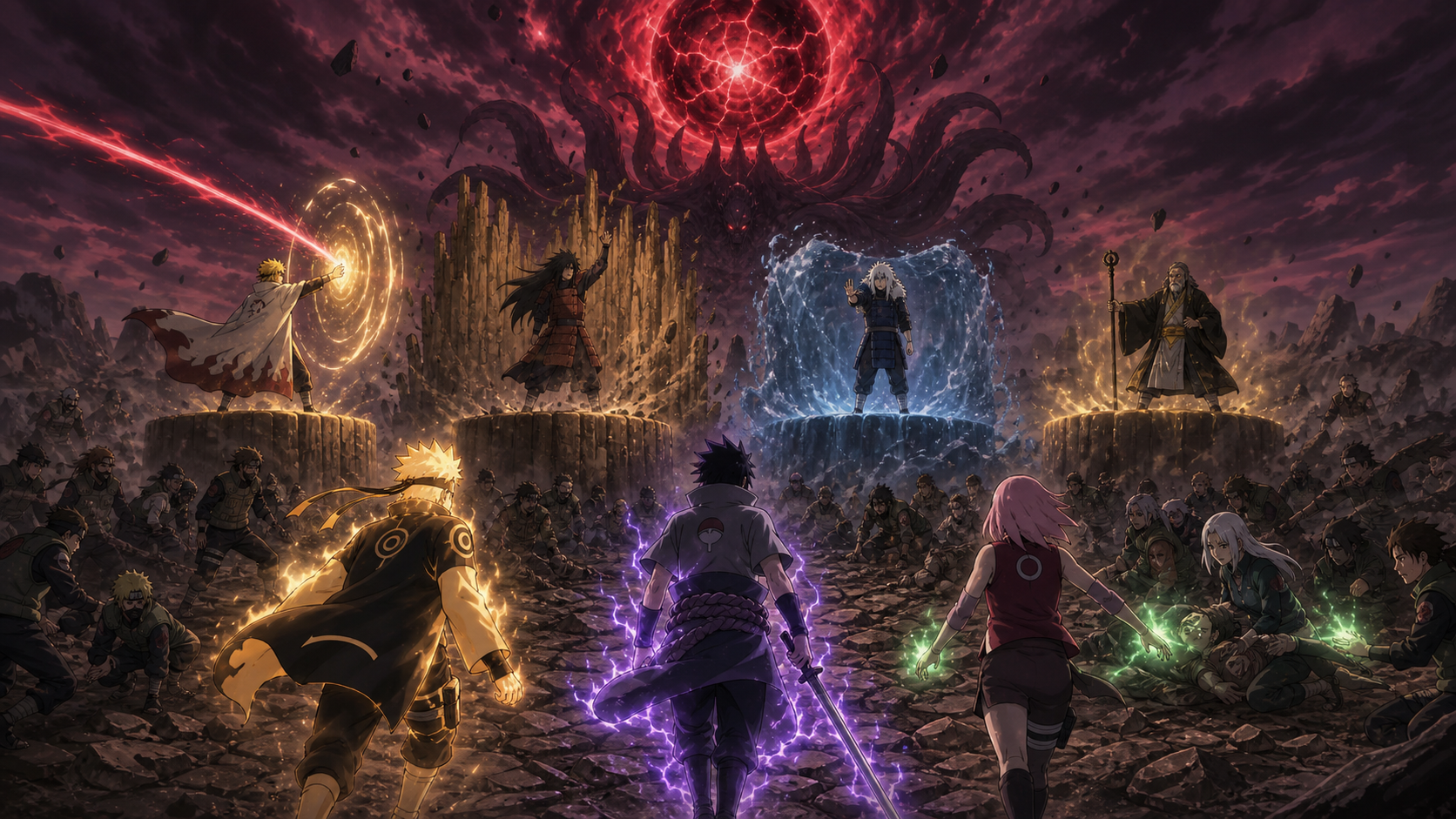
Something to Fill the Hole
The four Hokage and Sasuke arrive when the alliance reaches its limit, but rescue, reunion and a claim to leadership still carry unfinished responsibilities.
Bottom line
“Something to Fill the Hole” answers battlefield exhaustion with reinforcement, not a miracle that makes earlier labor disappear. The Ten-Tails prepares a Tailed Beast Bomb large enough to erase the Allied Shinobi Forces. Minato arrives and redirects the attack, then Hashirama, Tobirama, and Hiruzen join him to contain the creature. The dead Hokage bring overwhelming ability, but they enter a war the living alliance has sustained through enormous loss. Sasuke arrives with Orochimaru’s group and announces that he will become Hokage. Protecting Konoha is a meaningful change from destroying Konoha. Claiming its highest office before facing the people he harmed is another matter. Naruto, Sakura, and Sasuke finally stand together again. The reunion has power because the old team mattered, and tension because shared formation does not erase abandonment, violence, or mistrust.
The Ten-Tails approaches another transformation
Its changing body makes previous estimates unreliable. The alliance has already adapted repeatedly, and every new form changes range, durability, and attack timing.
Exhausted fighters must update strategy faster than the threat evolves.
A massive Tailed Beast Bomb begins forming
The scale exceeds the defenses currently available on the field. Naruto and Kurama have spent enormous chakra protecting thousands.
The weapon turns accumulated exhaustion into a likely mass casualty event.
The alliance cannot simply scatter
Thousands of injured fighters, medical units, command remnants, and support personnel cannot outrun an attack covering the battlefield. Movement also risks breaking the coordination that still exists.
Retreat needs time the Ten-Tails does not offer.
Naruto reaches a real limit
His determination remains intact, but willpower cannot manufacture endless chakra or attention. The network he and Kurama maintained has a physical cost.
Acknowledging the limit respects their work more than pretending the hero never runs out.
The alliance faces the attack together
Shared danger does not guarantee a shared solution. Fighters remain present because abandoning one another would create even greater losses.
Solidarity can look like staying when nobody has a good answer yet.
Minato arrives before the impact
The Fourth Hokage uses the Flying Raijin technique to move the bomb away from the alliance. His entrance changes the field through timing and preparation rather than a speech.
Technical precision saves lives that raw force could not protect.
The marker placed earlier matters
Minato can redirect the attack because his technique depends on established seals and spatial relationships. The rescue feels sudden to the alliance but rests on learned method.
Competence is preparation meeting the correct second.
Redirection avoids a strength contest
He does not try to overpower the Ten-Tails bomb with a larger blast. He changes the weapon’s destination.
Efficient defense asks what must change, not who can create the biggest spectacle.
Moving destruction still carries responsibility
Teleporting the bomb saves the battlefield, but a safe destination matters. Defensive success cannot transfer catastrophe onto an unseen civilian community.
Spatial techniques need ethical target selection as much as accuracy.
Naruto recognizes his father’s chakra
The reunion begins through sensory recognition before conversation. Naruto knows the presence attached to the sealing, the war’s history, and the parent he barely met.
Relief arrives beside years that cannot be returned.
Minato sees the son who carried the burden
Naruto stands at the center of a multinational alliance with Kurama as a partner. The sight justifies pride.
The achievement does not make the loneliness and public hostility of Naruto’s childhood acceptable.
A battlefield is a cruel reunion room
Father and son have almost no space for private truth, anger, or ordinary affection. Their first shared work is preventing mass death.
War compresses family repair into tactical seconds.
The other Hokage arrive
Hashirama, Tobirama, and Hiruzen join Minato, giving the alliance access to leaders whose abilities shaped previous eras. Their combined presence carries history as well as force.
The monument has stepped onto the ground.
Reinforcement does not replace prior resistance
Naruto, Kurama, the alliance, headquarters, medics, and countless units kept the war from ending before the Hokage arrived. The newcomers enter because others bought time.
Late power should honor early labor.
The Hokage assess before acting
Each leader reads the battlefield through personal specialties and experience. Their coordination benefits from prior relationships and established roles.
Rapid assessment prevents legendary status from becoming reckless improvisation.
Four leaders create a containment barrier
The Hokage position themselves around the Ten-Tails and use a powerful barrier to restrict its movement and attacks. Their formation changes the battle from open exposure to managed space.
Containment creates time for the living forces to reorganize.
A barrier is infrastructure under pressure
The technique works through four synchronized points. No single Hokage can casually substitute for the whole structure.
Even extraordinary power becomes stronger through assigned positions and coordination.
Hashirama suppresses the creature
His techniques restrain the Ten-Tails inside the barrier, adding control beyond the perimeter. The action reflects ability on a scale few living shinobi can match.
Power that protects must remain tied to clear purpose and limits.
The tailed-beast history complicates restraint
Hashirama once captured tailed beasts and distributed them among villages as military assets. Restraining the Ten-Tails now protects everyone, but his history belongs to the system that normalized beast ownership.
Present necessity should not erase past policy.
The alliance receives room to breathe
Containment does not end the war. Fighters can regroup, heal, exchange information, and prepare for the next phase without facing immediate total destruction.
Breathing room is a strategic resource.
Sasuke reaches the battlefield
His arrival produces shock because the alliance knows him as a missing-nin connected to Akatsuki attacks and the Five Kage Summit. Nobody present heard the Hokage inquiry.
They see a dangerous person appear with almost no explanation.
Naruto reads Sasuke through long history
Naruto has pursued, fought, defended, challenged, and refused to abandon him. Recognition does not automatically answer whether Sasuke’s newest direction will hold.
Hope needs evidence without becoming cynicism.
Sakura has her own reason for caution
Sasuke attacked her and accepted lethal conflict during their last encounters. Team affection cannot require her to ignore direct danger.
Her response belongs to her experience, not only Naruto’s faith.
Sasuke announces his intention to become Hokage
The declaration is bold enough to sound absurd in the middle of war. Sasuke has redefined the office through his reading of Itachi and the founders.
Wanting to change Konoha does not establish a right to lead Konoha.
The office requires public recognition
Hokage is a relationship with residents, shinobi, institutions, and other villages. Leadership needs trust from people affected by the leader’s choices.
Power and insight cannot replace consent.
Sasuke has not completed accountability
He attacked Killer Bee, disrupted the Five Kage Summit, abandoned teammates, threatened Konoha, and tried to kill people who once loved him. Those actions need truth and consequence.
A new goal should change conduct before earning authority.
His declaration still reveals progress
Sasuke now wants to preserve and reshape a real community rather than eliminate that community. Political responsibility has entered a worldview previously organized around destruction.
The shift matters even when the proposed office is premature.
Reform can become control
Sasuke may imagine Hokage as the person strong enough to force a corrected system into existence. That approach risks repeating the village’s habit of allowing exceptional leaders to make hidden decisions for everyone.
Institutional repair needs participation, records, limits, and dissent.
Orochimaru’s presence deepens distrust
The man who attacked Konoha and killed Hiruzen arrives beside Sasuke and the reanimated Hokage. His cooperation is tactically valuable and emotionally explosive.
The alliance has no reason to treat the group as uncomplicated rescue.
Taka arrives with unresolved relationships
Suigetsu, Jugo, and Karin stand behind Sasuke for different reasons. Their presence reflects loyalty, curiosity, attachment, and practical alignment.
The group’s injuries do not vanish because the mission changed.
Karin deserves more than comic forgiveness
Sasuke used her body as a route to attack Danzo and then tried to kill her. Rejoining him should include space for anger and a meaningful change in how he treats her.
Devotion is not permission to skip accountability.
Sakura declares her own place
The old Team 7 formation can easily center the two boys and push Sakura into observation. She has trained under Tsunade, led medical work, and survived the war through her own skill.
Reunion should expand her agency rather than restore an old hierarchy.
Team 7 stands together again
The visual callback carries years of separation, longing, pursuit, violence, and growth. Kakashi is absent from the immediate formation, making the reunion incomplete even while the three students align.
Nostalgia arrives with missing people and unfinished trust.
Shared enemies create temporary clarity
Naruto, Sakura, and Sasuke all need to stop the Ten-Tails and protect those on the field. Tactical cooperation has an obvious target.
Agreement during survival does not settle what happens after survival.
The formation gives each member a job
Naruto brings chakra connection and battlefield endurance. Sasuke brings ocular power and lethal precision. Sakura brings medical expertise, stored strength, and command of her own training.
Team value depends on contribution rather than sentimental labeling.
Kakashi remains with Obito
The former teacher is still confronting a teammate and a version of the history that shaped Team 7’s values. His absence keeps the reunion from becoming a complete restoration fantasy.
Some relationships cannot return on the same schedule.
Reinforcements change morale
The alliance sees legendary leaders and unexpected allies arrive when destruction seemed unavoidable. Hope can improve coordination and willingness to act.
Morale should support clear judgment rather than hero worship.
The living still own the future
Reanimated Hokage can defend, teach, and correct some inherited failures. They will not remain to govern whatever survives.
Current shinobi must decide how much of the old village structure deserves continuation.
Something fills the battlefield gap
Minato fills the immediate defensive gap with transportation. The four Hokage fill a containment gap. Sasuke fills part of Team 7’s missing combat formation.
None of those arrivals fills grief as though a person or lost year were replaceable.
Reinforcement is different from replacement
Help adds capacity to people already present. Replacement language would erase the labor, wounds, and relationships that carried the alliance this far.
The episode is strongest when new power joins rather than claims the whole rescue.
Minato arrives as rescue and unfinished parenthood
Redirecting the Ten-Tails bomb saves thousands immediately. The entrance deserves relief without pretending one brilliant technique repairs Naruto’s childhood, Kushina’s death, or the village system that left a jinchūriki child publicly isolated.
Minato returns with love and extraordinary power. He also returns to a son who built himself without the daily protection his parents wanted to provide.
Naruto recognizes his father through action
The battlefield gives them no private reunion. Naruto reads Minato’s timing, chakra, and familiar confidence while still carrying the shock of a parent appearing in the middle of catastrophe.
Recognition can be joyful and incomplete. Naruto should not have to perform uncomplicated gratitude because Minato saved everyone now. Their relationship deserves questions alongside pride.
The four Hokage bring power and institutional history
Hashirama, Tobirama, Hiruzen, and Minato create a barrier capable of containing the Ten-Tails. The technique demonstrates cooperation across administrations while placing the village’s political past visibly around the current crisis.
Their usefulness is undeniable. So are the policies, omissions, and unresolved harms each man carries into the field. Heroic return does not close Sasuke’s hearing.
The barrier depends on synchronized leadership
No Hokage completes the formation alone. Placement, timing, technique, and trust make four legendary shinobi function as one defensive system. The field benefits when authority coordinates rather than competes for centrality.
That lesson belongs outside combat. Village governance also needs distributed power, review, and roles that remain clear when leaders disagree.
Sasuke’s arrival is help before reconciliation
He comes to oppose the Ten-Tails and protect the world Konoha inhabits. That choice changes the immediate danger. It does not erase leaving the village, attacking former allies, joining dangerous actors, or the fear his sudden return creates.
Changed action deserves evidence-based recognition. Trust will require time, disclosure, boundaries, and room for the people affected to decide what repair means.
Declaring Hokage is not submitting an application
Sasuke’s claim shocks everyone because the office belongs to a public system, not whichever powerful shinobi announces the strongest intention. He has reasons for wanting structural change, but reasons do not create consent.
A legitimate candidacy needs a stated program, accountability for prior conduct, public participation, and a process that does not treat military force as a qualification overriding residents.
Revolutionary language needs concrete safeguards
Sasuke wants to prevent the village from producing another Itachi. That goal is morally serious. Residents need to know what he would change about Root, clan representation, policing, secret missions, records, and leadership review.
Without those details, “Hokage” risks becoming another symbol onto which pain, control, and personal certainty are projected.
Sakura’s presence completes Team 7 operationally
She is not standing between Naruto and Sasuke as decoration for their reunion. Sakura trained under Tsunade, managed battlefield medicine, accumulated chakra, and chose to enter the front line with her own expertise.
Team 7 returns as three developed shinobi whose roles differ. The formation should make her labor visible rather than using her reaction to validate the boys’ importance.
Sakura deserves information before renewed trust
Sasuke’s battlefield support does not answer what he intends after the enemy falls or how he understands the harm between them. Sakura can fight beside him against a shared threat without pretending the relationship has reset.
Proximity is not consent to emotional restoration. She retains the right to caution, anger, questions, and boundaries.
Naruto’s welcome does not bind everyone else
Naruto has spent years insisting Sasuke can return and now sees proof of changed direction. His hope matters because he knows their bond and has repeatedly risked himself for it.
Other teammates and village residents may need different evidence. Naruto can advocate for Sasuke without deciding forgiveness, safety, or political legitimacy on their behalf.
Kakashi receives the reunion from another battlefield
He is trapped with Obito inside Kamui while the students he tried to hold together converge outside. The absence keeps Team 7’s restoration from becoming a neat reward for his teaching.
Kakashi’s influence is present in their cooperation, and his current danger remains part of the cost. A team is not fully restored while its teacher fights alone against their shared history.
Orochimaru’s help remains dangerous assistance
He enabled the Hokage return and follows Sasuke toward the war. Those acts increase the alliance’s chance of survival. They do not resolve his experiments, invasions, stolen bodies, or control over the reanimation technique.
Emergency cooperation should include monitoring and explicit limits. The people he harmed should not later be told usefulness earned automatic forgiveness.
The alliance’s exhaustion remains part of the victory
The Hokage and Team 7 arrive after ordinary shinobi have held the field, transmitted plans, buried friends, protected Naruto, and spent their chakra. Reinforcement does not replace that labor.
Credit should preserve the sequence. The dramatic entrance works because thousands kept a survivable battlefield available for reinforcements to enter.
Something fills the hole through relationships, not replacement
Minato cannot replace every lost year. Sasuke cannot replace Neji. Team 7 cannot restore its childhood. New connection lives beside absence instead of deleting it.
The title becomes honest when filling means support around a wound: people sharing power, returning with information, accepting limits, and refusing to let grief become permission to erase reality.
Reunion creates a new accountability stage
Bringing powerful people back into one place makes conversation and cooperation possible. It also makes evasion harder. Minato can answer Naruto, Sasuke can answer teammates, the Hokage can answer history, and Orochimaru can be observed.
The episode offers hope because connection increases what can be addressed, not because arrival makes every debt disappear.
The reunion is not a return to innocence. It is an arrangement where every person arrives changed, names what happened, contributes skill, and accepts that closeness must be deliberately rebuilt. Team 7 stands without pretending the separation was empty.
RaeRae’s verdict
“Something to Fill the Hole” delivers the kind of arrival sequence that could easily become empty fan service, then gives every entrance political baggage. Minato saves the alliance through precision. The four Hokage contain the Ten-Tails through coordinated structure. Their power matters because the living fighters have reached a real limit after carrying the war through devastating losses.
Sasuke’s entrance is even messier. Choosing to protect Konoha is progress. Announcing a Hokage campaign before accountability is pure Sasuke audacity. Team 7 standing together again gives the battlefield more capacity and gives fans a long-delayed emotional image. The formation deserves excitement without pretending the old team has been repaired. They can fight together now. Trust, apology, public legitimacy, and the future of Konoha will require work after the smoke clears.
RaeRae’s call
Minato saves the alliance without erasing Naruto’s lost childhood. Sasuke helps without earning instant trust or the Hokage title by announcement. Sakura completes Team 7 through her own labor, and the four Hokage bring both power and history into the barrier. The hole is not filled by replacement. People build support around absence through truth, shared work, consent, and responsibility that survives the reunion.
Episode details and viewing routes
- Official episode reference: Naruto Official episode guide
- Licensed episode route: Crunchyroll licensed episode page
What I am carrying forward
Minato redirected the Ten-Tails’ massive Tailed Beast Bomb, and all four reanimated Hokage reached the battlefield. They contained the creature with a coordinated barrier and gave the Allied Shinobi Forces time to reorganize.
Sasuke arrived with Orochimaru and Taka, declared his intention to become Hokage, and aligned with Naruto and Sakura against the Ten-Tails. Episode 373 brings the three Team 7 students into direct coordinated action and tests whether the reunited formation gives Sakura equal room to act.