
Frozen Character Profile · Reindeer · Ice-Harvest Partner · Kristoff’s Actual Conscience
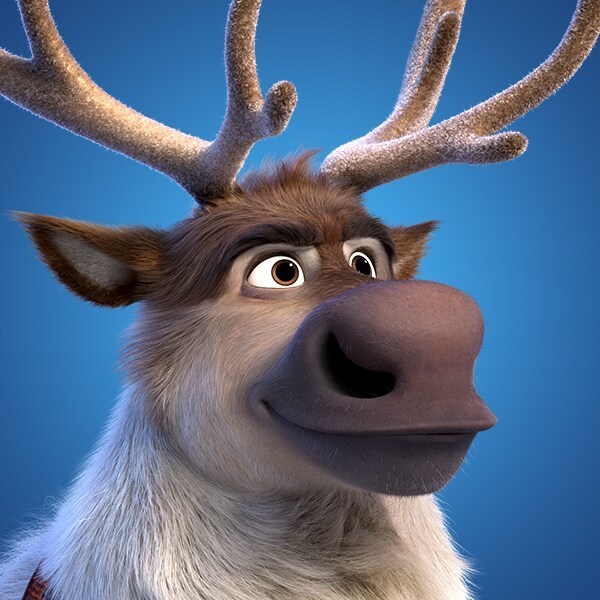
Sven
Labor, loyalty, animal agency, Sámi research, animation, and the family member who never needed human dialogue to make himself clear.
Profile
| Name | Sven |
|---|---|
| Species | Reindeer |
| Sex | Male |
| Family and partner | Kristoff and the troll household |
| Natural vocalizations | Frank Welker |
| Kristoff’s imagined voice | Jonathan Groff |
| First feature appearance | Frozen (2013) |
| Primary work | Ice-harvest and transport partner |
What kind of character can exist without speech
Sven’s silence is not an empty space waiting for Kristoff to fill it. The films build a repeatable system of response: ears turn before the head, weight shifts before movement, eyes hold or reject contact, breath marks effort, and the timing of a grunt changes whether it reads as warning, impatience, affection, or disbelief. The audience learns the system because the camera gives reactions enough time to register.
That construction distinguishes a nonverbal character from a decorative animal. Sven receives information, evaluates it, and changes what happens next. Human characters sometimes misunderstand him, which proves communication is interpretation rather than magic. His agency survives those misunderstandings because action supplies a second channel. He can walk away from Kristoff’s bad decision, physically redirect him, or choose the dangerous route back.
Care file: food, equipment, rest, and touch
Carrots are the visible running preference, but Sven’s working life requires more than a snack gag. Harness fit, sled weight, hoof condition, rest, shelter, water, seasonal food, recovery after dangerous travel, and the physical consequences of repeated pulling all belong to the care relationship the films mostly leave between scenes. Kristoff’s familiarity and affection imply routine knowledge without documenting every part of it.
Physical affection is also negotiated through a body much larger and stronger than the humans around him. Sven leans, nudges, licks, lifts, and crowds space, while Kristoff answers with touch and embodied familiarity. The comedy works because both understand the ordinary boundaries of the relationship. When Sven uses his head to push Kristoff toward a decision, force becomes communication inside an established trust rather than random animal behavior.
Bottom line first
Sven is the most emotionally literate character in Frozen who never receives ordinary dialogue. He reads Kristoff’s fear before Kristoff admits it, rejects cowardice disguised as restraint, carries people through danger, and communicates with a vocabulary built from movement, breath, eyes, antlers, weight, and years of shared routine.
Calling him Kristoff’s pet misses the relationship the films actually stage. Sven is companion, coworker, transport partner, conscience, family, and occasionally the only member of the household willing to push Kristoff toward the truth. The comedy never requires him to be less intelligent than the humans.
Profile and identity
Sven is a male reindeer and Kristoff’s lifelong companion. The opening of Frozen shows them both young among the ice harvesters, establishing that the bond predates the adult romance, royal employment, and every crisis involving Elsa.
He does not speak human language in the feature-film world. Frank Welker performs his natural vocalizations, while Jonathan Groff supplies the exaggerated voice Kristoff uses when imagining Sven’s side of a conversation. In “Lost in the Woods,” Groff also voices the singing reindeer chorus from Kristoff’s subjective musical perspective.
Name, age, and canon limits
The character is named Sven and is consistently referred to as male. The filmmakers reportedly considered the name Thor before settling on Sven. The films do not give him a birthday, a conventional pedigree, or a detailed account of how he and young Kristoff first found each other.
Both appear young at the beginning, followed by a long time jump. Applying real reindeer life expectancy produces questions the fantasy has not answered. A reference profile can note the chronology without pretending that a biological age estimate is official canon or that Arendelle’s reindeer must follow an exact modern veterinary table.

The ice-harvest childhood
Young Sven works beside young Kristoff in the opening ice-harvest sequence. The job places animal strength inside a human economy from the first minutes of the franchise. He is not introduced wandering in a forest waiting to become cute. He is already laboring.
That history explains adult skill. Pulling a loaded sled, responding to terrain, pacing effort, navigating weather, and coordinating with Kristoff are learned practices. When the eternal winter destroys the ice market, Sven loses economic stability alongside his human companion even though the screenplay expresses the loss through Kristoff’s ruined business.
Adoption into the troll family
Bulda and the trolls take in Kristoff and Sven together. The choice matters because the family unit is never human child first and animal accessory second. Sven is part of the adoption package and remains inside Kristoff’s idea of home.
The films leave daily life with the trolls mostly unseen. Sven’s comfort around them, participation in “Fixer Upper,” and lack of fear suggest long familiarity. His family position is relationally clear even when Arendelle’s legal categories for an adopted reindeer are wisely left out of the musical.
Working partnership with Kristoff
Sven pulls the sled, carries supplies, responds to commands, reads routes, waits, returns, and contributes physical power Kristoff cannot replace alone. Kristoff provides shelter, food, grooming, equipment, interpretation, and companionship. Their work depends on coordination rather than ownership alone.
The partnership is not perfectly equal because Kristoff controls commerce and often narrates Sven’s thoughts. Sven still exercises visible agency. He refuses directions, redirects Kristoff, chooses when to pursue Anna, reacts to danger before the humans, and expresses approval or disgust without waiting for translation.
The private language
Kristoff voices Sven through a rough comic register, switching positions in an argument as if the reindeer has answered. The habit externalizes thought but is not reliable enough to erase Sven’s own communication.
Sven answers through eyes, head movement, posture, sound, pace, and refusal. Sometimes Kristoff’s invented line matches the response. Sometimes Sven looks at him as if the translation is nonsense. The film lets audiences read both layers, making their communication richer than a magical talking-animal shortcut.
Sven as conscience
Directors Chris Buck and Jennifer Lee have described Sven as Kristoff’s conscience. The role is clearest when Kristoff tries to leave Anna after bringing her back to Hans. Sven refuses the retreat and pressures him to recognize that care still requires action.
A conscience is not the same as a command. Sven cannot explain the full moral argument, but he knows Kristoff’s stated reason does not match his behavior. Their history gives him access to the gap between what Kristoff says and what he wants.
Meeting Anna
Sven initially encounters Anna through the business arrangement that buys supplies and hires the sled. She is inexperienced in the mountains but treats him as a participant, shares danger, and becomes part of his social group through action.
He warms to Anna before Kristoff fully admits doing so. The response is not simply approval of a romantic match. Sven observes her courage, generosity, mistakes, effort, and willingness to return for Elsa. His later push toward her rests on evidence gathered during the trip.
The wolf chase
During the wolf attack, Sven runs under pressure while Kristoff and Anna defend the sled. He accelerates, jumps, follows direction, and survives a sequence that tests the working partnership at full speed.
The destroyed sled is often treated as Kristoff’s loss, but it is also Sven’s equipment and workplace. The replacement Elsa provides after the thaw restores a shared tool. Sven’s labor makes the royal title “Ice Master and Deliverer” possible even though the title names only Kristoff.
Olaf and the carrot
Sven’s interest in carrots becomes the bridge to Olaf in the original teaser and throughout the films. The joke begins with appetite and repeatedly ends with restraint, affection, or accidental threat to Olaf’s nose.
Their friendship works because both communicate outside ordinary adult social rules. Olaf talks constantly while Sven says nothing verbal. Sven’s reactions puncture Olaf’s logic, and Olaf gives Sven a companion who accepts physical comedy without interpreting quietness as absence.
Returning for Anna
After Kristoff leaves the palace, Sven challenges the decision and helps carry him back through the storm. His urgency tells the audience that the retreat is not noble enough to survive scrutiny from the person who knows him best.
Sven does not know whether Anna’s cure will be romantic love, sisterly sacrifice, or something else. He knows she is in danger and Kristoff will regret turning distance into an excuse. That practical moral clarity is one reason the relationship feels like family rather than livestock management.
After the thaw
Sven receives the new sled with Kristoff and continues inside the expanded Arendelle household. The film does not narrate whether Elsa’s royal appointment changes his care, workload, housing, or formal status.
The omission points to a larger labor question. If Kristoff is Ice Master and Deliverer, Sven is still pulling the vehicle that performs delivery. A deeper franchise would recognize the animal labor supporting the charming title without forcing Sven into a human payroll joke.

Frozen Fever
Sven assists with Anna’s birthday chaos, responds to Kristoff’s loud declaration of love, and helps hold the celebration together while Elsa’s cold creates escalating problems.
The short uses him as a reaction performer. Because he cannot interrupt with dialogue, a look can register the exact social judgment the audience needs. The economical response often lands harder than a written punch line.
Olaf’s Frozen Adventure
Sven participates in the search for Olaf and carries information back toward the palace. The featurette also places him beside Kristoff’s troll-family tradition, reinforcing that he shares the household history rather than merely transporting it.
Holiday stories often reduce animal companions to sleigh imagery. Sven’s design makes that temptation obvious, but the narrative preserves his specific relationships. He is not Santa’s interchangeable reindeer. He is the family member who knows which humans need to be moved and when.
Once Upon a Snowman and Olaf Presents
Once Upon a Snowman revisits parts of the first film’s route from Olaf’s perspective, allowing Sven’s earlier interactions to sit inside a new chain of cause and effect.
The Olaf Presents shorts use Sven’s sounds and recognizable reactions inside compressed comic retellings. These appearances belong in the media record while remaining distinct from the feature chronology.
Frozen II and the family game
The sequel opens with Sven inside the palace-family routine, including charades and preparations for the journey. His presence confirms that Kristoff’s move toward royal life did not require leaving the oldest relationship outside.
Sven watches Elsa’s distraction, travels with the group, and adapts to the Enchanted Forest. He remains the practical body capable of transport even while the story’s mythology expands far beyond the economic world of ice harvesting.
Meeting the reindeer herd
In the Enchanted Forest, Sven encounters a large herd and people whose lives include reindeer in a community context. The meeting briefly moves him from singular comic companion to one animal among many.
That shift should matter more than the film has time to explore. Sven has spent most of his life inside Kristoff’s troll and human relationships. The herd raises questions about animal sociality, belonging, and what he recognizes beyond the private language of one human.

Lost in the Woods
Kristoff’s musical imagination turns Sven and the herd into a full soft-rock chorus. Jonathan Groff voices the singing reindeer, giving Sven words inside a sequence explicitly shaped by Kristoff’s emotional perspective.
The number does not prove that Sven secretly speaks fluent English. It dramatizes the role he already plays: listener, conscience, and emotional translator. Kristoff imagines the herd affirming feelings he cannot organize alone.
The proposal campaign
Sven helps Kristoff prepare and repeatedly responds to failed proposal attempts. His reactions show recognition that timing, listening, and Anna’s actual circumstances matter more than the existence of a ring.
He cannot repair the screenplay’s decision to isolate Kristoff from much of the historical conflict. He can keep the subplot honest by refusing to treat romantic intention as sufficient evidence of communication.
The dam and final rescue
During the climax, Sven helps carry Kristoff into Anna’s plan to break the dam. His strength and speed make the human decision physically possible.
The line “my love is not fragile” belongs to Kristoff, but the action arrives through the same partnership that has supported every mountain rescue. Sven is part of the grammar of dependable love even when the script gives the sentence to the man riding beside him.
Relationship file: Kristoff
Kristoff is Sven’s oldest companion, coworker, interpreter, caregiver, and chosen family. Their bond contains affection, dependence, projection, and enough trust for disagreement.
A careful reading does not romanticize every element of animal labor or pretend the two hold identical power. It also refuses to reduce visible choice to obedience. Sven repeatedly alters Kristoff’s decisions and the direction of the plot.
Relationship file: Anna
Anna becomes somebody Sven chooses to protect and reunite with Kristoff. She trusts his strength, responds to his communication, and includes him in the family formed after the thaw.
Their bond receives less private screen time than Sven’s bond with Kristoff, yet her treatment of him helps distinguish the relationship from pure utility. She sees a companion where a royal traveler could have seen transportation.

Relationship file: Olaf
Olaf is friend, vegetable competition, travel companion, and a magical person whose detachable body invites the kind of physical exchange Sven understands immediately.
The carrot joke could have remained predatory. Repeated returns of the nose and protective behavior transform appetite into a running test of friendship. Sven wants the carrot and recognizes that it belongs to somebody he cares about.
Relationship file: Elsa
Elsa changes the weather that governs Sven’s livelihood, later repairs the household’s immediate losses, and brings him into a world where magical beings become family.
The films show no sustained resentment from Sven, which may reflect animal adaptation more than political forgiveness. Elsa’s power repeatedly alters the environment he must cross. His physical reactions ground magical spectacle in the body of a creature that cannot debate policy.
Strength, stamina, and terrain
Sven can pull a loaded sled at speed, climb and jump across difficult terrain, carry riders, lift Kristoff with his head, push through storms, and sustain travel that exhausts less adapted bodies.
These abilities come from species, conditioning, work, and animation exaggeration. He is formidable without becoming a combat monster. Ice, cliffs, wolves, fire, distance, and magical weather still create risk.
Communication and intelligence
Sven recognizes names, plans, danger, emotional states, routes, and consequences. He understands Kristoff’s speech well enough to participate in complex decisions, though the exact limits of comprehension remain unstated.
Intelligence appears through choices rather than human vocabulary. He anticipates, jokes, negotiates, protests, remembers, and changes tactics. A profile that calls him mute comic relief discards most of the evidence the animators put onscreen.
Animal labor and ethical reading
The franchise presents sled pulling as a shared life rather than an abusive arrangement. Sven shows enthusiasm, refusal, rest, appetite, and affection, while Kristoff treats him as family.
That tone does not end the ethical question. Working animals depend on humans for equipment, food, medical care, workload, and freedom. The films offer enough mutuality to support a positive reading, but not enough daily detail to declare every condition ideal.
Sámi research and cultural responsibility
The production researched reindeer at a Sámi-owned farm in Røros, Norway, observing animals and the relationship between reindeer, work, and environment. Kristoff’s design and occupation also draw from Sámi inspiration.
The Sámi are living Indigenous peoples, not fantasy decoration. Crediting the research prevents Sven’s world from becoming generic Nordic texture. It also raises responsibility: reindeer husbandry has cultural, legal, economic, and ecological meaning that a comic companion cannot represent by himself.
A real reindeer in the animation studio
The animation team brought a real reindeer into the studio to study movement. The animal reportedly spent much of the observation standing still, which did not supply all the expressive behavior a feature character required.
Animators retained observed details, including scratching behind the ear with a rear leg, then combined anatomy with dog-like curiosity and energy. The result is not a documentary reindeer. It is a designed performance anchored by enough physical truth to make exaggeration readable.
The excited-dog influence
Filmmakers compared Sven’s behavior to an excited or inquisitive dog, and John Lasseter connected the performance to his Labrador. This influence explains sniffing, eagerness, facial responsiveness, and social timing familiar to audiences.
The shortcut makes a reindeer emotionally legible, but it can also erase species difference if treated as the whole design. Sven’s antlers, weight, gait, pulling mechanics, herd encounter, food, and environmental adaptation keep him from becoming a Labrador wearing a winter silhouette.
Michael Woodside and expressive design
Frozen II animation supervisor Michael Woodside has highlighted features such as Sven’s large expressive eyebrows. Those brows give the face readable judgment without turning the muzzle into a human mouth delivering dialogue.
Animation must coordinate ears, eyelids, brows, head angle, breath, weight shift, and antlers. A small head movement can read as refusal because the relationship and timing have prepared the audience to understand it.
Frank Welker, Jonathan Groff, and layered voice credit
Frank Welker records Sven’s grunts, snorts, and animal sounds in major screen appearances. Those sounds carry effort, alarm, pleasure, impatience, and response without translating the character into speech.
Jonathan Groff performs Kristoff’s invented Sven voice and the heightened singing reindeer perspective in the sequel. Both credits matter, but they describe different layers: Sven’s audible animal performance and Kristoff’s human projection of what his companion might say.

Broadway Sven
Onstage, Sven requires a performer to operate an elaborate physical design with strength, flexibility, stamina, and precise coordination. Andrew Pirozzi originated the role on Broadway, with later performers taking on the demanding suit.
The adaptation makes labor visible in a new way. Film animation hides the human work behind a rendered reindeer. Theater asks an audience to accept an animal character while also admiring the live body producing gait, breath, balance, and personality.
Television, LEGO, books, and comics
An alternate Sven appears in the Once Upon a Time television branch using a live reindeer. LEGO Frozen Northern Lights, books, and comics translate him through different rules, sometimes playing more freely with the idea of speech.
These versions belong in a complete media file with continuity labels. They can expand situations and relationships without retroactively proving that feature-film Sven talks or experienced every licensed adventure.
Games and crossovers
Sven appears in games including Frozen: Olaf’s Quest, Frozen Free Fall, Disney Magic Kingdoms, Kingdom Hearts III, and other Disney crossovers. His design also appears through costumes, emoji, and platform-specific adaptations.
Interactive media often turns recognition into mechanics. Pulling, travel, collection, or companionship may become a task rather than a scene. A complete profile records these branches without treating a selectable avatar or decorative item as equal to narrative development.
The Moana cameo and visual Easter eggs
Maui briefly cycles through transformations in Moana, including a moment shaped like Sven. The cameo works as a studio-level visual Easter egg rather than evidence that Arendelle and Motunui share one literal encounter.
Separating reference from canon matters across franchise research. A recognizable silhouette can reward viewers without creating biography. Easter eggs belong in the record when accurately labeled, not inflated into crossover history.
Merchandise and mascot translation
Sven appears as plush, figures, ornaments, ride imagery, apparel, toys, and park-related merchandise. The broad antlers, muzzle, harness, and large eyes remain readable when animation and sound disappear.
Products often emphasize softness and loyalty while minimizing labor, age, cultural research, or independent judgment. Merchandise is reception evidence, not a replacement for the character the films construct through motion.
Reception and criticism
Audiences frequently read Sven as a loyal pet-like friend and a source of reaction comedy. Critics and reference coverage often praise the emotional clarity created without ordinary speech.
The pet label remains too small, while claims that he is secretly the smartest character can become another flattening joke. His interest lies in specific competence, relational intelligence, animal difference, and the way silence can carry agency when filmmakers pay attention.
The encyclopedia floor
A complete factual profile must cover creation, naming, species, film chronology, shorts, sound performers, Kristoff’s projected voice, animation research, design choices, abilities, relationships, stage adaptation, television, games, books, merchandise, reception, and notable cameos.
CVM Sekai then has to add evidence-based interpretation: animal labor, chosen family, communication ethics, Sámi context, the herd encounter, conscience as plot function, species difference, adaptation boundaries, and the question of aging that fantasy chronology leaves open.
Future file
Future films need to decide whether Sven’s long chronology matters, what the Enchanted Forest herd changed for him, and how Kristoff’s royal marriage affects their work and living arrangements.
A strong continuation would give Sven consequential choices without forcing him to speak like a human. The franchise already has the vocabulary. A refusal, route change, reunion, injury, new herd bond, or decision about work can carry an arc if the camera treats his agency as story rather than reaction.
Sources and certainty
Primary sources include the feature films, animated shorts, official Disney character material, Walt Disney Animation drawing and production coverage, D23 records, published film credits, and stage production documentation.
Major encyclopedic and specialist references serve as an omission check. Observed film action, creator statements, adaptation branches, inference, and unknown facts remain labeled separately. That method lets the profile go deeper than Wikipedia without pretending every attractive theory is canon.
Frozen coverage
Return to the Frozen hub for every character, review, React, rant, and guide.