
RaeRae Reacts · One Piece Episode 118
Ancient Weapon Pluton
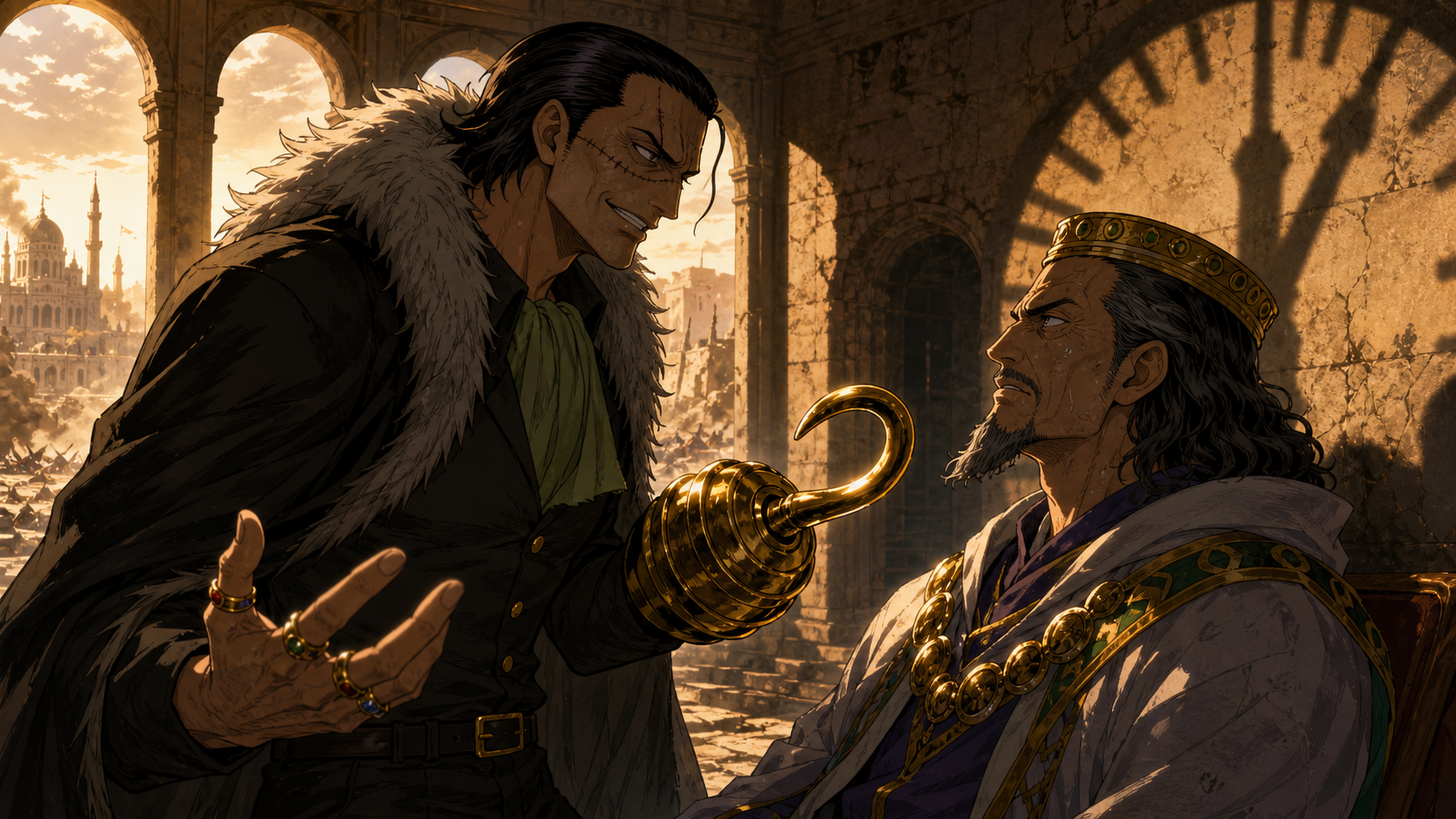
One Piece Episode 118 reveals Crocodile’s cannon deadline, his demand for the Poneglyph location, and the political stakes behind Pluton.
Quick reaction
One Piece Episode 118 puts a clock over Alubarna. Crocodile tells Cobra that a cannon shell will strike the palace plaza at 4:30 p.m., thirty minutes away, while both armies remain packed inside the blast zone. He asks whether Pluton exists in Alabasta, then demands the location of the Poneglyph when Cobra refuses certainty.
Cobra agrees to guide him. That answer looks like surrender until one remembers that rulers under coercion may use compliance to move a threat, gain time, or protect information through controlled access.
RaeRae’s bottom line: Crocodile has turned the war into a timed mass-casualty weapon, and every secret now carries human lives on both sides.
The thirty-minute deadline changes the battlefield
Before the cannon announcement, fighters can imagine that surviving the next clash preserves another chance.
A scheduled blast removes that assumption. Every minute spent fighting, searching, or arguing now consumes evacuation time.
The plaza becomes a trap because the two armies are concentrated exactly where Crocodile wants the shell to land.
Urgency also creates opportunities for misinformation. A false location or false deadline could waste the only remaining response window.
Thirty minutes is long enough for many characters to believe someone else will solve the problem and short enough for that assumption to become fatal. Search teams need sectors. Messengers need routes. Commanders need authority to interrupt combat without waiting for perfect proof. The deadline forces leadership to decide which actions can run in parallel. A sequence where everyone waits for one answer will fail before the cannon fires.
Crocodile weaponizes crowd concentration
The rebellion and royal defense have gathered people into a dense symbolic space. Crocodile converts that political concentration into blast efficiency.
One shell can kill soldiers from both sides, erase witnesses, damage state leadership, and make the final violence look like the kingdom’s own collapse.
The plan depends on years of manipulation that moved public anger toward the palace.
Mass violence is not separate from his information campaign. The campaign arranged the target.
Crocodile has engineered density through politics. Drought accusations pushed public anger toward Cobra, Baroque Works encouraged escalation, and the palace became the stage where both sides expected a final decision. The shell exploits that choreography. A crowded plaza did not simply happen to exist. Crocodile spent years moving people, beliefs, weapons, and grief toward one point that a gunner could erase from a distance.
The deadline is also psychological coercion
Crocodile tells Cobra about the shell because fear can extract information faster than physical force alone.
Cobra must evaluate whether the threat is credible, whether cooperation can save anyone, and whether disclosure creates a larger future disaster.
The deadline blocks careful consultation with Vivi, guards, historians, or other trusted people.
Coercion works by making every available option carry responsibility for harm chosen by the coercer.
Cobra may feel that refusing makes him responsible for the blast or that guiding Crocodile makes him responsible for Pluton. Both frames serve the captor. Crocodile selected the threat and controls the deadline. Cobra still has moral agency, but agency under a mass-casualty ultimatum is constrained. Fair judgment must examine which options were deliberately removed and who benefited from removing them.
Cobra refuses to confirm Pluton’s existence
Cobra says he cannot state with certainty that Pluton exists in Alabasta. The wording protects the boundary between knowledge and assumption.
Crocodile wants a clean answer, but historical records, inherited duty, and state secrets may not produce certainty on demand.
Refusing false confidence matters because powerful people often treat uncertainty as disobedience.
Cobra does not owe Crocodile an invented fact simply because citizens are being threatened.
Pluton represents power beyond the throne
Crocodile has already built influence capable of destabilizing a kingdom. Pluton promises force that could reshape relationships between many kingdoms.
The ancient weapon changes his objective from local rule to strategic domination.
A throne can be resisted, inherited, or lost. A weapon of catastrophic scale creates leverage even without public legitimacy.
Crocodile seeks the kind of power that makes consent, law, and reputation feel optional.
That ambition explains why becoming Alabasta’s public hero was never enough. Reputation helped him operate, recruit, and isolate the royal family, but reputation remains dependent on audiences. Pluton would offer coercion that does not need admiration. Crocodile wants the ability to dictate terms after the lie has served its purpose. The weapon represents a transition from concealed influence to openly enforceable domination.
The Poneglyph is knowledge under armed extraction
When Cobra cannot confirm Pluton, Crocodile asks for the location of the stone carrying historical text.
The Poneglyph matters because information can lead to weapons, suppressed history, or evidence that existing institutions fear.
Guiding an armed aggressor to protected knowledge is not ordinary disclosure. The request arrives inside a hostage situation.
Any ethical analysis must keep the coercer’s responsibility at the center rather than blaming the person forced to choose.
Cobra’s agreement may be tactical compliance
Cobra agrees to lead Crocodile to the Poneglyph location. Compliance does not automatically mean consent or ideological surrender.
Movement can separate Crocodile from the plaza, create a narrower route, expose a physical vulnerability, or buy time for Vivi.
Cobra also knows the destination better than Crocodile, preserving one remaining advantage inside an unequal encounter.
Leadership under coercion sometimes means choosing the option that preserves the most possibilities rather than the option that looks proudest.
Cobra also has to consider what Crocodile already knows. Refusal may not protect the site if the location can be found through archives, excavation, captured staff, or Robin’s research. Guiding the route could let Cobra control pace and context. None of those possibilities guarantees a plan, but they show why visible cooperation cannot be judged without evidence about the ruler’s remaining options and intended destination.
Vivi needs actionable information, not another rumor
Stopping the cannon requires location, timing, blast expectations, and a communication route capable of reaching both armies.
Vivi has already learned that shouting truth into a manufactured war does not guarantee anyone can hear.
A thirty-minute warning must become tasks: find the gunner, search sightlines, move civilians, create visual signals, and prepare medical response.
Information only saves people when an organization can translate the warning into coordinated action.
The cannon plan exposes emergency-management failure
Alubarna has no functioning shared alert system because political trust has collapsed and combat noise overwhelms ordinary communication.
Evacuation routes may be blocked by rubble, soldiers, fire, and frightened crowds.
A palace-centered blast threatens both open-space casualties and secondary collapse from nearby structures.
Response needs messengers, medical teams, crowd-control plans, shelter guidance, and independent confirmation that the shell has been neutralized.
Even a successful warning could create a crush if thousands run toward the same narrow street. Evacuation requires route separation and credible leadership from both armies. Royal soldiers alone may not be trusted by rebels, while rebel officers may not command civilians. Vivi needs messengers whose relationships cross those lines. The human network matters as much as the warning because people must believe the instruction before movement begins.
Crocodile treats civilian death as administrative cleanup
He does not view the people in the plaza as citizens with histories, families, and political rights.
They are evidence to erase, opponents to remove, and bodies whose deaths can be folded into the story of civil war.
That logic turns mass killing into a management decision.
RaeRae is naming the structure plainly: Crocodile created the conditions, selected the target, set the deadline, and owns the planned casualties.
Nami begins mastering the Clima-Tact
While the palace crisis escalates, Nami starts converting the Clima-Tact’s separate outputs into a coherent weather system.
Mastery does not come from memorizing Usopp’s party functions. She identifies how heat, cool air, moisture, and wind interact.
The weapon becomes useful when her navigation expertise supplies the missing operating model.
Nami’s progress offers a smaller-scale contrast to Crocodile: she uses knowledge to create options, while he uses knowledge to remove them.
The contrast also involves authorship. Usopp built the physical interface, but Nami produces the operating method through use. Her knowledge should not be treated as a decorative contribution added after “real” invention. Without her model, the rods remain unpredictable props. Collaborative tools often depend on users who discover workflows the designer never documented. Credit and future redesign should include that field expertise.
Weather science rewards sequencing
Temperature and moisture effects may seem weak when activated alone. Sequence creates pressure change, cloud formation, and potential electrical charge.
Nami must manage order, distance, timing, and the movement of surrounding air.
Miss Doublefinger can interrupt any long setup, so the process needs misdirection and defensive spacing.
A successful combination proves that scientific literacy can function as combat discipline without becoming magic detached from cause.
Nami’s learning rate becomes the real threat
Miss Doublefinger entered the fight with greater direct power and complete familiarity with the Spike-Spike Fruit.
Nami entered with a wound and a poorly explained prototype.
Every surviving experiment changes that balance because Nami learns faster than Miss Doublefinger updates her assumptions.
The opponent who looked least prepared becomes dangerous precisely because she keeps turning failure into usable evidence.
Knowledge can protect or dominate
Episode 118 places two forms of expertise beside one another. Nami uses atmospheric knowledge to survive an attacker. Crocodile seeks historical knowledge to gain catastrophic leverage.
The moral difference does not live inside knowledge itself. Purpose, consent, accountability, and consequences determine the use.
Cobra protects a record because access can harm millions. Nami needs access to usable instructions because withholding operation can get the user killed.
Responsible information policy must distinguish legitimate need from coercive extraction.
The royal family carries a dangerous stewardship burden
Inherited responsibility for a Poneglyph places decisions about history and security inside one family.
That arrangement may preserve a secret across generations, but concentration creates vulnerability when the ruler is captured.
Distributed safeguards, trusted stewards, and clear succession procedures could reduce the risk of one coerced disclosure.
The story raises a hard institutional question: how should dangerous knowledge survive without becoming the private property of power?
Production choices make time visible
Michiru Shimada’s script connects the Pluton interrogation, cannon deadline, Poneglyph demand, and Nami’s developing Clima-Tact control.
Yuji Endo’s direction turns thirty minutes into narrative pressure without losing the political meaning behind the countdown.
Masayuki Takagi’s animation direction contrasts Crocodile’s controlled stillness with Nami’s active experimentation.
Miyuki Sato and Michiyo Kawasaki’s art connect palace shadows, plaza exposure, and the wider damaged city.
What Episode 118 changes
Crocodile announces that a cannon shell will strike the palace plaza at 4:30 p.m., thirty minutes away.
Cobra refuses to confirm that Pluton exists in Alabasta but agrees to guide Crocodile to the Poneglyph location.
The planned explosion places both armies and surrounding civilians inside a timed mass-casualty threat.
Nami begins mastering the Clima-Tact by applying her own weather knowledge to the device’s separate functions.
Episode details
Japanese title: 王家に伝わる秘密!古代兵器プルトン
English title: Secret Passed Down in the Royal Family! The Ancient Weapon Pluton
Japanese broadcast: July 14, 2002
Saga: Alabasta
Material: Manga-canon adaptation
Script: Michiru Shimada
Episode direction: Yuji Endo
Animation direction: Masayuki Takagi
Art: Miyuki Sato and Michiyo Kawasaki
The official One Piece guide confirms Cobra refusing certainty about Pluton’s existence in Alabasta, Crocodile announcing a shell aimed at the palace plaza for 4:30 p.m. in thirty minutes, Crocodile demanding the Poneglyph location, Cobra agreeing to guide him, and Nami beginning to master the Clima-Tact. The emergency management, coercion, information security, institutional design, labor, and accountability analysis is RaeRae’s reading of those events.
Final verdict
Episode 118 earns a 9.6 out of 10. Crocodile’s plan becomes horrifying because every earlier lie now serves a precise physical target.
Cobra faces a coerced choice between guarded knowledge and immediate lives. Nami faces a different information crisis and proves that expertise can turn confusing fragments into protection.
The countdown has started. Alabasta no longer needs one heroic speech. The kingdom needs verified information, coordinated labor, and enough people willing to act before 4:30.
Crocodile believes secrecy and panic will keep those people isolated until the shell arrives. Nami’s parallel story offers the rebuttal. Confusing fragments can become a working system when someone studies relationships and communicates what each part can do. The national version requires the same discipline at brutal scale: connect witnesses, assign searches, share routes, challenge false assumptions, and keep responsibility fixed on the architect of the crisis.