
RaeRae Reacts · One Piece Episode 117
Clima-Tact Burst
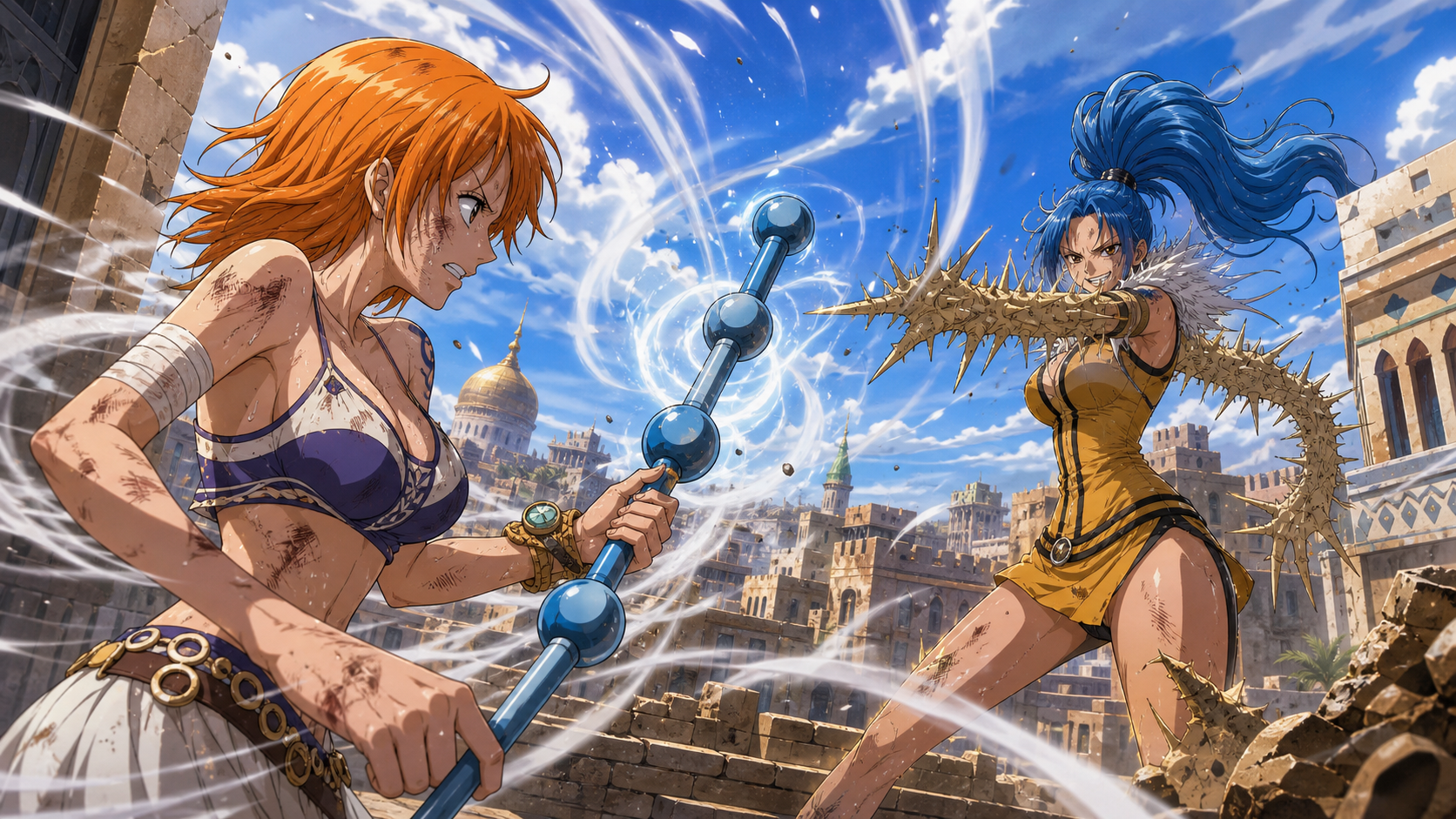
One Piece Episode 117 forces Nami to turn poor Clima-Tact instructions into weather science while Crocodile questions Cobra about Pluton.
Quick reaction
One Piece Episode 117 gives Nami a weapon designed by a friend and then reveals that the instructions are practically a workplace prank. Miss Doublefinger has already pierced Nami’s right shoulder with the Spike-Spike Fruit. Nami swings the Clima-Tact for survival and gets party tricks. Reading the manual creates another opening, and Miss Doublefinger drives spikes along Nami’s center line.
At the palace, Crocodile questions Cobra about the ancient weapon Pluton while the civil war continues outside.
RaeRae’s bottom line: Nami’s intelligence is the real weapon. The Clima-Tact becomes useful only when she translates bad documentation into weather science under lethal pressure.
Nami enters without a finished combat system
Zoro and Sanji bring years of practiced fighting. Nami brings navigation, weather knowledge, survival instincts, and a device she has barely tested.
The difference matters because invention does not become competence at the moment of delivery.
Nami must learn controls, distinguish useful functions from jokes, and adapt the tool while an experienced assassin attacks.
The episode treats first use as dangerous labor rather than an instant upgrade.
That choice protects Nami’s characterization. A sudden mastery would suggest the device, not the navigator, created her value. Instead, every useful result must pass through knowledge she built during years at sea. She recognizes patterns, tests assumptions, and keeps a mental model while injured. The Clima-Tact expands what she can express in combat, but the intelligence guiding that expression was already present long before Usopp handed over the rods.
Miss Doublefinger controls close distance
The Spike-Spike Fruit lets Miss Doublefinger turn body surfaces into sharp weapons. Arms, fingers, and other points can punish nearly any approach.
Nami cannot trade ordinary strikes at close range without entering a field of blades.
The shoulder wound immediately limits reach, grip, balance, and the speed needed to assemble or swing the Clima-Tact.
Miss Doublefinger understands that injury can shrink an opponent’s available choices before the finishing attack arrives.
Her ability also turns ordinary defensive contact into a risk. Blocking an arm, grabbing clothing, or closing for leverage may create a new puncture point. Nami therefore needs distance without surrendering control of the space. Weather effects offer that possibility because wind, heat, and moisture can travel where her body cannot safely go. The matchup rewards environmental thinking precisely because direct physical exchange favors Miss Doublefinger so heavily.
The shoulder wound changes every movement
A punctured shoulder is not cosmetic battle damage. Muscles, nerves, blood vessels, and joint function may all be affected.
Nami needs both hands to manage three connected sections, read instructions, and create controlled combinations.
Pain competes with concentration. Blood loss threatens judgment. Repeated movement can worsen tissue damage.
Her continued resistance shows discipline, but courage does not remove the need for urgent medical care.
The Clima-Tact begins as failed documentation
Usopp built a device with real scientific potential and packaged crucial knowledge behind entertainment functions and confusing instructions.
That choice is funny until the user stands in front of an assassin. Documentation quality becomes a safety issue.
A responsible manual would separate emergency combat functions, known limitations, activation sequences, failure states, and party modes.
Nami loses valuable seconds because the designer did not prioritize the user’s actual operating conditions.
Usopp deserves credit for creating advanced functions with limited time and materials, but invention is not exempt from accountability. A designer can be brilliant and still make unsafe communication choices. The episode makes the failure visible through Nami’s body. Every unclear label and misplaced joke becomes another second of exposure. Good intentions explain why the tool exists. They do not excuse a manual that hides emergency operation behind comedy.
Party tricks reveal a design mismatch
The first outputs look useless because Usopp imagined a different use case from Nami’s immediate need.
Novelty features may demonstrate airflow, heat, or cool vapor without explaining how those effects combine into a defensive system.
Nami must reverse-engineer intent from output. Each embarrassing trick becomes a small experiment whose result can still provide evidence.
The joke lands, but the burden of making the tool safe falls almost entirely on the injured user.
Nami’s response is not passive frustration. She gathers results. A gust establishes airflow. A cool output suggests condensation. Heat changes surrounding pressure. Even failed attacks create data. That habit is the heart of field science: observe the actual system, compare output with expectation, and revise the next action. Miss Doublefinger sees a woman fumbling with toys. Nami sees an unfinished weather model becoming clearer with every attempt.
Nami turns weather expertise into combat analysis
Nami understands pressure, temperature, moisture, wind, and the way small atmospheric changes can accumulate.
That knowledge lets her see relationships that neither Usopp’s manual nor Miss Doublefinger recognizes.
One rod’s effect may look trivial alone. Several effects combined in sequence can create a meaningful weather event.
Her navigation work becomes frontline power because weather science has always been practical survival knowledge.
On a ship, a small pressure shift can announce a storm before the sky looks dangerous. A navigator who waits for obvious proof may lose the chance to change course. Nami brings the same anticipatory thinking into combat. She does not need to generate a natural climate at full scale. She needs enough local change to disturb sight, movement, balance, or timing. Small atmospheric effects become powerful when applied at the exact vulnerable moment.
Reading under attack is cognitive labor
Nami must divide attention among the manual, the opponent, the weapon, her wound, the surrounding space, and the larger crisis.
Every glance at the page reduces visual contact with Miss Doublefinger. Every dodge risks losing the correct instruction sequence.
Stress narrows working memory, making poorly organized text even harder to use.
The scene demonstrates why emergency instructions require clarity, hierarchy, and rapid retrieval rather than personality-driven clutter.
Human-factors design assumes the user may be frightened, injured, rushed, or working in poor visibility. Usopp’s manual appears designed for a calm reader who can tolerate experimentation. Nami has none of those conditions. A safer system would use tactile distinctions, simple symbols, numbered combinations, and an emergency quick-start sequence. The physical interface also needs feedback so the user can confirm which rod or mode is active without rereading a page.
The center-line strike escalates the medical danger
Miss Doublefinger pierces from Nami’s head toward the chest along the center line while Nami reads.
That attack threatens the skull, face, airway, major vessels, lungs, and other critical structures.
Even where the animation avoids graphic detail, the implied injury is severe and cannot be dismissed as a dramatic scratch.
Nami’s survival depends on movement, luck, and the story’s heightened durability, not on the attack being medically minor.
Miss Doublefinger uses contempt as pressure
She sees confusion and assumes Nami lacks the competence to become dangerous.
Mockery encourages rushed decisions, shame, and abandonment of an unfamiliar tool.
Nami has spent years surviving people who underestimated her because they reduced intelligence to physical weakness.
Contempt creates an opening when the attacker stops asking what the target has learned between failed attempts.
Miss Doublefinger’s confidence is grounded in evidence. She has landed serious wounds, watched several useless outputs, and controls close range. The failure comes from treating current advantage as proof of permanent superiority. Nami’s learning rate becomes the hidden variable. Every minute she survives changes the weapon from unknown object to understood system. An opponent who mocks adaptation may not recognize the precise moment when the balance has shifted.
Invention requires collaboration after delivery
Usopp’s engineering and Nami’s weather expertise belong in the same development process.
He understands mechanisms, materials, range, and improvised construction. She understands the atmospheric system the device tries to manipulate.
A proper test cycle would let Nami identify useful combinations, dangerous outputs, and control changes before combat.
The unfinished handoff reflects time pressure, but urgency does not make the missing collaboration harmless.
Nami refuses the crew’s narrow strength hierarchy
Nami knows she cannot copy Zoro’s sword work or Sanji’s kicks. She does not need to.
Her value has never depended on matching the strongest crew member in direct force.
The Clima-Tact creates a route from existing expertise to new defensive capability without erasing her identity as navigator.
Strength becomes the ability to understand a system and act before that system kills someone.
The weapon carries friendship and frustration
Nami trusted Usopp to build something that could help her survive. The party functions make that trust feel dangerously misplaced.
Anger is reasonable. A friend’s good intentions do not erase consequences created by poor design decisions.
At the same time, the device contains possibilities that only their combined knowledge could produce.
The relationship can hold gratitude, fury, humor, and accountability without forcing one feeling to cancel the others.
Crocodile asks Cobra about Pluton
At the palace, Crocodile reveals that his ambitions reach beyond controlling Alabasta’s throne.
Pluton represents concentrated destructive power tied to hidden history and state knowledge.
Cobra’s position makes him a target because institutions often store dangerous information inside a small number of people.
Crocodile uses war as cover for extraction, treating national suffering as a tool for gaining access to a weapon.
Ancient weapons change the scale of the conspiracy
A criminal takeover is already devastating. A search for Pluton places consequences beyond one kingdom.
Crocodile wants durable leverage capable of reshaping political relationships after the current rebellion ends.
The question also reframes his patience. Years of drought manipulation and public deception may serve an objective larger than personal status.
Alabasta’s citizens are paying the immediate cost of a project whose final threat they cannot yet see.
Information design links Nami and Cobra
Nami struggles because vital operational knowledge is poorly organized. Cobra struggles because vital historical knowledge is dangerous to expose.
Both scenes ask who controls information, how information is protected, and what happens when someone needs an answer under coercion.
Good documentation helps a legitimate user act safely. Good security prevents a hostile actor from gaining catastrophic power.
The same episode places those needs in tension without pretending every secret or every disclosure follows one rule.
Production choices make failure painful
Michiru Shimada’s script lets the Clima-Tact fail repeatedly before Nami can interpret the underlying system.
Yoko Ikeda’s direction uses the contrast between comic party effects and Miss Doublefinger’s sharp attacks to keep the stakes from becoming soft.
Hideaki Maniwa’s animation direction gives the weapon’s segmented movement and the Spike-Spike Fruit distinct physical rhythms.
Miyuki Sato and Fumihiro Uchikawa’s art connect the exposed Alubarna battlefield with the palace confrontation.
What Episode 117 changes
Nami begins using the Clima-Tact against Miss Doublefinger and discovers that the available instructions prioritize party tricks over survival.
Miss Doublefinger pierces Nami’s shoulder and center line, escalating the fight’s medical urgency.
Nami starts translating the weapon’s separate outputs through her own weather expertise.
Crocodile questions Cobra about Pluton, revealing a larger objective behind the Alabasta conspiracy.
Episode details
Japanese title: ナミの旋風注意報!クリマタクト炸裂
English title: Nami’s Cyclone Advisory! Clima-Tact Burst
Japanese broadcast: June 30, 2002
Saga: Alabasta
Material: Manga-canon adaptation
Script: Michiru Shimada
Episode direction: Yoko Ikeda
Animation direction: Hideaki Maniwa
Art: Miyuki Sato and Fumihiro Uchikawa
The official One Piece guide confirms Miss Doublefinger piercing Nami’s right shoulder, Nami using Usopp’s new Clima-Tact, the weapon initially producing party tricks, Nami reading the instructions, Miss Doublefinger striking along Nami’s center line, and Crocodile asking Cobra for Pluton’s location. The medicine, documentation, labor, product design, knowledge security, and accountability analysis is RaeRae’s reading of those events.
Final verdict
Episode 117 earns a 9.2 out of 10. Nami receives no clean transformation sequence and no friendly tutorial.
She gets pain, bad instructions, public embarrassment, and a weapon whose real logic must be discovered before Miss Doublefinger lands another critical strike.
The episode respects Nami most when her weather knowledge becomes the difference between a novelty gadget and a fighting system. Usopp built the pieces. Nami has to make the science work.
That burden is unfair, impressive, and completely consistent with her history. Nami has spent years turning incomplete maps, hostile rules, changing weather, and other people’s bad decisions into routes that keep people alive. Episode 117 gives that survival intelligence a new instrument. The real breakthrough will not be a magic button. The breakthrough will be Nami recognizing how each small output belongs to one larger atmospheric process.