
RaeRae Reacts · Olaf’s Frozen Adventure (2017)
Olaf’s Frozen Adventure React: The Family Tradition Was the Door They Kept Opening
Olaf searches an entire kingdom for the tradition Anna and Elsa think isolation stole from them, then discovers the ritual was hiding inside their relationship.
Immediate reaction
The holiday packaging is aggressive, but the emotional question belongs to Frozen: what happens when a family survives isolation and realizes survival left holes where rituals should be? Anna and Elsa have each other again. They do not have years of shared practice to point toward.
Olaf interprets the absence as a problem he can solve by collecting traditions from everyone else. His mission is loving, invasive, sincere, and doomed. A family cannot build identity by shopping through other people’s sacred habits like a seasonal catalog.
The kingdom gets to be specific
The door-to-door sequence works because traditions differ. Food, decorations, songs, objects, and community practices carry different meanings in different homes. The special does not declare one correct holiday. It lets Arendelle feel populated by families rather than background citizens waiting for royal weather.
Olaf’s enthusiasm risks flattening those differences into props, but the montage keeps returning ownership to the people explaining them. He is gathering ideas, not announcing that every ritual belongs to him now. The households speak, demonstrate, and keep practicing after he leaves, which prevents their customs from becoming decorations stored inside the palace.
Olaf and Sven
Sven remains the franchise’s most competent adult. He recognizes danger, reads Olaf’s intention, and keeps trying to save both the mission and the snowman. Their physical comedy gives the special motion while Anna and Elsa handle the emotional frame.
The sleigh disaster is predictable and still painful because Olaf believes he destroyed the proof he was bringing home. The object loss becomes a crisis only because he has mistaken collected items for the love that motivated the trip.
The answer was in the box
Anna and Elsa discover years of drawings and keepsakes connected to Olaf. Even while separated, Anna created a ritual around the memory of the snowman they built together. Elsa kept the evidence. Their tradition survived because both sisters preserved a version of the relationship when direct contact felt impossible.
That reveal avoids telling them the isolation did no damage. They still lost shared holidays. The point is that damage and continuity can coexist. Olaf did not manufacture belonging. He helped them recognize the form it had already taken.
The songs
The special has more music than its runtime comfortably needs, but “When We’re Together” earns the finale. The song defines home through relationship without pretending location and ritual are meaningless. It works because the story spent twenty minutes showing why inherited structure still matters.
Josh Gad gives Olaf enough sincerity to keep the material from becoming pure product. The joke velocity drops whenever he realizes the mission may have failed, and the quiet makes the final reunion land. His voice loses its sales-pitch brightness before the family finds him, giving the character room to experience disappointment without immediately turning it into another joke.
RaeRae verdict
This is a holiday special with an actual reason to exist inside the franchise. It examines the domestic aftermath of the first film and lets the kingdom contribute more than applause. 8/10. Sven deserves hazard pay and a permanent seat at the council table.
The empty castle after the party is the real opening wound
The kingdom gathers for a holiday bell ceremony and immediately disperses into family traditions. Anna and Elsa remain in a palace that can host everybody and still feel empty when inherited ritual belongs to everyone else. The scene is painful because the gates are open. Isolation is no longer enforced, yet the sisters discover another thing childhood separation prevented them from building.
Anna remembers asking Elsa to make holiday preparations together and receiving no answer. Elsa remembers every unanswered request from the other side. Neither sister caused the original system, but both live with its missing calendar. The special treats tradition as a form of continuity, which means interrupted relationship produces absences that love alone cannot retroactively fill.
Olaf hears a practical problem. If other families have traditions and this family does not, he will collect one. That logic is loving and impossible. Traditions are not objects detached from the relationships that repeat them. His quest becomes useful because failure teaches the distinction.
The premise also refuses the idea that a royal household automatically possesses meaningful heritage. Arendelle has public ceremony. Anna and Elsa lack private ritual. National pageantry cannot substitute for the small repeated acts through which people recognize home.
The tradition tour is cultural curiosity with a built-in boundary problem
Olaf and Sven visit households whose practices involve food, music, clothing, decoration, games, and beliefs. The montage celebrates variety without declaring one correct holiday. That openness fits Olaf, who approaches every door expecting wonder rather than ranking what he finds.
He also keeps trying to remove practices from context. A sauna, food item, ornament, or ritual cannot necessarily be transported into the palace and become the sisters’ tradition. The comedy exposes how easily appreciation turns into collection when the collector focuses on objects instead of relationships.
The special is careful enough to show families participating rather than presenting traditions as museum labels. It is less interested in ethnographic precision than emotional function. Each practice organizes people around memory and repetition. Olaf learns the visible act before understanding the invisible history.
For viewers, the best response is not to ask which tradition wins. Ask what each family is doing for one another through the ritual. Warmth, remembrance, hospitality, continuity, play, and belonging can take different forms without becoming interchangeable.
The fruitcake disaster is where the helper becomes the person who needs help
Olaf’s collected objects are destroyed, the sled falls, and the fruitcake is lost. He interprets the failure as proof he disappointed the family and leaves alone. The character who wanted to repair everybody else’s absence repeats Elsa’s old conclusion: if his presence creates trouble, disappearance is the loving response.
That parallel matters. Olaf was created from the sisters’ childhood memory and carries their emotional habits in comic form. His flight is not a random sad turn. It demonstrates how family systems reproduce themselves through people who were not present for the original injury.
Sven has to communicate the emergency without speech, and Kristoff understands. The household then mobilizes. Search replaces waiting. Nobody accepts that Olaf should remain missing because he feels guilty. The rescue party becomes a public answer to the locked-door years.
The fruitcake eventually survives in altered form, which is exactly right. Tradition does not require pristine preservation. An object can be damaged, carried, shared, and still hold the relationship that made it matter. The special keeps turning perfection into the enemy of continuity.
Olaf was the tradition because care had already been repeating
Anna finds the box containing annual Olaf drawings and gifts she made for Elsa. During the years of separation, the snowman image was a way to keep offering shared memory. Elsa preserved the objects. The sisters therefore had a tradition even when they could not enact it together openly.
Calling Olaf their tradition does not reduce him to symbol. He is a person created from the memory, and he now chooses to sustain the relationship. Tradition becomes reciprocal. The sisters gave him an emotional origin. He gives them a way to recognize what survived.
The discovery also complicates the idea that the closed years contained no connection. Anna’s offerings crossed as far as the door. Elsa’s preservation answered silently. That was not enough, and the film should never romanticize the isolation. It was still a thread. Repair can use a thread without pretending the wall was harmless.
The community’s arrival makes the family larger than blood. Kristoff, Sven, citizens, and castle staff participate. A tradition becomes real because people repeat care together, not because it can be traced to an ancient royal ancestor.
Final reaction
The special runs longer than its plot requires and contains enough holiday packaging to power several retail quarters. It still identifies a real aftermath the features could skip. Families rebuilt after separation have to invent ordinary life, and invention does not make a ritual fake.
Olaf’s search fails because he tries to deliver a perfect object. It succeeds because the effort reveals the care already present. That is a better holiday lesson than consuming every custom until one feels sufficiently festive.
The ending works for estranged, adopted, blended, grieving, and newly formed families because it refuses bloodline as the only source of continuity. Repetition begins somewhere. The first year counts. A ritual can become meaningful because people return to it with care, even when no ancestor handed them instructions or a perfect holiday memory.
RaeRae React verdict: 8/10. The fruitcake has survived more structural violence than Arendelle’s monarchy and deserves its own profile.
Keep exploring Frozen
Return to the Frozen hub for character files, reviews, Reacts, rants, lore, and watch-order guides.
Olaf interviews the kingdom because the palace archive failed the family
The search for a tradition becomes an accidental oral-history project. Olaf visits households, listens to rituals, borrows objects, and discovers that belonging is practiced differently behind every door. The palace could have kept records about festivals, food, music, and seasonal customs. Instead, the snowman becomes the archivist because Anna and Elsa need evidence that a family without inherited routine can still build continuity.
His method is chaotic and ethically questionable because enthusiasm does not always wait for consent before collecting somebody else’s tradition. The short knows this and lets the overloaded sleigh collapse under the weight of borrowed meaning. A tradition cannot become intimate merely because it looked beautiful in another home. Olaf has to move from gathering objects to understanding what the sisters were already doing with him.
The search party proves the family changed its emergency reflex
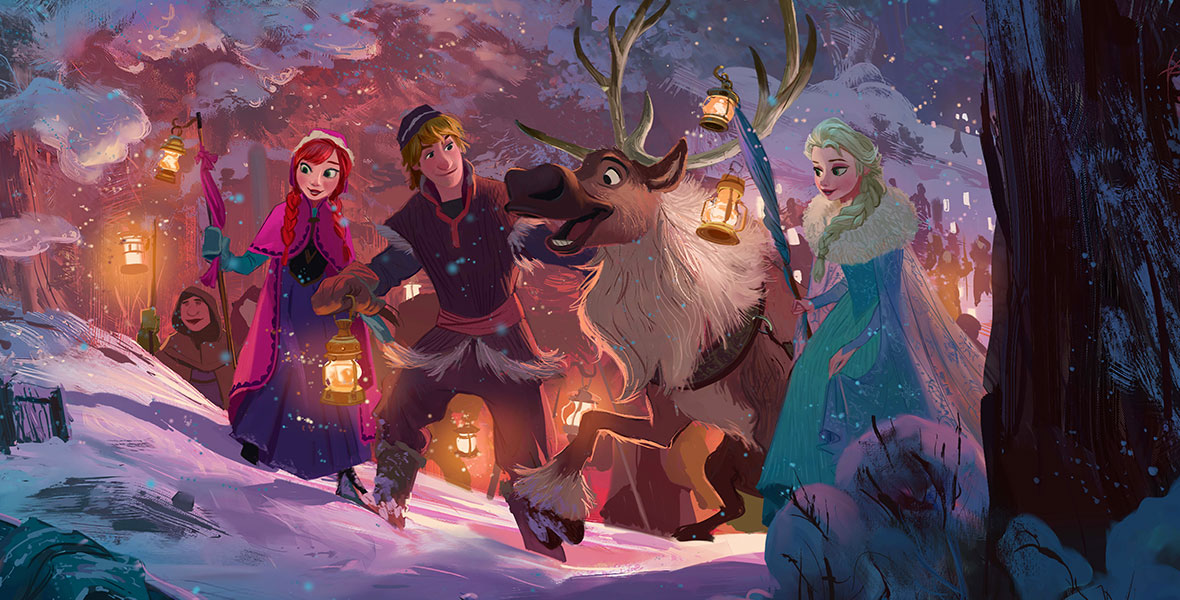
When Olaf disappears, Anna, Elsa, Kristoff, Sven, and the larger community go looking. Nobody closes a gate, hides the problem, or assumes the lost person should solve his own distress. That response reverses the childhood system that trained both sisters to survive separately. The palace now mobilizes outward. Love becomes visible through coordinated action instead of a private feeling trapped behind a door.
Olaf has spent the special trying to provide a tradition for the sisters. The search reveals that he is not an accessory to their celebration. He is a family member whose absence changes the meaning of the day. Being wanted when useful is employment. Being sought when hurt, embarrassed, and unable to finish the task is belonging. The special earns its final warmth by making that difference physical.
The answer was a repeated choice, not an antique ritual
Anna and Elsa preserved Olaf through drawings and memories during the years of separation, long before they knew he could become alive again. Their tradition was the act of returning to the same symbol of connection while the household taught them not to touch. It was informal, private, and built under pressure, which makes it more meaningful than a ceremony inherited without struggle.
I keep the special because it refuses to define family legitimacy through age. A new household can have a real tradition. A chosen person can become part of a family story that began before his current body existed. Ritual gains meaning through attention and repetition, not through a committee certifying that it is old enough. The door kept opening because the people inside finally learned to cross the distance together.
Tradition stops being a test once the sisters name what they actually need
Anna and Elsa begin the day assuming a legitimate holiday should look like something inherited intact from childhood. That assumption makes absence feel like failure. Their family history was interrupted by fear, secrecy, and grief, so the archive is thin. Olaf’s search helps them recognize that a tradition does not have to prove their household was always healthy. It can document the moment the household learned to choose connection on purpose.
The emotional repair is specific. They do not recover the years behind the door or discover that the palace secretly maintained a perfect ritual. They create continuity from the evidence available: drawings, a snowman, repeated efforts to reach each other, and the people who now stay. The special respects grief by refusing a magical replacement childhood. It gives them a present capable of holding what the past could not provide.
The community matters because family repair is no longer confined to royalty
Olaf’s route through Arendelle lets ordinary households define the celebration before the palace announces an answer. Food, decorations, songs, and small repeated habits become a map of belonging larger than one royal family. The sisters’ solution remains personal, but it arrives after listening to the community around them. Arendelle feels warmer when tradition moves in both directions across the palace gate.
That wider frame keeps the ending from becoming another story where royal emotion is the entire kingdom’s weather. Anna and Elsa can have an intimate revelation while other families retain traditions that do not need royal approval. Olaf returns with the knowledge that difference is normal. The holiday becomes shared time without requiring every household to perform the same history.