
RaeRae Reviews · Frozen II (2019) · Full Spoilers
Frozen II Review: The Sequel Finds the Crime Under the Kingdom and Then Rushes the Repair
Frozen II gives the franchise history, land, grief, and colonial receipts. It also wants one song and one bridge collapse to carry more repair than the ending can honestly hold.
The verdict
Frozen II is more ambitious, more beautiful, and less structurally secure than the original. It asks why Elsa has power, what Arendelle buried to become prosperous, and whether a kingdom can repair violence without sacrificing the image it built around innocence. Those are better questions than most franchise sequels attempt.
The film also runs through its final political consequences so quickly that the repair can feel ceremonial. A dam falls. Water races toward Arendelle. Elsa diverts it. Anna becomes queen. The story identifies a foundational crime, then saves nearly every visible symbol of the system that benefited from it. The emotional work lands harder than the civic accounting.
Some things never change, except everything already changed
The opening status song insists the household has found stability. Anna, Elsa, Kristoff, Olaf, and Sven share routines. The gates remain open. The promise feels sincere, which is why Elsa’s response to the mysterious voice becomes painful instead of merely adventurous. She finally has a home where she can stay, and part of her still knows staying is not the same as belonging.
Anna hears uncertainty as the possible return of abandonment. Elsa hears it as a call toward unexplained identity. Neither sister is wrong. Their conflict emerges because the first film solved love but did not erase their survival habits. Elsa withholds until she has a plan. Anna closes distance until she can verify Elsa is safe. The sequel turns that mismatch into its central pulse.
Into the Unknown is desire arguing with responsibility
Elsa does not simply want adventure. She wants permission to admit that contentment has not silenced curiosity. The voice threatens the stability she worked to regain, and she spends the song constructing reasons not to answer. Each refusal makes the attraction more obvious.
Idina Menzel lets the performance climb from irritation into recognition. The song works because it does not frame restlessness as ingratitude. Elsa can love Anna and Arendelle while sensing that the throne is not the final shape of her life. The danger comes from treating that private truth as another reason to leave without full communication.
Olaf explains change because the adults are avoiding it
Olaf’s comedy becomes the film’s thesis delivery system. He notices autumn, asks whether maturity will make everything understandable, and keeps inventing reassurance as the world grows stranger. “When I Am Older” is funny because the audience knows adulthood does not deliver the promised clarity.
His later death gives those jokes weight. Olaf depends on Elsa’s magic, yet he experiences himself as a separate person with memories, attachments, and fear. When the magic fades, he does not become an object. He becomes someone dying in Anna’s arms. The resurrection is expected, but the grief before it remains real.
The Northuldra and the problem of the fictional substitute
The Northuldra are a fictional people developed with Sámi consultation. Their reindeer herding, clothing, relationship to land, and visual coding make the influence legible. The collaboration matters and should be credited. It does not make Northuldra another name for Sámi people or turn fantasy into ethnography.
The film uses the Northuldra to challenge Arendelle’s national story. They were trapped in the forest after a conflict the kingdom describes as their betrayal. The truth reveals King Runeard planned control while calling it a gift. That inversion is politically sharp. The people treated as suspicious were responding to the violence hidden inside development.
King Runeard knew exactly what the dam was for
Runeard’s prejudice is not merely personal dislike. He fears people whose relationship to magic and land limits his authority. The dam is infrastructure as domination. It changes the environment while producing dependence, and he presents it publicly as generosity.
That detail saves the backstory from becoming a vague misunderstanding between equal sides. Arendelle initiated the harm. The kingdom’s prosperity and self-image sit on a lie maintained across generations. Anna does not discover that everybody made mistakes. She discovers her grandfather designed a trap and murdered the Northuldra leader when challenged.
Ahtohallan and the danger of needing every answer
Elsa reaches the archive alone after sending Anna away. She believes protecting her sister requires controlling access to danger. That is the old family system wearing heroic clothing. Anna is no longer locked in a bedroom, but Elsa still decides which truth she can survive.
Ahtohallan rewards inquiry and punishes excess. Elsa follows memory below the warning point because certainty feels like the only responsible basis for action. The freezing echoes Anna’s first-film fate and turns knowledge into physical risk. She obtains the receipt, then must trust Anna to act without her.
The Next Right Thing refuses inspirational shortcuts
Anna believes Elsa and Olaf are dead. The film removes her usual optimism, romantic reassurance, and immediate rescue target. She cannot solve grief by loving harder. She can only identify the next action that remains morally available.
Kristen Bell performs the song as labor. Breath, posture, and rhythm make movement feel negotiated rather than triumphant. The sequence respects depression more than the film’s rapid ending respects political reconstruction. It understands that courage can look like crawling toward a duty you do not feel ready to carry.
Destroying the dam is the right action
Anna leads the earth giants toward the dam knowing Arendelle may be destroyed. The decision works because repair becomes materially costly. She does not ask the harmed community to accept apology while preserving every benefit of the crime. She chooses truth over inherited property.
The giants break the structure, the forest opens, and water heads toward the kingdom. At this point the film has built a genuinely radical consequence for a family musical. Anna acts without assurance that Elsa can save the city. Her moral choice is complete before the rescue arrives.
Saving Arendelle weakens the receipt without erasing it
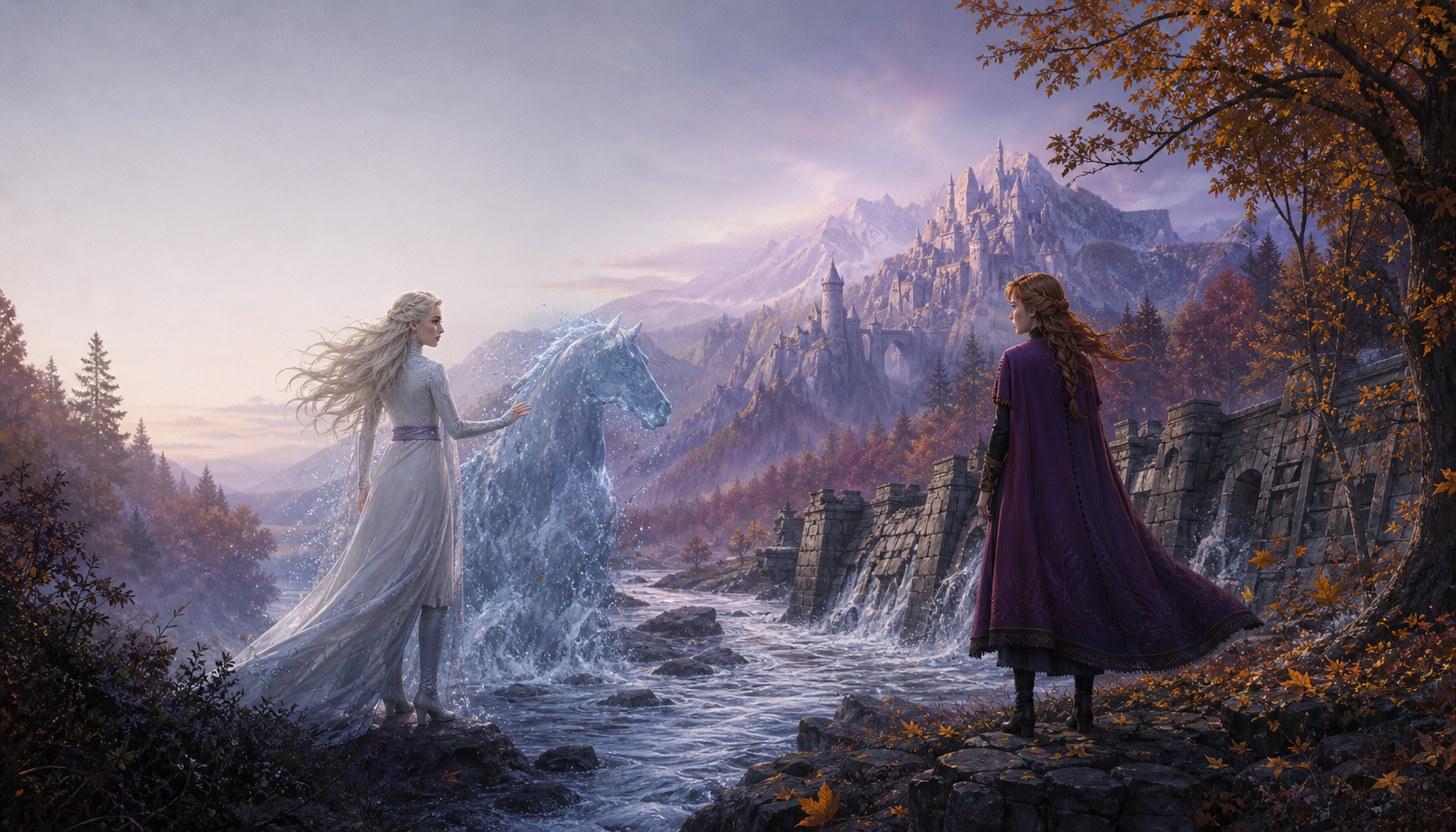
Elsa returns on the Nokk and diverts the flood. The image is thrilling. It is also politically convenient. Arendelle gets revelation, a new queen, restored contact with the forest, and almost no visible material loss. The castle that symbolizes continuity remains standing.
Repair does not require indiscriminate destruction, but the script never shows what Arendelle returns, funds, rebuilds, or changes after learning the truth. The Northuldra gain freedom from the mist. They do not receive a sustained voice in designing the new relationship. The ending gestures toward reconciliation before dramatizing accountability.
Elsa leaving the throne
Elsa’s move to the forest can be read as liberation from a job that never fit. She is curious, magical, mobile, and more comfortable mediating forces than managing court. Anna understands people and institutions. Their new roles make sense as choices rather than rankings.
The film needs more transition. Elsa disappears for much of the crisis, returns, announces Anna’s suitability, and settles elsewhere. Anna’s coronation can look like empowerment and like another responsibility handed to the sister who stayed. The strongest reading requires continued partnership, not a magical sister outsourcing government to the practical one.
Animation, songs, and production pressure
The elemental animation gives each spirit a different physical logic. Gale must be visible through what air moves. Bruni shifts from hazard to creature through scale and gesture. The Nokk combines horse anatomy with water effects that never stop feeling heavy. The earth giants move like landscape deciding to stand.
The songs carry so much narrative that some transitions feel compressed around them. The Disney+ documentary Into the Unknown: Making Frozen II shows the production revising under enormous pressure. That context explains instability without excusing it. The film looks effortless because hundreds of people labored through uncertainty.
A sequel about the part after “happily ever after” has to disturb happiness
Frozen II begins with a problem every successful family sequel inherits. The first movie ended by opening the gates, restoring the sisters, creating a viable romance, and giving Elsa a public relationship with her power. Repeating separation would make the original healing feel fraudulent. Preserving stability would leave no movie. The sequel chooses a more adult disturbance. Nobody has stopped loving anybody. The household works. Elsa is still called by something she cannot explain, Anna still monitors the possibility of loss, Kristoff still struggles to say what he needs without hiding inside performance, and Olaf has become old enough to understand that permanence was never promised. The conflict comes from people whose love is real and whose coping habits remain active.
That is why “Some Things Never Change” is both sincere and ominous. The group is not lying when they describe shared rituals. Their game nights, public celebrations, and physical ease demonstrate repair. The song becomes uneasy because each person uses permanence differently. Olaf asks for certainty. Anna makes a promise. Kristoff prepares a proposal that would formalize the life he already treasures. Elsa sings the same melody while hearing a voice nobody else can hear. Harmony allows difference to remain temporarily hidden, just as “For the First Time in Forever” once held opposite meanings inside one event.
A lesser sequel would punish the characters for becoming comfortable. This film understands that comfort can be valuable and still become a reason not to acknowledge change. Elsa has a kingdom, a sister, friends, and acceptance. She also has unanswered questions about why she is the only person she knows whose body can alter nature. Anna has the relationship she begged for as a child. She also remains alert to every sign that Elsa might withdraw. Their home is not fake. It is a real achievement being asked to hold needs the first movie did not solve.
The story therefore expands from family secret to national secret. Agnarr and Iduna once withheld information about magic. Arendelle has withheld information about its own foundation. The parallel does not mean every private omission equals colonial violence. It shows how institutions teach families which truths are survivable. Elsa and Anna grew up inside a palace where concealment was normal long before their parents shut the nursery door. Runeard’s lie lives in public memory, architecture, diplomacy, and the bedtime story Agnarr tells his daughters.
The ambition is impressive because it risks contaminating the first film’s comforting kingdom. Arendelle was never merely home. It was a monarchy with a past. The sequel asks whether the sisters can love a place after learning what made its stability possible. That question is stronger than another villain seeking Elsa’s power. The difficulty is that the movie has less than two hours to manage mythology, grief, romance, comedy, Indigenous coding, political confession, elemental action, and two separate coronation-scale transformations. Its reach is the reason it matters and the reason the ending feels rushed.
The bedtime story is propaganda with a father’s voice
Agnarr’s opening story gives the children a version of history shaped by fear and inherited loyalty. Arendelle built a dam as a gift to the Northuldra. A celebration turned violent. Spirits attacked. The forest closed. The young prince escaped after an unknown rescuer saved him. None of those statements is entirely invented, which is how durable national myths work. Facts are arranged so motive disappears. The dam becomes benevolence. Violence becomes mutual confusion. Runeard’s murder of the Northuldra leader vanishes. Arendelle becomes victim of an inexplicable rupture rather than architect of a calculated betrayal.
Agnarr is not shown consciously teaching propaganda. He tells the story available to him, which makes the scene more useful. Institutions do not require every parent to lie deliberately. They require a version repeated often enough that uncertainty feels disloyal. The king remembers terror, loss, and rescue. His emotional truth gives the incomplete history authority. Elsa and Anna receive the account in bed, where family intimacy lowers the defenses they might bring to a public lesson. National memory arrives as paternal care.
Iduna knows more and says less. Her lullaby about Ahtohallan promises a river containing answers while warning that a person can drown by seeking too much. On first viewing, the song sounds like myth. Later, it becomes testimony delivered in a form the children cannot decode. Iduna’s silence is complicated by trauma, displacement, royal marriage, and the risk of revealing her Northuldra identity inside the family that benefited from Runeard’s violence. The film grants her fear without fully examining what Anna and Elsa lost because their parents again chose protective ambiguity.
The visual transition from parents to adult sisters makes the past feel sealed, but the voice reopens it. Elsa is not merely summoned toward adventure. She is being called by a truth her household turned into atmosphere. The melody is familiar before its source is known. This is how inherited history often operates. A person recognizes the emotional shape of an absence before possessing the facts. Elsa’s magic becomes the instrument through which the buried account refuses to remain private.
The final revelation should send viewers back to the opening with sharper questions. How much did Agnarr suspect about Iduna? What did Iduna believe would happen if she spoke plainly? Did their voyage toward Ahtohallan represent a late attempt to repair the silence that structured Elsa’s childhood, or another journey conducted without the daughters most affected? The sequel provides enough information to transform the parents from simple protectors into tragic participants in a longer system. It does not provide enough time to let the sisters confront them except through memory.
Into the Unknown is not a call to adventure. It is a fight over whether desire is allowed to exist.
Elsa begins the song by naming every reason not to respond. She has responsibilities, people she loves, and evidence that pursuing mysterious magic can destabilize an entire kingdom. Her resistance is mature. It is also defensive. She describes the voice as something outside trying to lure her, while the arrangement keeps letting the call complete musical spaces she has not filled. The duet structure reveals recognition before the lyrics admit it. Elsa is arguing with a need that already knows her phrasing.
The scene avoids claiming that gratitude should erase restlessness. Elsa has what she once believed impossible: acceptance without concealment. She can still feel misaligned. That idea matters for anyone told that dissatisfaction proves ingratitude. Safety creates the conditions under which older questions can finally become audible. During crisis, survival was the task. In stability, identity has room to become complicated. The voice does not invalidate Arendelle. It exposes that Arendelle may be home without being the only place Elsa belongs.
Her refrain asks whether the caller knows her, feels what she feels, and can show where she fits. These are not the questions of a queen seeking another policy challenge. They belong to a person whose difference was accepted before it was understood. Love repaired shame but did not explain origin. Elsa wants context, not permission to exist. The distinction is why the journey cannot end with Anna simply assuring her that she is enough. Anna’s love is necessary. It is not a substitute for knowledge Elsa has the right to seek.
The magical projections that awaken the spirits make private desire public. Elsa’s response releases wind, fire, water, and earth signs across Arendelle, forcing evacuation. The sequence can be read as punishment for answering the voice, but it is better understood as consequence. Suppressed history has material conditions. The kingdom cannot continue ordinary life while the elements connected to its founding crime remain contained. Elsa does not create the injustice. Her openness removes the mechanism keeping its effects dormant.
Idina Menzel performs the number as escalation rather than instant certainty. The early phrases resist, the middle tests, and the final run becomes consent to investigate. Elsa does not know the destination. She chooses to stop pretending she feels no pull. That is a different liberation from “Let It Go.” The first song claimed a private space where nobody could judge her. This one accepts that self-knowledge may require relationship, history, danger, and returning with facts that change the place she loves.
Anna’s vigilance is love shaped by a childhood emergency
Anna’s promise that she will never let Elsa out of sight can sound romantic in the broad sense of devotion. The movie gradually reveals its cost. Anna has learned that separation may precede catastrophe and that Elsa tends to withhold danger until she believes she can manage it alone. Staying close is therefore both affection and surveillance. Anna does not want to control Elsa’s identity. She wants to prevent the old pattern from taking another person without warning. Her nervous system treats distance as evidence.
The enchanted forest intensifies the habit because every new danger confirms her concern. Elsa runs into fire. Giants move through the mist. The river leads toward a sea nobody can cross safely. Anna’s interventions are often reasonable in the moment, but they accumulate into a relationship where Elsa must manage Anna’s fear while pursuing her own task. This is the sequel’s most emotionally honest conflict. Love can become exhausting when one person’s safety strategy requires constant access to the other person’s risk.
Elsa responds with the strategy she already knows: decide privately, protect Anna by withholding, and eventually send her away. The ice boat is betrayal disguised as care. Elsa understands the threat and chooses separation without consent. She has good evidence that Anna will follow her into lethal conditions. She still repeats the central injury of their childhood by making disappearance the solution. The sequel does not need Elsa to become uncaring for this to hurt. The fact that she acts from love is exactly what makes the pattern difficult to break.
Anna’s collapse in the cave follows more than presumed bereavement. Olaf disappears in her arms, Elsa appears dead, the mission seems impossible, Kristoff is absent, and the woman who promised permanence has no remaining relational anchor. Kristen Bell lets “The Next Right Thing” begin below inspiration. Anna cannot imagine a meaningful future and does not pretend the pain contains a lesson. She reduces action to scale: stand, step, move toward a known obligation. The song respects grief by making survival procedural before it becomes hopeful.
Destroying the dam is Anna’s transition from protector of Elsa to accountable leader. She acts on information Elsa died to send and accepts that Arendelle may be lost. The choice is not abandonment of home. It is refusal to preserve home through another people’s ongoing harm. Anna’s vigilance becomes politically useful when it shifts from preventing every loss to choosing which values must survive loss. She cannot keep everyone and everything unchanged. She can decide what the kingdom should stop defending.
Elsa’s need for answers becomes dangerous when knowledge turns into a private test
Ahtohallan is irresistible because it promises an archive that cannot be edited by human institutions. Water remembers. Images replay. The past becomes visible without depending on the testimony of people who inherited competing stories. For Elsa, who grew up inside omissions, that promise carries enormous emotional force. She can finally see rather than infer. The glacier is library, mother, mirror, and trap.
The “Show Yourself” sequence provides recognition in stages. Elsa expects an external figure who will explain her. The answer returns her own image and Iduna’s voice. She is not waiting for a stranger to grant identity. She is the fifth spirit, a bridge connected to the relationship between human and magical worlds. The revelation works emotionally because the film lets her mother’s pride arrive where childhood fear once dominated. It is also strategically convenient. Difference becomes destiny, which can dignify Elsa while avoiding less mythic questions about ordinary adult identity.
The white dress and released hair repeat the transformation grammar of “Let It Go,” but the emotional direction changes. On the mountain Elsa built a palace away from witnesses. In Ahtohallan she enters an archive of relationship. The new clothing does not announce indifference. It marks acceptance of connection across ancestry, element, and responsibility. The sequence is richer when read as integration rather than upgrade. Elsa does not become more worthy because she receives a brighter outfit. She acquires a context capable of holding what she already was.
Then she goes too deep. The lullaby warned that seeking every answer could drown the seeker, and Elsa treats the warning as a challenge she alone must absorb. She descends because partial knowledge will not expose Runeard’s crime. The choice secures the truth needed for repair. It also kills or freezes her and extinguishes Olaf. The film refuses a simple celebration of research. Knowledge has cost when a person believes only complete certainty can authorize action.
Before freezing, Elsa sends the evidence to Anna. That act corrects part of her isolation. She does not keep the final truth as private enlightenment. She trusts Anna to decide what it requires. The sisters become a two-part bridge: Elsa reaches the archive, Anna converts knowledge into political action. The structure is powerful even though the film keeps assigning Elsa discovery and Anna governance along familiar magical and practical lines. Their partnership succeeds when neither role is treated as sufficient alone.
Olaf is the only person willing to admit that growing up feels like losing the map
Olaf’s new fascination with change begins as comic philosophy and gradually becomes anticipatory grief. He believes adulthood will make everything understandable because children are often promised that confusion is temporary. The adults around him know better and mostly let the belief stand. His jokes about facts, water memory, and maturity therefore carry a quiet accusation. Everybody is collecting knowledge while remaining unable to guarantee safety.
“When I Am Older” stages terror as material for a future story. Wind spins him, strange creatures appear, and the environment repeatedly threatens bodily coherence. Olaf interprets each event through faith that later understanding will make the current experience harmless. The song is funny because his confidence exceeds evidence. It is painful because this is a recognizable survival technique. People tell themselves the event will become meaningful when they do not yet have power to stop it.
His recap of the first film is more than a franchise comedy break. Olaf turns a traumatic family history into breathless theater, and the Northuldra and Arendelle soldiers respond together. Shared laughter becomes the first cooperative act across the mist. The summary also exposes how absurd royal mythology sounds when compressed. Doors close for years, parents die at sea, a prince appears, winter erupts, and love solves weather. Olaf performs the facts without the reverence institutions use to protect them.
The charades scene places him between Anna and Elsa before the journey. He tries to communicate without words and becomes frustrated when the group cannot identify his meaning. That game foreshadows an entire plot about signals, inherited stories, and incomplete translation. Olaf’s body is especially suited to the joke because he can rearrange himself into clues. He is built from pieces and spends the sequel trying to understand whether pieces remain a person when circumstances change.
His death in Anna’s arms answers that fear without easy reassurance. Flurries lift away, memory fails, and the body that once survived disassembly can no longer hold. Olaf asks Anna to stay with him, reversing the fireplace scene where he stayed with her. The moment works because the comic immortality has limits. Elsa’s later restoration does not erase the grief Anna experienced. It establishes that memory can support continuity when relationship actively rebuilds what was lost.
Kristoff’s proposal plot is funny until the joke keeps taking his interior life hostage
Kristoff wants to marry Anna, and the desire is not a problem. The sequel has to find conflict without making their relationship suddenly unhealthy, so it builds a series of failed proposals around timing and phrasing. At first the comedy reveals something real. Kristoff assumes formal commitment will secure a future already changed by royal life. Anna is preoccupied with Elsa’s safety. Neither person is rejecting the other. They are speaking from different emergencies.
The repeated misunderstandings eventually reduce Kristoff to a man wandering through somebody else’s myth. He disappears for long stretches because the central journey does not know how to include his skills after the forest. “Lost in the Woods” turns that exclusion into style. The power-ballad staging, reindeer chorus, and direct emotional language parody a masculine music-video tradition while letting Groff sing the vulnerable solo the first movie denied him. It is hilarious and sincerely beautiful.
The song’s central insight is that Kristoff has organized direction around Anna without fully deciding what partnership means for his own identity. “You are my true north” sounds romantic, but a person cannot permanently outsource orientation. His life changed from independent ice harvester to royal companion, and the film barely addresses class, work, public role, or belonging. The proposal becomes a solution to uncertainty larger than marriage.
His return during the Earth Giant sequence produces one of the film’s best lines: “My love is not fragile.” Kristoff does not demand an explanation before helping Anna. He recognizes that she made decisions under crisis and trusts the relationship enough to discuss hurt later. The line corrects romantic plots that use miscommunication as proof love was false. Their bond can contain absence, fear, and imperfect timing without collapsing into punishment.
The actual proposal succeeds because it stops trying to control setting. Anna has survived grief, destroyed the dam, learned Elsa lives, and watched the kingdom escape the flood. Kristoff asks plainly. The simplicity is the point. Still, the film owes him a fuller life beyond emotional availability. A healthy male partner should not have to become narratively optional to prove he respects a woman’s central story. The next chapter needs to give his labor, family, political position, and independent desires the same curiosity granted to everyone else.
The Northuldra are not fantasy accessories, but the film still uses them to finish Arendelle’s story
The Northuldra enter the adult timeline as a community trapped inside consequences created by Arendelle. They have lived for decades with soldiers, mist, disrupted movement, and spirits withdrawing from ordinary relationship. The film refuses to portray them as frozen in one posture. Yelena is cautious and authoritative. Honeymaren is curious and attentive. Ryder is exuberant, socially observant, and delighted to help Kristoff. Children and elders share the space. Reindeer are part of livelihood and community without becoming the only cultural marker. That range is an improvement over a single mystical guide who exists to hand the heroine a lesson.
The production’s relationship to Sámi culture also changed from the first film. Disney entered consultation with Sámi representatives and publicized a cooperation intended to support respectful use of language, clothing, music, story elements, and cultural knowledge. That process matters because the Northuldra are fictional but visibly shaped by living Indigenous northern cultures. Consultation cannot make every narrative decision beyond criticism. It does establish that representation required expertise and consent beyond internal studio taste.
The problem lies in narrative gravity. The Northuldra possess the historical injury, but Anna and Elsa receive the discoveries, decisive action, transformations, and final emotional resolution. Yelena can distrust Arendelle. She does not get a long scene defining the terms of repair. Honeymaren can explain the fifth spirit. She does not cross into Ahtohallan. Ryder helps Kristoff propose. He does not articulate what political future his community wants after the mist falls. The community remains essential to the sisters’ development while its own internal disagreements stay mostly offscreen.
Iduna’s identity connects the royal family to both peoples, but ancestry should not be confused with accountability. Elsa and Anna learning that their mother was Northuldra deepens belonging and explains rescue. It does not automatically authorize them to speak for the community harmed by their grandfather. The film sometimes treats the sisters as a bridge because their family contains both sides. A bridge is useful only if people on both sides determine how it is crossed. Otherwise it becomes another structure built through somebody else’s territory.
The sequel deserves credit for naming the aggressor and showing the fictional Indigenous community as contemporary to the story rather than extinct memory. It also needs criticism for allowing reconciliation to move at royal-family speed. A richer ending would show Northuldra voices debating restitution, access, governance, and whether renewed connection with Arendelle is desirable at all. Friendship is possible. It cannot be the assumed reward for confession.
Runeard’s dam is colonial violence wearing the costume of development
Runeard’s plan is frightening because it understands the political usefulness of a gift. He does not announce conquest. He offers infrastructure. The dam appears to honor peace while altering water, weakening land, and increasing Arendelle’s control. When the Northuldra leader questions the project, Runeard treats independent knowledge as threat. The murder is not a sudden prejudice erupting inside an otherwise benevolent policy. It is enforcement of the policy’s actual purpose.
The film therefore identifies several mechanisms of colonial power with unusual clarity for a family musical. Development is presented as neutral progress. The affected community’s ecological knowledge is dismissed as superstition. A ceremony creates images of friendship. Violence begins when the recipient refuses the giver’s definition of benefit. Later generations inherit a story in which nobody knows who struck first. The lie works because the visible object still looks useful and because the aggressor controlled the first archive.
Runeard’s fear of magic is also fear of limits. The Northuldra live in relationship with forces Arendelle cannot command, and that relationship constrains the king’s claim to sovereign authority. He describes magic as corrupting because it distributes agency beyond monarchy. The spirits answer land, memory, and reciprocity rather than decree. A ruler whose power depends on hierarchy interprets that independence as instability. The dam is both material weapon and ideological statement: water should move according to Arendelle’s design.
Anna’s decision to destroy it matters because she refuses to preserve inherited benefit after motive becomes clear. She does not ask whether Runeard’s descendants personally intended harm. She asks what the structure continues to do. That distinction moves the story beyond guilt into responsibility. A person can inherit a system without committing its founding crime and still become responsible for ending the ongoing advantage.
The giant-led collapse gives the decision spectacular force, but the ethical work happens before the stones fall. Anna recognizes that Arendelle may be destroyed by released water and proceeds. Repair without cost would repeat Runeard’s gift logic, where the powerful side defines generosity while controlling every condition. Her willingness to lose the kingdom is the film’s strongest receipt. The later rescue complicates it because the audience does not have to live with the full material cost Anna accepted.
Fire, water, air, and earth are characters with boundaries, not collectible powers
The elemental spirits could have become a game-like sequence of bosses Elsa defeats and absorbs. The film mostly resists that structure. Gale communicates through movement and objects. Bruni responds to fear and calms through attention rather than domination. The Nokk tests Elsa’s ability to move with force that cannot be commanded by royal title. The Earth Giants remain dangerous, sleepy, territorial, and uninterested in becoming mascots. Relationship takes a different form with each element.
Bruni’s scene is especially useful because Elsa first contains fire through ice, then changes approach. Suppression reduces immediate danger but also traps the frightened salamander. Once she recognizes a being inside the phenomenon, her touch becomes careful and the environment calms. The sequence condenses the franchise’s central lesson without dialogue. Power controlled through fear produces more fear. Regulation improves when the other participant is treated as an agent.
The Nokk sequence refuses softness. Water remembers, but memory is not automatically welcoming. Elsa is thrown, submerged, and forced to adapt. She cannot build a static staircase across the Dark Sea because the medium destroys fixed solutions. She has to read motion, time breath, change tools, and eventually ride rather than eliminate the horse-shaped force. Mastery here means negotiated movement, though the later flood rescue risks making the Nokk look fully subordinated.
The Earth Giants never receive the cute intimacy given to Bruni. Their scale protects otherness. Anna uses their behavior to break the dam, which raises an ethical question the movie moves past quickly. She provokes them into throwing stones without explaining the political purpose. The action is necessary and she has no shared language, but a story about respecting natural agency should notice when a human converts that agency into instrument. The giants help restore balance because the structure harms the land, not because Anna owns their force.
Together, the spirits create an ecological argument more complex than “nature good, kingdom bad.” The forest community also depends on conditions that can become dangerous. The issue is reciprocity and the fantasy that infrastructure can be imposed without relationship. Elsa’s bridge role should mean ongoing translation, consent, and limits, not possession of four elemental friends. The ending gestures toward that responsibility but celebrates belonging faster than it defines duty.
Show Yourself gives Elsa an answer and raises a harder question about destiny
“Show Yourself” is constructed as a meeting with an external authority. Elsa asks the voice to reveal itself, walks through memories, and reaches for the figure who can explain why she has always felt different. The emotional turn occurs when the answer is not a stranger waiting to certify her. Her own reflection completes the pattern. Iduna’s remembered voice celebrates the daughter, and the glacier reveals that Elsa is the one she has been waiting for. Recognition arrives through relationship without becoming permission granted by a new superior.
The number works because it answers shame with context. Elsa’s power was never a random defect threatening an otherwise ordinary royal life. Her existence connects a Northuldra rescue, an Arendellian prince, the spirits, and a future possibility of repair. The origin does not excuse the harm created by secrecy. It proves that the family interpreted difference through the wrong story. What they treated as contamination was connection.
Destiny is also a convenient corporate solution. A character who resonated through ambiguous difference becomes uniquely appointed to a mythic office. Sacred purpose can be empowering, especially for viewers taught that their difference has no value. It can also imply that acceptance becomes easiest when difference proves useful to everyone else. Elsa deserves belonging even if her power never saves a kingdom, repairs history, or makes her the fifth spirit.
The transformation repeats franchise imagery while shifting its emotional meaning. She lets down her hair, changes clothing, expands her movement, and sings at full range. In the first film, that visual grammar accompanied retreat. Here it accompanies arrival into history. The sequence is not more mature simply because the dress is white. It is more integrated because Elsa can receive maternal love, acknowledge ancestry, and accept public obligation in the same space as personal freedom.
Her new identity should remain a beginning. A bridge is not a throne with different scenery. It involves labor, conflict, mistranslation, and accountability to communities whose interests may diverge. If future films use “fifth spirit” only as power level and fashion, the revelation will become decorative. If they show Elsa negotiating duties she cannot solve through magic, the song’s promise can grow beyond self-recognition.
The Next Right Thing is the franchise’s most honest song about grief
Disney songs often convert despair into motivation before the audience has to remain inside it. “The Next Right Thing” refuses that tempo. Anna begins in darkness with no triumphant counter-melody, no visible companion, and no certainty that action will restore what she lost. Her voice narrows. Breath becomes audible. The cave does not transform in response to emotion. Grief is allowed to make the world small.
The lyric does not tell Anna that everything happens for a reason. It does not claim Elsa and Olaf live on through metaphor, promise reunion, or ask her to feel grateful. The task is smaller: listen for what is known, move one step, repeat. That procedural approach resembles how people survive when meaning is unavailable. Action precedes hope. The song’s wisdom is not inspirational polish. It is permission to function without pretending to be healed.
Kristen Bell’s performance carries the history of Anna’s earlier momentum. This is the character who filled silence with words and movement. Now speech itself requires effort. The contrast makes the scene feel earned rather than imported as an awards ballad. Anna cannot outrun absence, so she stops trying to generate the version of herself other people expect. The princess associated with optimism admits that optimism is inaccessible.
The song also changes the scale of leadership. Anna does not know she will become queen. She has no public audience. She acts because the evidence Elsa sent creates an obligation. Destroying the dam becomes the next right thing, not a guarantee of happy outcome. Ethical action is separated from personal reward. That is a more demanding definition of courage than confidence in success.
The later restoration of Elsa and Olaf risks softening the finality inside the cave, but it does not make Anna’s experience false. She made the decision while believing the deaths were permanent. The song records a version of her who can continue when reassurance is gone. Future stories should preserve that capacity without making her the endlessly resilient caretaker for everybody else’s danger.
The music is better when it lets characters disagree with themselves
Kristen Anderson-Lopez and Robert Lopez build the sequel’s score around questions rather than declarations. “Into the Unknown” argues with desire. “Show Yourself” asks an external figure for recognition before locating the answer within relationship and history. “The Next Right Thing” reduces moral action to the smallest survivable unit. “Lost in the Woods” turns masculine confusion into a sincere parody. The songs do not merely state feelings. They dramatize people revising the stories they use to understand those feelings.
“All Is Found” operates as lullaby, map, warning, and evidence. Its simplicity lets it travel across time. Iduna can soothe children, conceal biography, and transmit knowledge without speaking directly. When the melody returns at Ahtohallan, comfort becomes archive. The song demonstrates why oral tradition cannot be dismissed as decorative folklore. It carried a route and a danger that Arendelle’s official story omitted.
“Some Things Never Change” gains weight on rewatch because almost every promise is technically true and temporally fragile. Love can remain while roles change. The castle can remain while legitimacy changes. Olaf can retain continuity while his body disappears and is rebuilt. The song’s title becomes less a claim that change stops than a question about what continuity means when form does not.
“When I Am Older” and Olaf’s recap provide comedy, but both are about interpretation. He assumes future knowledge will domesticate fear and turns past trauma into theater. These numbers give the youngest-coded character control over narrative framing. The humor sometimes arrives where the political plot needs more room, yet removing Olaf would also remove the person most willing to expose how strange the adults’ explanations sound.
Christophe Beck’s score and the songs create a broader sonic world while again drawing on northern musical associations. The production’s collaboration and the return of Frode Fjellheim matter, as does careful naming of Sámi influence rather than calling every choral texture vaguely Nordic. The music is emotionally effective because specificity shaped it. Proper credit is part of hearing that specificity, not an interruption of the magic.
The documentary proves that polish was built inside uncertainty
Disney’s Into the Unknown: Making Frozen II is unusually valuable because it records creative uncertainty close to release. The filmmakers, songwriters, animators, performers, and production staff are not presented as people executing a perfect plan discovered years earlier. Story problems remain active. Songs change. Sequences are tested, cut, reframed, and finished under pressure. The documentary does not make every final weakness forgivable. It gives those weaknesses a production context more honest than the myth of effortless studio magic.
One recurring tension is the need to make mythology emotionally legible. The fifth spirit, Ahtohallan, Iduna’s past, Runeard’s crime, elemental awakening, and the sisters’ separation all have to converge. When viewers feel the final act racing, that sensation reflects density, not lack of ambition. The team is trying to land a family story and a national reckoning inside franchise expectations that still require songs, comic characters, spectacle, marketable designs, and a reassuring ending.
The documentary also exposes collaboration as friction. Jennifer Lee carries responsibility for story and studio leadership. Chris Buck, Peter Del Vecho, the Lopezes, department heads, animators, and cast approach scenes through different disciplines. A song can solve character and create structure problems. A visually magnificent sequence can arrive before its narrative purpose is stable. A performer’s emotional clarity can reveal that dialogue is insufficient. “Disney made” is not a useful critical subject unless we remember the many people negotiating what the company’s name will contain.
That context sharpens criticism of the ending. The flood rescue feels convenient because the film has carefully established that destroying the dam may cost Arendelle. Saving the city protects hope and franchise continuity, but it reduces the visible consequence of Anna’s decision. Production pressure helps explain why a clean emotional landing was attractive. It does not change what the choice communicates. Critics can respect the labor while still asking what honesty the final spectacle avoided.
The most moving lesson from the making-of material is that certainty was produced, not possessed. Artists kept working while unsure whether the film would cohere. That reality parallels the story’s better themes. The next right thing is not only Anna’s philosophy. It is how complicated creative work reaches an audience. The danger is when corporate marketing erases process so completely that viewers are invited to call labor magic and structural compromise destiny.
The animation makes autumn feel like a warning before anybody understands it
Moving from winter to autumn was not cosmetic. The palette introduces gold, rust, crimson, moss, and grey, letting beauty carry decay. Leaves are at their most vivid while dying. That seasonal contradiction matches a household insisting some things never change while every character feels transition. Arendelle remains warm and inhabited, but the world has shifted from the clean binary of freeze and thaw toward cycles no single act can permanently resolve.
Gale’s leaves give an invisible character a visible performance. Direction, pressure, curiosity, irritation, and affection appear through objects moving around bodies. The animation has to preserve air as air while making intention readable. Bruni presents the opposite technical problem: a tiny solid creature whose flame state changes environment and threat level. Cuteness cannot erase heat. The scene succeeds because the eyes and gestures invite care while the spreading fire demands respect.
The Dark Sea uses scale to make Elsa look skilled and insufficient at once. She can generate ice structures instantly, but waves break them with indifferent force. Camera placement repeatedly reduces her body against water. When the Nokk emerges, fluid simulation and character animation have to become one system. The horse is recognizable without looking like an ordinary animal painted blue. Its body remains current, foam, memory, and will.
Ahtohallan shifts from natural glacier to impossible archive without abandoning material cold. Memory figures appear as sculpted light and ice. The beauty invites Elsa deeper, while empty space and dark descent preserve threat. The sequence understands archives as seductive. Seeing the past feels like control until the seeker reaches material the body cannot survive.
The flood is staged with extraordinary clarity. Water gathers the consequence of the dam’s collapse and turns history into movement toward Arendelle. Elsa’s ride across it is thrilling because every prior water encounter taught the audience the force involved. The visual triumph is also the political compromise. Spectacle makes rescue feel inevitable at the exact moment the story’s argument requires viewers to question whether preservation should be guaranteed.
Saving Arendelle protects civilians and protects the franchise from its own argument
There is no ethical problem with Elsa saving people. Anna evacuated the kingdom earlier, so most citizens appear physically safe, but uncontrolled flooding can still destroy homes, work, memory, infrastructure, and future stability. Preventing indiscriminate harm is not betrayal of the Northuldra. The issue is what remains unchanged after Elsa stops the water. The castle and city survive as symbols of continuity, allowing the ending to celebrate repair without dwelling in redistribution.
Anna’s choice was powerful because she accepted material consequence. Elsa’s rescue does not change the integrity of that choice, since Anna did not know rescue was possible. It changes the audience’s experience of consequence. We receive the moral satisfaction of sacrifice and the visual comfort of preservation. Disney gets to say justice requires risk while protecting the recognizable destination needed for parks, sequels, and merchandise.
A more accountable ending could save lives and still transform property. The flood might damage the castle built under Runeard’s legacy while sparing ordinary homes. Arendelle might rebuild through shared decisions with Northuldra leadership. Resources could move toward forest restoration and community exchange. Anna’s coronation could include explicit commitments rather than a statue alone. None of this requires turning a children’s film into a legislative transcript. It requires one or two images proving normal did not simply return.
The spirits’ release and open mist are meaningful changes. Families separated for decades can move. Soldiers return. Elsa relocates. Anna takes the throne. These are not nothing. The ending’s weakness is emphasis. Personal role changes receive emotional close-ups while political repair becomes montage. The community harmed by Runeard watches the royal descendants complete their arc.
Future films inherit this debt. If Arendelle appears prosperous and reconciled without conflict over land, memory, authority, and restitution, then Frozen II becomes a confession used to clear the brand. If Anna’s reign materially changes the kingdom and Elsa’s bridge role includes accountability to Northuldra people rather than vague nature guardianship, the ending can become a first step instead of a convenient finish.
Anna as queen and Elsa in the forest can be growth without pretending separation is automatically freedom
Anna is suited to governance in ways the first film quietly established. She moves toward people, notices immediate needs, acts under uncertainty, and understands what closed institutions do to ordinary life. In the sequel she accepts evidence against her own inheritance and chooses public responsibility over preservation. Becoming queen is not a consolation prize for lacking magic. It aligns authority with the person whose gifts are relational and practical.
The coronation still raises questions. Monarchy remains hereditary. The Northuldra do not select her. Arendelle’s citizens do not deliberate about a ruler after learning the dynasty’s founding crime. Anna is morally preferable to Runeard, but benevolent succession is not structural reform. The franchise keeps locating justice in the right woman wearing the crown.
Elsa’s move to the forest can be read as a healthier separation than the mountain exile because she remains connected. She writes to Anna, rides to Arendelle, participates in family rituals, and lives among people who understand magic as relationship rather than aberration. The choice is not “Let It Go” repeated. She has a home she can leave without making disappearance the condition of safety.
The film does not give enough evidence about her daily role. Is she part of the Northuldra community, a visitor, an ambassador, a guardian, or an independent fifth spirit nearby? Ancestry and destiny do not automatically grant belonging. Honeymaren’s invitation suggests welcome, but Elsa’s gorgeous ride through the forest should not substitute for showing reciprocal obligations. Freedom needs a schedule eventually.
The sisters’ final arrangement is credible if distance becomes chosen, communicated, and revisable. Anna no longer has to keep Elsa in sight to trust the bond. Elsa no longer has to vanish to pursue identity. Their game-night invitation is small but important because ordinary connection survives transformed roles. The sequel’s emotional success lies there. Growth does not require returning to one palace forever, and independence does not require cutting the relationship that made growth possible.
Callbacks and Easter eggs should reveal structure, not become a scavenger hunt that replaces criticism
The sequel contains direct callbacks to childhood play, the first film’s songs, Olaf’s creation, Elsa’s ice palace, the parents’ voyage, and the sisters’ promises. Ahtohallan turns several into literal memory figures. These are not all Easter eggs in the cameo sense. They function as evidence. Elsa can walk around preserved moments, inspect what she once believed, and discover that memory contains angle rather than complete truth.
Olaf’s recap openly converts the previous movie into an in-world artifact. His imitation of voices and events is funny, but the Northuldra and trapped soldiers receive Arendelle’s royal crisis through a snowman’s compressed performance. That framing asks who gets to narrate history and which omissions an audience notices. The recap is a joke about franchise familiarity and a demonstration that storytelling is political even when everyone laughs.
The shipwreck sequence corrects a gap from the first film. Agnarr and Iduna were not simply conducting royal business. They were seeking answers about Elsa. The revelation adds intention without absolution. Their last attempt still excluded the daughter whose body was the question, and their deaths left both children with the consequences. A callback becomes meaningful when it changes moral interpretation rather than merely rewarding recognition.
Elsa’s ice memories include moments she did not personally witness, which confirms Ahtohallan as more than autobiography. Water’s memory is a world rule with convenient boundaries the film does not fully define. Instead of treating every frozen figure as forensic certainty, viewers should notice how the archive is curated by the story. It reveals what the sisters need to act. It does not provide a complete Northuldra history or show generations of life inside the mist.
The most important repeated image remains hands reaching across separation. Iduna rescues Agnarr. Elsa and Anna reach through memory, danger, and grief. The dam interrupts relationship between water and land. Bridges appear as metaphor and structure. These patterns deserve more attention than speculative background claims because they organize the film’s ethical argument. A verified cameo is fun. A repeated gesture can explain what the movie believes repair looks like and where that belief remains insufficient.
The performances keep exposition attached to people
Idina Menzel has to make Elsa’s questions sound urgent without turning contentment into dishonesty. Her spoken performance remains controlled around the household, then develops breath and forward motion as the voice becomes harder to deny. In song, the scale is expected. The more revealing work happens in the quieter transitions, especially when Elsa decides what not to tell Anna. Menzel lets protection and evasion occupy the same sentence. Elsa can believe she is caring while already moving toward another unilateral separation.
Kristen Bell gives Anna a different musical body from the first film. The speed and comic openness remain, but vigilance repeatedly interrupts them. Anna watches Elsa even during group pleasure. Her questions sharpen when information is delayed. In “The Next Right Thing,” Bell removes the bright rhythm audiences associate with the character and makes every phrase feel physically selected. The performance prevents resilience from becoming a personality shortcut. Anna is not strong because she never collapses. She is strong because collapse does not eliminate ethical action.
Josh Gad balances Olaf’s explanatory comedy with a new awareness of mortality. The character still misunderstands danger, but the misunderstandings now operate as questions about whether growth produces certainty. Gad lets jokes accelerate past fear until the fear finally catches up. During Olaf’s disappearance, the voice loses theatrical bounce. The request that Anna remain close is simple enough to avoid turning death into a motivational speech.
Jonathan Groff receives the film’s most overt stylistic experiment and some of its least integrated plot material. “Lost in the Woods” succeeds because he commits to the power ballad without protecting himself through irony. Kristoff’s confusion is funny, but the feeling underneath it is not mocked. Sterling K. Brown gives Mattias institutional loyalty, fatigue, and adaptability within limited screen time. Evan Rachel Wood makes Iduna’s lullaby intimate enough that the later political meaning feels inherited rather than inserted.
Alfred Molina’s Runeard is effective because the king’s fear sounds like policy. He does not perform a fantasy tyrant until the violence is already visible. The controlled contempt in his memory scene makes the dam’s purpose legible as governance. Martha Plimpton, Rachel Matthews, Jason Ritter, and Jeremy Sisto give the forest community and trapped soldiers distinct social textures even when the screenplay cannot fully develop them. The ensemble repeatedly suggests lives beyond the sisters’ route, which is why the ending’s brevity feels like such a missed opportunity.
What repair should look like after the last shot
The final game-night invitation proves that Anna and Elsa intend to maintain ordinary relationship across distance. That is emotionally important. Political repair requires an equally ordinary routine. Meetings, resource decisions, access agreements, historical education, environmental restoration, and conflict should become part of Arendelle’s life rather than one ceremonial gesture. Justice becomes real when it survives boring days after spectacle.
Anna’s first responsibility is truth infrastructure. Runeard’s version endured because the kingdom lacked an account capable of challenging royal memory. Arendelle should preserve testimony from Northuldra elders, returned soldiers, Iduna’s history, Ahtohallan’s evidence, and citizens who experienced the elemental evacuation. A public archive would not create one uncontested story. It would prevent the monarchy from remaining the only institution authorized to remember.
Material repair should follow. The dam altered land and water for decades. Destroying it stops the structure but does not repay lost time, mobility, livelihood, or autonomy. The Northuldra should determine priorities. Arendelle can provide resources without calling them another gift designed on royal terms. If the franchise wants children to understand Runeard’s manipulation, it should show why a new project becomes ethical only when the affected community controls the decision.
Elsa’s bridge role needs boundaries. She cannot become the magical solution summoned whenever either side avoids politics. Her connection to the spirits gives access, not ownership. Northuldra ancestry gives family context, not automatic leadership. Arendellian birth gives responsibility, not the right to define forgiveness. The strongest future for Elsa would include moments when she listens, carries messages accurately, admits conflict she cannot resolve, and remains connected even when nobody applauds the result.
Kristoff, Mattias, Yelena, Honeymaren, and Ryder should matter to that future as people with independent stakes. Kristoff understands extraction and trade from the ground rather than the throne. Mattias embodies service to a kingdom whose history changed while he was trapped. Yelena holds communal authority. Honeymaren and Ryder represent a generation inheriting the mist without choosing it. A real bridge is made from many relationships. Leaving all responsibility with two royal sisters would repeat the central problem in prettier clothes.
Final receipt: the sequel asks the right question and gives itself an easier consequence
Frozen II is a better object of analysis than a perfectly efficient sequel would be. Its ambitions produce friction. Family trauma expands into historical violence. Self-discovery becomes civic responsibility. Nature refuses to remain scenery. Songs allow certainty to break apart. The movie is willing to tell children that a beloved kingdom benefited from a lie and that repairing the lie may require destroying something ancestors built.
Its most serious limitation is not confusion. It is convenience at the point of consequence. Elsa saves Arendelle, the Northuldra offer welcome, Anna becomes queen, the sisters settle into complementary roles, and the bridge is visually complete. The harmed community receives freedom, but the story does not remain long enough to hear its terms. The kingdom confesses without losing its central symbols.
The character work still lands. Anna’s grief is not converted into instant inspiration. Elsa’s curiosity is not treated as ingratitude. Kristoff’s love survives imperfect communication. Olaf’s mortality gives continuity a cost. Iduna becomes more than absent mother, and Runeard becomes more than prejudiced ancestor. The family tree turns into a political archive.
The craft is exceptional. Autumn color, elemental animation, water simulation, music, vocal performance, costume, hair, environment, and editing build a world that feels larger than the exposition can hold. The official making-of documentary makes that labor visible and shows how close to release major creative questions remained active. Respecting the artists means examining the choices, not calling every choice inevitable.
My verdict remains affectionate and irritated. The sequel finds the crime under Arendelle, gives Anna the courage to accept loss, and then lets Elsa arrive with spectacular flood insurance. That does not erase the questions. It makes the next story responsible for answering them. RaeRae verdict: 8.5/10. Half a point is trapped in the mist, and the other full point is waiting for an actual repair plan.
Sources and production receipts
Core production facts were checked against Walt Disney Animation Studios’ official film material and Disney’s official media kit for Into the Unknown: Making Frozen II. The latter identifies Jennifer Lee, Chris Buck, Peter Del Vecho, Kristen Anderson-Lopez, Robert Lopez, the principal performers, and the documentary’s direct access to the final year of production.
The review treats the official documentary as evidence about process, not as proof that every final decision was correct. Statements about story pressure, revision, collaboration, and late-stage uncertainty are grounded in the production record. Interpretations of the film’s politics, psychology, and imagery are identified through analysis rather than presented as quotations from creators.
Discussion of Northuldra representation distinguishes the fictional community from real Sámi peoples. The production’s consultation and cooperation are relevant context, but fictionalization does not make every story choice a statement on behalf of Sámi communities. This review avoids assigning sacred meaning to designs without reliable support and does not treat northern Indigenous culture as fantasy lore.
Easter eggs and callbacks are limited to details visible in the released film or supported by official material. Fan theories are not production facts. The review gives priority to repeated images, musical structures, and character blocking because those patterns carry the argument even when a viewer does not recognize a background reference.
The bridge needs traffic in both directions
Frozen II names Anna and Elsa as a bridge between Arendelle and the Northuldra, but a bridge is not repair merely because two sisters stand on it. People have to cross with power, information, resources, and the ability to refuse. The Northuldra need a political future beyond welcoming descendants of the kingdom that trapped them. Arendelle needs to learn history from more than a corrected royal story delivered after the crisis.
Anna becoming queen and Elsa remaining near the forest can support that work if the arrangement creates accountability rather than dividing responsibility into palace and magic. Anna can open records, change how development decisions are made, and negotiate material repair. Elsa can listen without treating her ancestry as permission to speak for the Northuldra. Neither sister should become the symbolic solution to a crime committed by an institution.
The film gives us the right moral direction and then ends before reciprocity becomes visible. A third film does not need to punish civilians with a flood to prove seriousness. It needs ordinary evidence that the kingdom changed who gets heard before another dam, road, resource project, or royal gift becomes somebody else’s cage.
Repair becomes real when the relationship survives disagreement about resources, authority, memory, and the next decision made after the music stops.
Keep exploring Frozen
Return to the Frozen hub for character files, reviews, Reacts, rants, lore, and watch-order guides.
My last receipt belongs to the bridge between movies. Elsa’s choice makes emotional sense only when freedom includes return, communication, and responsibility. Solitude can be restorative without becoming another locked door. Anna’s future also needs room beyond managing Elsa’s fear. The sequel works best when both sisters gain a life instead of trading which one waits for the other.