
RaeRae Reviews · Frozen (2013) · Full Spoilers
Frozen Review: The Door Was the Villain Long Before Hans Took Credit
Frozen survives the merchandise, the karaoke fatigue, and the corporate princess machine because its real love story is about two sisters learning how fear rearranged their home.
The verdict
Frozen is uneven, overexposed, and much smarter than the version sold on backpacks. Its trolls nearly derail the middle, its villain reveal is more useful than elegant, and its politics stop exactly where a Disney monarchy usually asks questions to stop. None of that erases the emotional accuracy of a house reorganized around one child’s fear.
The film earns its ending because it refuses the easiest definition of true love. Anna does not thaw because a prince validates her. Elsa does not heal because the kingdom finally applauds her power. The sisters act for each other while neither one has proof that the act will be rewarded. That choice turns a familiar princess machine into a story about repair.
A family emergency becomes a parenting philosophy
The opening accident is frightening, but the disaster is what the adults build afterward. Grand Pabbie removes Anna’s memory of magic, warns Elsa that fear will be her enemy, and leaves two terrified parents to decide what safety means. They choose closed gates, reduced staff, gloves, separation, and a slogan. Nobody teaches Elsa how to regulate power while connected to other people.
The household treats concealment as treatment. Elsa learns that successful love means making herself smaller and less knowable. Anna learns only that her best friend disappeared without explanation. The parents believe they are containing one risk, yet they create two different injuries. Elsa carries shame. Anna carries abandonment. The locked doors preserve both.
Do You Want to Build a Snowman is the whole movie in four minutes
The song compresses years without pretending time heals anything by itself. Anna’s playfulness becomes negotiation, then loneliness, then grief. Elsa remains on the other side of the door, close enough to hear and too frightened to answer. Their parents die between verses, which means the girls inherit the exact system that failed them.
The final image of both sisters sitting against the same door is brutal because nobody is withholding love. They simply have no method for reaching each other. The movie keeps returning to doors because architecture became the family’s emotional grammar. Open means danger. Closed means love. The plot has to break that false equation.
Anna and the hunger for an answer
Anna’s engagement to Hans is foolish, but the film understands the hunger that makes it plausible. She has spent years with no peers, no explanation, and no practice distinguishing attention from intimacy. Hans listens, mirrors, and provides a complete story within minutes. Of course the answer feels better than another locked room.
The jokes can make Anna look merely naive. Kristen Bell keeps something sadder underneath them. Anna talks quickly because silence has already stolen too much. She treats every connection as urgent because she has no evidence it will remain available. Her romantic mistake grows from a real wound rather than a generic princess obsession.
Let It Go is not the healing scene
The sequence is magnificent because Elsa experiences relief. She tests scale, changes posture, builds architecture, and lets beauty replace defensive utility. The song does not lie about that freedom. It does, however, reveal the limitation. Elsa can imagine being fully herself only after removing every witness.
The ice palace is liberation designed as another locked door. She stops performing goodness for Arendelle and begins performing indifference for herself. The mountain protects her from judgment, but it cannot undo the winter or answer Anna’s need for truth. Avoidance has never looked better, which is why audiences sometimes mistake it for the destination.
Kristoff, Sven, and a romance that waits its turn
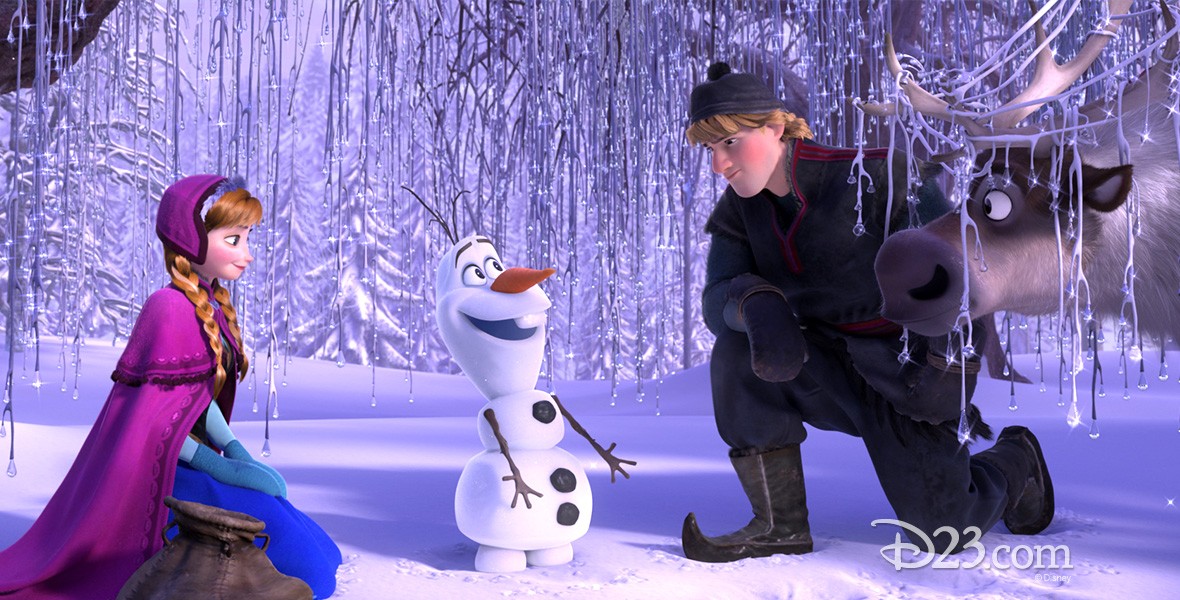
Kristoff works because he enters as labor rather than destiny. The eternal winter destroys his market, Anna wrecks his sled, and he helps anyway after the transaction becomes personal. His bond with Sven lets the film externalize his softer thoughts without turning him into a polished prince.
The romance develops through irritation, competence, and repeated choices. He questions Anna’s engagement without claiming her. He rushes her toward Hans when he believes that kiss will save her. The story allows him to love her before he becomes the answer, which is exactly why he can remain part of the ending after romantic love loses the climactic job.
Hans and the limits of the twist
Hans works thematically because he is the fantasy Anna wants: immediate recognition, shared loneliness, and a clean exit from the palace. His betrayal forces the film to separate performance from care. The person who says everything correctly may still be using the script.
The reveal is less convincing as character construction. Earlier scenes hide his private intention so thoroughly that the twist sometimes feels like a writer changing the rules rather than a mask finally dropping. The thematic function survives. The psychological continuity needs more evidence. A stronger film would let the audience notice small acts of control before the library door closes.
Olaf is funny because mortality keeps entering the room
Olaf could have been pure merchandising. Josh Gad and the animation team make him stranger. He is an innocent creation carrying Elsa’s childhood memory, dreaming of summer without understanding heat, and offering warmth while his body melts. The joke and the death impulse occupy the same snowman.
His fireplace scene with Anna lands because he explains love through cost. He stays beside her even as the heat harms him. That definition prepares the climax without announcing the answer. Olaf does not save Anna, but he gives her language for recognizing what love has been doing all along.
The trolls are where the movie loses its nerve
The trolls provide Kristoff’s family and the exposition that moves the final act. They also interrupt a dying woman’s journey with a wedding song that treats boundaries like decorative obstacles. “Fixer Upper” has wit, but its placement is astonishing. Anna is freezing, Hans remains a presumed solution, and everybody decides forced matchmaking needs a chorus.
The scene reflects an older Disney habit that the rest of the film is actively revising. Romantic pairing becomes social pressure rather than earned connection. The story recovers, but the detour exposes how many competing versions of Frozen were still inside the production.
True love is an action, not a prize
Anna sees Kristoff approaching and turns toward Elsa. The decision matters because she abandons the rescue she has been told will save her. She acts from recognition rather than strategy. Elsa is about to die, and Anna chooses her before understanding that the choice is also her own cure.
The thaw works because it resolves both sisters’ false lessons. Anna learns that romantic access is not the only proof she is loved. Elsa learns that connection does not automatically endanger the person who approaches. Love becomes a practice capable of changing how power moves, not a reward handed to the correct couple.
Animation, music, and the machinery underneath the phenomenon
The film’s snow and ice effects remain astonishing because they serve emotional shape. Elsa’s magic shifts from sharp and defensive to architectural, playful, and communal. Arendelle’s warm interiors make the cold feel less like weather than a rupture in the social body.
Kristen Anderson-Lopez and Robert Lopez write songs that expose what characters cannot say in dialogue. The score is least successful when it pauses for comic assignment and strongest when desire collides with self-deception. “For the First Time in Forever” lets Anna and Elsa sing opposite meanings over the same event. That is the film in miniature.
What the film cannot quite confront
Arendelle is a monarchy that closes its borders and almost collapses because the royal family has no public plan for succession, magical crisis, or basic communication. The film treats governance as backdrop even when Elsa’s private fear freezes every citizen’s livelihood. The restoration of summer resolves material suffering without asking how the kingdom should prevent another royal secret from becoming public catastrophe.
The cultural sources also remain more visible than named. Norwegian design gives Arendelle specificity, while Sámi-inspired material enters through Kristoff and reindeer culture without receiving clear identification. Later collaboration on Frozen II would address part of that gap. The first film benefits from cultural texture it does not teach audiences to recognize.
The movie Disney almost made is still visible inside the one that worked
It is easy to discuss Frozen as if the finished film arrived from one clean creative decision. The actual object feels more interesting because you can still sense the earlier versions pushing against it. Hans Christian Andersen’s Snow Queen offered an iconic woman of ice, a broken mirror, a missing boy, and a girl who travels to retrieve him. Disney had circled the material for decades without finding a feature structure that could carry the studio’s preferred emotional machinery. The 2013 film does not solve that adaptation problem by becoming more faithful. It breaks the source apart and redistributes its functions. The distant queen becomes a frightened sister. The rescuer becomes the isolated person’s younger sibling. The dangerous cold moves from an external enchantress into a family system built around fear. That is not a minor update. It changes the question from “How do we defeat the icy woman?” to “What taught this woman that being known would destroy everyone she loves?”
Elsa was not always the wounded co-protagonist audiences met. Development material and accounts from the filmmakers describe a more conventional antagonist, complete with a harsher visual idea and a story that positioned Anna against her. The pivotal change was not simply making Elsa nicer. “Let It Go” revealed that the character’s isolation had an interior logic powerful enough to reorganize the movie. Once the songwriters treated the moment as release rather than villain declaration, the story could no longer ask viewers to wait for Elsa’s defeat. It had to understand her. That revision explains why portions of the plot feel built for two different films. Hans absorbs villain labor late. The trolls carry exposition from an older romantic adventure. Elsa’s emotional story becomes the spine even though she spends long stretches physically separated from the traveling group.
That production history matters to criticism because rough seams are not automatically failures. Sometimes they show where a movie became more honest faster than its inherited structure could adjust. Frozen still contains the bones of a princess quest. Anna leaves a castle, gains a rugged companion and comic animal, faces weather, and races toward a supposed romantic cure. At the same time, the movie keeps interrupting that route with evidence that the real emergency began years before the coronation. Every romantic beat sits beside a door, a glove, a memory gap, or a sister who learned to interpret absence without facts. The fairy-tale machinery keeps promising that the right man will complete the journey. The family drama keeps demonstrating that no man created the wound and no kiss can repair it.
Jennifer Lee’s screenplay is strongest when it lets those competing structures argue instead of pretending the subversion erased the tradition. Anna genuinely wants romance. Kristoff genuinely becomes a viable partner. Hans genuinely knows how to occupy the prince-shaped space in her expectations. The ending does not announce that romantic love is fake. It identifies the danger of treating romance as the only socially legible form of salvation. Anna’s sacrifice does not work because sisterhood wins a contest against dating. It works because an act of love is recognized by what it costs and protects, not by the role assigned to the person performing it.
The result is a movie that can feel overstuffed because it is doing adaptation, revision, franchise engineering, musical theater, comedy, and family trauma at once. I would rather examine those collisions than flatten them into a victory speech about Disney finally becoming modern. The studio did not escape its habits. It found a new emotional truth inside them. That truth was strong enough to pull the villain away from Elsa, strong enough to move the kiss out of the climax, and strong enough to make a closed bedroom door more frightening than the blizzard outside. The older film remains visible, but the sisters keep taking authorship away from it.
The accident is not the family tragedy. The response is.
Young Elsa striking Anna is an accident produced by play, excitement, and power moving faster than judgment. Nothing in the nursery sequence suggests cruelty. Elsa is showing off because Anna delights in what she can do. Anna keeps asking for more because her sister has always made wonder feel safe. The terror begins when one missed landing changes the meaning of that shared language. Elsa does not merely learn that magic can injure. She watches every adult in the room respond as though her body has become an emergency. That distinction is essential. A child can survive knowing that a capacity requires care. What Elsa receives is the message that the capacity makes intimacy itself unsafe.
Grand Pabbie’s warning is remembered through the vocabulary of fear, but the trolls do not prescribe years of isolation. He repairs Anna, removes her memory of Elsa’s magic, and shows the family a vision in which fear becomes the danger. The parents build the treatment plan. They close the gates, reduce contact, give Elsa gloves, separate the sisters, and turn “conceal, don’t feel” into household doctrine. Their decision is understandable. They have nearly lost a child and have no manual for elemental magic. Understanding the panic does not make the system healthy. Good intentions can still produce a home where one child becomes a secret and the other becomes collateral damage.
Agnarr’s instruction teaches suppression rather than regulation. Elsa is not helped to name sensations, test limits, ask for space without disappearing, or repair after mistakes. She is trained to prevent evidence. The gloves become a portable version of the locked room. Their function is practical at first, but the symbolism hardens around them. Covered hands mean successful daughter. Bare hands mean exposure, danger, and shame. When Hans removes one glove in the dungeon, the act is not just a restraint tactic. It weaponizes the family rule. Elsa has been taught that losing concealment means losing control, so taking the glove helps produce the panic the captor claims to fear.
Anna experiences the same policy from the opposite side. Her memory no longer contains the reason for separation, so she cannot even organize the loss into a coherent grievance. She only knows that Elsa stopped answering. Children often protect attachment by inventing explanations that preserve the absent person, and Anna turns the hallway into a waiting room. She knocks, jokes, sings, offers company, and eventually grieves at the door after their parents die. The persistence looks cheerful because Kristen Bell and the animators keep motion in her body. Underneath it is a child repeating the same bid for connection because nobody has given her enough truth to stop asking the question.
The parents die without undoing the structure they created. This is one of the film’s cruelest decisions. Elsa inherits authority but not emotional skill. Anna inherits a palace but not an explanation. Their grief has no shared ritual because the door remains between them. When adults describe the sisters as estranged, the word can imply a mutual falling-out. That is not what happened. A frightened institution separated them before either child could consent, then normalized the separation until both sisters performed it themselves. The coronation does not begin the crisis. It removes the last adult cover from a crisis that has been managed as family routine for years.
Doors are the film’s real monsters
The most important repeated object in Frozen is not the snowflake. It is the door. Doors divide the nursery, close the kingdom, frame Anna’s courtship, protect Elsa’s mountain retreat, trap Anna with Hans, imprison Elsa, and finally stand open in the restored palace. The repetition works because each door changes function while carrying the same emotional history. A door can create safety, enforce secrecy, offer possibility, or conceal violence. The movie asks viewers to stop treating openness as automatically good and closure as automatically bad. What matters is who controls the threshold, what information sits on either side, and whether the person outside is allowed to understand why access has changed.
“Do You Want to Build a Snowman?” gives the architecture a timeline. Anna begins with confidence that the door will open because it once did. Her body is active, her questions are playful, and the hallway still feels temporary. As the years pass, the same composition becomes evidence of institutional permanence. Anna’s requests shrink from play to company. Elsa’s silence becomes more expensive because the sisters now possess fewer shared experiences from which to rebuild. By the final verse, they sit against opposite sides after their parents’ funeral. The physical distance may be inches. The emotional system makes it impassable.
Hans succeeds because he presents himself as an open door. He shares a story of neglect, finishes Anna’s musical phrases, and offers immediate mutual recognition. “Love Is an Open Door” sounds like the opposite of the childhood hallway, and that is exactly why Anna mistakes relief for knowledge. The song is not evidence that she is stupid. It is evidence that she has been deprived. A person who has waited years for one door to open may not inspect the hinges on the first entrance offered. Hans understands enough about royal loneliness to turn access into acceleration.
Elsa’s ice palace is usually discussed as liberation, and visually it is. Architecturally, it repeats the family solution at a grander scale. She leaves one closed palace, builds another, and places it where almost nobody can reach her. The difference is authorship. Elsa chooses this threshold, changes her clothes, and fills the structure with evidence of her own taste. That agency matters. It still does not transform isolation into regulation. The palace gives her room to discover what power can make. It cannot teach her how power can remain in relationship. When Anna arrives, Elsa experiences the visit as invasion because she has no model for negotiated closeness.
The final open gates work only because the film has changed the conditions of access. Elsa is not required to surrender power so Arendelle can enter. Anna is not required to pretend years of silence did not hurt. Kristoff does not become king by romantic entitlement. The rink at the end turns the courtyard into shared space created by the very magic once confined. Openness becomes sustainable when difference is visible and boundaries are not enforced through disappearance. That is a more demanding conclusion than “do not shut people out.” It says a home must become safe enough that a door can close without threatening abandonment and open without requiring self-erasure.
Let It Go is a survival song, not a treatment plan
The cultural life of “Let It Go” often detaches the sequence from the plot. Heard alone, it is an anthem about rejecting judgment and claiming the self. Inside the movie, it is also a beautifully scored avoidance strategy. Both readings are true. Elsa has spent years measuring every gesture against catastrophe. On the mountain she finally experiments without apologizing. The animation changes her center of gravity. Her shoulders release, her stride lengthens, and the magic moves from accidental defense into deliberate design. Relief is not fake because it is incomplete. Anybody who has escaped a punishing environment knows that the first private breath can feel like a whole new life.
The sequence becomes more complicated when Elsa declares the cold never bothered her anyway. We have already watched cold organize every relationship in her life. The line is not factual autobiography. It is the kind of sentence a person says while trying to make a new identity hold. She converts pain into aesthetic, fear into architecture, and exile into sovereignty. That performance can be necessary. It can also become another demand not to feel. “Conceal, don’t feel” required Elsa to look calm for other people. “Let it go” risks requiring her to look invulnerable for herself.
The dress transformation is powerful because clothing had been part of her containment. Coronation fabric covers her from throat to floor, the cape extends the burden of office, and the gloves police contact. The ice dress exposes skin, movement, and personal choice. None of this requires the sequence to be read as sexual or romantic. It is bodily authorship. Elsa decides how she will be seen after years of dressing for risk management. That is why queer, disabled, neurodivergent, anxious, and traumatized audiences can all find genuine points of entry. The metaphor does not belong to only one experience, but it absolutely belongs to people whose difference has been managed as a family embarrassment.
The palace rises from geometric control. Stairs form underfoot. Symmetry expands. The chandelier and snowflake patterns prove that Elsa’s power is not merely weather but thought made material. Yet the building has no kitchen, bed, community room, or visible place for another person to stay. It is a monument to the self she can imagine when no relationship makes a claim on her. The absence is the point. She has designed freedom according to the only model available: nobody can be hurt if nobody is close.
The movie does not punish Elsa for singing. It lets the relief stand and then tests the belief underneath it. Arendelle remains frozen because leaving a system does not erase one’s effect on it. Anna remains wounded because self-discovery cannot substitute for a conversation with the person harmed by silence. Elsa’s return matters only after love changes how she understands control. The finale does not tell her to put the gloves back on. It proves that power can be expressive, public, useful, playful, and connected. “Let It Go” is the necessary break with concealment. The ending is the beginning of integration.
The songs do the psychological work the dialogue cannot carry
The Lopezes’ score is not a collection of pauses around the plot. At its best, it is the plot’s diagnostic system. “For the First Time in Forever” lets Anna and Elsa occupy the same day while living in opposite emotional realities. Anna sees gates opening, faces arriving, and a chance to become visible. Elsa sees exposure, scrutiny, and a countdown to failure. Their melodies eventually overlap, but harmony does not mean agreement. The counterpoint makes two valid experiences audible at once. That is the family conflict more precisely than a dialogue scene explaining that one sister feels lonely and the other feels afraid.
“Love Is an Open Door” works as seduction because its musical construction supplies the compatibility the characters have not earned. Hans and Anna trade lines, synchronize jokes, and complete thoughts. The speed feels like proof. Later knowledge turns the song into evidence of method. Hans does not need to invent every similarity from nothing. Manipulation is more effective when it uses real points of recognition. He is a younger son who understands being overlooked. He converts that understanding into a performance calibrated to Anna’s hunger. The duet shows why chemistry cannot serve as a background check.
“Reindeer(s) Are Better Than People” gives Kristoff a comic number that is also a compact attachment profile. He speaks safely through Sven, answers himself, and keeps human judgment at a distance. Jonathan Groff differentiates the voices just enough to show that Sven is both beloved companion and channel for feelings Kristoff resists owning directly. The device could reduce Sven to a puppet. The animation protects the reindeer’s agency by giving him reactions that do not always submit to Kristoff’s narration. Their relationship makes solitude look functional, then allows Anna to complicate it.
“In Summer” is the movie’s best use of dramatic irony because Olaf’s impossible fantasy never becomes a cruel joke at his expense. The audience knows heat will destroy him. Olaf knows only that warmth seems connected to happiness. His confidence exposes how desire can be sincere while built on missing information. The sequence also hides a future argument about love and melting in a comic production number. By the fireplace, Olaf chooses heat to keep Anna company. What was once ignorance becomes sacrifice. The same physical fact changes meaning when he understands the cost and acts anyway.
“Fixer Upper” is the score’s failure of placement and consent. The trolls diagnose both Anna and Kristoff while ignoring Anna’s stated engagement, her worsening physical condition, and the urgency of reaching Hans. The song wants to argue that imperfect people can be loved. That theme is harmless. The staging turns it into collective pressure, complete with an improvised wedding and assumptions that objections are obstacles to overcome. The number belongs to a version of the movie that still thought romantic matchmaking should drive the climax. Its interruption makes the final sisterly choice feel even more radical, but I refuse to give the song credit for a correction it actively delays.
Anna is not foolish. She is under-informed, touch-starved, and moving fast.
Anna’s comedy depends on momentum. She wakes with bed hair, races through the palace, talks to paintings, collides with a horse, and narrates feelings before deciding whether another person is ready to receive them. It is tempting to reduce that rhythm to lovable clumsiness. Kristen Bell gives the speed an emotional source. Silence has dominated Anna’s life. When an interaction becomes possible, she fills it before it can disappear. The behavior is not mature, but it is legible. She has had almost no peer contact, no model of healthy courtship, and no truthful account of why her central childhood relationship vanished.
Her proposal scene with Hans is reckless in practical terms. It is also the first time an adult structures attention entirely around her. He asks questions, mirrors posture, offers family pain, and makes the future sound immediate. Anna does not possess the experience required to separate disclosure from trustworthiness. Viewers who mock her for failing to detect a villain are using information the scene intentionally withholds and skills her upbringing never allowed her to practice. The palace educated her in etiquette while leaving her relationally unschooled.
The confrontation with Elsa matters because Anna is finally asking the correct person for access and still asks in the wrong form. She presents the engagement as a finished decision requiring approval. Elsa responds with authority rather than explanation. Neither sister can slow the exchange enough to discuss what the proposal means. Anna hears another unexplained refusal from the person who has refused her for years. Elsa hears evidence that opening the gates has already produced an uncontrollable threat. The argument escalates because every present sentence carries the weight of the missing childhood conversation.
On the mountain, Anna remains solution-driven. She assumes Elsa can reverse winter because Elsa caused it. That belief is rational until Elsa says she cannot. Anna then keeps pushing, partly because the kingdom is in danger and partly because accepting Elsa’s uncertainty would eliminate the only available plan. Her optimism can become coercive when she treats connection as something persistence will force open. The film is wise enough to let Anna’s devotion and her boundary problems coexist. Love does not make every approach skillful.
Her final decision completes an arc that is not primarily about choosing the correct love interest. For most of the film Anna pursues proof that somebody will choose her. At the climax, she has apparent proof that Kristoff is coming, yet turns toward Elsa without knowing the choice will be seen, rewarded, or survivable. She stops organizing love around receipt and performs it as protection. The frozen body is not a prize for virtue. It is the physical endpoint of a person who finally acts from her own value system rather than begging another person to certify that she matters.
Elsa’s control problem is really a relationship problem
Elsa is often described as afraid of her powers, but she is more precisely afraid of what her powers will do inside relationship. Alone, she can build a palace in minutes. In public, a dropped glove becomes catastrophe. The difference is not technical capacity. It is the pressure created by witnesses, responsibility, and the possibility of harming somebody who matters. Her magic responds to emotion, and emotion responds to the social demand that she not have emotion. The feedback loop is vicious. She must appear calm to keep everyone safe, but the effort required to appear calm increases the fear that makes control harder.
That makes her coronation a remarkable piece of suspense. Nothing traditionally threatening happens. A young woman holds ceremonial objects while strangers watch. The film has taught us that contact, scrutiny, and performance are the danger. Elsa has prepared for the task by repeating the family rule, not by developing a new skill. When she briefly succeeds, the relief is fragile because success confirms the method that injured her. She gets through the ritual by dissociating from need. Anna’s request then arrives not as one isolated disagreement but as proof that public life will demand decisions Elsa has no practice making.
Elsa’s language repeatedly removes herself from other people’s choices. She tells Anna to leave, tells the kingdom to stay away, and insists she belongs alone. These statements sound authoritative, but they protect everyone from having to negotiate with her uncertainty. If Elsa disappears, nobody can choose whether the relationship is worth risk. That is why Anna’s persistence both helps and harms. Anna refuses the conclusion that isolation is the only loving option, yet she often refuses to hear Elsa’s immediate boundary. The sisters need a language where “not now” does not mean “never again” and approach does not mean invasion.
The Marshmallow sequence literalizes defensive escalation. Elsa first creates a small snowman from childhood memory. Under threat, she produces a giant guard whose purpose is removal. Her creations are not random creatures. They externalize relationship states. Olaf carries play, warmth, and the version of sisterhood that existed before fear. Marshmallow carries the command to leave and grows more dangerous when visitors resist. The magic makes emotional patterns visible, which means the solution cannot be a stronger lock. Elsa has to recognize the pattern before she can create something else.
Love gives Elsa control at the end, but the phrase can sound like emotion magically solving disability. What changes is her model of emotion. Fear had been treated as contamination, while love was treated as a reason to hide. Anna’s sacrifice proves that closeness can produce protection rather than only injury. Elsa does not become calm because somebody tells her to think positive thoughts. She receives new relational evidence strong enough to interrupt the old loop. The skating rink then becomes practice. She uses power with people, watches their responses, adjusts, and lets joy remain visible. Control becomes co-regulation instead of private suppression.
Hans and Kristoff are two answers to the prince problem
Hans and Kristoff are not simply bad man and good man. They represent two ways a story can make male attention legible. Hans arrives fluent in the language Anna already recognizes from paintings and stories. He is polished, available, royal, verbally aligned, and willing to promise permanence before inconvenience tests him. Kristoff arrives as labor. He smells like reindeer, worries about his destroyed livelihood, challenges Anna’s judgment, and helps through a sequence of choices that rarely sound romantic while he is making them. The contrast is less about class than about performance preceding evidence.
Hans’s deception works because the film gives him useful competencies. He manages frightened citizens, distributes supplies, challenges the Duke’s aggression, and leads a search party. A shallow con artist would be easier to detect and less dangerous. Hans can perform governance because he wants the position and understands its visible duties. The failure is ethical rather than logistical. He treats people as routes to legitimacy. Anna is an available marriage. Elsa is an obstacle who can become a martyr. Arendelle is a vacancy waiting for someone decisive enough to occupy it.
The library reveal is still mechanically unfair in one important respect. Hans receives private reaction shots earlier that are difficult to reconcile with total calculation. After Anna falls into the boat, his smile appears unwitnessed. The film wants viewers to remember those images as proof of chemistry so the betrayal will land. On rewatch, some become evidence that the camera itself protected the twist. A more rigorous version would show tiny moments where control peeks through the charm. The absence does not ruin the theme, but it makes Hans feel like a revised function more than a fully continuous person.
Kristoff earns trust partly because he does not convert care into entitlement. He returns Anna to Hans when he believes Hans can save her. That decision hurts, and the film lets Jonathan Groff play the hurt without turning it into punishment. Kristoff does not say that his effort purchased Anna. Sven has to push him toward admitting what he wants because his default is retreat, not conquest. This does not make him emotionally perfected. Speaking through a reindeer and withholding affection are their own defenses. It makes him a partner whose growth can continue after the kiss.
The final sled joke is small but revealing. Anna replaces the vehicle destroyed during their journey and gives Kristoff a royal title connected to his actual work. The gesture acknowledges material loss rather than treating adventure as free labor performed for a princess. She then asks before kissing him. The exchange is playful, but it quietly corrects the coercive energy of “Fixer Upper.” Romance becomes an arrangement between two people who can offer, refuse, negotiate, and laugh. The film does not abandon the couple. It asks the couple to arrive after evidence.
Olaf is childhood memory walking toward death without knowing it
Olaf’s design looks engineered for immediate affection, and pretending otherwise would be silly. He is a compact merchandising miracle with movable parts, a broad face, expressive twigs, and a voice built for quotation. What keeps him from becoming only product is the sadness embedded in his origin. Elsa creates him while singing about freedom, but his personality carries the sisters’ childhood play. He enters the adult story as a memory neither sister has been able to inhabit safely. Anna recognizes him before Elsa has to acknowledge what she made.
His fascination with summer is funny because the audience understands the material contradiction. The joke would be mean if the film treated Olaf as disposable once he learned the truth. Instead, summer becomes his language for warmth, company, and sensory abundance. He wants a season because he has inherited desire without knowledge. That is close to Anna’s condition. Both characters move toward an imagined future using fragments of information. Anna thinks a prince will end loneliness. Olaf thinks heat will complete happiness. Experience has to revise the fantasy without humiliating the person who needed it.
The fireplace scene is where the mascot becomes a moral witness. Olaf lights a fire for Anna even though proximity makes him melt. He does not make a speech about sacrifice. He notices her need, understands enough about his own cost, and stays. “Some people are worth melting for” becomes the film’s clearest definition of love because it joins affection to chosen vulnerability. The line also prepares Anna to recognize an act of love that does not look romantic. Olaf cannot thaw her heart, but he can correct the category error that has trapped the plot.
His detachable body allows slapstick to coexist with existential danger. Limbs separate and return. His head turns backward. A sneeze or impact reorganizes him without lasting harm. That flexibility makes the later melting legible without becoming visually traumatic for children. The film can approach mortality through a body whose boundaries are comic. Yet the emotional point remains serious. Olaf is alive because Elsa’s power can create relationship, not only destruction. Saving him with a personal flurry at the end is Elsa’s first sustained act of care toward one of her creations.
There is also something useful in Olaf’s lack of suspicion. He accepts statements at face value and approaches strangers as possible friends. In another movie that innocence would exist to be corrected by cynicism. Here it becomes one part of the group’s survival. Kristoff supplies practical skepticism. Anna supplies urgency. Olaf supplies an assumption that connection is possible. No single disposition is sufficient. The found family works because their vulnerabilities overlap without becoming identical. Olaf is not wise despite being ridiculous. His ridiculous openness is one form of wisdom the frightened adults have lost.
Snow, hair, cloth, light, and the labor hidden under “magic”
The animation’s greatest achievement is not that the snow looks realistic. It is that snow behaves according to emotional and physical context without losing material credibility. Powder compresses beneath feet. Wind lifts fine particles while heavier drifts hold shape. Ice can be translucent, reflective, cloudy, sharp, decorative, or load-bearing. Elsa’s magic does not use one generic texture. The surfaces change as her confidence changes. Defensive shards arrive differently from palace columns. The frozen fjord has another scale entirely, turning weather into public infrastructure failure.
Computer animation often struggles when beauty becomes too polished to feel inhabited. Arendelle avoids that problem through clutter, wear, fabric, food, timber, stone, and crowds moving with different priorities. The coronation rooms are arranged for ceremony, but Anna slides through them with the energy of someone who has been denied ordinary use. Oaken’s shop feels stocked rather than staged. Kristoff’s sled contains tools and damage. These details matter because the story depends on a contrast between royal secrecy and a world of people who still have to trade, travel, heat homes, and survive weather.
Costume design carries class, region, season, and psychology. Elsa’s coronation clothes restrict motion and concentrate visual weight at the center. Anna’s travel clothing accumulates exposure to the journey while preserving her color and openness. Kristoff’s outfit communicates work in cold conditions instead of fantasy ruggedness alone. Norwegian folk influence appears through silhouettes, embroidery, decorative pattern, and the visual vocabulary of Arendelle. The film turns research into a coherent world, though coherence should not be confused with transparent cultural attribution.
Hair is another technical performance audiences tend to read only as character beauty. Elsa’s braid, Anna’s braids, flyaway strands, snow contact, and movement through wind all require simulation controlled enough to support acting. The famous transformation works because hair participates in the change of posture. Elsa does not merely receive a new dress. Her whole silhouette stops reporting obedience. Anna’s white streak functions differently. It is visible damage and inherited trace, a bodily countdown that other characters can read before she can fully feel the ending approaching.
Lighting keeps the color system from collapsing into blue. Warm interiors, lanterns, sunrise, candlelight, and skin tones give the cold something to interrupt. During “Let It Go,” cyan and violet create exhilaration, while the later palace confrontation sharpens contrast and empties warmth from the environment. The climax uses the whiteout to remove orientation. Characters become silhouettes searching for each other through limited information. When the storm stops around Anna’s sacrifice, stillness is not just spectacle. The entire visual system pauses long enough for Elsa to see what fear had kept obscuring.
Norway gives Arendelle its body, while Sámi influence requires clearer naming
Arendelle is fictional, but its visual confidence comes from specific research rather than a generic northern mood board. The stave-church shapes, fjord geography, rosemaling-inspired decoration, textiles, carved wood, mountain architecture, food, and formal clothing all help the kingdom feel built by a culture rather than assembled from snow icons. Disney’s official material has long emphasized the filmmakers’ research travel and the visual development that grew from Norway. That specificity is one reason the world survived beyond the plot. Audiences can imagine streets, rooms, work, and seasons outside the scenes shown.
Specificity also creates responsibility. Kristoff’s clothing, reindeer livelihood, and musical introduction draw on Sámi associations, yet the first film does not name the people whose living culture helped make him readable. “Vuelie,” adapted from Frode Fjellheim’s “Eatnemen Vuelie,” places a choral sound connected to Sámi musical practice at the beginning, but many viewers received it as an atmospheric signal for mystical north. When cultural material is used primarily as texture, appreciation can become extraction even when individual collaborators are credited.
The issue is not that fantasy must reproduce one nation with documentary precision. Arendelle combines sources, alters geography, and invents a monarchy. The question is whether audiences are encouraged to understand which parts were invented and which came from communities that still exist. A fictional kingdom can acknowledge inspiration without turning a living people into lore. The first film rarely gives viewers the vocabulary required to make that distinction. Later work around Frozen II, including formal consultation and a cooperation agreement with Sámi representatives, implicitly demonstrates that the gap was real enough to address.
Kristoff should therefore be discussed carefully. Calling him straightforward Sámi representation overstates what the text establishes. Ignoring the coding erases the source. The honest reading holds both facts: his occupation, clothing, relationship with reindeer, and some design choices evoke Sámi culture, while the film does not identify him as Sámi or build a community around that identity. He functions inside Arendelle’s fantasy economy. Cultural influence is visible, but representation remains incomplete and mediated by Disney’s needs.
A deep fandom guide should make the source material more visible than the franchise marketing did. That means naming artists and traditions where reliable documentation exists, avoiding claims that every geometric pattern has one sacred meaning, and refusing to use northern Indigenous culture as shorthand for magic. It also means recognizing the difference between loving the film’s design and declaring the borrowing harmless because the result is beautiful. Beauty is a reason to learn where something came from, not an exemption from the question.
The kingdom freezes because private secrecy became public policy
Elsa’s winter is magical, but the scale of the disaster is political. A royal family isolates itself, withholds critical information, stages a coronation without a workable contingency plan, and then leaves citizens to absorb the economic and physical consequences. The Duke is opportunistic, yet his concern about trade is not invented. Kristoff loses his market immediately. Ships become trapped. Food, heating, shelter, and movement become urgent. The movie shows enough civic disruption to prove that royal emotion has material effects, then keeps governance mostly at the edge of the frame.
Arendelle’s closed gates are treated as family atmosphere until opening day reveals how many systems depend on the palace. The staff reduction after Anna’s accident may have protected secrecy, but it also concentrated knowledge and removed possible support. No council, regent, magical advisor, or transparent succession process appears. Elsa becomes queen because bloodline and ceremony say so, not because anyone has evaluated whether years of confinement prepared her to govern. Her distress deserves compassion. Citizens still deserve institutions capable of functioning when the monarch is distressed.
Hans exploits that vacuum with alarming ease. He receives authority from Anna, performs emergency management, and nearly converts provisional responsibility into a crown. The Duke’s men can attempt to kill Elsa while claiming defense of the realm. News about Anna’s supposed death becomes a political instrument nobody independently verifies. These are not only villain tricks. They are signs of a state where legitimacy travels through proximity to royal bodies and where private statements can become public fact without durable checks.
The thaw restores commerce and produces collective celebration, but the ending does not show constitutional learning. Elsa opens the gates and becomes a beloved queen because she now controls magic. That is emotionally satisfying and civically thin. The same person remains the single point of magical and political failure. Love has improved her regulation, but a kingdom should not need its ruler’s nervous system to remain stable every hour. The film wants openness to function as reform. Openness is a value, not an emergency plan.
This limit does not invalidate the sisters’ achievement. It locates where the franchise could grow. Anna has practical knowledge of ordinary isolation, Elsa has direct knowledge of institutional fear, Kristoff understands labor and trade, and the population has survived the cost of secrecy. A serious sequel could ask how those experiences change governance. Frozen II moves toward historical accountability but still solves public crisis through royal family transformation. The monarchy remains the genre habit Disney is least willing to let go.
The villain reveal works as a theme better than it works as a mystery
Hans’s betrayal is often treated as the film’s great subversion, but the more important move is Anna’s misunderstanding of true love. Hans could have been merely inadequate and the climax could still redirect salvation toward Elsa. Making him murderous sharpens the warning about accelerated intimacy, yet it also gives the audience a convenient individual to blame. The conditions that made Anna vulnerable were created by years of family secrecy. Hans exploits the wound. He did not make it.
The reveal scene is effective because it removes warmth through behavior rather than special effects. Hans closes curtains, extinguishes the fire’s promise, and speaks with a calmness that reclassifies every romantic gesture. He does not rant about evil. He explains logistics. Anna’s emotional devastation comes from realizing that the story she used to organize the last day was never shared by the other participant. The physical freezing then advances while her interpretive world collapses. Betrayal becomes temperature.
His plan still depends on extraordinary luck. He cannot know Elsa will expose herself at the party, flee, create winter, or be captured alive. He cannot guarantee Anna will return dying, that the trolls’ proposed cure will be a kiss, or that nobody will challenge his account after both sisters are gone. Opportunists do not need a perfect plan, but the screenplay sometimes treats adaptability as omniscience. Hans is best understood as a person who recognizes openings and escalates quickly, not as a mastermind who choreographed the entire plot from the boat.
The Duke provides a more transparent form of threat. He arrives focused on exploitation, turns fear into a case for violence, and protects his own hands by issuing commands. His cartoon movement and mispronounced title make him easy to dismiss, which mirrors a familiar political danger. Ridiculous people can still authorize lethal action. The film eventually cuts trade with Weselton, but it never examines Arendelle’s previous willingness to build economic relationships with someone Elsa already expected to be predatory.
Neither villain is as frightening as the family slogan because villains can be expelled. “Conceal, don’t feel” survives inside Elsa after the parents are dead. Anna’s hunger for immediate proof survives after Hans reveals himself. The final act wins because the sisters interrupt internalized rules, not because Hans is punched into the water. His defeat is satisfying. Their recognition is transformative. The movie’s smartest choice is making the antagonist removable while locating the real work somewhere no guard can arrest.
Easter eggs, callbacks, and details worth noticing without inventing folklore
A useful Easter-egg section begins by separating visible detail from viral certainty. Rapunzel and Eugene from Tangled can be seen among the coronation guests. That is a visual cameo, not proof that every fan-made family tree is canon. The figures resemble their post-film designs and reward viewers familiar with the earlier movie. Nothing in the scene establishes political alliance, cousinhood, or a shared chronology beyond the playful studio appearance. A deep review should enjoy the nod without converting three seconds of background animation into unsupported genealogy.
Oaken’s trading post contains a small Mickey-shaped figure or arrangement visible on a shelf, one of the studio’s familiar hidden-character signatures. Again, the value is observational. It tells us artists layered the environment with details for repeat viewing. It does not mean Mickey governs a secret northern economy. The store also rewards attention through ordinary inventory, signage, winter goods, and the sauna glimpse that establishes Oaken’s family life. The environment is funny because it feels occupied before Anna crashes into it.
The chocolate shared by Anna and Elsa during coronation festivities echoes Disney-princess visual language, and viewers often connect it to Wreck-It Ralph or earlier films. The safer point is the character beat visible on screen. After years apart, both sisters respond to the same temptation with almost synchronized delight. The moment proves compatibility before either can sustain a conversation. Food becomes a tiny surviving piece of sisterhood, which matters more than assigning the confection a cinematic passport.
Watch the repeated snowman imagery rather than only the hidden cameos. Young Anna and Elsa make Olaf together. Elsa unconsciously recreates him during her escape. Anna recognizes the design. Olaf later supplies language for love, and Elsa preserves him with a personal flurry. The callback is structural. A childhood object travels through repression, creation, recognition, sacrifice, and repair. Unlike a background Easter egg, it changes meaning each time the story returns.
The film also plants its ending through gesture. Anna repeatedly moves toward people who might answer her loneliness. Elsa repeatedly retreats to protect them. At the climax, Anna reverses direction and Elsa moves toward the frozen body. The blocking resolves character patterns before dialogue explains the thaw. That is the kind of detail worth calling an Easter egg only if the term expands beyond cameos. It is a visual promise hidden in plain sight: the story will change when each sister can do what the other has been doing for years.
The ending earns the thaw, then begins work the credits cannot finish
Anna’s act of love is sometimes summarized as choosing Elsa over Kristoff. The actual decision is harsher. She chooses Elsa over the possibility of surviving. From Anna’s limited knowledge, Kristoff represents the last chance at the cure. Elsa is moments from a sword. Anna cannot protect both futures, so she spends the one she believes remains. The sacrifice counts because it is not a clever test. She does not know a sisterly act will reverse the curse. She only knows Elsa should not die alone.
Elsa’s grief completes the circuit. For years she has believed closeness makes her lethal. Anna’s frozen body appears to confirm the fear in its most absolute form. Then the body thaws because Anna’s closeness was protective. Love does not merely add warmth to ice. It overturns Elsa’s causal model. The person she thought she destroyed has acted with agency, saved her, and revealed that fear was never the only force capable of moving magic. Control follows understanding because understanding changes the emotion directing the power.
The punch delivered to Hans belongs to Anna, and that matters. Kristoff does not avenge her to prove masculine worth. Elsa does not execute the threat as queen. Anna confronts the person who tried to convert her death into political theater. The moment is broad comedy, but it returns action to the character who was manipulated. She is no longer waiting in a room for somebody else to decide whether her heart is valuable.
The restored summer does not erase the sisters’ history. Opening gates cannot return missed birthdays, shared mourning, education, or the ordinary intimacy they should have had. The final play suggests willingness rather than completion. Elsa uses magic publicly. Anna participates without chasing reassurance. Olaf receives care. Kristoff remains close without replacing the sister bond. These are new behaviors. A responsible reading should not mistake a montage of joy for trauma disappearing. Repair is credible because the film shows a first different pattern, not because every consequence is solved.
That distinction is why the ending remains emotionally durable after the twist became familiar. Surprise fades. Recognition deepens. Viewers can return knowing Hans’s plan and still feel the storm stop around Anna because the scene depends on character choice, not information control. The thaw is satisfying on the hundredth viewing if the audience understands what each sister had to unlearn. The movie’s final magic trick is making a fairy-tale cure feel like evidence from a relationship.
The phenomenon, the backlash, and the movie underneath the merchandise
The scale of Frozen became part of the text’s reception. “Let It Go” escaped the film, children repeated it until adults developed defensive reflexes, Elsa’s dress became an industry, and the sisters occupied parks, books, toys, ice shows, theater, shorts, sequels, and bedrooms worldwide. Disney’s own tenth-anniversary account emphasizes the song’s awards and the hundreds of millions of publishing units connected to the franchise. Cultural saturation can make criticism strangely impatient. People begin reviewing how often they encountered the product rather than what the movie actually does.
Backlash was inevitable and sometimes healthy. The film’s racial narrowness, cultural borrowing, monarchy, thin villain continuity, troll sequence, and marketing machine deserve scrutiny. Other complaints amount to irritation that girls loved something loudly. A song associated with children and women becomes “annoying” in ways equally repetitive male-coded franchises often escape. Popularity does not prove quality, but contempt is not analysis either. The job is to separate corporate omnipresence from the emotional reasons audiences kept choosing the story.
The sister ending arrived at a moment when Disney Princess branding had trained viewers to expect romance as the organizing reward. Brave had already challenged that expectation through mother and daughter. Frozen placed sisterhood inside a musical architecture that looked much closer to the classic princess formula, then let the familiar machinery misdirect the audience. The achievement should not be exaggerated into a claim that Disney invented non-romantic love. Its industrial influence still matters. The success widened what executives could imagine as commercially central.
Elsa’s resonance also exceeded any single official interpretation. People living with anxiety, shame, disability, queerness, family secrecy, cultural expectation, and emotional suppression recognized structures in her story. No studio press release can limit that recognition after release. Interpretation belongs to the encounter between text and audience. At the same time, Disney benefits financially from expansive identification while often keeping identity-specific commitments vague. Loving what Elsa means to viewers should not require pretending the corporation is brave in every way the audience has been.
Strip away the saturation and the film remains a story about two people who already love each other but have been taught forms of love that keep injuring them. Elsa disappears to protect Anna. Anna pursues Elsa to restore connection. Both actions make sense. Both become dangerous when repeated without new information. The climax works because neither sister stops loving. They change what love does. That is more psychologically interesting than a simple lesson about acceptance, and it is why the movie survives even when the dolls, slogans, and karaoke have exhausted the room.
Final receipt: what Frozen gets right, what it leaves unpaid
The film’s strongest achievement is structural empathy. It does not require the audience to choose which sister suffered correctly. Elsa’s terror is real. Anna’s abandonment is real. The parents’ fear is understandable. The system they create is harmful. Kristoff’s skepticism is useful. His withdrawal is limited. Olaf’s innocence is absurd. It carries moral knowledge. The story becomes rich when apparently opposing truths remain in the frame long enough to affect one another.
Its weakest material comes from older habits it never fully rewrites. “Fixer Upper” confuses pressure with care. Hans’s private presentation protects the twist too aggressively. The kingdom’s institutions vanish whenever monarchy would become inconvenient to question. Norwegian and Sámi-derived elements make the world vivid without giving most viewers enough language to identify the living sources. The finale repairs emotional weather faster than public accountability. These are not footnotes. They define where admiration needs friction.
The craft remains exceptional. Songs carry conflicting interior states. Snow behaves as substance and metaphor. Costume, hair, light, architecture, and blocking turn psychology into visible systems. Bell, Menzel, Groff, Gad, and Fontana provide distinct rhythms that keep exposition from flattening character. Christophe Beck’s score connects the songs to a broader sonic landscape, while “Vuelie” establishes a cultural and spiritual atmosphere whose source deserves explicit recognition. The movie is built by hundreds of artists whose labor should not disappear behind the word magic.
The Easter eggs are enjoyable, but the deepest repeat-viewing rewards are not cameos. They are patterns. Doors change ownership. Gloves change meaning. Snowmen carry memory. Characters reverse direction. Songs repeat emotional mistakes before dialogue catches up. A serious fandom review should give those choices more attention than a list of background references because they are how the film keeps speaking after surprise is gone.
Frozen earns a high score because its emotional argument survives contact with its flaws. Love is not proven by immediate access, perfect compatibility, inherited role, or a kiss delivered on schedule. Love becomes trustworthy when it protects another person’s life and allows both people to remain real. The movie reaches that conclusion through a messy production history, a compromised monarchy, one terrible troll song, and two sisters who finally stop mistaking silence and pursuit for the only ways to care. RaeRae verdict: 9/10. The missing point is distributed among the trolls, the constitutional crisis, and Hans’s suspiciously private smile.
Sources and production receipts
The production and credit facts in this review were checked against Walt Disney Animation Studios’ official Frozen film page, which identifies directors Chris Buck and Jennifer Lee, producer Peter Del Vecho, the November 27, 2013 release, and official visual-development material. Disney’s own tenth-anniversary retrospective documents the film’s awards, publishing reach, principal cast, and franchise impact. Those sources establish what Disney officially claims. They do not replace critical analysis of the film.
Awards claims were checked against the Academy’s ceremony record for the 2014 awards, where Frozen received Animated Feature and “Let It Go” received Original Song. Cultural-source discussion distinguishes Norway-inspired production design from Sámi influence and avoids treating Arendelle as a documentary nation. Claims about later consultation belong to the history of Frozen II and are used here only to explain why the first film’s lack of naming deserves attention.
Visible cameos and hidden details were treated conservatively. Rapunzel and Eugene’s appearance and the small Mickey detail in Oaken’s shop are discussed as visual studio nods, not evidence for fan theories the film never confirms. Where a repeat-viewing claim depends on interpretation, this review labels it as interpretation. An Easter egg is not permission to turn speculation into production fact.
The open door has to become policy, not one beautiful ending
Anna opens the castle gates at the end, but a door is only the first visible action. Arendelle spent years absorbing the consequences of royal secrecy. Staff learned not to ask. Citizens learned to accept absence. Elsa learned that leadership meant controlling what other people were allowed to know. A lasting thaw requires more than sunlight on the courtyard. It requires a court able to communicate risk without turning the queen into a rumor and a sister into the only emergency plan.
The sequel mostly treats public trust as repaired, which makes emotional sense for a musical ending but leaves institutional work offscreen. Who advises Elsa about magic? What protections exist if fear returns? Can Anna disagree with royal policy without becoming the bridge between every frightened person in the kingdom? Love solves the immediate winter because Anna and Elsa finally act toward each other. Governance begins after the hug, when a family lesson must become a safer structure for everybody else.
This is why the door remains the best symbol in the first movie. Closing it created the disaster slowly. Opening it ends isolation quickly. Keeping it open demands repeated choices nobody can finish during the final song.
Keep exploring Frozen
Return to the Frozen hub for character files, reviews, Reacts, rants, lore, and watch-order guides.
The ending also asks us to separate reconciliation from erasure. Anna and Elsa can choose each other without pretending the years behind locked doors never happened. Love interrupts the final disaster, but the sisters still have to build habits that childhood isolation denied them. That unfinished work is not a flaw in the ending. It is the reason the ending feels alive after the ice melts.