
Coup d’État
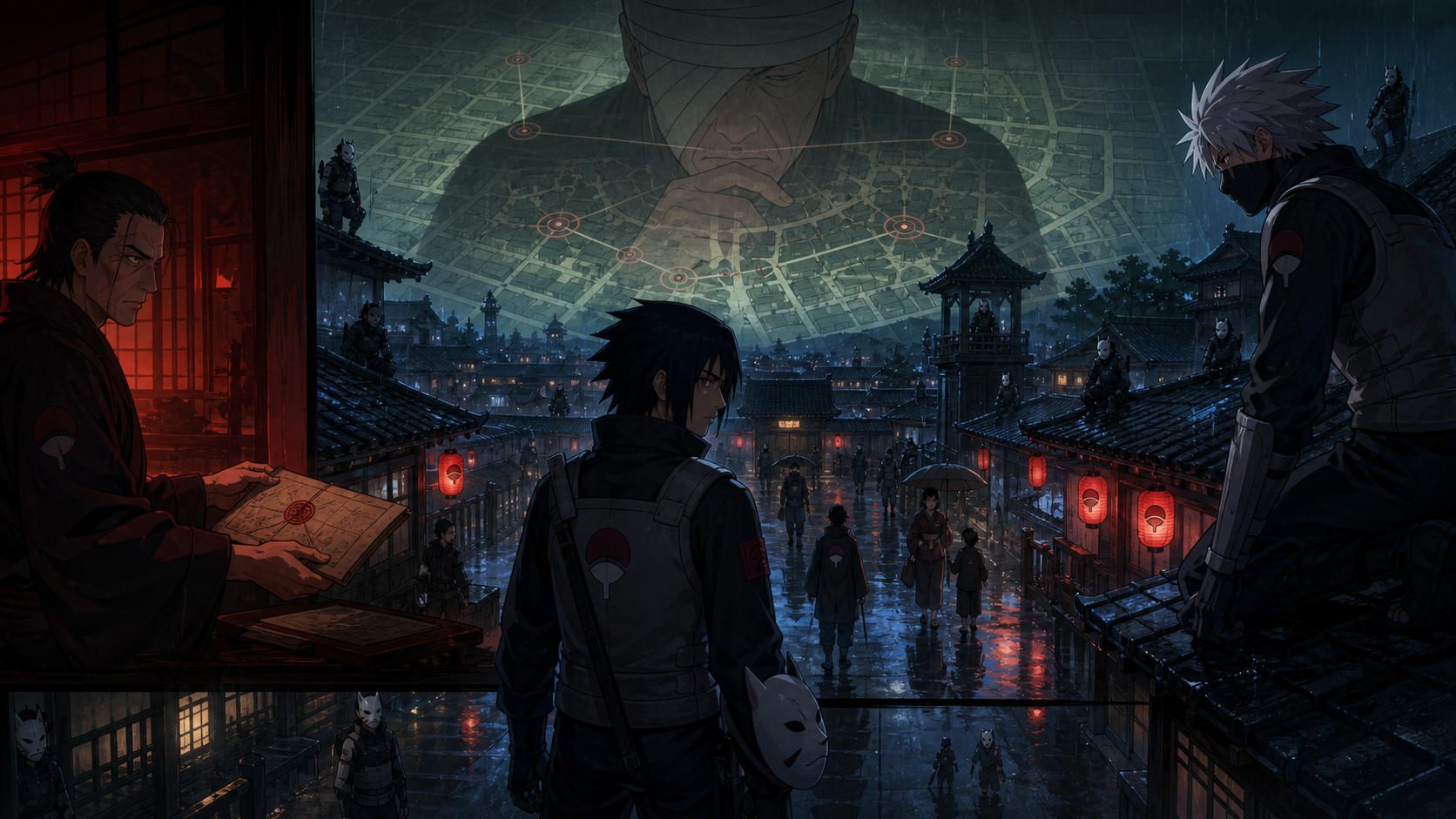
The village answers fear with round-the-clock surveillance, isolating the Uchiha until suspicion begins manufacturing the revolt everyone claims to fear.
Bottom line
“Coup d’État” shows Konoha helping create the crisis leaders claim only surveillance can contain. After the Nine-Tails attack, council figures suspect the Uchiha because Sharingan can control the beast. The village responds by placing the entire clan under twenty-four-hour ANBU surveillance. Capability becomes collective accusation without public evidence connecting ordinary Uchiha families to the catastrophe. Constant monitoring increases exclusion, humiliation, and anger. Those reactions then appear to confirm that the clan is dangerous. Uchiha leaders move closer to a coup, which would expose civilians and deepen the political disaster. Surveillance is not the sole cause of that decision, and discrimination does not make armed seizure harmless. The episode’s tragedy lies in a feedback loop: state suspicion makes peaceful belonging less credible, clan militancy makes state fear easier to defend, and Itachi is ordered to carry information between adults narrowing every nonviolent exit.
The Nine-Tails attack becomes a political origin point
Konoha lost Minato, Kushina, shinobi, civilians, homes, and trust during one night. Collective trauma creates urgent demand for explanation.
Urgency makes a simple suspect emotionally attractive before evidence is complete.
Trauma can narrow institutional imagination
Leaders face pressure to promise that another attack will never happen. Surveillance offers a visible action that can be announced internally as control.
Doing something quickly may reassure authority without identifying the actual attacker or repairing the conditions survivors face.
Mourning and investigation need separate safeguards
People making security decisions are also grieving colleagues, leaders, and family. Those emotions deserve support, while evidence review needs procedures that limit fear-driven generalization.
Unprocessed collective grief should not become an inherited sentence for one clan.
Sharingan capability drives suspicion
Uchiha ocular power can influence the Nine-Tails, so council members connect the clan to the attack. A technical possibility becomes a collective theory.
Capability establishes an investigative question, not guilt for every person who shares a name.
Means, motive, and opportunity remain distinct
A technique can establish possible means. Investigators still need evidence about who possessed sufficient power, who intended the attack, and who was positioned to carry the plan out.
Skipping those questions transforms intelligence assessment into identity profiling.
Inherited ability is not collective intent
Sharingan belongs to individual Uchiha under different circumstances and at different stages of development. Clan membership does not create a shared decision.
Treating biology as political guilt makes innocence impossible to demonstrate.
The actual attacker remains hidden
Obito controlled the Nine-Tails while operating outside ordinary clan life and under Madara’s identity. Konoha leaders do not possess that context.
Missing truth explains uncertainty without validating punishment of an entire community.
Obito benefits from internal suspicion
The real attacker does not need to remain physically present for the damage to continue. Konoha’s response turns his assault into a long-term fracture between village and clan.
An enemy gains strategic value when a community punishes itself after the enemy leaves.
Investigation should follow anomalies
The scale, timing, mask, and disappearance raise questions beyond ordinary clan involvement. Evidence-led inquiry would test multiple explanations rather than settle on the most reachable group.
A broad search protects both security and innocent residents.
Fear seeks a visible group
The masked attacker disappears, while the Uchiha live inside Konoha and carry a recognizable inherited ability. Visibility makes them easier to monitor than the person responsible.
Security policy moves toward whoever can be reached rather than whoever evidence proves responsible.
Visibility produces unequal enforcement
Uchiha homes, workplaces, and relationships can be mapped. A masked outsider has no comparable public network for authorities to pressure.
Practical ease becomes confused with investigative validity.
Familiar neighbors become imagined strangers
The clan has lived, worked, policed, and fought within Konoha. Suspicion reinterprets that shared history through a theory of hidden disloyalty.
Fear can make long familiarity seem like proof of successful concealment rather than evidence requiring balanced judgment.
The council generalizes from power to intent
Knowing that some Sharingan could control a tailed beast does not show who wanted the attack, who had opportunity, or who acted.
Collective suspicion collapses those separate questions into one identity category.
Twenty-four-hour surveillance begins
ANBU monitors the Uchiha continuously. Observation enters daily movement, family life, and political conversation.
Emergency practice becomes an enduring condition without transparent charges or a clear endpoint.
Constant monitoring removes private civic life
Political discussion, family disagreement, grief, and ordinary frustration can all enter security interpretation. People lose space to think aloud without creating a record.
A community cannot participate freely when every conversation may become intelligence.
No endpoint means no route to innocence
If surveillance continues until suspicion disappears, monitoring itself can keep producing suspicious behavior. The clan receives no defined evidentiary standard that would restore ordinary treatment.
Indefinite control becomes easier than admitting uncertainty.
Monitoring is not a neutral pause
Surveillance changes behavior, relationships, and how people interpret every interaction. Awareness of being watched produces caution and anger.
The state cannot later treat those changes as untouched evidence of prior intent.
Observation alters what observers see
Watchers expect conspiracy and therefore notice secrecy, anger, and gathering more readily than ordinary care or internal disagreement. Confirmation bias shapes reports.
Raw surveillance data never arrives without interpretation.
Watched people adapt for self-protection
Clan members may speak less openly, restrict visitors, or move meetings away from known observers. Those choices can protect privacy without proving a coup.
Security analysis must distinguish predictable adaptation from verified preparation for violence.
The whole clan carries the suspicion
Children, elders, police, civilians, and leaders live beneath one security category. Individual conduct matters less than inherited membership.
Collective monitoring makes belonging conditional for people who already belong.
Children inherit a crisis they did not create
Young Uchiha grow up watched because of an attack they neither planned nor understood. Their early relationship with Konoha begins through institutional distrust.
Collective policy manufactures generational consequences.
Internal diversity disappears from policy
Clan members can disagree about leadership, surveillance, village loyalty, and a coup. Treating the group as one mind obscures potential allies for peaceful resolution.
Collective suspicion weakens the distinctions good intelligence should preserve.
The Uchiha police role becomes contradictory
The clan performs village law enforcement while village intelligence treats the clan as a possible internal enemy. Public responsibility coexists with private distrust.
That contradiction communicates that service will not necessarily produce inclusion.
Segregated authority limits political integration
Police responsibility gives the clan a visible function while concentrating members inside one institution. Service occurs beside rather than throughout the village’s power structure.
Functional inclusion can coexist with political exclusion.
Public contact may deepen resentment on all sides
Villagers experience Uchiha authority through enforcement, while Uchiha officers experience villagers through conflict and complaint. Limited roles reduce the ordinary relationships that complicate stereotype.
Institutional design shapes social distance before any individual interaction begins.
Physical separation deepens political separation
Relocation and concentrated residence can make monitoring easier while reducing ordinary contact with other villagers. Distance allows rumor to replace relationship.
A clan discussed primarily as a security subject becomes harder for neighbors to know as people.
Geography can turn suspicion into routine
Concentrated residence makes checkpoints, cameras, patrol routes, and boundary monitoring administratively simple. Built space begins carrying the assumptions of policy.
What starts as an emergency arrangement can become ordinary because infrastructure now supports ordinary exclusion.
Distance weakens informal correction
Neighbors who share schools, shops, and celebrations can challenge exaggerated stories through experience. Separation leaves fewer everyday facts against rumor.
Political polarization grows more easily where social contact has already narrowed.
Anger grows under observation
Uchiha members recognize exclusion and infer that village leadership will not treat them as equal participants. Resentment has material causes.
Explaining anger does not make every proposed response ethical.
Surveillance creates confirming evidence
Officials see guarded meetings, private conversation, and hostility toward watchers. Those reactions are interpreted as signs of conspiracy.
Policy manufactures the behavior used to defend policy.
The loop rewards escalation
More anger produces more monitoring, and more monitoring produces more anger. Each side sees the next response as proof that prior fear was correct.
Breaking the loop requires an intervention that accepts risk without demanding trust appear first.
Leaders need an off-ramp before crisis
Transparent review, defined surveillance limits, representative negotiation, and independent mediation could create ways to step back without public humiliation.
Without an off-ramp, every concession can look like defeat and every hard line can look like strength.
The clan considers a coup
Some Uchiha leaders move toward taking power through force. The plan expresses accumulated distrust and a belief that ordinary channels have failed.
Armed seizure would place people beyond the council at serious risk.
Coup planning narrows internal debate
Secrecy and urgency may empower leaders most willing to use force while making cautious members appear weak or disloyal. The clan can reproduce the same pressure dynamics operating against Itachi.
Collective grievance does not guarantee collective agreement about remedy.
Control of the village cannot guarantee belonging
Seizing institutions by force might reverse who holds authority without repairing trust between communities. Power gained through fear can preserve the logic the clan opposes.
Political inclusion requires more than occupying the highest office.
Discrimination does not authorize civilian harm
The clan has legitimate grievances against collective suspicion and exclusion. A coup can still trigger combat across homes and draw uninvolved residents into violence.
Oppression explains political escalation without making every tactic liberatory.
Civilians are not extensions of the council
Many Konoha residents did not order surveillance or participate in secret decisions. A coup would still place their lives inside the confrontation.
Accountability should reach decision-makers without treating an entire village as a legitimate target.
Uchiha civilians also face coup consequences
Retaliation, siege, internal conflict, and economic disruption would fall on clan members who may not support force. Leaders cannot claim a collective mandate merely from collective injury.
The people most harmed by exclusion may carry the heaviest cost of escalation.
Village leaders retain responsibility for the narrowing path
Authorities chose surveillance over transparent evidence, representation, and accountable negotiation. Each choice made peaceful trust harder.
Responsibility for coup planning does not erase responsibility for policies that intensified the crisis.
Greater state power creates greater preventive duty
Konoha controls surveillance, official records, negotiations, policing, and military response. That capacity gives leaders more options than the clan and therefore more responsibility to de-escalate.
Unequal power prevents a simple both-sides equation even where both leadership groups make harmful choices.
Danzo benefits from failed dialogue
Escalation supports his claim that coercive control was necessary. Peaceful resolution would weaken the authority of leaders who define themselves through hidden security action.
Institutional incentives matter when evaluating why alternatives receive too little space.
Peaceful alternatives require power to participate
Telling the Uchiha to remain patient has little meaning if major decisions remain closed and surveillance continues indefinitely. Dialogue must include the ability to influence outcomes.
Participation offered without change can become another performance of control.
Evidence disclosure could challenge collective guilt
Village leaders could share the basis and limits of suspicion through accountable representatives while protecting necessary operational details. The clan could answer specific claims rather than a permanent atmosphere.
Defined allegations are more negotiable than inherited distrust.
Independent mediation could protect both sides
A respected party without direct control over surveillance or coup planning could verify commitments and create channels for correction. Mediation would not guarantee peace.
The absence of guaranteed success is not a reason to skip every less violent path.
Itachi stands between surveillance and home
As ANBU and Uchiha, he sees both the village’s secret response and the clan’s growing plans. Adults treat access as an intelligence advantage.
The position denies him a relationship untouched by political function.
Adults mistake access for authority
Itachi may know more than many people on either side, yet knowledge does not give him power to change council policy or clan leadership decisions. Information and authority remain separate.
Expecting him to prevent catastrophe confuses proximity with control.
Every report can harm someone he loves
Silence may preserve family plans that endanger the village. Disclosure may trigger force against relatives and neighbors. Leaders have designed a role where every action carries intimate cost.
No child should be the sole container for that conflict.
Double agency becomes more dangerous
Information Itachi reports can prompt state force against family. Information withheld can allow coup planning to advance.
No option gives him control over how leaders use the information.
Fugaku expects clan loyalty
As father and clan leader, Fugaku places family authority beside political expectation. Itachi’s actions can be judged as both filial and collective duty.
The son receives pressure from a person whose approval matters intimately.
Danzo expects village betrayal of family
Danzo defines loyalty through willingness to report on the clan. Refusal can be framed as evidence that Uchiha identity outranks Konoha.
The test is structured so that only betrayal proves belonging.
Kakashi’s unit becomes part of surveillance
ANBU personnel carry out policy shaped above them. Operational compliance can make collective suspicion look routine.
Kakashi’s duty includes recognizing when mission structure harms citizens the unit claims to protect.
Operational professionalism cannot replace policy judgment
ANBU can observe accurately and follow procedures while the overall policy remains unjust. Good execution does not redeem collective suspicion.
Operatives need channels to report patterns of harm upward without being treated as disloyal.
Kakashi has reason to question hidden command
Danzo already used Foundation against Kakashi and sought his Sharingan. That history demonstrates that covert orders can serve private power rather than public safety.
Healthy skepticism toward surveillance policy is evidence-based, not naïve.
Secrecy blocks democratic correction
Ordinary villagers cannot evaluate the evidence, scope, or effects of monitoring they may not fully know exists. Uchiha members cannot meaningfully challenge a hidden case.
Policy without review can escalate while every side operates through rumor.
The title names a plan and a fear
“Coup d’État” identifies the Uchiha escalation and the scenario village leaders use to justify control. The title should not make the coup appear inevitable from the first suspicion.
Political choices create the route toward that outcome.
Surveillance creates facts without creating trust
The village can record movement, meetings, and guard rotations while learning nothing about how exclusion changes the people being watched. Constant observation produces data inside a relationship already defined by suspicion. Every ordinary action can be interpreted as preparation because the conclusion arrived before the evidence.
Security officials then point to growing anger as proof that surveillance was necessary. The system helps create the response it cites.
The district becomes a boundary around citizenship
Relocating the Uchiha after the Nine-Tails attack made village belonging conditional. They remain Leaf shinobi, taxpayers, parents, and children, yet physical separation announces that their neighbors should experience them as a contained risk.
A clan cannot be asked for loyalty while the village treats ancestry as probable cause. Collective suspicion gives innocent residents no conduct capable of clearing the inherited accusation.
Itachi carries secrets no child can reconcile
Fugaku expects information from ANBU. Danzō expects information from the clan. Hiruzen hopes proximity might somehow preserve peace. Each adult places another obligation on Itachi without giving him power to change the institutions producing the crisis.
His access is mistaken for agency. Knowing more only means he can see every route toward disaster while becoming answerable to people who refuse to speak honestly with one another.
A coup plan does not excuse the road toward it
The Uchiha leadership remains responsible for choosing organized force and for exposing families to retaliation. Naming village discrimination does not make every response wise or harmless.
Accountability must keep the timeline intact. Konoha imposed collective punishment, surveillance, and political isolation. Clan leaders then moved toward a coup. Both decisions endanger residents, and the earlier injustice cannot be deleted when judging the later plan.
Peace would require more than asking Itachi to choose the correct side. Hiruzen must confront Danzō’s covert power, restore political access, establish evidence standards, and give the clan a negotiation route whose outcome is not predetermined. Fugaku must protect dissent within the Uchiha and reject violence against uninvolved neighbors. Shared responsibility is not equal responsibility. Each leader controls different levers, and peace depends on adults using those levers before a child is forced to become the final barrier.
RaeRae’s verdict
“Coup d’État” works as a feedback-loop tragedy. Konoha experiences real terror and asks a reasonable initial question about Sharingan control. Leaders then convert possibility into clan-wide surveillance, making innocence impossible to demonstrate because every reaction to monitoring becomes suspicious.
The Uchiha response also carries responsibility. Planning armed seizure risks people who did not design the surveillance regime. Itachi is forced into the center as though one child’s intelligence can repair adult failures. The episode’s moral demand is not choosing one institution as innocent. The demand is tracing how unequal power, collective suspicion, secrecy, and militant response keep shrinking the alternatives.
RaeRae’s call
Konoha watches the Uchiha around the clock, then treats the anger produced by exclusion as evidence that exclusion was correct. The coup plan remains dangerous, but the village cannot erase the district boundary, collective suspicion, and secret policing that narrowed every peaceful route. Itachi is a child trapped inside an adult-made feedback loop.
Episode details and viewing routes
- Official episode reference: Naruto Official episode guide
- Licensed episode route: Crunchyroll licensed episode page
What I am carrying forward
Konoha’s council suspects the Uchiha after the Nine-Tails attack and has placed the clan under continuous ANBU surveillance. Monitoring and exclusion have increased anger and political separation.
Uchiha leaders are moving toward a coup, while Itachi serves as a double agent between clan and village authority. Peaceful options are narrowing under adult decisions on both sides. Episode 359 follows the night those failures culminate in the Uchiha massacre.