
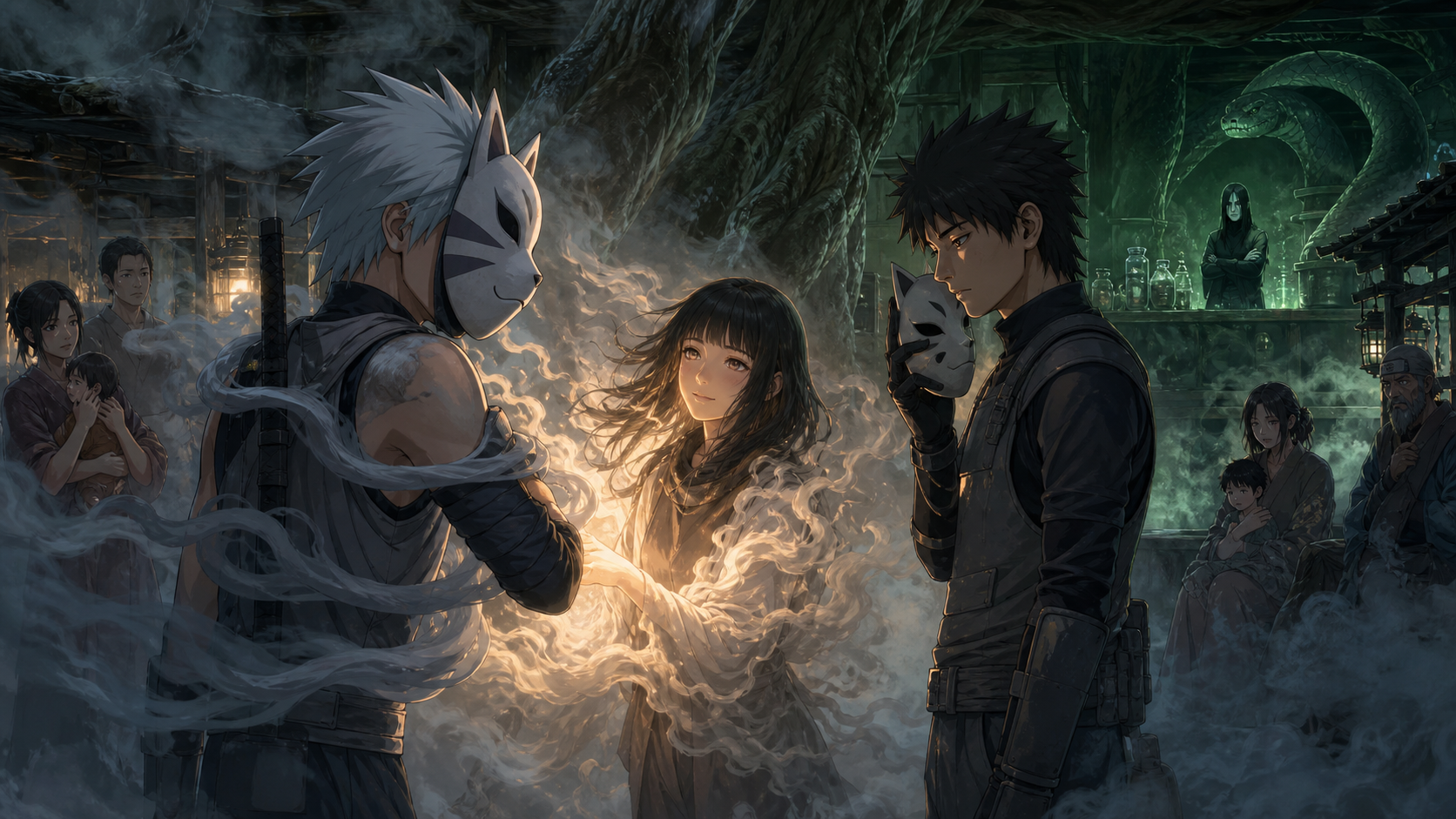
Orochimaru’s Test Subjects
The Iburi Clan can become smoke, but the unstable gift has made an entire community dependent on the man who calls exploitation treatment.
Bottom line
“Orochimaru’s Test Subjects” finds Kakashi inside the hidden community carrying the cost of Orochimaru’s research. The Iburi Clan can transform into smoke, but members cannot reliably control the change and may be scattered by wind. Orochimaru stabilized their bodies with curse marks, then converted relief into dependence and service. Kakashi is captured after entering their refuge during his pursuit. Kinoe, the Foundation Wood Style user, is already among them, and Yukimi mistakes him for the child Orochimaru once took away. The clan’s loyalty is not evidence that Orochimaru treated them well. Their survival has been tied to the person exploiting them. Yukimi’s desire to experience the outside world makes the central injustice visible: protection has become confinement, treatment has become leverage, and a community with a real medical vulnerability has been taught that one abuser is the only possible source of safety.
Kakashi enters the Iburi refuge
His pursuit of Orochimaru brings him into a community hidden from ordinary village life. The refuge is both home and containment.
Discovery places Kakashi among people affected by the fugitive he has been ordered to capture.
The Iburi Clan defends its secrecy
An armed stranger can expose their location, threaten their survival, or interfere with Orochimaru. Their attack on Kakashi emerges from danger rather than random hostility.
Defensive action should be read within the history that made discovery frightening.
Hidden life changes how outsiders are judged
The clan cannot assume that a Konoha mask means rescue. Great-village operatives may bring capture, research interest, or the fugitive whose return they have been taught to await.
Trust must be earned through conduct because institutional symbols have offered no reliable safety.
Community defense can still make mistakes
Context explains why members attack and detain Kakashi, but fear does not make every judgment accurate. They may misread a pursuer as an enemy of their survival.
Compassion for constrained choices can coexist with scrutiny of harm caused under those constraints.
Kakashi is captured
The elite operative loses control of the encounter because the clan’s smoke ability works outside familiar assumptions. Their knowledge of the refuge also gives them local advantage.
Capture forces him to listen rather than treating the community as a stop along the chase.
Smoke transformation is bodily vulnerability
The clan can become smoke, an ability that appears extraordinary from outside. Instability means wind can disperse a person beyond recovery.
Power and disability can occupy the same condition.
Instability reaches identity as well as movement
Transformation threatens the boundary of the body itself. Clan members face not only injury but the possibility of being physically dispersed beyond return.
That risk can make every departure feel like a decision about whether the self will remain intact.
Shelter is a medical accommodation
Protected underground space reduces wind exposure and allows the clan to live more safely. The shelter should not be dismissed as cowardice or superstition.
The injustice lies in having no independent treatment that would make broader choices possible.
Spectacle hides daily fear
A viewer may first notice visual novelty or combat potential. Clan members must calculate weather, movement, shelter, and the possibility that a change becomes fatal.
Their bodies are not special effects detached from ordinary needs.
Wind turns the outside world dangerous
Open space offers freedom and exposure at once. A breeze that means little to another person can threaten the clan’s physical continuity.
Environmental access therefore requires reliable stabilization, not lectures about courage.
Orochimaru offered temporary stabilization
His curse marks help members control smoke transformation. The intervention addresses a real and urgent need.
Providing relief does not excuse the conditions attached to relief.
Stabilization creates earned trust at first
Someone who reduces an immediate threat may reasonably appear compassionate. Clan members do not need to be foolish for believing the person whose intervention helped them survive.
Orochimaru abuses a trust grounded in observable benefit.
The cure remains deliberately incomplete
Temporary control requires the clan to await further contact rather than own a reproducible treatment. Knowledge stays with the provider.
A care relationship becomes coercive when dependency is preserved because dependency secures access and obedience.
Treatment becomes dependency
Orochimaru positions himself as the person who can keep the clan alive. Medical knowledge remains concentrated rather than transferred to the community.
Dependency increases his power to demand obedience and restrict contact with alternatives.
Medical monopoly limits political choice
Rejecting Orochimaru risks more than losing an ally. Rejection may appear to threaten every member whose body depends on stabilization.
Collective survival pressure turns disagreement into a danger the entire clan may punish.
Gratitude is not permanent jurisdiction
The clan can appreciate relief without surrendering every later decision. A provider does not own recipients because treatment worked.
Ethical care expands autonomy and accepts that a patient may eventually leave.
A helpful act can be part of exploitation
The curse marks produce genuine benefit. That fact makes manipulation more effective because clan members have material reasons to value his return.
Ethical judgment must hold benefit and abuse together instead of pretending one cancels the other.
The clan serves Orochimaru
Their service reflects survival pressure, gratitude, isolation, and limited information. Loyalty formed under those conditions is not simple consent.
People can defend the person controlling access to something they need.
Orochimaru controls the available story
If he presents outsiders as threats and himself as rescuer, the hidden community has few independent sources against which to test the claim.
Isolation turns information into another form of medicine he can ration.
Outside contact threatens his narrative
Kakashi can bring evidence that Orochimaru is fleeing illegal experiments and that Konoha seeks him. Independent information changes the clan’s ability to assess loyalty.
That possibility explains why control over the refuge matters to Orochimaru beyond physical safety.
The clan needs alternatives, not abandonment
Telling members that Orochimaru is abusive does not solve the unstable transformation. Removing the provider without replacing essential support can reproduce danger.
Accountability and continuity of care must proceed together.
The title uses experimental language
“Test subjects” names the role assigned by Orochimaru’s project. The phrase should expose dehumanization rather than define the clan.
They are relatives, neighbors, survivors, and people with futures beyond what was tested on them.
Kinoe is already inside the refuge
Danzo sent the Foundation operative into the network surrounding Orochimaru. His Wood Style body also connects him to the history of experimentation Kakashi has investigated.
One survivor encounters a community still dependent on the same perpetrator.
His mission conflicts with survivor recognition
Foundation orders place Kinoe inside Danzo’s effort to protect Orochimaru’s escape. The Iburi community offers evidence of why that assistance is harmful.
Seeing people affected by the network can disrupt the abstract language of mission necessity.
Wood and smoke carry different experimental histories
Kinoe’s body reflects Hashirama-cell trials. The Iburi condition predates Orochimaru’s intervention, but his curse-mark research turns their vulnerability into a controlled resource.
The histories are distinct while meeting under the same pattern of bodily exploitation.
Yukimi recognizes a missing child
She sees Kinoe and associates him with Tenzo, the boy Orochimaru took away. Her response brings family memory into a story otherwise organized by code names and missions.
The missing child is not merely an experimental result. Someone waited for him.
Tenzo is a relationship before a code name
Yukimi’s use of the name carries memory, affection, and belonging. Foundation’s designation “Kinoe” carries rank and function.
The conflict between names reveals competing claims about whether a person belongs to a community or a command system.
Recognition offers connection and pressure
Being welcomed as someone loved can give Kinoe a glimpse of identity beyond Foundation. The mistaken certainty may also place expectations on him before he understands his own past.
Care must leave room for him to determine what the connection means.
Mistaken identity carries emotional truth
Kinoe may not be the person Yukimi first believes him to be in the way she understands that person. Her recognition still reveals how removal left an unresolved absence.
Accuracy about identity should not erase the grief underneath the mistake.
Kinoe has been denied his own history
Foundation conditions him through function, obedience, and a code name. Access to childhood connection could threaten the identity Danzo built.
Confusion is predictable when other people have controlled the records of who someone was.
Memory loss benefits institutions
A child who cannot verify origin depends on the organization supplying identity, purpose, and explanation. Foundation becomes the only available author of his life.
Recovered relationship threatens control because another person can remember him outside assigned usefulness.
Identity cannot be returned by command
Even truthful information would not instantly restore childhood continuity. Kinoe needs time, choice, and safe relationships through which to integrate what he learns.
Replacing Danzo’s fixed story with another fixed story would repeat the denial of self-authorship.
Yukimi wants the outside world
Her desire is ordinary: movement, experience, sunlight, food, strangers, and a life beyond the refuge. Bodily risk has narrowed those possibilities.
Wanting freedom does not mean she misunderstands danger.
Ordinary curiosity deserves respect
Markets, food, crowds, and open sky may look trivial beside covert missions. For Yukimi, those experiences represent a life not organized entirely around bodily crisis.
The episode gives everyday pleasure the weight of a political demand.
Her risk assessment belongs in the decision
Adults and clan members can explain wind danger and help create safer conditions. Yukimi still deserves a voice in how much risk she accepts.
Protection that never listens becomes another authority speaking over her body.
Protection can become confinement
The refuge shields the clan from wind and discovery. Long-term isolation also limits education, relationship, choice, and access to independent care.
Safety should expand life wherever possible rather than become the permanent boundary of life.
A day outside carries political meaning
Ordinary pleasure challenges Orochimaru’s monopoly over what survival can look like. Yukimi experiences a world larger than dependence and service.
Joy becomes evidence that protection should preserve more than breathing.
Accessibility should make freedom safer
The humane goal is not a choice between permanent confinement and reckless exposure. Planning, weather awareness, escorts, shelter routes, and independent stabilization could expand access.
Creative accommodation respects both danger and desire.
Freedom includes the right to return
Leaving the refuge does not require rejecting family or community. Yukimi can want experience outside and still value the people who protected her.
False choices between loyalty and autonomy benefit whoever controls movement.
Gotta’s danger makes the risk concrete
An unstable smoke body can be scattered by wind. The threat is neither imaginary nor an excuse invented by elders.
Respecting freedom requires taking that medical reality seriously.
Gotta is more than a warning device
His vulnerability belongs to a person with relationships and community responsibility. Harm to him should not exist only to teach Kakashi or Yukimi a lesson.
Every clan member has an individual stake in whether treatment and freedom can coexist.
Risk does not erase autonomy
People with dangerous conditions still deserve truthful information and meaningful participation in decisions. Others may advise, prepare, and intervene during immediate crisis.
Control should not become the default answer to vulnerability.
Kakashi faces competing objectives
He wants Orochimaru and may see the clan as a route to the fugitive. He also encounters people whose survival could be endangered by using them as bait.
Mission clarity gives way to an ethical choice about means.
Using Yukimi would repeat Orochimaru’s logic
Turning her into bait would treat bodily vulnerability and relationship as tools for capturing a target. The mission’s lawful purpose would not make that method harmless.
Accountability loses moral force when pursuit reproduces the perpetrator’s objectification.
Refusal can be an ANBU skill
Operational judgment includes recognizing when an available tactic creates unacceptable harm. Obedience alone is not professionalism.
Kakashi’s growth depends partly on using expertise to limit power rather than only execute power.
The cold-blooded reputation is tested
An operative focused only on capture could treat Yukimi’s dependency as leverage. Kakashi’s response will show whether mission efficiency still governs every decision.
Seeing the person behind useful information creates space for another path.
Rin’s memory may sharpen the ethical boundary
Kakashi knows what happens when a girl’s body is turned into a weapon for a larger operation. Yukimi’s circumstances are different, but the structural warning is familiar.
He has reason to reject any plan that makes her carry a mission she did not choose.
Compassion does not require abandoning pursuit
Kakashi can continue seeking Orochimaru while refusing one exploitative tactic. Ethical limits change how a mission proceeds without erasing the need for accountability.
The episode’s challenge is to hold protection and pursuit together.
The Iburi refuge is both shelter and confinement
Underground walls protect clan members from wind that could disperse their smoke bodies. The same safety isolates them from neighbors, trade, independent medicine, and information about Orochimaru.
Accessibility should expand choice rather than turn one protected space into a lifetime boundary. The clan needs safer routes, weather planning, stabilization research, and the right to decide when leaving becomes worth the risk.
Orochimaru makes treatment inseparable from obedience
His intervention reduces dangerous transformations enough to earn trust. Then he keeps the process incomplete and positions himself as the only person capable of providing continued stability.
That medical monopoly converts gratitude into control. Patients cannot give free consent when refusing the provider may mean bodily dissolution, community danger, or loss of the only treatment available.
Yukimi’s curiosity is a claim to ordinary life
She wants to see weather, roads, people, and places beyond the refuge. Her desire is not childish ignorance of risk. She understands danger and still wants a future larger than survival.
Community protection should give her accurate information, preparation, companions, and a route home. Locking someone away because the outside world lacks accommodations makes safety another form of exclusion.
Kinoe hears a name that predates Foundation
Yukimi’s recognition of Tenzo offers a relationship outside the code name, orders, and function Danzō assigned him. The possibility unsettles the identity Foundation built.
Memory cannot be restored through pressure, but truthful records and patient witnesses can return choices. Kinoe deserves time to compare accounts without either side demanding immediate loyalty as proof of who he is.
Kakashi must refuse another body-based mission
Using Yukimi to reach Orochimaru would repeat the logic that turned the Iburi Clan and Kinoe into tools. Her unusual body does not make her the natural route to an adult criminal.
ANBU duty should include refusing an unethical method when the mission objective can be pursued through surveillance, records, and other evidence. Restraint is operational judgment, not softness.
Gotta’s danger shows why autonomy needs preparation
The risk of wind and instability is real, and one bad decision can become fatal. That danger does not erase the clan’s right to participate in planning their lives.
A responsible response combines consent with practical safeguards: forecasts, sealed clothing, emergency shelter, companions, stabilizing medicine, communication, and clear return points. Freedom becomes safer through resources rather than prohibition.
The village owes the clan an independent medical path
Konoha cannot demand testimony or cooperation while leaving Orochimaru as the only source of stabilization. Rescue needs continuity of care, privacy, and protection from retaliation.
Researchers should study the condition with voluntary participation and transparent limits. The clan’s survival cannot become another opportunity to collect rare bodies under a different authority.
Community fear should not make Orochimaru trustworthy
The clan knows exposure could bring violence, capture, or medical exploitation from outsiders. That danger makes the familiar provider feel safer than uncertain help.
Orochimaru benefits when every alternative looks worse. Building trust requires Konoha to demonstrate confidentiality, consent, stable treatment, and protection through actions before expecting the Iburi Clan to risk disclosure.
Kakashi and Kinoe need a relationship outside competing orders
Each operative enters the refuge carrying commands from a different Konoha authority. Those orders position them as obstacles before either can compare what he knows.
Shared investigation could expose how Danzō and Orochimaru used Kinoe while giving Kakashi evidence his mission brief omitted. Cooperation should begin with specific facts and boundaries, not a demand that either boy transfer loyalty immediately. Their next choice should protect people before preserving another secret chain.
RaeRae’s verdict
“Orochimaru’s Test Subjects” makes the Iburi Clan’s loyalty legible without making exploitation acceptable. Orochimaru stabilized a life-threatening condition and then kept knowledge, access, and movement under his control. The clan serves someone who made himself necessary.
Yukimi’s wish to see the outside world restores a scale that experimental language erases. She wants a day, a view, and an ordinary future. Kinoe’s presence connects that desire to a child removed and renamed by secret institutions. Kakashi enters looking for a fugitive and finds people whose lives cannot ethically be reduced to clues.
RaeRae’s call
The Iburi Clan needs shelter without captivity and medicine without obedience. Yukimi’s curiosity deserves preparation, not dismissal. Kinoe deserves his history without a new loyalty test. Kakashi must refuse any plan that turns another unusual body into mission equipment, while Konoha builds independent care strong enough to end Orochimaru’s medical monopoly.
Episode details and viewing routes
- Official episode reference: Naruto Official episode guide
- Licensed episode route: Crunchyroll licensed episode page
What I am carrying forward
Kakashi has found the hidden Iburi Clan, whose unstable smoke transformations were temporarily controlled by Orochimaru’s curse marks. The clan serves Orochimaru because survival, gratitude, isolation, and dependency have been bound together.
Kinoe is inside the refuge, and Yukimi associates him with the child Tenzo whom Orochimaru took away. Yukimi wants to experience life outside despite the danger wind poses to her smoke body. Episode 354 follows the characters choosing their own paths as Kakashi must decide whether capture justifies using Yukimi.