
World of Dreams
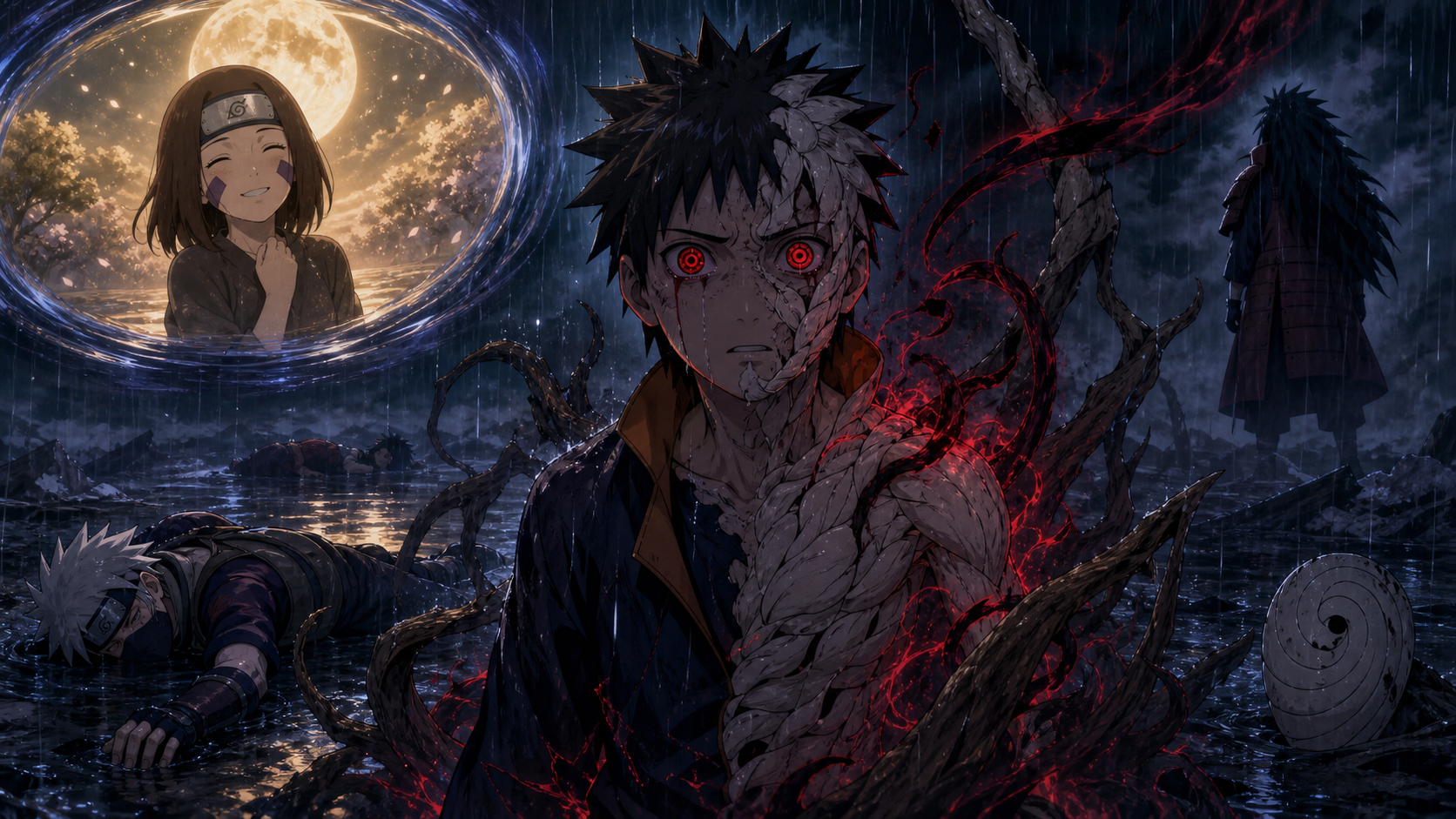
Obito turns one unbearable battlefield image into a verdict against reality, then accepts Madara’s name and the machinery of a dream-world prison.
Bottom line
“World of Dreams” shows the moment Obito turns unbearable grief into a political program. He arrives after Rin’s death without the context that would explain her sacrifice, awakens the Mangekyō Sharingan alongside Kakashi, and destroys the Mist shinobi surrounding them through Kamui and Wood Style. The violence is not framed as liberation. Obito moves through the battlefield as though reality has already lost moral authority. He holds Rin, rejects the world that permitted her death, and returns to Madara ready to build an illusion where she can exist again. Madara responds by transferring the Moon Eye Plan, the role of “Madara Uchiha,” and the task of finding Nagato’s Rinnegan. The episode makes manipulation visible without erasing Obito’s agency. Madara arranged the isolation and supplied the doctrine, but Obito chooses to convert one traumatic scene into a universal judgment. A world of dreams promises reunion without consent, grief without mourning, and peace without freedom. That promise becomes the engine behind years of violence.
Obito sees the result before the reason
Rin lies dead after moving into Kakashi’s Chidori to prevent the Three Tails from being unleashed against the Leaf. Obito knows none of that when he arrives.
The visible outcome overwhelms every possible explanation. Trauma decides what the scene means before dialogue can begin.
Kakashi collapses under the same loss
Kakashi did not choose to kill Rin. His body and expression register horror before exhaustion leaves him unconscious.
Obito cannot process that evidence because the image of his hand through Rin has already become the entire world.
Both Sharingan awaken through one catastrophe
The eye Obito kept and the eye he gave Kakashi respond together. Their Mangekyō forms emerge through shared grief experienced from opposite positions.
The paired awakening binds them more deeply at the instant their understanding of each other breaks apart.
Obito’s reconstructed body answers with force
Hashirama-derived material gives Obito strength far beyond his earlier limits. Wood erupts across the battlefield as rage takes physical shape.
Madara’s repair has become a weapon before Obito has learned how to live inside that body.
Kamui turns panic into untouchable movement
Attacks pass through Obito as threatened parts shift into the private dimension. He moves without the restraint or analysis Kakashi later brings to the same power.
The technique isolates him even during combat. Nobody can reach the body or the mind behind that first violent response.
The Mist shinobi become targets for displaced grief
The forces surrounding Rin participated in the operation that placed the Three Tails inside her. Their threat is real, but Obito’s retaliation exceeds immediate defense.
He destroys everyone nearby because the whole scene has fused into one object of hatred.
Violence provides motion without understanding
Obito can remove enemies, split the ground, and protect Kakashi’s unconscious body. None of those actions explain Rin’s choice or restore trust.
Power gives grief somewhere to travel while leaving the wound untouched.
Rin remains outside the dream Obito designs for her
Obito imagines creating a world where Rin lives, but Rin cannot consent to becoming the center of that plan. Her sacrifice protected real people in a real village.
Replacing reality may preserve his preferred image of her while rejecting the values behind her final decision.
Holding Rin makes denial feel like devotion
Obito cradles the person he wanted to save and promises another world. The gesture carries genuine love and a refusal to accept death.
Those emotions can coexist, which makes the scene tragic rather than morally simple.
“Hell” becomes a theory of reality
In the previous moment, hell named shock. Now Obito expands that feeling into a claim that the entire world is false and irredeemable.
A personal wound becomes evidence for a universal conclusion because Madara supplied the language waiting to contain despair.
Madara’s doctrine now sounds confirmed
The old Uchiha warned that love creates loss and that reality cannot sustain peace. Rin’s death appears to validate every part of that argument.
Manipulation works when the target experiences pain that seems to prove the manipulator right.
Obito returns to the cavern by choice
Madara did not drag him back after the battlefield. Obito returns because the dream proposal now appears to offer the only future containing Rin.
The decision marks a change from physical captivity to ideological allegiance.
Madara receives the answer he engineered
The old man encounters a boy whose resistance has collapsed under the exact kind of loss he predicted. He does not offer mourning, context, or care.
Madara immediately turns grief toward tasks, inheritance, and a plan that will outlive his body.
The Moon Eye Plan replaces repair with control
Infinite Tsukuyomi promises a dream tailored to every person. The method removes conflict by removing the independent reality where disagreement can exist.
Peace becomes universal captivity disguised as fulfillment.
Obito wants a world where Rin exists
His stated goal sounds intimate rather than imperial. He is not yet speaking about nations, armies, or Tailed Beasts.
Madara converts that intimate wish into a mechanism requiring manipulation of every living person.
A false reunion avoids Rin’s final choice
The dream can restore a version of Rin who never dies and never places herself in Kakashi’s attack. Such restoration edits the moral agency Obito cannot bear to confront.
Idealization becomes another form of control over the person he claims to honor.
Madara names Obito a savior
The title reframes domination as rescue. Obito is invited to believe that imposing illusion will free humanity from suffering.
Grand moral language helps convert private despair into permission for public violence.
The Madara identity becomes an assignment
Obito will carry the name of the older Uchiha into negotiations, threats, and war. The alias provides historical authority while burying the boy connected to Kakashi and Rin.
Erasing his own name becomes practice for erasing reality itself.
The mask creates emotional distance
Covering his face prevents enemies and former friends from seeing the person making each choice. The disguise also helps Obito avoid recognizing himself.
An identity designed for strategy becomes armor against accountability and memory.
Nagato holds the necessary Rinnegan
Madara directs Obito toward the young man in the Rain whose eyes are essential to the resurrection plan. Nagato believes those eyes belong to his own life.
The conspiracy treats his body and grief as resources to be activated later.
Pain becomes the recruitment pattern
Obito has been recruited through Rin’s death. Nagato will be approached through war, Yahiko, and the dream of peace.
Madara’s legacy spreads by locating wounded idealists and redirecting their compassion toward coercive systems.
Obito learns to repeat Madara’s method
The boy who was manipulated will later manipulate others. He carries doctrine, selective information, and staged identities into the next generation.
Victimization explains the transmission without making the later recruitment morally neutral.
Zetsu supplies continuity and surveillance
The artificial beings connect Madara’s cavern to the outside world, monitor targets, and support Obito’s movement. Their apparent helpfulness serves the plan’s infrastructure.
The conspiracy can survive Madara because Zetsu preserves information and access across time.
Kakashi wakes without the full truth
Kakashi will remember Rin’s death and carry crushing guilt, but he does not know Obito witnessed the scene or survived nearby.
Both boys leave the same battlefield with partial information that prevents shared mourning.
Team Minato is divided by controlled silence
Rin is dead, Obito hides his survival, Kakashi blames himself, and Minato cannot reunite the fragments. The team’s relationships become isolated stories.
Madara benefits from every missing conversation that might complicate Obito’s conclusion.
The episode avoids calling grief weakness
Obito’s love for Rin, loyalty to Kakashi, and desire to protect others are not flaws. Madara exploits those qualities under extreme conditions.
The moral failure begins when Obito decides that pain authorizes control over lives beyond his own.
Context matters without becoming absolution
Knowing Rin’s sacrifice and Madara’s manipulation changes how the fall should be understood. Neither fact erases years of planning, killing, and deception.
Compassion can explain a route while judgment remains attached to each later choice.
The dream rejects the risk of real bonds
Real relationships contain difference, uncertainty, and the possibility of loss. Infinite Tsukuyomi offers perfect versions that can never contradict the dreamer.
Obito chooses guaranteed presence over another person’s independent existence.
Naruto will embody the opposing answer
Naruto also knows isolation, grief, and the temptation to answer pain with destruction. He repeatedly chooses imperfect bonds in reality.
Their eventual conflict will concern more than strength. Each represents a different response to suffering.
The episode turns a mask into a worldview
The white spiral mask is not only a disguise. Its single opening narrows perception to the reality Obito has chosen to accept.
The design visually matches an ideology that filters the world until only despair and the promised dream remain.
The route toward Akatsuki begins here
Finding Nagato, controlling the Rinnegan plan, and inheriting Madara’s identity provide the foundation for Obito’s later actions. The war’s machinery starts with this private agreement.
One battlefield trauma becomes a conspiracy capable of reshaping nations.
The next story returns to the Rain
Nagato, Yahiko, and Konan built Akatsuki around peace before outside powers and hidden manipulation changed the organization. Obito’s arrival will add another pressure.
Episode 347 must show how the shadow of the Moon Eye Plan reaches their movement.
Obito confuses ending pain with ending reality
Mourning asks a survivor to keep living in a world permanently changed by absence. Obito rejects that demand and chooses a system promising that absence can be overwritten. The distinction matters because reducing suffering is not the same as destroying the shared conditions under which people make choices.
Infinite Tsukuyomi offers emotional certainty by eliminating every independent person who might disappoint, leave, resist, or die. Such certainty resembles comfort only from inside the dreamer’s preferred script. Obito’s refusal to endure grief therefore grows into a refusal to let anyone else inhabit an uncontrolled reality.
Madara transfers a mission before Obito can heal
Madara gives Obito no space between trauma and recruitment. The plan, the alias, Nagato’s location, and the promise of becoming a savior arrive while the battlefield shock remains raw. Urgency prevents reflection and turns emotional collapse into immediate purpose.
Purpose can feel like recovery because tasks organize pain. Obito suddenly has a route, a title, and a future where Rin returns. Yet every element serves Madara’s design. The new mission does not process grief; the mission freezes grief into the permanent justification for a global prison.
Obito’s first response is survival without comprehension
His body moves through enemies, Wood Style erupts, and Kamui makes attacks miss while his mind remains fixed on Rin. The reconstructed half answers danger before Obito can understand the battlefield.
That separation makes the violence frightening. Extraordinary capacity gives grief immediate reach. Nobody is present to slow the reaction, explain the seal, or distinguish the Mist plan from every individual shinobi standing nearby.
The massacre redirects pain toward available bodies
The Mist forces helped create the crisis, but Obito attacks with a scale far beyond investigation, restraint, or surrender. Rage turns every nearby person into a container for one unbearable loss.
Motion can feel like agency during shock, yet killing does not answer why Rin chose the Chidori or who designed the Three-Tails operation. Violence temporarily removes witnesses while preserving the missing truth.
Holding Rin cannot return her agency
Obito reaches the person he wanted to save and imagines a world where she stands alive beside him. The fantasy protects him from the finality of her body for a few moments.
Love becomes dangerous when the imagined Rin replaces the girl who made choices under impossible pressure. A dream version can never disagree, explain, grieve Kakashi, or choose a future beyond Obito’s need.
Kakashi survives without knowing Obito witnessed the scene
He wakes carrying the memory of his own hand through Rin and no knowledge that his lost teammate stood nearby. That silence shapes decades of guilt.
Obito later interprets Kakashi through the worst instant while withholding the fact of his survival. Both boys remain trapped in incomplete versions of the same event, and Madara benefits from every missing conversation.
Madara waits for grief to repeat his conclusion
He does not need to invent war, loss, or institutional cruelty. The shinobi system supplies real evidence. Madara arranges the conditions so that evidence reaches Obito at maximum emotional vulnerability.
Then he offers one answer: reality itself is defective, so nobody should remain awake inside it. The manipulation works because the indictment is partly true and the proposed remedy avoids every difficult form of repair.
The savior title turns despair into assignment
Madara calls Obito a rescuer of the world when the boy has barely processed Rin’s death. Grand purpose arrives before mourning, context, food, rest, community, or any competing account.
The title gives pain a flattering direction. Obito can stop feeling like a powerless child by becoming the person who will overwrite reality. That promise converts vulnerability into labor for Madara’s project.
The mask separates action from the boy who loved his team
Adopting Madara’s identity allows Obito to speak through legend, hide age and scars, and treat personal relationships as weaknesses belonging to a discarded self.
The disguise does not eliminate Obito. The mask protects him from accountability by making every victim confront a myth rather than the teammate, student, attacker, recruiter, and conspirator making choices underneath.
Nagato becomes another person recruited through loss
Madara’s plan depends on the Rinnegan placed in Nagato and on suffering severe enough to move the young man toward control. Obito learns to reproduce the same recruitment structure.
He will not merely share an idea. He will watch grief, isolate targets, shape information, and offer power as the answer. The harmed child becomes an adult who understands exactly where another harmed child is vulnerable.
Zetsu provides support that also functions as surveillance
The figures help Obito move, train, receive news, and survive. They also connect his body and decisions to Madara’s network at every stage.
Useful companionship can still limit freedom when reporting lines remain hidden. Obito never receives a private recovery space outside the system that saved him. Every conversation occurs within infrastructure built for succession.
A real response would preserve reality and change its institutions
Rin’s death indicts child warfare, jinchūriki weaponization, secret operations, poor communication, and villages that make children responsible for preventing mass casualties. Those systems deserve transformation.
Infinite Tsukuyomi prevents transformation by removing public action. Nobody can reform policy, testify, compensate victims, build safeguards, or choose relationships inside a dream assigned from above. Ending awareness is not ending injustice.
The Three-Tails plan exposes war through a medic’s body
Rin’s medical role should have placed her near care, triage, and preservation of life. The Mist instead turns her body into a delayed attack against her own village.
Weaponizing a child medic’s body is deliberate institutional cruelty.
Obito mistakes permanent pain for permanent truth
The battlefield feels like the complete nature of reality because shock narrows his attention to one image. Madara needs that temporary state to harden into philosophy.
Grief can remain lifelong without making every conclusion formed during grief accurate. Time would not erase Rin, but time could bring witnesses, context, anger, accountability, and relationships capable of challenging the idea that love requires replacing the world.
Dream peace removes the very bonds Obito claims to honor
Real affection includes surprise, disagreement, boundaries, and another person’s independent future. Infinite Tsukuyomi offers a Rin who cannot refuse the role Obito gives her.
That fantasy protects him from loss by erasing relationship. A perfect image may soothe desire, but nobody is loved when one consciousness controls both sides of the reunion. Obito saves an idea while abandoning the person’s freedom.
The episode needs institutional blame beside personal tragedy
Madara engineered the trap, Mist shinobi weaponized Rin, villages fielded child soldiers, and Konoha lacked safeguards capable of finding or supporting Obito after Kannabi Bridge. The disaster has many adult authors.
Obito later authors new disasters of his own. A complete account refuses the easy choice between blaming only the system and blaming only the survivor. Systems shape options, while adults remain answerable for the power they exercise within them.
RaeRae’s verdict
“World of Dreams” works because Obito’s fall is neither a random reversal nor a complete excuse. Madara prepares the doctrine and environment, Rin’s death supplies catastrophic proof, and Obito chooses to turn grief into a plan imposed on everyone. The episode keeps love at the center while showing how love can be distorted into possession when another person’s agency becomes intolerable.
The paired Mangekyō awakening is especially cruel. Kakashi and Obito share one loss through two connected eyes, yet silence prevents them from understanding each other. That broken connection creates the space where Madara’s inherited identity can replace Obito’s own.
RaeRae’s call
Madara lets the shinobi world provide the wound, then gives Obito one controlled explanation before grief can meet context or community. The dream promises Rin without her agency and peace without anyone’s consent. Mourn the child, judge the adult, preserve Kakashi’s parallel trauma, and repair the institutions that made this tragedy possible.
Episode details and viewing routes
- Official episode reference: Naruto Official episode guide
- Licensed episode route: Crunchyroll licensed episode page
What I am carrying forward
Obito responded to Rin’s death by awakening Mangekyō Sharingan, using Kamui and Wood Style against the Mist shinobi, and rejecting the reality where she died. He returned to Madara prepared to create a dream world where Rin would live again.
Madara transferred Project Tsuki no Me, the Madara Uchiha identity, and the mission to approach Nagato, whose Rinnegan is required for the plan. Obito’s private grief has now become an organized conspiracy. Episode 347 will follow that shadow toward the original Akatsuki in the Hidden Rain.