
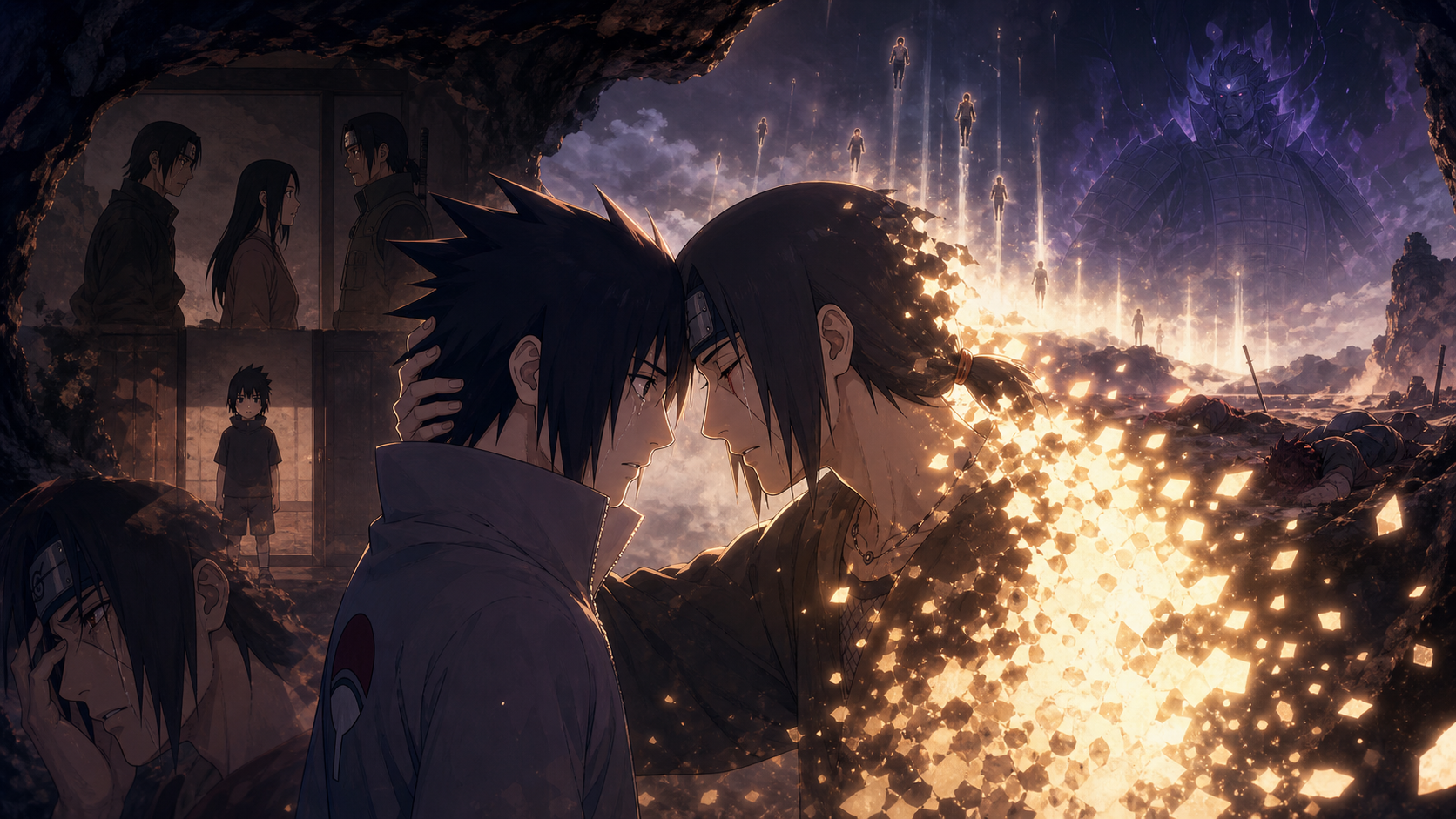
I Will Love You Always
Itachi finally gives Sasuke the truth without reserving ownership of the conclusion, and love arrives without another mission attached.
Bottom line
“I Will Love You Always” finally lets Itachi speak to Sasuke without building another mission around the truth. He forces Kabuto to release Edo Tensei, which begins returning the reanimated dead across the battlefield, though Madara knows how to sever the contract and remain. Inside the cave, Itachi uses the last moments of his borrowed body to show Sasuke the massacre directly and admit the failure beneath every protective lie. He does not ask Sasuke to forgive the village, excuse the clan’s murder, or follow a predetermined path. He says Sasuke never has to forgive him and that his love will remain regardless of what Sasuke chooses next. That unconditional ending matters because Itachi spent most of Sasuke’s life using love as justification for control. The forehead touch recalls childhood affection, but the new words remove the demand hidden inside earlier gestures. Love arrives too late to repair the past. For once, love also stops trying to own the future.
The Five Kage face a different scale of Madara
Away from the cave, Madara reveals Perfect Susanoo. The Five Kage watch a humanoid defense become a landscape-level weapon.
Their combined experience no longer guarantees an answer. The visual scale reminds us why ending Edo Tensei matters before Madara can continue fighting without exhaustion or mortality.
Perfect Susanoo turns power into weather
Madara’s completed form towers over terrain and changes the atmosphere around the battle. A sword stroke carries force beyond ordinary battlefield measurement.
The Kage are not weak. The episode establishes that Madara exists outside the assumptions under which their ranks normally mean anything.
Reanimation makes that power structurally worse
An opponent with Madara’s ability should still face fatigue, injury, and death. Edo Tensei removes those limiting conditions.
Kabuto has not merely returned a legendary fighter. He has removed the costs that once made even legendary power finite.
Itachi reaches Kabuto’s controls
Izanami keeps Kabuto trapped while Itachi uses genjutsu to direct the release sequence. The operational goal finally becomes possible.
The solution preserves Kabuto’s life because his hands and knowledge remain necessary. Restraint delivers something lethal victory could not.
The release signs matter more than spectacle
The cave battle has included Sage Mode, Susanoo, forbidden eyes, and borrowed bloodlines. The decisive action is a controlled sequence of hand signs.
War turns on procedure. Knowing how a system ends can matter more than overpowering every component the system created.
Edo Tensei begins to unravel
Light gathers around reanimated shinobi across multiple fronts as their summoned forms start returning to the dead. Fighters recognize that the impossible army is changing.
The release creates thousands of separate emotional endings at once. Every summoned person leaves behind another relationship interrupted by war.
The dead lose forced participation
Kabuto used the deceased as equipment while preserving enough personality to exploit their knowledge and bonds. Release ends that ongoing violation.
Freedom here means returning to death. The paradox shows how thoroughly Edo Tensei converted memory and attachment into weapons.
Relief reaches people who never saw the cave
Most battlefield units do not know Itachi, Sasuke, or the details of Izanami. Their survival still depends on choices made far from them.
The episode connects intimate family confrontation with collective consequence. A brother’s final conversation occurs inside an operation affecting the entire war.
Madara recognizes the release immediately
Madara understands what is happening and knows Edo Tensei well enough to respond. Knowledge separates him from ordinary summoned fighters.
Kabuto believed controlling the technique meant controlling every person produced by the technique. Madara proves that exceptional knowledge can break a supposedly complete system.
Madara severs the summoning contract
By performing the appropriate signs, Madara releases his side of the contract while retaining the reanimated body. Kabuto’s global release cannot remove him.
The exception preserves the war’s largest threat and exposes another danger of forbidden infrastructure. A powerful subject who learns the controls can inherit the system.
Ending one catastrophe does not end the war
Itachi succeeds, yet Madara remains. Victory closes a massive front without solving every downstream consequence Kabuto created.
That limitation does not make the operation meaningless. Progress can be decisive without becoming total.
Itachi’s reanimated time begins to close
The same release ending the army also ends Itachi’s borrowed return. His body starts losing cohesion as the jutsu withdraws.
He has only a short interval to fulfill the promise made to Sasuke before the cave battle: tell the truth after Kabuto is stopped.
Sasuke still needs more than a summary
Obito gave Sasuke an account of the massacre, but every narrator carried motives. Sasuke needs to hear what Itachi understood and chose.
Truth cannot restore the clan. Truth can remove the manufactured story that made Sasuke build his life around the wrong enemy.
Itachi uses genjutsu as testimony
He shares direct memories of the coup, village leadership, Danzō’s pressure, his parents, and the night of the massacre. Genjutsu becomes a record rather than punishment.
The change in purpose matters because Itachi previously used illusion to torture Sasuke and shape his behavior. The same medium now returns information Sasuke was denied.
The village forced a criminal choice
Konoha’s leaders treated mass killing as a solution to political conflict. Danzō narrowed the available path while protecting the institution from public accountability.
Itachi made the final choice, but adults with greater authority designed the conditions and then let a teenager carry the moral stain.
The clan’s coup was also real
Uchiha leadership planned to seize power after years of surveillance, segregation, and distrust. The grievance was legitimate, while violent escalation threatened civilians and wider war.
Holding both facts prevents propaganda from replacing history. Oppression does not make every response wise, and danger does not justify extermination.
Fugaku and Mikoto face their son
Itachi’s parents understand enough to know what he has chosen. Their final composure refuses to make the killing emotionally easy.
They remain parents, clan leaders, targets, and people caught inside the same political collapse. No single label contains the scene.
Sasuke was spared and assigned a role
Itachi left Sasuke alive because he loved him, then constructed a future based on hatred. Sasuke was expected to become strong, kill Itachi, and return to the village as a hero.
Survival came attached to a script. The plan treated Sasuke’s mind as another battlefield Itachi could control from a distance.
Hatred was never neutral protection
Itachi exposed Sasuke to the massacre through Tsukuyomi and repeatedly intensified trauma to preserve the avenger role. The damage was deliberate.
Calling that harm protective does not change what Sasuke endured. Intent belongs in the explanation, not in place of accountability.
Itachi admits he underestimated Sasuke
He recognizes that he treated his younger brother as someone too fragile or uninformed to share responsibility. Secrecy became a habit disguised as care.
The admission gives Sasuke something rare: acknowledgment that exclusion was not proof of Sasuke’s inadequacy.
Another path might have existed
Itachi wonders whether telling Sasuke earlier could have changed the Uchiha family’s course. Sasuke’s relationship with their parents might have created an opening Itachi never attempted.
The possibility cannot be proven, but the regret matters. Fatalism protected Itachi from considering collaboration before catastrophe.
A child should not have carried that burden either
Sharing truth with young Sasuke would not automatically solve a coup or make a child responsible for preventing genocide. Adults still owed both brothers better choices.
Itachi’s regret identifies isolation as a failure without transferring institutional duty onto Sasuke.
Itachi stops asking for forgiveness
He tells Sasuke that forgiveness is not required. That sentence respects the scale of harm more than an apology demanding reconciliation.
Forgiveness belongs to the injured person. Love cannot purchase the answer or establish a deadline.
Unconditional love replaces a final instruction
Itachi does not tell Sasuke to protect Konoha, abandon revenge, or inherit his political judgment. He says his love remains whatever Sasuke chooses.
For the first time, Itachi separates affection from obedience. Sasuke receives a bond without an assigned mission attached.
The forehead touch changes meaning
The familiar gesture once postponed closeness: maybe next time. In the final moment, Itachi closes the distance and rests his forehead against Sasuke’s.
There will be no next time. The gesture becomes presence rather than deferral.
The title refuses a clean absolution
“I Will Love You Always” promises continuity of feeling, not moral innocence. Itachi’s love coexisted with manipulation, violence, and catastrophic secrecy.
The episode asks us to hold love and harm together. One truth does not cancel the other.
Sasuke receives truth without a ready answer
The revelation does not immediately tell Sasuke whether to destroy, reform, or protect the Leaf. His political problem becomes more complicated.
That uncertainty is healthier than another borrowed mission. Sasuke must decide after hearing more than one controlled narrative.
Itachi’s final honesty arrives after control ends
Death removes his ability to supervise Sasuke’s response. The truth must survive interpretation he cannot manage.
That loss of control is part of the apology. Itachi finally gives information without reserving ownership of the conclusion.
Kabuto remains inside his own process
Kabuto has released Edo Tensei under genjutsu, but Izanami continues until genuine recognition changes his internal choice. Operational defeat and personal change remain separate.
The story avoids claiming that one forced action completes rehabilitation. Kabuto’s exit still belongs to a later decision.
The Kage cannot enjoy full relief
Madara’s contract release keeps Perfect Susanoo on the field. The most visible threat survives the collapse of the larger army.
The episode balances emotional closure with strategic danger. Itachi’s ending matters even while the war refuses to pause for grief.
Sasuke’s next question becomes larger
Knowing what happened does not explain what a village should be, why shinobi institutions keep producing secret atrocities, or which inherited loyalties deserve survival.
Sasuke now needs history beyond Itachi’s individual experience. That need will eventually send him toward people who built and led Konoha.
Truth returns agency without guaranteeing peace
Sasuke now has a more honest record, but honest information cannot choose a moral response on his behalf. Grief, rage, loyalty, and responsibility still point in competing directions.
That difficulty is the point. Itachi’s earlier plan offered a simple route built on falsehood: hate one brother, avenge one clan, return as one village hero. The truth removes that manufactured clarity. Sasuke must evaluate the clan, the village, the shinobi system, and his own capacity for harm without using Itachi’s instructions as a substitute. Agency feels less comforting than certainty because real choice includes responsibility for whatever follows.
Releasing Edo Tensei returns the dead to themselves
The battlefield relief is larger than a tactical reversal. Reanimated people stop being weapons, shields, intelligence sources, and emotional traps operated through another person’s command. Their final departure restores a boundary death should have protected.
Families and comrades still face grief, but grief belongs to them again. Kabuto’s technique forced private mourning into public combat. Itachi’s release ends that exploitation even though the war and its living architects remain.
Madara exposes the danger of incomplete safeguards
He recognizes the release, performs the required signs, and severs the contract before his body disappears. One knowledgeable subject can preserve the exact catastrophe everyone believed had ended.
The loophole shows why emergency victories need verification. Stopping a controller does not guarantee every controlled system is gone. The Allied Shinobi Forces must update the threat immediately instead of treating the rising souls as proof that every reanimation followed them.
Itachi finally gives Sasuke the evidence he withheld
His genjutsu shows the coup, Konoha’s pressure, his meetings, his parents, and the massacre through memory rather than another carefully edited confession. Sasuke receives context that other men repeatedly used to shape him.
Testimony cannot restore the years stolen by silence. Testimony can return the right to interpret. Sasuke now owns facts that belong to his life, and Itachi no longer gets to decide which conclusion will make those facts safe.
Fugaku and Mikoto remain parents inside the political disaster
Their final encounter with Itachi refuses to make the Uchiha household a simple nest of conspirators. They understand what their son has chosen, refuse to fight him, and ask him to care for Sasuke.
The tenderness makes the massacre worse, not cleaner. Political conflict reached a bedroom where parents accepted death from their child. Every leader who narrowed the available choices belongs in that room morally, even if Itachi held the blade.
The coup does not excuse collective punishment
Uchiha leaders planned violence, and civilians would have faced terrible risk if the coup began. That fact demands intervention. The fact does not turn every child, parent, shopkeeper, officer, and dissenter into a lawful target.
Konoha’s answer erased a population and concealed the state’s role. Security cannot become a word that converts identity into guilt. Specific conspirators required specific evidence, negotiation, restraint, arrest, or proportionate force.
Itachi admits that controlling Sasuke was failure
He believed hatred would make his brother strong, direct revenge toward one target, and keep Sasuke away from the village’s secret. The plan treated Sasuke’s mind as another battlefield Itachi could manage alone.
His admission matters because love did not prevent abuse. Itachi terrorized Sasuke, rewrote his memories, and assigned a life purpose without consent. Naming the intent cannot cancel the harm. Naming the failure can stop the final conversation from repeating the same control.
The final words remove the required outcome
Itachi does not ask Sasuke to forgive Konoha, protect the village, avenge the clan, or become a particular kind of brother. He says his love will remain whatever Sasuke decides.
That freedom is the most responsible gift he can offer now. The statement cannot repair childhood, but it ends the pattern of tying affection to obedience. Sasuke can reject Itachi’s politics without losing the truth that he was loved.
The forehead touch becomes contact instead of distance
Earlier taps postponed honesty with a promise of later. The final gesture carries no future appointment because time has run out. Itachi closes the physical distance and tells the truth while looking directly at the person affected.
The emotional force comes from changed meaning, not the gesture alone. Familiar touch becomes an admission that delay caused damage. Affection arrives beside accountability rather than standing in for it.
Sasuke deserves time before anyone judges his response
He receives proof of family betrayal, state violence, brotherly love, personal manipulation, and a possible lost path within minutes. No honest person would turn that information into a stable political position immediately.
Confusion is not moral failure. Sasuke needs space to question people who knew the village’s founding, the Uchiha conflict, and the structures that made a child choose massacre. Agency includes the right to investigate before choosing allegiance.
The Kage victory disappears before celebration
Tsunade and the other Kage watch reanimated bodies dissolve and have every reason to believe the impossible pressure is ending. Madara’s refusal strips away that relief almost immediately.
Leadership must communicate Madara’s exception and reorganize exhausted fighters before false relief creates another vulnerability.
Truth should have arrived while choice remained possible
Itachi’s memories prove that another conversation with Sasuke might have changed their family’s direction. He cannot know whether a child could have stopped the coup, and placing that burden on Sasuke would repeat the original cruelty.
Sasuke deserved honest inclusion, though no child should carry responsibility for solving an adult political crisis shaped by dangerous secrecy.
Love can be true inside an abusive decision
Itachi loved Sasuke fiercely, spared him, monitored threats around him, and built much of his life around keeping him alive. Itachi also tortured him, cultivated hatred, and denied him informed agency.
Love explains why the farewell lands, but affection cannot make psychological torture, manipulation, and denied agency acceptable for Sasuke alone.
Sasuke inherits questions rather than instructions
The farewell leaves him with no brother to interrogate and no simple enemy who contains the entire crime. He must examine the village founders, the clan, Danzō, Hiruzen, Obito, and the shinobi system itself.
That investigation can become the first decision truly authored by Sasuke. He may reach a frightening answer, but the answer will no longer be a mission planted by Itachi. Freedom includes risk, especially after years when everyone called control a form of care.
RaeRae’s verdict
“I Will Love You Always” earns its emotional weight because Itachi finally abandons the part of love that kept trying to manage Sasuke. The truth does not make the massacre noble, and the apology does not erase years of psychological harm. The final promise matters because no request follows. Sasuke can refuse forgiveness, reject Itachi’s politics, and choose a path his brother would never have selected. The love remains.
The episode also refuses complete strategic closure. Edo Tensei ends for nearly everyone, but Madara understands the contract well enough to remain. Itachi saves the battlefield without magically resolving every consequence of Kabuto’s jutsu.
RaeRae’s call
Itachi’s last act matters because he finally releases two systems of control: Edo Tensei’s grip on the dead and his own grip on Sasuke’s future. Love does not erase the massacre or the years of psychological harm. Love finally stops demanding an approved answer, and that freedom belongs to Sasuke now.
Episode details and viewing routes
- Official episode reference: Naruto Official episode guide
- Licensed episode route: Crunchyroll licensed episode page
What I am carrying forward
Itachi has forced Kabuto to perform the Edo Tensei release signs. Reanimated shinobi are beginning to leave the battlefield, while Madara has severed his summoning contract and retained his immortal body.
Before fading, Itachi showed Sasuke the full massacre memory, admitted that secrecy and manipulation failed him, and said forgiveness was never required. His love would remain regardless of Sasuke’s next choice. Episode 340 follows the battlefield-wide release and the consequences left behind.