
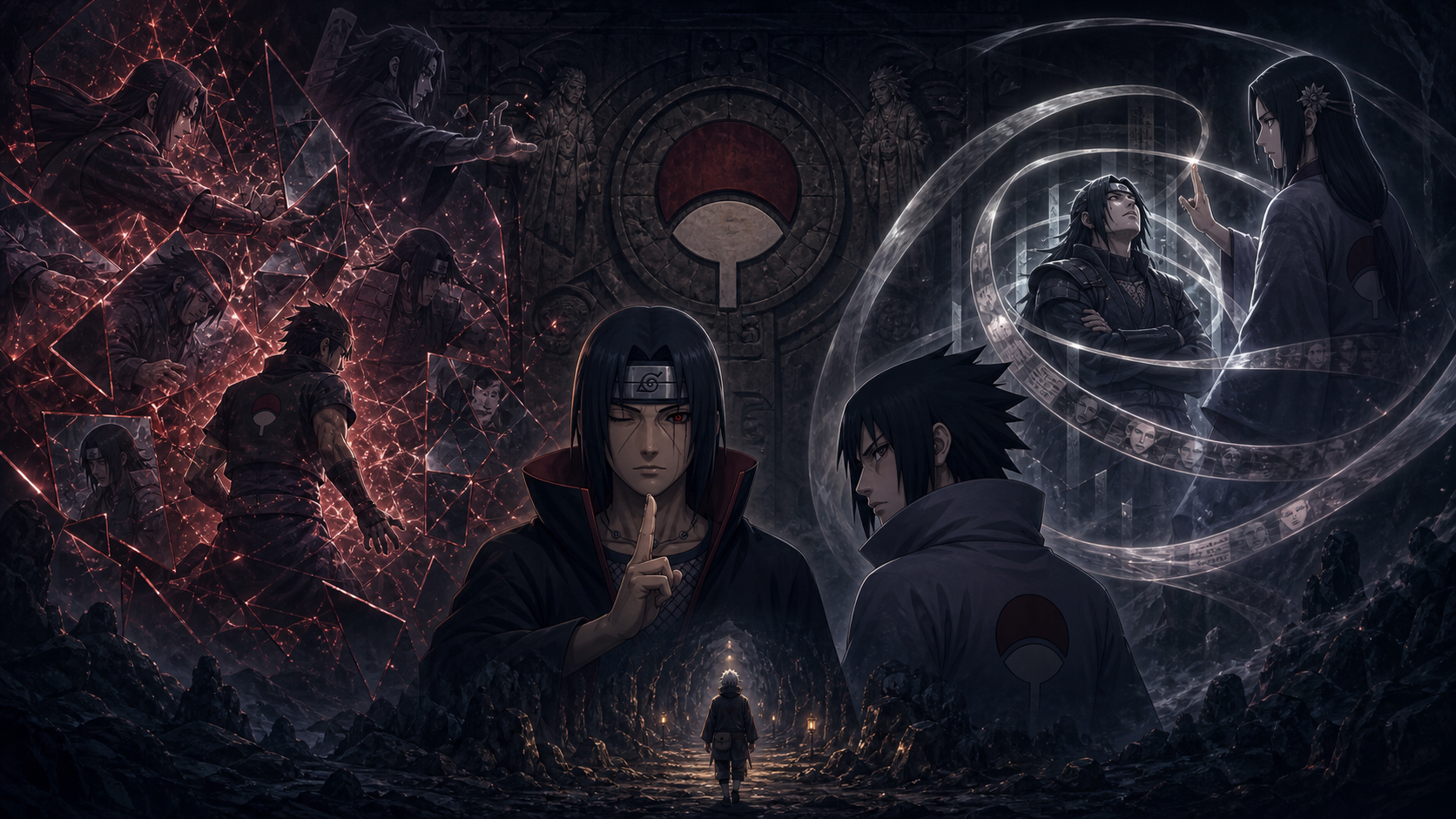
Izanagi and Izanami
One Uchiha technique rewrites reality to protect the self from consequence. The other holds reality still until denial can no longer choose the next move.
Bottom line
“Izanagi and Izanami” explains two Uchiha techniques as opposing responses to unbearable reality. Izanagi lets a user reject an outcome and rewrite injury or death as illusion, but every use sacrifices an eye. Clan members began treating that power as permission to replace any result they disliked, which turned disagreement into endless conflict between competing revisions. Izanami was created as a countermeasure. The sensory loop does not let its target escape through another rewritten reality; release requires recognizing the self and accepting the consequence being denied. Itachi applies that history to Kabuto, whose entire adult body has become a revision project built from Orochimaru, the Sound Four, Jūgo, and every identity he thought might make him complete. The episode’s moral language is imperfect because coerced self-acceptance remains coercion. Still, the paired logic lands. Izanagi changes the world to protect the self from truth. Izanami holds the world still until the self can no longer run.
The episode shifts from activation to explanation
Episode 337 showed Kabuto entering a repeating sequence without understanding how Itachi built the trap. Episode 338 slows the battle so Sasuke can ask what Izanami actually does.
The explanation is not detached lore. Kabuto continues living the loop while Itachi describes why the Uchiha created a technique with such a severe exit condition.
Izanagi begins with reality as material
Izanagi allows a Sharingan user to treat harmful events as illusion and favorable actions as reality. The boundary between what happened and what remains becomes temporarily editable.
That power exceeds ordinary genjutsu because the user is not only changing perception. The outcome itself is revised for the person performing the technique.
An eye pays for the revision
The Sharingan used for Izanagi loses its light. Permanent blindness creates a visible cost for refusing one completed sequence of events.
The price sounds sufficient until access to multiple eyes turns sacrifice into a resource problem. Power finds a market whenever bodies can be treated as inventory.
Danzō already demonstrated the abuse
Sasuke fought Danzō while the elder repeatedly used implanted Sharingan to cancel fatal outcomes. A stolen arm converted Uchiha lives into spare revisions.
That battle showed the political endpoint of the technique. Institutional power did not merely borrow Uchiha ability; Danzō stockpiled other people’s sight to protect himself from consequence.
Obito also survived through revision
Izanagi has appeared as a way to escape an apparently decisive attack. Survival becomes difficult to trust when death can be reassigned to illusion.
The technique changes combat logic and moral logic together. Evidence loses authority when a powerful user can simply reject the result.
Early Uchiha users began rejecting defeat
Itachi’s account describes clan members using Izanagi to reverse outcomes they could not accept. The technique moved from emergency survival toward routine control.
Repeated access changed expectation. Reality became provisional whenever pride or ambition disliked the answer.
Competing revisions created conflict
One user could overwrite a battle, while another user could reject the new outcome. Authority shifted toward whoever remained willing to sacrifice more sight.
Disagreement became impossible to settle because nobody accepted a shared record. A community cannot govern itself when every loss can be privately erased.
Reality stopped being common ground
Conflict normally requires some agreement about what occurred, even when motives remain disputed. Izanagi abuse removed that foundation.
The danger was larger than individual cheating. Clan memory, accountability, and trust collapsed when powerful members treated fact as personal preference.
Izanami was designed as an internal restraint
The Uchiha created Izanami to stop fellow clan members abusing Izanagi. The countermeasure emerged because external force could not reliably defeat endless revision.
The origin complicates the clan’s image. Uchiha history includes dangerous excess and a deliberate attempt to build limits against that excess.
The pair functions through opposition
Izanagi changes an unwanted outcome. Izanami repeats an outcome until the target changes the internal response sustaining resistance.
One technique edits external reality around the user. The other removes external novelty until self-deception becomes the only remaining variable.
Izanami records physical sensations
The caster selects one sensory moment, then recreates matching sensations at another point. Those points connect into a repeating sequence inside the target’s consciousness.
The mechanism depends on contact, timing, and risk. Itachi had to participate in Kabuto’s attacks rather than cast a distant command.
The loop is not ordinary paralysis
Kabuto keeps moving, thinking, attacking, and believing he can find a counter. Subjective action continues even though progression has stopped.
That distinction makes the trap psychologically specific. Kabuto receives endless opportunities to make another choice, but every familiar choice recreates the same path.
Escape depends on self-recognition
Izanami releases a target who stops running from the real self and accepts the relevant outcome. Technical strength cannot substitute for that change.
The condition sounds therapeutic while operating through imprisonment. The episode wants transformation, but the route remains a weapon.
The ethical discomfort should remain
No person can meaningfully consent while trapped inside a mental loop imposed during combat. Calling the result acceptance does not erase coercion.
War conditions and Edo Tensei make containment necessary. Necessity explains Itachi’s decision without converting psychological domination into uncomplicated care.
Kabuto is an exact thematic target
Kabuto has replaced uncertainty with additions. New cells, techniques, masters, and forms promise a final version nobody can fail to recognize.
Every acquisition avoids the original question. He knows what his body contains but cannot say what values belong to Kabuto without referring to someone else.
Nonou gave him a real beginning
The name Kabuto, the Yakushi family connection, the glasses, the birthday, and the orphanage were chosen rather than inherited. Chosen foundations can still be authentic.
Root taught him to distrust that authenticity by manipulating Nonou’s recognition. The institution made external confirmation feel both necessary and impossible.
Root trained revision as survival
Each espionage assignment required another identity. A successful cover could replace the previous self before anyone became close enough to ask questions.
Kabuto learned that adaptation prevented abandonment. Izanami turns constant adaptation into the very behavior that keeps him confined.
Orochimaru rewarded endless modification
Orochimaru offered a laboratory where transformation looked like freedom. Knowledge and biological alteration gave Kabuto visible progress after Root’s deliberate erasure.
The mentorship never created a stopping point. A system based on acquisition cannot tell a person when enough has finally become enough.
Kabuto claims superiority without independence
He says he surpassed Orochimaru while using Orochimaru’s cells, research, and assumptions about bodies. Greater technical range coexists with inherited values.
Independence requires more than outperforming a teacher. Kabuto must decide which parts of the teacher’s worldview deserve rejection.
Itachi recognizes the danger of assigned selves
Itachi lived as prodigy, spy, traitor, murderer, criminal, protector, and hated brother. Institutions and family demands defined him through incompatible functions.
His experience gives weight to the warning that becoming what others require cannot replace knowing oneself. His own life also proves how difficult that principle is to practice.
Itachi still speaks from contradiction
He urges Kabuto toward self-recognition after manipulating Sasuke’s identity through hatred and secrecy for years. Correct insight arrives from someone who caused a similar wound.
The contradiction should not invalidate the lesson. That contradiction should prevent the episode from presenting Itachi as a clean moral authority.
Sasuke hears a lesson beyond Kabuto
Sasuke has moved from avenger to Orochimaru’s student, Akatsuki ally, village enemy, and brother demanding truth. Each mission promised a complete identity.
Izanagi’s history warns against revising reality whenever the current answer hurts. Izanami warns against confusing one consuming objective with an entire self.
Accepting reality does not excuse injustice
Kabuto’s exit cannot require pretending Root, Danzō, or Orochimaru treated him fairly. Those harms remain real and demand accountability.
Acceptance means acknowledging what happened and who he became without using injury as permission to consume other lives.
Acceptance also includes responsibility
Kabuto was exploited as a child and later chose grave harm as an adult. Both truths belong in the same record.
Self-recognition becomes meaningful only when biography explains choices without erasing ownership of their consequences.
The clan history mirrors institutional history
Uchiha Izanagi users rewrote outcomes to preserve personal authority. Root rewrote photographs and identities to preserve institutional authority.
Both systems manipulate reality when truth threatens control. Kabuto became a victim of one practice and a participant in another.
The eye cost becomes collective memory
Blindness marks every use of Izanagi or Izanami. The body records that reality manipulation carries permanent consequence even when an event is mentally revised.
That symbolism matters in a clan defined by visual power. Refusing to see truth eventually destroys the organ associated with seeing.
Izanami was never designed for convenience
The caster also sacrifices sight, which discourages casual punishment. A person cannot impose the loop without losing something irreversible.
Cost does not guarantee justice, but cost prevents the technique from becoming an effortless moral correction available after every disagreement.
Kabuto remains dangerous outside the loop
His body still carries Sage Mode, regeneration, sensory reach, and borrowed bloodlines. Physical containment has not made those capacities disappear.
The loop works because Kabuto’s consciousness cannot progress toward another attack. If released without change, the same strategic danger would return immediately.
The battlefield still waits for release signs
Thousands of reanimated shinobi remain connected to Kabuto’s jutsu. Itachi needs him capable of performing the release rather than destroyed beyond action.
The wider emergency keeps the philosophical discussion tied to consequence. Every moment inside the cave affects people fighting elsewhere.
The title names a pair, not two trivia entries
“Izanagi and Izanami” frames the techniques as a system. One creates the abuse; the other was developed as a corrective boundary.
Understanding only the power effects would miss the relationship. The clan needed a cultural answer to members who had made shared reality impossible.
Mythic names reinforce creation and consequence
The names draw on Japanese creation mythology, where Izanagi and Izanami are paired figures connected to life, death, creation, and separation.
Naruto adapts that pairing into techniques concerned with creating reality and confronting the limit of creation. The reference gives the jutsu moral scale beyond a clever combat trick.
Kabuto cannot acquire an exit
No Sound Four ability, transplanted cell, or stored technique can supply the internal recognition Izanami demands. The solution cannot be stolen from another body.
For the first time, Kabuto’s extraordinary archive offers no shortcut. Escape must come from a choice that belongs specifically to him.
Izanagi makes private desire override shared reality
The technique lets a user reject injury, death, or defeat by rewriting the result as illusion. The immediate miracle belongs to one person, while everyone else must live inside the revised outcome and whatever violence the user attempts next.
That imbalance explains why repeated use fractures community. Conflict needs common evidence before anyone can negotiate, grieve, surrender, or accept responsibility. When powerful people can erase every unwanted consequence, reality becomes another resource controlled by whoever owns enough eyes.
The historical lesson exposes an Uchiha governance failure
The clan developed extraordinary power without a durable public structure for regulating use. Rival wielders answered one another with more revision until disputes became contests over whose preferred reality would survive.
Izanami arrives as an internal punishment because ordinary accountability has already failed. The solution is ingenious and horrifying. A healthy institution would not depend on secret eye sacrifice and forced psychological captivity as the final check on elite abuse.
Danzō industrialized the old danger
The flashback discusses early Uchiha conflict, but Danzō later turns Izanagi into inventory. He implants multiple stolen Sharingan so the cost that once limited abuse becomes a sequence of expendable eyes.
His arm converts murdered clan members into extra attempts at controlling reality. That history prevents the technique from remaining a clan morality tale. State power, medical experimentation, and stolen bodies reproduce the same refusal to accept limits on a larger institutional scale.
Accepting reality must include naming injustice
Itachi says escape from Izanami requires accepting the true self and actual outcome. That lesson cannot mean victims should quietly accept massacre, discrimination, coerced service, or false records as though resistance caused the problem.
Reality includes who held power, who made the decision, who benefited, and who carried the cost. Acceptance becomes useful when denial ends and responsibility begins. Acceptance becomes propaganda when leaders use the word to demand obedience from people they harmed.
The technique was designed for people who refuse consequence
Izanami does not simply punish ambition. The loop targets a person who keeps rewriting an unwanted result instead of changing the choice that produces the result. Escape depends on ending that repeated refusal.
Kabuto fits because every identity crisis leads him toward another borrowed body, title, master, or technique. More accumulation changes his capacity without resolving why recognition from Nonou, Orochimaru, Sasuke, or the world must prove his existence.
Self-recognition cannot stop at personal comfort
Kabuto may eventually remember the child Nonou named and accept that history as his own. That emotional truth matters. The dead under Edo Tensei and the living people fighting them still require action.
A complete awakening would release the technique, preserve evidence, identify collaborators, assist survivors, and accept consequences without another escape into usefulness. Feeling whole cannot substitute for repairing harm caused while he felt empty.
Itachi teaches a lesson he struggled to follow
He accepted an assigned role as the person who would carry every crime alone, control Sasuke through hatred, and protect Konoha through silence. That performance also rewrote reality for his brother.
Itachi’s insight is real because he finally recognizes the failure. His authority remains complicated because Sasuke paid for the experiment. Teaching acceptance should include admitting that Itachi denied Sasuke the information needed to interpret his own life.
Sasuke must not become the hidden second target
The explanation clearly speaks to his fixation on revenge and the identities other men have assigned him. However, Sasuke is not trapped in Izanami, and Itachi should not use Kabuto’s crisis to pressure a predetermined answer about the village.
Sasuke needs evidence, time, and freedom to judge Konoha after hearing the truth. Guidance becomes manipulation when a brother withholds facts and then presents one moral conclusion as the only sign of growth.
The paired techniques turn power into an argument
Izanagi represents control without consent: reject the outcome and impose another. Izanami represents a forced confrontation with repetition: remain inside the consequence until denial ends. Neither technique offers ordinary democratic accountability.
The mythology works because both answers carry danger. Unlimited revision destroys common reality, while enforced acceptance can become coercion. The episode becomes stronger when viewers hold that tension instead of treating one eye technique as evil and the other as automatically wise.
The eye cost cannot repair the people already harmed
Blindness limits future use, but personal cost cannot restore people already harmed.
Naruto often uses sacrifice as moral currency. Episode 338 needs a stricter ledger. A wielder can pay dearly and still owe other people. Personal pain proves cost, not innocence.
Common reality is a form of public protection
Stable records protect families from powerful people who would privately edit deaths, orders, resources, and broken promises.
Konoha’s ordinary secrecy often performs a quieter version of the same harm. Classified massacres, altered mission stories, hidden experiments, and erased operatives prevent families from understanding their own lives. The village does not need a forbidden eye technique to make truth inaccessible.
The flashback should deepen rather than flatten the clan
The Uchiha users shown abusing Izanagi represent a dangerous period, not every clan member across history. Children, police officers, parents, civilians, and shinobi cannot be reduced to a bloodline lesson about pride.
That distinction matters because Konoha later treats collective suspicion as security policy. A story about internal Uchiha abuse should never become retroactive permission for surveillance, segregation, or massacre. Specific people made specific choices in both histories.
Kabuto’s exit must be chosen inside the constraint
Izanami controls the loop, but the technique cannot manufacture a sincere new identity. Kabuto must recognize the repeated decision and choose another response. Otherwise the jutsu would only replace Root’s programming with Itachi’s.
The difference remains narrow and uncomfortable. His agency survives in the possibility of choosing truth, releasing Edo Tensei, and accepting responsibility. The coercive setting deserves criticism even if the choice eventually becomes real.
RaeRae’s verdict
“Izanagi and Izanami” is dense exposition, but the history earns its place because the account explains why this particular weapon confronts this particular enemy. Izanagi represents reality revised to protect pride. Izanami represents repetition imposed until denial stops determining the next move. Kabuto’s whole adult life has followed the first impulse without literally casting the jutsu.
The ethical tension keeps the episode from becoming easy self-help language. Izanami is a coercive prison used during an emergency. Any eventual change belongs to Kabuto, but the conditions forcing that confrontation were chosen by Itachi.
RaeRae’s call
Izanagi proves what happens when power can erase every consequence, and Izanami proves how frightening the emergency restraint becomes after public accountability fails. Kabuto must stop rewriting himself through borrowed bodies. The Uchiha and Konoha histories must also name who created the conditions, who stole the eyes, and who paid for every revision.
Episode details and viewing routes
- Official episode reference: Naruto Official episode guide
- Licensed episode route: Crunchyroll licensed episode page
What I am carrying forward
Itachi has explained that Uchiha members created Izanami to restrain clanmates abusing Izanagi’s power to rewrite unwanted reality. Both techniques cost the sight of the eye used, and Izanami releases its target only after genuine self-recognition changes the repeated response.
Kabuto remains inside the loop while Edo Tensei continues across the war. Itachi still needs the release signs, and Sasuke still needs answers from his brother. Episode 339 moves toward the jutsu’s release and Itachi’s final truth.