
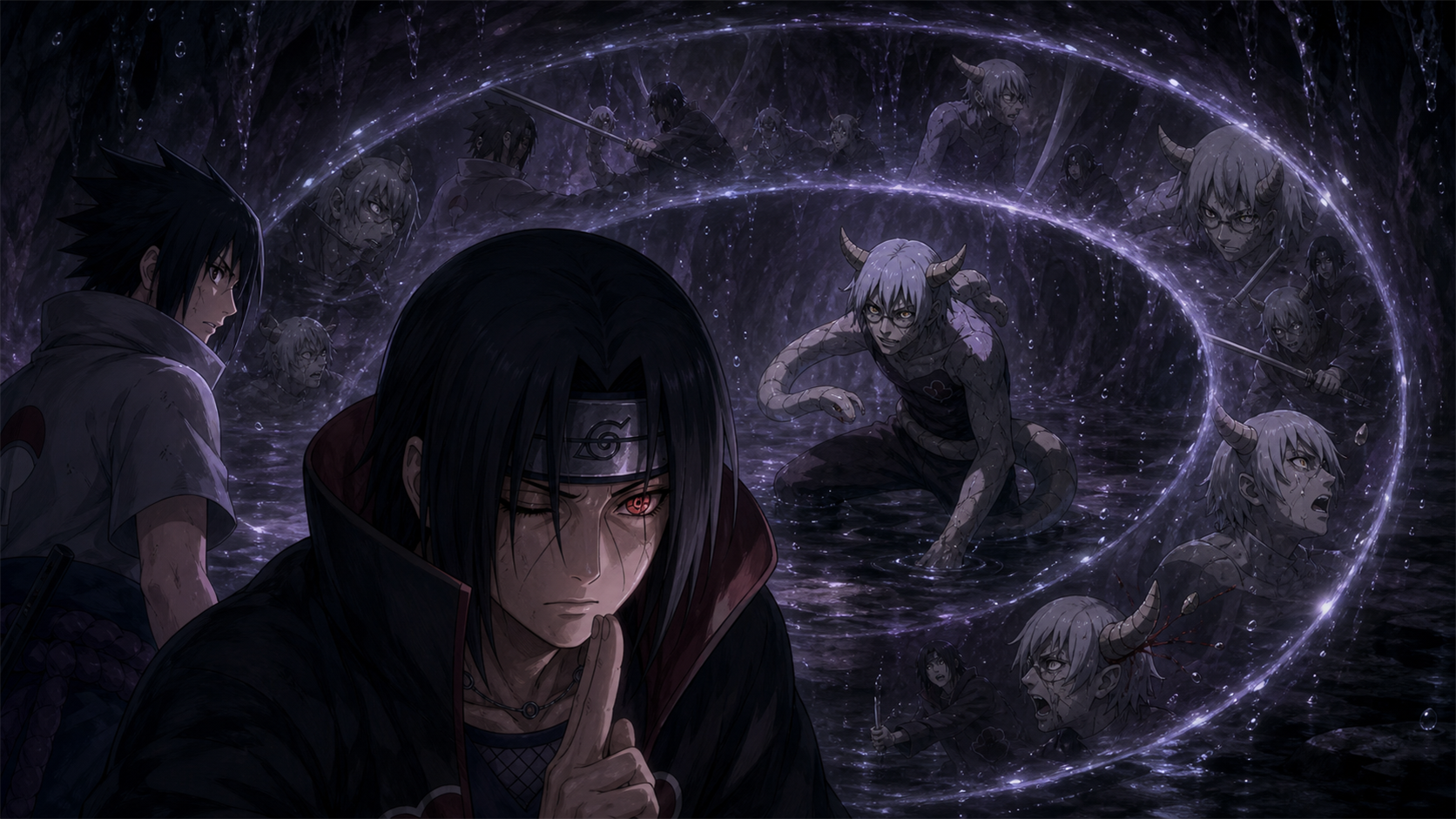
The Izanami Activated
Kabuto can counter force, regenerate damage, and borrow another body, but Izanami traps the decision pattern beneath every attempted rewrite.
Bottom line
“The Izanami Activated” turns Kabuto’s identity crisis into the structure of the fight. Kabuto believes growth means gathering enough bodies, bloodlines, techniques, and information to become impossible to dismiss. Itachi answers with Izanami, a jutsu built around repetition and self-recognition rather than superior force. Before the trap becomes visible, the episode repeats small physical events: positions reset, sensations return, and Kabuto keeps making the same choices because he cannot imagine that certainty itself has become the cage. Sasuke sees only fragments of Itachi’s plan, while Itachi accepts the loss of an eye to create a nonlethal route toward ending Edo Tensei. The technique raises difficult questions about coercion, but its dramatic logic is precise. Kabuto has spent years rewriting his surface to escape an unwanted self. Izanami forces him to confront the pattern underneath every rewrite.
The battle returns with biography attached
Episode 336 showed how Nonou named Kabuto, Root separated them, and manipulated recognition until their reunion became fatal. The cave fight now carries that history inside every technique.
Kabuto’s power is no longer merely a list. Each borrowed trait becomes another attempt to produce certainty after Root destroyed his earliest evidence of belonging.
Kabuto presents accumulation as completion
Kabuto describes the cells, abilities, and research incorporated into his body. He treats collection as proof that he has moved beyond every earlier limitation.
The confidence sounds earned because the results are real. The unresolved question is whether expanded capacity has produced an identity or only a larger inventory.
Orochimaru remains inside the achievement
Kabuto claims to have surpassed Orochimaru while carrying Orochimaru’s cells, methods, laboratory knowledge, and appetite for appropriation.
Surpassing a mentor technically does not guarantee independence from that mentor’s values. Kabuto has changed the scale while preserving the central premise.
The Sound Four become deployable features
Jirōbō, Kidōmaru, Tayuya, Sakon, Ukon, and Kimimaro survive inside Kabuto as useful biological functions. Their individual histories become combat options.
Absorption creates access without relationship. Kabuto can call upon another person’s ability without accepting disagreement, grief, or reciprocal obligation.
Sasuke recognizes the danger of resemblance
Sasuke also sought Orochimaru’s training, absorbed power, and transplanted Itachi’s eyes. Kabuto’s body offers a possible future built from the same logic.
The resemblance does not make their choices identical. The comparison matters because Sasuke must decide whether inheritance serves a chosen purpose or replaces one.
Itachi refuses the obvious kill
Kabuto must remain alive long enough to release Edo Tensei. A lethal victory would leave the battlefield trapped under the same reanimation crisis.
Restraint is therefore tactical rather than sentimental. The brothers need control over someone whose abilities are designed to prevent control.
Kabuto exploits their restraint
He knows the brothers cannot simply destroy him. Regeneration, cave awareness, and transformed anatomy make every limited attack harder to land.
Constraints favor the defender who can keep escalating. Kabuto mistakes that advantage for proof that no answer exists outside his rules.
Itachi begins recording sensations
Izanami requires selected moments to be captured through physical sensation and then matched with corresponding repetitions. Itachi prepares those points inside ordinary combat.
The setup hides within movement. A clash, a wound, a sound, and a shift in position can become coordinates without Kabuto realizing a pattern is being assembled.
Repetition enters before explanation
The episode lets actions feel familiar before naming why. Kabuto returns to moments that appear close to earlier moments, yet his confidence keeps him moving forward.
That viewing experience mirrors the trap. Recognition arrives slowly because each individual event still looks plausible on its own.
The cave becomes a closed circuit
Stone, water, sound, and narrow routes already make the battlefield feel enclosed. Izanami converts that physical enclosure into a mental one.
Kabuto has shaped the cave to favor his senses. Itachi uses the same limited environment to make repeated sensations easier to anchor.
Kabuto keeps choosing the same response
The loop does not need to force every movement. Kabuto’s certainty makes his reactions predictable whenever the same challenge returns.
A person convinced that adaptation always means adding another counter may fail to notice that the decision pattern remains unchanged.
Power cannot diagnose the loop
Kabuto can regenerate, transform terrain, borrow sensory systems, and deploy multiple bloodlines. None of those abilities automatically reveal why experience has begun repeating.
More tools can deepen confusion when every tool is used to defend the same assumption. Quantity does not replace reflection.
Sasuke remains outside the full plan
Itachi gives Sasuke only the information needed to keep fighting. Sasuke sees his brother taking risks without receiving a complete explanation.
The choice repeats Itachi’s habit of carrying plans alone. Even when the objective is protective, secrecy keeps trust incomplete.
Cooperation still matters
Sasuke’s pressure limits Kabuto’s freedom while Itachi prepares the technique. The plan depends on two distinct fighters rather than one person absorbing the other’s role.
Their coordination contrasts with Kabuto’s internal collection. Cooperation preserves separate agency, even when communication remains frustratingly partial.
Itachi accepts the cost to his eye
Izanami carries the price of permanent blindness in the eye used to activate the technique. Itachi commits despite already living on borrowed time through reanimation.
The sacrifice fits his character and exposes his recurring flaw. He solves danger by spending himself before asking whether anyone else accepts that cost.
Sacrifice does not become automatically noble
Itachi’s willingness to lose part of himself can protect thousands by ending Edo Tensei. The strategic value is enormous.
The series also shows how readily institutions exploited that willingness. Admiration should not erase the damage created by treating self-destruction as a person’s best virtue.
Izanami targets denial rather than the body
The technique traps consciousness inside a repeating sequence. Escape depends on accepting the real self and changing the choice that sustains the loop.
That condition makes the jutsu unusually moralized. Victory occurs through recognition, though the recognition is imposed through severe coercion.
The ethical problem remains real
Forcing psychological transformation can be described as rehabilitation while functioning as domination. Kabuto cannot consent to the process or leave on his own terms.
The immediate war context explains Itachi’s decision without making the method ethically clean. A necessary constraint can still deserve scrutiny.
Kabuto’s crimes create the emergency
Kabuto has animated the dead, extended the war, experimented on bodies, and treated people as material. Stopping him is not an abstract attempt to improve his personality.
The loop is connected to a concrete demand: release Edo Tensei and end the mass violation sustaining the battlefield.
Root taught Kabuto to survive through masks
Every spy assignment rewarded a convincing external identity. Safety depended on reading the room and becoming whoever the mission required.
Izanami attacks that survival method by removing the next room. No new audience or cover story can interrupt the repeating encounter.
Nonou’s question still drives him
“Who are you?” reached Kabuto as proof that the person who named him no longer recognized him. Root designed that wound through altered photographs.
His later transformations keep trying to answer the question with visible evidence. If his body contains enough greatness, perhaps recognition can never be denied again.
Orochimaru offered function instead of healing
Orochimaru explained Root’s manipulation and gave Kabuto a place in the laboratory. That truth rescued Kabuto from immediate erasure.
The new belonging still centered usefulness. Research gave him direction without creating a safe space to grieve Nonou or rebuild a self beyond service.
Izanami removes the useful audience
Inside the loop, Kabuto cannot impress Orochimaru, Danzō, the orphanage, or the brothers with another acquisition. Performance no longer changes the situation.
The trap narrows identity to the choice he makes when nobody else can certify the answer.
The title announces activation, not resolution
The technique has begun, but Kabuto has not completed the internal work required to escape. Activation creates a process rather than an instant victory.
That boundary belongs to Episode 337. Episode 338 will explain the paired history of Izanagi and Izanami and clarify why the Uchiha created this countermeasure.
Itachi understands weaponized identity
The village asked Itachi to become loyal shinobi, secret traitor, clan killer, Akatsuki operative, and hated brother at the same time. He also lived through imposed roles.
His answer differed from Kabuto’s, but neither man escaped institutional manipulation. Itachi can recognize the danger of letting assigned function consume every private truth.
Recognition cannot come only from others
Kabuto’s earliest self was relational. Nonou’s care genuinely mattered, and Root’s destruction of her recognition caused real harm.
The episode does not argue that relationships are irrelevant. The challenge is building an identity that can survive when another person’s memory is manipulated or lost.
Acceptance is not surrender to abuse
Accepting a real self should not mean accepting Root’s labels, Orochimaru’s ownership, or the injuries inflicted upon Kabuto. Those systems deserve judgment.
Acceptance means recognizing the history, needs, and choices already present without demanding another stolen body to make them legitimate.
Kabuto confuses change with replacement
Healthy change can add knowledge and capacity while preserving responsibility for earlier choices. Kabuto repeatedly tries to replace the person who felt powerless.
Replacement makes accountability impossible because every failure belongs to a discarded version. Izanami refuses to let the next version leave the pattern behind.
The loop externalizes a trauma pattern
Kabuto experiences identity threat, acquires another feature, gains temporary certainty, then encounters a new reason that certainty feels incomplete. The cycle drives further acquisition.
Izanami makes that invisible cycle literal. Repeated combat becomes the physical grammar of repeated self-avoidance.
Sasuke is watching a warning meant for him too
Sasuke defines himself through clan loss, revenge, transplanted eyes, and changing targets. He has also tried to solve grief by selecting a complete external mission.
Kabuto’s trap warns that a new objective cannot automatically answer who Sasuke wants to become after revenge ends.
A nonlethal solution changes what victory means
Most combat victories in the war end when an opponent is sealed, incapacitated, or killed. Kabuto presents a different problem because his continued life and cooperation are required to undo Edo Tensei.
Izanami reframes success as interrupting the decision system that keeps Kabuto fighting. The brothers still need physical skill to survive long enough for the loop to form, but force alone cannot deliver the release signs. That distinction gives restraint actual narrative weight. Keeping an enemy alive is not softness here. The harder objective demands a technique capable of containing danger while preserving the possibility of a later choice.
Izanami is built from recorded consequences
Itachi does not overpower Kabuto with a larger blast. He records paired sensations, reproduces the same physical sequence, and closes a loop around choices Kabuto keeps making. The technique turns cause and effect into the battlefield.
That design fits an opponent who constantly changes his body while repeating the same emotional decision. Kabuto adds abilities whenever identity feels unstable, yet every addition avoids the original grief and dependence beneath the transformation.
The loop denies Kabuto an audience for performance
Kabuto cannot impress Root, Orochimaru, Sasuke, or the world inside Izanami. Nobody grants the recognition he expects from Sage Mode, stolen bloodlines, medical mastery, or control over the dead.
Without an audience, the performance stops producing new proof. Kabuto faces his own response repeatedly, which exposes how much of his claimed self depends on defeating someone else’s judgment rather than choosing a life he can inhabit.
Acceptance cannot mean agreeing with the abuser
Itachi describes escape through accepting oneself, but that phrase becomes dangerous if readers hear obedience. Kabuto should not accept Root’s lie that he was disposable, Nonou’s manufactured failure to recognize him, or Orochimaru’s claim that usefulness creates identity.
Healthy acceptance means recognizing the injured child, the chosen name, the love he received, the harm he later caused, and the limits no borrowed technique can erase. Truth includes resistance to abuse.
The technique raises a consent problem
Izanami forces psychological repetition until the target reaches a prescribed insight. A nonlethal method is preferable to execution, especially when Kabuto must release Edo Tensei, but survival does not automatically make the intervention ethical.
The loop removes time, outside counsel, and the ability to refuse the process. The emergency explains why Itachi chooses it. The emergency should not become a blank check for mind control dressed as moral education.
Itachi knows the cost of living through a role
He spent years performing loyal brother, murderer, criminal, spy, and village protector while almost nobody knew the full assignment. That history gives him real insight into Kabuto’s dependence on external definitions.
Itachi also proves how dangerous self-appointed sacrifice becomes when one person controls every explanation. His lesson will mean more if he admits that secrecy did not only hurt him. Sasuke carried the largest cost without consent.
Sasuke receives another warning through someone else
Kabuto’s insistence that power and revenge will settle identity mirrors paths Sasuke has taken. Watching the loop could help him recognize the risk without reducing both men to the same person.
Sasuke’s history differs in crucial ways, including the Uchiha massacre, Itachi’s deception, and Obito’s manipulation. A warning works best when difference remains visible. Otherwise empathy becomes another tool for telling Sasuke what conclusion he must reach.
The eye sacrifice deserves scrutiny
Using Izanami costs Itachi sight in one eye. The price prevents the technique from feeling casual, but Naruto repeatedly turns bodily loss into proof of sincere intention. Pain alone does not validate a decision.
The better measure is whether the sacrifice protects lives, respects the mission boundary, and creates a route that does not require Kabuto’s death. Here, the cost supports restraint. The moral question about forced insight still remains.
Kabuto’s victims remain present outside the cave
The loop centers his identity crisis while thousands of reanimated people and living fighters continue paying for his decisions. Their suffering cannot disappear because the antagonist finally receives psychological attention.
Stopping Edo Tensei is the immediate obligation. Any later recovery must include names, bodies, families, and accountability for the war. Self-recognition becomes meaningful only when Kabuto can face the harm done through the self he chose.
A different institution could have interrupted this path
Stable orphan funding, accurate records, independent oversight, an end to coerced child espionage, and support for agents returning from long missions could have changed Kabuto’s options before Orochimaru arrived.
Those protections are less spectacular than Izanami. They are also more humane. Villages should not wait until abused children become battlefield emergencies before investing extraordinary power in forcing them to confront what the village refused to prevent.
Repetition exposes the choice hidden inside habit
Kabuto experiences the same clash, injury, and response until brute improvisation stops feeling like freedom. He can vary a movement, deploy another ability, or insist that the loop belongs to someone else, yet he keeps defending the same identity story.
The distinction between habit and destiny matters. Root trained him to survive through masks, and Orochimaru rewarded endless modification, but neither institution controls every future decision. Kabuto’s responsibility begins where he can finally see the pattern and choose whether to repeat it.
The brothers still need a plan for the aftermath
Activating Izanami does not release Edo Tensei by itself. Itachi must reach Kabuto inside the loop, obtain the hand signs or cooperation required, and protect Sasuke from the cave’s remaining dangers. The battlefield problem continues after the spiritual explanation arrives.
That practical boundary keeps the episode honest. A breakthrough is not the same as repair. The reanimated dead remain active, the Allied Shinobi Forces remain endangered, and every minute spent on Kabuto’s internal struggle carries a public cost outside the cave.
Nonou’s love should not become merely a lesson
She was a medic, caretaker, former operative, administrator, and mother figure managing a house full of children under financial pressure. Her life cannot be reduced to the moment Kabuto failed to receive recognition.
Root manipulated and killed a woman whose labor sustained people the village neglected. Remembering Nonou properly means judging what was taken from her, not using her death only as emotional fuel for Kabuto’s eventual growth. Her care created his first self, and her own story deserves moral weight.
Izanami can stop violence without completing justice
Accountability continues.
Understanding opens the door. Kabuto must repair harm, testify, accept restraint, and face survivors.
RaeRae’s verdict
“The Izanami Activated” succeeds because the technique grows directly from Kabuto’s biography instead of arriving as a convenient new power. He has built an extraordinary body from other people while refusing the frightened child whose first identity was deliberately dismantled. A repeating sensory loop is therefore more threatening than another destructive attack. Kabuto can counter force, but he cannot overpower a pattern maintained by his own refusal.
The episode also preserves discomfort around Itachi. Izanami may stop a catastrophic jutsu without killing its caster, yet psychological imprisonment remains coercive. That tension makes the solution more interesting than simple redemption magic.
RaeRae’s call
Izanami gives the brothers a nonlethal route through an impossible mission, but survival does not erase the consent problem. Kabuto must recognize the child, name, love, crimes, and victims beneath his borrowed body. Konoha must also recognize every policy that helped manufacture the emergency before anyone calls this loop a complete answer.
Episode details and viewing routes
- Official episode reference: Naruto Official episode guide
- Licensed episode route: Crunchyroll licensed episode page
What I am carrying forward
Kabuto has continued using absorbed abilities and Sage transformation while insisting that collection proves he has surpassed Orochimaru. Itachi and Sasuke cannot kill him because they need the release signs for Edo Tensei.
Itachi has quietly assembled the repeated sensations required for Izanami and sacrificed the sight of one eye to activate the loop. Kabuto has entered the repeating sequence without understanding the exit condition. Episode 338 explains Izanagi, Izanami, and the history behind a jutsu designed to confront denial.