
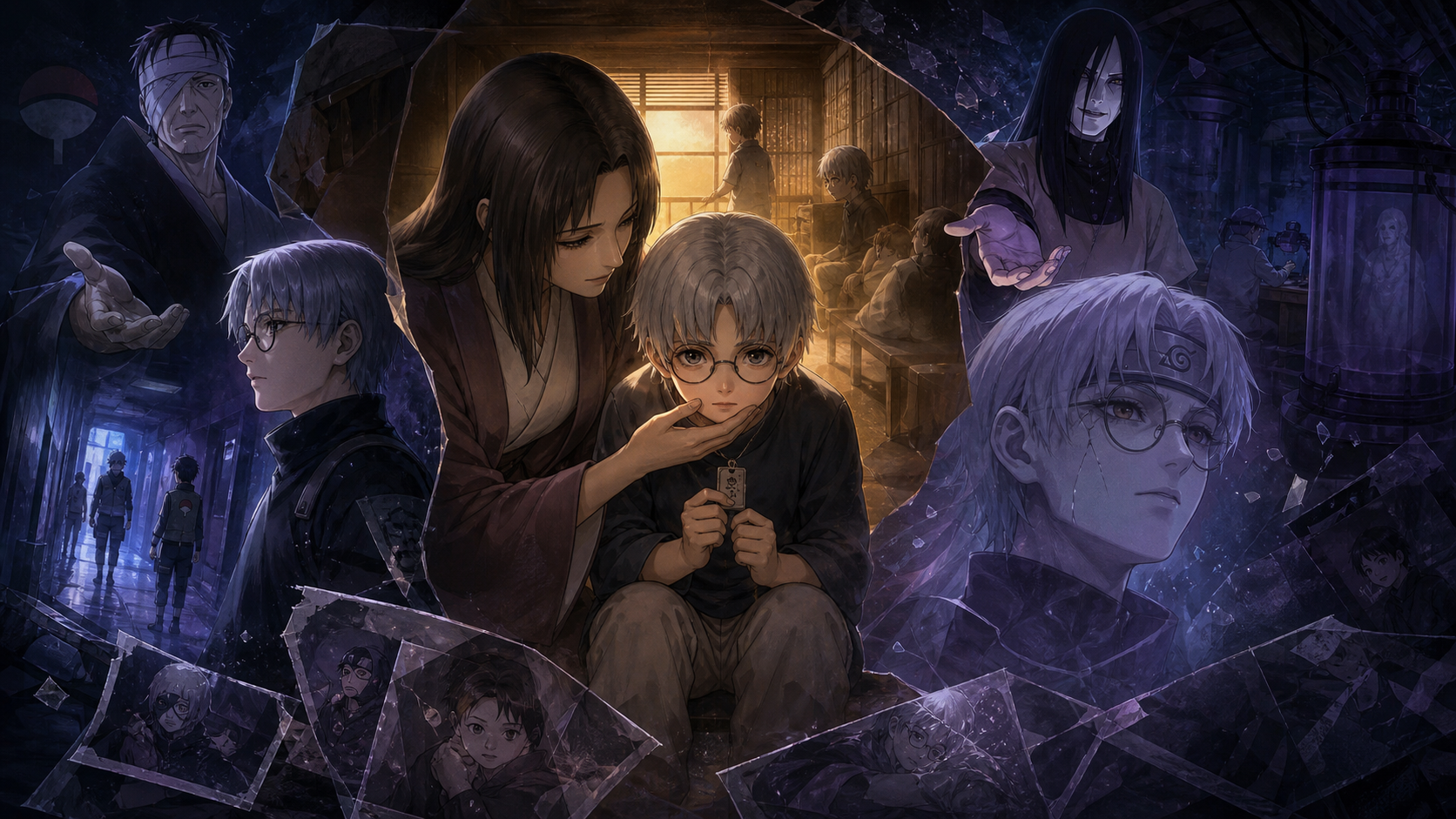
Kabuto Yakushi
Nonou gives an unnamed child the first stable coordinates of a self, then Root weaponizes distance, photographs, and recognition against them both.
Bottom line
“Kabuto Yakushi” reveals that Kabuto did not begin as a child obsessed with stealing other people’s powers. He began without a name, a clear history, or reliable sight. Nonou gave him glasses, a birthday, a place at the orphanage, and the name Kabuto. Root later turned every piece of that belonging into leverage. Danzō threatened the orphanage, recruited Nonou again, and took Kabuto as a spy. Years of changing countries, faces, and assignments severed Kabuto from any stable reflection. Root then arranged for Nonou and Kabuto to kill each other after feeding Nonou altered photographs until she could no longer recognize the child she had named. Orochimaru offered the explanation and a new place, but his rescue also redirected a shattered young man into another system built around usefulness. Kabuto’s hunger for identities becomes comprehensible here without becoming harmless.
The episode stops the cave fight
Episode 335 ended with Kabuto presenting stolen abilities as proof that he had surpassed every earlier version of himself. Episode 336 pauses the physical battle and asks why accumulation became his answer.
That pause matters. A villain’s technique can look like spectacle until the story identifies the wound the technique keeps trying to cover.
Kabuto begins without a usable record
The orphanage receives a wounded child after a battle. He cannot offer a family name, a village, or even his own name.
Other adults can define a child more easily when no record protects him. Missing history becomes an opening for care, but also an opening for institutional ownership.
Poor eyesight shapes the first meeting
The child cannot clearly see the woman helping him. Nonou notices his vision problem and lends him her round glasses.
The gesture gives more than sharper sight. Someone has looked closely enough to identify a need and answer without demanding payment.
Nonou gives him the name Kabuto
She names him after the helmet he was wearing when found. The choice is ordinary, affectionate, and immediate.
A name creates continuity where official history offers none. Kabuto can now be called back to dinner, remembered on a list, and addressed as a particular child.
The orphanage supplies a birthday
Because nobody knows his birth date, the household chooses one. The children celebrate a life whose original paperwork cannot be recovered.
Chosen ritual does not become fake because records are missing. The birthday tells Kabuto that belonging can begin in the present.
Mother becomes Nonou’s real role
The children call Nonou Mother. Her authority comes through feeding, teaching, tending injuries, and making scarce resources stretch.
Kabuto’s attachment is not an abstract debt. She becomes the first person connected to sight, language, safety, and a stable daily rhythm.
Healing becomes Kabuto’s contribution
Kabuto learns medical ninjutsu and uses chakra control to help at the orphanage. Skill gives him a way to participate rather than remain only a rescued child.
Contribution feels different from exploitation when refusal remains possible. The orphanage values his presence before measuring his usefulness.
The budget is always fragile
Food, medicine, and shelter depend on limited money. The adults keep adjusting expenses while the children notice more than adults hope.
Material precarity makes noble institutions vulnerable to coercion. Root does not need to attack the orphanage directly when funding can become a weapon.
Danzō arrives with conditional aid
Danzō and Orochimaru visit under the language of village support. Assistance comes attached to a demand that Nonou return to intelligence work.
The offer is coercion dressed as administration. Refusal would place children at risk, which means consent has already been removed from the room.
Nonou has a history with Root
Her medical skill and information work once made her valuable as the Wandering Nun. The peaceful orphanage did not erase the village’s record of what she could do.
Institutions often describe prior service as a permanent claim. Expertise becomes a chain when leaders refuse to recognize retirement.
Kabuto volunteers to protect the home
Kabuto offers himself as a Root operative after hearing the threat behind Danzō’s terms. He believes service can keep the orphanage funded and spare Nonou.
The decision shows love and limited options at once. A child cannot freely negotiate when powerful adults have placed his family’s survival on the table.
Root rewards disappearance
Training teaches Kabuto to adopt cover identities, cross borders, collect information, and leave before relationships become permanent.
Success requires becoming forgettable. Every completed mission proves competence while weakening the stable self the orphanage had begun to build.
Each country needs another face
Kabuto serves in the Five Great Nations under changing roles. Accent, clothing, allegiance, and personal history shift with each assignment.
Performance can protect a spy, but endless performance makes private identity harder to locate. No mirror can answer which face counts as home.
Information replaces intimacy
Kabuto becomes skilled at learning other people’s names, loyalties, habits, and vulnerabilities. Nobody in the field is allowed to know him with equal depth.
Knowledge becomes one-directional. He can map everyone around him while remaining unrecognized inside the map.
Root keeps Nonou and Kabuto apart
Their missions prevent direct contact. The organization controls what each person learns about the other.
Separation creates the conditions for later manipulation. Love survives, but love cannot correct false evidence when communication has been cut.
Photographs become manufactured memory
Root sends Nonou photographs said to show Kabuto growing older. Over time, the images are altered so the pictured face changes away from the real Kabuto.
The tactic attacks recognition slowly. A single obvious lie might fail, while a sequence of small substitutions can rewrite the person someone expects to see.
Nonou receives an assassination order
Root eventually identifies a dangerous target and sends Nonou to eliminate him. The target is Kabuto, though the organization withholds that truth.
The order turns two loyal operatives into disposable cleanup. Their service has not purchased protection because exploitation never intended to honor that bargain.
Kabuto receives the matching trap
Kabuto encounters an enemy operative and fights for survival. He does not know that the masked opponent is the woman who gave him a name.
Root engineers the battlefield so either outcome removes a witness. Administrative violence becomes personal while decision-makers remain safely absent.
Medical skill causes the fatal wound
Kabuto strikes Nonou and then tries to heal her after recognizing her face. The same hands once used to support the orphanage cannot reverse the injury.
His panic collapses operative discipline. Beneath every cover identity, the child who wanted Mother to recognize him has remained present.
Nonou does not recognize Kabuto
She looks at him and asks who he is. Kabuto has imagined reunion as proof that his original self still exists somewhere outside Root’s assignments.
Her question destroys that proof. The woman who named him appears unable to connect his face with the child she raised.
The failure was designed
Nonou’s lack of recognition is not evidence that her love disappeared. Root changed the photographic record supplied during their separation.
The distinction cannot protect Kabuto in the moment. Emotional injury arrives before the explanation, and trauma does not politely wait for complete evidence.
Orochimaru appears after the collapse
Orochimaru finds Kabuto after Nonou’s death and explains Root’s plan. He knows the photographs were manipulated and both operatives had become liabilities.
Truth arrives from a person with his own interest in Kabuto’s talent. Accurate information can still function as recruitment.
Root planned to erase both witnesses
Danzō’s organization expected Nonou and Kabuto to remove one another. Long service made them dangerous because each carried knowledge of covert operations.
The system defines loyalty as obedience followed by disappearance. No amount of sacrifice can satisfy an institution whose safety depends on deleting its servants.
Orochimaru offers a different laboratory
He gives Kabuto a place where medical talent, espionage experience, and curiosity will be rewarded. The offer sounds like recognition after Root’s deliberate erasure.
Orochimaru’s world remains transactional. Kabuto is welcomed because his skills are useful, which repeats the pattern under more flattering language.
Rescue and recruitment occupy the same act
Orochimaru genuinely tells Kabuto what happened and stops immediate destruction. He also catches Kabuto at the moment when every earlier source of identity has collapsed.
Help becomes dangerous when the helper treats vulnerability as access. Gratitude can bind someone to a new controller before grief has room to form an independent choice.
Kabuto chooses the name Nonou gave him
Despite the collapse, he continues using Kabuto Yakushi. The family name preserves a connection to the orphanage and the woman who raised him.
That continuity matters. Kabuto never becomes completely empty, even while he later claims that only acquired powers can define him.
The glasses remain an emotional relic
Kabuto’s round glasses echo the first act of care he remembers. They help him see and keep Nonou’s presence on his face.
An object can carry love and injury together. The glasses signify being noticed, then intensify the pain of no longer being recognized.
His later body answers the wrong question
Adult Kabuto collects cells, techniques, knowledge, and physical traits as though enough additions will settle who he is. Every new ability gives measurable proof of existence.
The strategy answers what he can do, not who deserves his loyalty or what kind of life he wants. Capacity cannot replace a chosen ethical center.
Explanation does not erase accountability
Root, Danzō, and Orochimaru shaped Kabuto through coercion and manipulation. Those facts explain why stable identity and ordinary trust became difficult.
Kabuto still chooses experiments, corpse manipulation, and war. Compassion for the child should sharpen judgment of the systems involved without removing responsibility from the adult.
The Leaf created another enemy in secret
Konoha publicly presents itself as a community protected by sacrifice. Root privately consumes children and operatives, then erases them when their knowledge becomes inconvenient.
Kabuto’s history belongs beside the Uchiha massacre as evidence that concealed governance creates future catastrophe. Security policy has consequences long after leaders stop naming their victims.
The orphanage proves another future existed
Kabuto’s childhood does not show a naturally isolated person waiting to become Orochimaru’s assistant. He jokes with the other children, worries about the household budget, practices healing, and tries to protect the adults who protected him.
Those details establish possibility rather than sentimentality. Stable care was working. Kabuto had relationships, responsibilities, and a skill used for repair. Root did not merely discover a useful spy inside the orphanage. Root interrupted a developing life and redirected devotion toward secrecy. Recognizing that lost path makes institutional responsibility concrete while preserving the fact that later choices still belonged to Kabuto.
The orphanage gives Kabuto ordinary belonging
Nonou does not begin by asking what the injured child can produce. She checks his vision, offers her glasses, gives him a name, and folds him into a household where meals, birthdays, chores, and care build identity through repetition.
That ordinary beginning matters because Kabuto was not born incapable of attachment. He learns affection, usefulness, embarrassment, and pride among people who recognize him. Root later destroys a real home rather than rescuing an empty child.
Money makes the orphanage vulnerable to coercion
Danzō arrives knowing the institution needs funds. Root presents conscription beside financial relief, turning a public failure to support children into leverage against the woman keeping those children alive.
Kabuto’s choice to volunteer contains love, but the adults with state power created the impossible bargain. Calling his departure voluntary would hide the budget threat, armed presence, and knowledge that refusal could cost every child shelter.
Root converts care skills into extraction tools
Kabuto learned medical ninjutsu to help people at the orphanage. Root repurposes the same patience, observation, and steady hands for infiltration. A gift formed through care becomes useful to an institution built around secrets.
The transformation shows how systems exploit competence without honoring the person who developed it. Root praises results while removing relationships, records, and any stable community that could help Kabuto say no.
Years undercover fracture the continuity of self
Every assignment demands another name, allegiance, voice, and history. Kabuto must convince strangers that the latest identity is genuine while nobody is allowed to recognize the child beneath the performance.
Espionage does not only risk capture. Long-term infiltration makes memory and behavior occupational equipment. Root gains intelligence while Kabuto loses people who can confirm where he came from and what parts of him were never a mission.
Altered photographs weaponize Nonou’s love
Root sends Nonou changing images so she will stop recognizing Kabuto’s face. The cruelty needs administrative patience: someone selects photographs, alters the record, maintains the lie, and waits for affection to become unreliable.
That process is why blaming Nonou for the battlefield mistake would be obscene. Root attacks her memory from a distance, then places mother and son on opposite sides of an assassination order designed to erase both witnesses.
Nonou’s final confusion destroys the promised return
Kabuto heals the person he has mortally wounded and expects his name to restore their connection. Nonou looks at him without recognition. The one relationship that anchored his identity appears to deny that he ever belonged.
Her confusion is manufactured evidence, but Kabuto does not know that yet. He experiences the moment as personal erasure after years spent believing his sacrifice protected the orphanage and preserved a road home.
Orochimaru arrives with answers timed as recruitment
Orochimaru explains Root’s trap when Kabuto is injured, grieving, and desperate for a coherent story. The information is accurate enough to feel like rescue. The offer attached to the truth leads directly into another institution that values bodies, secrets, and usefulness.
A person can reveal abuse and still exploit the survivor. Orochimaru gives Kabuto the names of his betrayers while positioning himself as the only available witness who can define what comes next.
Danzō’s security logic creates the threat he feared
Root decides Kabuto and Nonou know too much, so the organization makes them kill one another. The plan removes loyal operatives and produces a survivor with exceptional intelligence, medical skill, no remaining trust, and intimate knowledge of covert systems.
The policy is not merely cruel. The policy is catastrophically stupid. A village that treats experienced agents as disposable creates enemies whose grievances come with access, training, and receipts.
Kabuto’s later choices remain his responsibility
Episode 336 explains why identity, bodies, and recognition become his obsessions. The episode does not excuse grave robbery, experimentation, reanimation, or his role in extending the war.
Accountability can hold both levels at once. Root and Orochimaru shaped the conditions, Kabuto later exercised power inside those conditions, and the people harmed by his decisions do not owe forgiveness because his origin is devastating.
The glasses carry a history nobody else can verify
Kabuto keeps Nonou’s glasses because the object remembers a version of him that Root tried to delete. They connect poor vision, patient care, a new name, and the first household where someone expected him at dinner.
The glasses cannot answer his later identity crisis, but their survival contradicts the lie that he began as nobody. Kabuto had a relationship before the laboratories, aliases, and stolen abilities. His tragedy comes from losing access to that history, not from never having one.
The Leaf owes the orphanage more than secret gratitude
Nonou provides housing, medical care, education, discipline, and affection while the village lets funding remain precarious. Then Danzō treats that financial vulnerability as a recruitment opening. The children receive no meaningful protection from the institution claiming jurisdiction over them.
A humane shinobi system would fund independent care, prohibit child conscription tied to aid, preserve accurate family records, provide oversight for intelligence work, and give agents a lawful route home. Those safeguards sound ordinary because they are. Naruto repeatedly shows how preventable cruelty becomes legend when nobody builds the boring protections first.
Itachi should recognize Root’s pattern in Kabuto
Itachi should recognize Kabuto as another result of Danzō’s disposable Root machinery.
Recognition does not demand surrender. The brothers still need to stop Edo Tensei. Recognition should change how Itachi explains Konoha, his own obedience, and the cost of treating secret organizations as acceptable tools whenever leaders fear public accountability.
RaeRae’s verdict
“Kabuto Yakushi” works because the central tragedy is recognition rather than power. Nonou gave an unnamed child the basic coordinates of a self. Root dismantled those coordinates through separation, rotating identities, altered photographs, and a final assassination trap. Her last question hits harder than any cave technique because Kabuto hears confirmation of his deepest fear: nobody can prove who he originally was.
Orochimaru’s intervention adds the necessary discomfort. He provides truthful context and a place to survive, yet that place continues valuing Kabuto through usefulness. The episode makes Kabuto understandable without pretending his later crimes are automatic or inevitable.
RaeRae’s call
Kabuto had a home, a mother, and a name before Root turned every source of belonging into a weapon. The village must answer for funding coercion, child espionage, altered records, and a planned double murder. Kabuto must still answer for what he chose after surviving. Both truths belong in the same judgment.
Episode details and viewing routes
- Official episode reference: Naruto Official episode guide
- Licensed episode route: Crunchyroll licensed episode page
What I am carrying forward
Kabuto was raised by Nonou Yakushi after arriving at a Leaf orphanage without a name or clear history. Danzō used funding pressure to force Nonou back into espionage and recruit Kabuto into Root. Years later, Root manipulated their records and sent them to kill each other. Nonou died without recognizing the grown Kabuto, and Orochimaru revealed the trap before recruiting him.
The cave battle now carries a clearer question. Kabuto has built a body from other people because his earliest stable identity was deliberately attacked. Episode 337 returns to Itachi and Sasuke as Itachi activates Izanami against someone who cannot stop rewriting himself.