
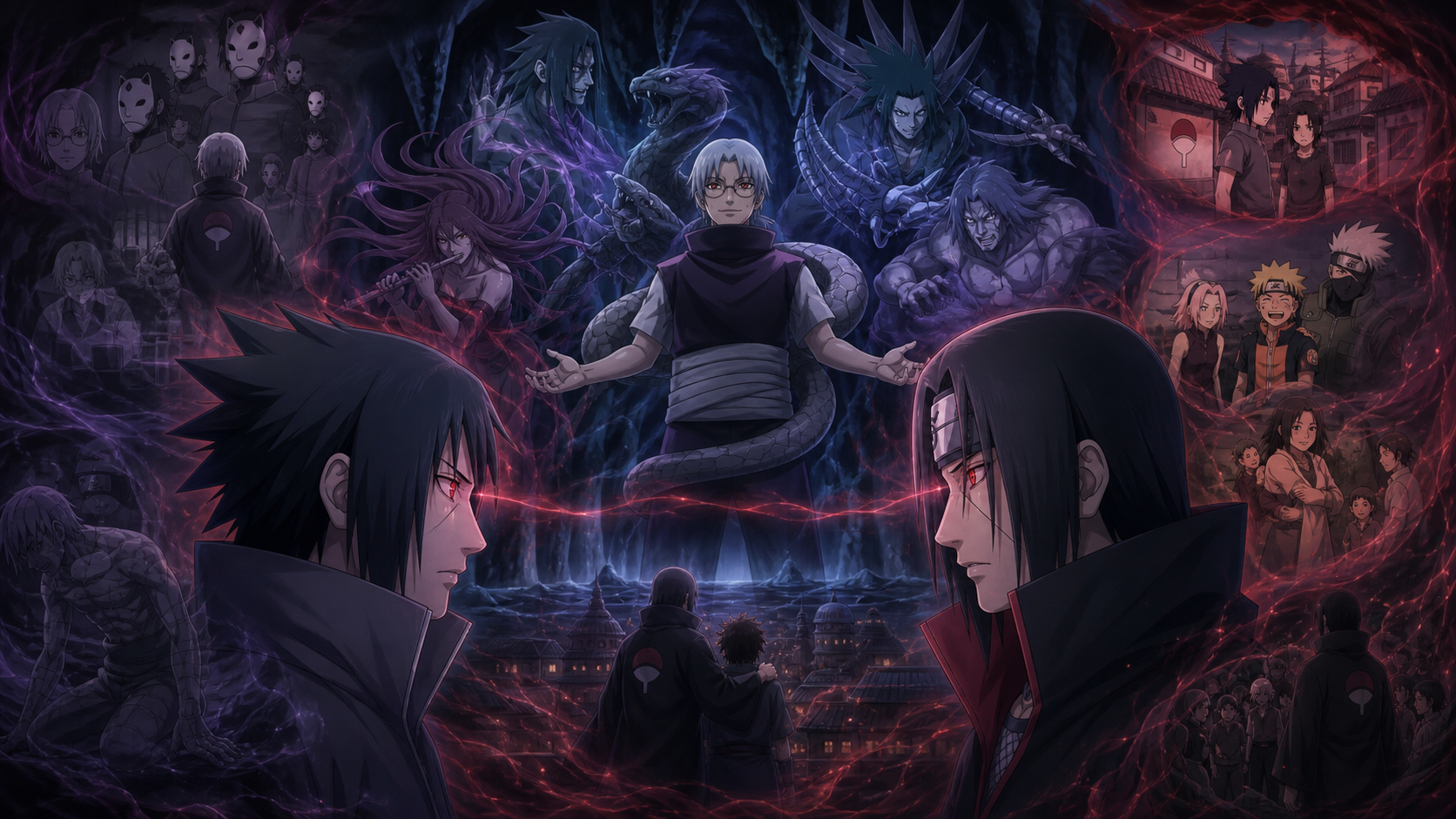
To Each Their Own Leaf
Kabuto turns shared institutional harm into a recruitment pitch, but Sasuke refuses to let another person decide what his anger must mean.
Bottom line
“To Each Their Own Leaf” refuses the idea that shared grievance automatically creates shared allegiance. Kabuto tells Sasuke that both of them were used by the Leaf, shaped by Orochimaru, and pushed outside ordinary belonging. Much of that comparison is factually grounded. Sasuke still rejects him because Kabuto treats Itachi as an obstacle and assumes anger gives him ownership of Sasuke’s next choice. The battle reinforces the argument: Kabuto produces abilities taken from the Sound Four and other experimental subjects, while Sasuke and Itachi escape Tayuya’s genjutsu by trusting one another enough to disrupt the illusion. Kabuto builds identity through accumulation. The brothers fight through relationship, even though each carries a different Leaf in his mind and neither version excuses what the village did.
Kabuto changes the battle into recruitment
Direct combat has not separated Sasuke from Itachi, so Kabuto tries persuasion. He presents himself as the person who understands Sasuke’s grievance most completely.
Recruitment becomes another attack surface. If Sasuke turns, Kabuto can isolate Itachi without overcoming both brothers physically.
The comparison begins with real harm
Both Sasuke and Kabuto were shaped by powerful institutions that withheld truth. The Leaf used people around them while describing sacrifice as protection.
Manipulation becomes persuasive when built from accurate facts. The lie often enters through the conclusion, not the evidence.
Both men passed through Orochimaru
Orochimaru marked Sasuke as a future vessel and trained him as a source of power. Kabuto served as assistant, spy, medic, and experimenter while trying to become indispensable.
Their experiences overlap without becoming identical. Similar proximity to an abuser does not create one required response.
Kabuto offers recognition with conditions
He tells Sasuke that they stand on the same side against the Leaf. The apparent recognition depends on Sasuke accepting Kabuto’s interpretation and goals.
Conditional belonging repeats the systems Kabuto condemns. Sasuke is welcome only as long as his pain serves someone else’s strategy.
Sasuke rejects the claimed alliance
Sasuke does not deny his hatred toward the village. He denies Kabuto the right to turn that hatred into partnership.
Autonomy includes choosing who does not get to represent a grievance. Agreement about an enemy does not erase conflict over methods, loyalties, or ownership.
Itachi remains the immediate boundary
Kabuto wants to regain control of Itachi or remove him as a threat. Sasuke will not join someone actively trying to take his brother away again.
The response is emotional and strategic. Sasuke needs Itachi alive enough to answer questions, and Kabuto’s control would restore the silence.
Sasuke’s Leaf is not Kabuto’s Leaf
For Sasuke, the Leaf includes the elders who ordered the massacre, the civilians who benefited from hidden violence, Team Seven, and the brother who sacrificed himself for the village.
Contradiction prevents a simple target. Destroying the village means destroying people and memories that do not carry equal responsibility.
Itachi’s Leaf centers protection
Itachi treated the village as something larger than the clan and accepted an atrocity to prevent wider war. His definition made service indistinguishable from self-erasure.
The desire to protect civilians does not make the massacre acceptable. A noble priority can be exploited by leaders offering only criminal options.
Kabuto’s Leaf centers disposability
His experience of the village is tied to Root, espionage, changing identities, and people discarded after usefulness ends. Distrust comes from direct institutional practice.
The harm deserves recognition even when Kabuto later harms others. Accountability should include what shaped him without converting that history into immunity.
The title allows multiple truths
“To Each Their Own Leaf” does not declare one correct emotional relationship to the village. Every person sees Konoha through different bonds and injuries.
Shared citizenship never guarantees shared experience. Institutions become more honest when they can hold those conflicting records.
Kabuto tries to collapse difference
He treats comparable injury as proof that Sasuke should choose the same side. The argument removes every relationship that might produce another answer.
Empathy becomes coercive when “I understand you” secretly means “therefore you owe me agreement.”
Sasuke protects his right to decide later
Rejecting Kabuto does not resolve whether Sasuke will attack, protect, or redefine the Leaf. He keeps the decision outside Kabuto’s control.
Uncertainty can be healthier than adopting the first complete ideology offered by someone who wants access to your power.
Itachi warns against easy identification
Itachi understands how adults and institutions used Sasuke’s feelings before. Kabuto’s appeal fits a familiar pattern of directing grief toward a convenient assignment.
His warning carries irony because Itachi also manipulated Sasuke’s hatred for years. Correct advice does not erase the adviser’s role in creating vulnerability.
Kabuto responds with borrowed bodies
When persuasion fails, Kabuto demonstrates abilities collected through experiments and cellular modification. His body becomes an archive of other people’s techniques.
The form matches the argument. He seeks belonging by absorbing traits rather than tolerating relationships he cannot control.
Sakon and Ukon supply bodily access
Their kekkei genkai lets Kabuto manifest components from incorporated bodies. Other identities emerge through him as usable mechanisms.
The original people receive no agency in the display. Their abilities survive while their choices remain absent.
The Sound Four return as functions
Jirōbō, Kidōmaru, Tayuya, and Kimimaro appear through techniques Kabuto has integrated. Each person once had loyalty, fear, ambition, and a relationship to Orochimaru.
Kabuto reduces that history to a menu of counters. Accumulation imitates community while eliminating mutual obligation.
Jirōbō changes the terrain
Earth techniques create barriers and pressure inside the cave. The brothers lose straightforward routes toward Kabuto.
Terrain control reinforces the living cave advantage. Every surface can serve a body assembled for environmental domination.
Kidōmaru restricts movement
Webbing and ranged attack lines punish direct pursuit. The material can hold targets long enough for another borrowed technique to strike.
Kabuto combines specialties because no original owner can object to sequence or risk.
Kimimaro supplies lethal structure
Bone techniques create close-range weapons and hard defensive forms. Kimimaro’s body was once consumed by illness and devotion to Orochimaru.
Reproducing the ability without that person’s suffering makes the power look clean. The archive hides the human cost behind technical utility.
Tayuya attacks through sound
Her flute-based genjutsu bypasses the brothers’ focus on visual traps. Sound fills the cave whether their Sharingan gaze finds Kabuto or not.
The technique traps Sasuke and Itachi in an illusion where physical power cannot immediately restore control.
Visual specialists become genjutsu targets
The Uchiha brothers are famous for ocular illusion, yet Kabuto catches them through another sensory channel. Expertise does not create immunity from the broader category.
The reversal keeps the fight tactical. Kabuto has studied the strengths he needs to route around.
Each brother needs the other’s intervention
An individual trapped inside genjutsu cannot trust every perceived signal. Sasuke and Itachi use their Sharingan on one another to disrupt the imposed chakra flow.
Escape requires vulnerability. Each brother permits the other person direct influence over his mind because remaining isolated guarantees capture.
Mutual genjutsu becomes an act of trust
The technique could be used to manipulate, especially given Itachi’s history of torturing Sasuke through illusion. Context changes the meaning.
This time the brothers use ocular power to free rather than imprison one another. A harmful tool becomes restorative only through consent and purpose.
Old trauma remains inside the cooperation
Sasuke allowing Itachi into his perception does not erase Tsukuyomi or the years of manufactured hatred. The act occurs with that memory present.
Trust here is limited, urgent, and earned through current behavior. Emotional repair will require more than one tactical exchange.
Amaterasu creates a defensive boundary
Sasuke uses black flames to restrict Kabuto’s path and protect openings. A technique associated with destructive rage becomes part of controlled defense.
Purpose matters alongside power. Sasuke is capable of using the same ability differently when the objective changes.
Itachi keeps Kabuto alive
The brothers continue balancing survival against the need for release signs. Kabuto exploits that restraint because lethal attacks remain unavailable.
Ethical and strategic constraints make their work harder. Necessary restraint should not be confused with lack of power.
Kabuto mistakes collection for self-knowledge
He lists acquired abilities as evidence that he has formed a complete identity. Every addition answers uncertainty by adding another external feature.
Self-knowledge would require deciding what he values when no master, village, or stolen body supplies the answer.
Sasuke recognizes the borrowed pattern
Sasuke has also pursued power from Orochimaru and taken Itachi’s eyes. He could resemble Kabuto if every inheritance became proof that the self is only accumulation.
His rejection does not automatically solve that risk. The comparison creates a warning he may understand more fully later.
Itachi sees another child shaped by the village
Kabuto’s hostility does not surprise Itachi because Konoha’s secret systems created people trained to disappear into assignments. Root and the massacre belong to connected governance failures.
Stopping Kabuto is necessary. Understanding how the village helped produce him is necessary for preventing another Kabuto.
The brothers’ Leaf remains unresolved
Itachi still believes in protecting Konoha, while Sasuke sees the village through betrayal and stolen family history. The fight does not settle which view will guide Sasuke.
Their cooperation creates space where the disagreement can eventually be spoken instead of decided by Kabuto’s recruitment pitch.
A village is people and administration at once
Kabuto’s argument treats the Leaf as one guilty object. Sasuke’s experience already shows why that simplification fails. Danzō and the elders authorized secrecy and violence, while Naruto, Sakura, Kakashi, and many civilians had no knowledge of the massacre’s real terms.
Separating responsibility does not protect the institution from judgment. The administration created policies, incentives, and silence that harmed the Uchiha and Root operatives. Accountability becomes sharper when named decision-makers, beneficiaries, bystanders, and resisters are not collapsed into one target.
Destruction cannot guarantee recognition
Kabuto implies that attacking the Leaf will validate the people the village discarded. Destruction may expose hidden harm, but destruction cannot force honest remembrance from survivors.
Sasuke’s deeper need includes having Itachi and the clan understood truthfully. That goal requires evidence, testimony, and living people capable of receiving both. Revenge can silence the audience whose understanding he still wants.
The episode protects Kabuto’s history for later
His claims about identity and belonging point toward an origin the present fight has not fully shown. Episode 336 will center that biography.
Keeping the boundary matters because explanation should not arrive only as a weapon in someone else’s argument.
Kabuto offers belonging through possession
Kabuto tells Sasuke that the two of them belong together because Orochimaru marked both lives. His argument sounds intimate until the conditions become visible. Sasuke must accept Kabuto’s interpretation of his pain, join Kabuto’s plan, and become useful to another man’s hunger for recognition.
Recognition without freedom is recruitment. Kabuto names real wounds, but he treats shared harm as ownership paperwork. Sasuke refuses because another survivor does not gain authority over his choices simply by recognizing the same scars.
The Sound Four return without their personhood
Kabuto draws on Jirōbō, Kidōmaru, Sakon and Ukon, Tayuya, and Kimimaro as stored functions. Their abilities remain available after their deaths while their motives, loyalties, fears, and individual histories disappear inside his body.
The display makes his idea of connection painfully clear. Kabuto collects what people can do, then calls the collection identity. Orochimaru built the same kind of institution around gifted children whose bodies mattered more than their futures.
Sasuke can recognize a pattern without accepting equivalence
Kabuto compares their orphanhood, village use, and time under Orochimaru because those parallels are real. Sasuke still rejects the conclusion. Similar abuse does not produce identical beliefs, obligations, or destinations.
That distinction protects survivor agency. Fandom conversations often turn shared trauma into a demand for sympathy, forgiveness, or alliance. Understanding how Kabuto arrived here can deepen the judgment without requiring Sasuke to trust him.
Itachi refuses Kabuto’s shortcut into Sasuke
Itachi warns Sasuke against accepting Kabuto’s comparison as destiny. The warning helps, but Itachi also helped create the loneliness Kabuto now exploits. He cannot stand outside that history as a clean guardian.
The strongest version of his intervention carries both responsibilities: stop Kabuto’s manipulation now, then answer Sasuke honestly later. Protection loses meaning when the protector keeps controlling the information that the protected person needs.
The brothers break genjutsu through mutual access
Tayuya’s sound-based illusion catches both brothers because closing their eyes cannot block the attack. Each needs the other to disrupt chakra flow and restore orientation. Neither Sharingan solves the trap alone.
The escape works because they permit influence at a vulnerable moment. That cooperation is more meaningful than a speech about brotherhood. Trust appears as a specific action with risk, timing, and a result both can verify.
Amaterasu creates a boundary rather than a victory
Sasuke uses black flames to block Kabuto’s paths and protect the brothers from another rush. The technique does not defeat Kabuto or release Edo Tensei. The flames buy space.
Defensive use matters in a series that often measures power through destruction. A barrier can be the smarter achievement when the mission requires capture, questioning, and survival. Sasuke shows control by refusing the easiest lethal answer.
Kabuto confuses adaptation with a complete self
Every borrowed technique proves discipline, study, and bodily endurance. Every borrowed technique also raises the same question: where does Kabuto end when his answer to uncertainty is adding another person’s cells, skill, or memory?
The problem is not that identity must remain pure. Nobody in Naruto develops alone. The problem is consent and authorship. Kabuto’s body records relationships that the people involved never freely chose.
The Leaf cannot mean one clean moral object
Sasuke remembers family, policing, massacre, secrecy, and elders who treated the Uchiha as a threat. Itachi remembers neighbors worth protecting and a political order he believed might collapse into wider war. Kabuto remembers institutions that used orphans and discarded inconvenient people.
Each memory belongs in the argument. Calling the village good or evil cannot account for the civilians, clans, workers, children, leaders, and covert systems gathered under the same symbol. Accountability needs names and decisions, not worship or total erasure.
Kabuto’s grievance deserves evidence, not obedience
His childhood and institutional abandonment explain why recognition became an obsession. The explanation should make Konoha and the shinobi system answer harder questions about orphan care, recruitment, medical ethics, and Root.
Those failures do not give Kabuto permission to control reanimated bodies or extend a war. A serious response can condemn the system that formed him and the choices he makes with the power he later gains.
Sasuke protects the right to decide after the truth
He does not announce a final position on Konoha because Itachi still owes him answers. Waiting is not indecision here. Sasuke refuses to let Kabuto, Itachi, Obito, or the village administration choose the meaning of his history for him.
That pause is one of his clearest acts of self-direction. He can fight beside Itachi now, reject Kabuto now, and still reserve judgment about the Leaf until the evidence and the person responsible for the massacre are fully in front of him.
The episode asks who gets to define home
Kabuto speaks about the Leaf as though suffering there gives him the final definition. Sasuke refuses because home can contain attachment and betrayal at the same time. A person may love neighbors, resent leaders, mourn family, and reject an institution’s official story without becoming confused.
That complexity matters for every child raised under a village symbol. Loyalty should not require pretending that Root, the Uchiha surveillance, orphan neglect, and covert medical exploitation were separate from public peace. The comfortable streets benefited from decisions hidden underground, even when ordinary residents never approved them.
Cooperation cannot erase the debt between brothers
Sasuke and Itachi fight beautifully together, and the beauty creates an emotional temptation to call their bond repaired. Their timing proves memory, skill, and surviving affection. Their timing does not return Sasuke’s childhood or excuse years of manufactured hatred.
Episode 335 wisely lets the mission continue while the debt stays open. Sasuke can protect Itachi, accept his warning, and depend on his genjutsu without granting forgiveness in advance. When the battle ends, Itachi still owes a complete account, and Sasuke still owns the response. The shared victory cannot become another excuse for silence between them afterward.
RaeRae’s verdict
“To Each Their Own Leaf” handles ideological recruitment well because Kabuto’s comparison is not nonsense. He and Sasuke were both manipulated, passed through Orochimaru, and learned that the Leaf’s protective language can conceal disposable people. Sasuke’s refusal matters precisely because shared facts do not force shared allegiance.
The battle makes the same point through form. Kabuto assembles other people’s abilities into a body he controls. Sasuke and Itachi combine distinct powers while remaining two people who must risk trust. The difference between collection and relationship becomes the episode’s clearest answer to Kabuto’s offer.
RaeRae’s call
Kabuto recognizes Sasuke’s wounds and then tries to own the conclusion. No. Shared damage does not create automatic loyalty, and borrowed bodies do not become a stable identity because the borrower mastered their techniques. Let Sasuke hear every answer before he defines his Leaf, and make every institution that used these children answer by name.
Episode details and viewing routes
- Official episode reference: Naruto Official episode guide
- Licensed episode route: Crunchyroll licensed episode page
What I am carrying forward
Sasuke has rejected Kabuto’s attempt to recruit him through their shared grievances against the Leaf. His future relationship to Konoha remains undecided, but Kabuto does not get to make that decision for him.
Kabuto has used Sage Mode and incorporated Sound Four abilities to trap the brothers, including Tayuya’s auditory genjutsu. Sasuke and Itachi escaped by disrupting the illusion for one another. Episode 336 moves into Kabuto’s childhood, Root exploitation, and loss of identity.