
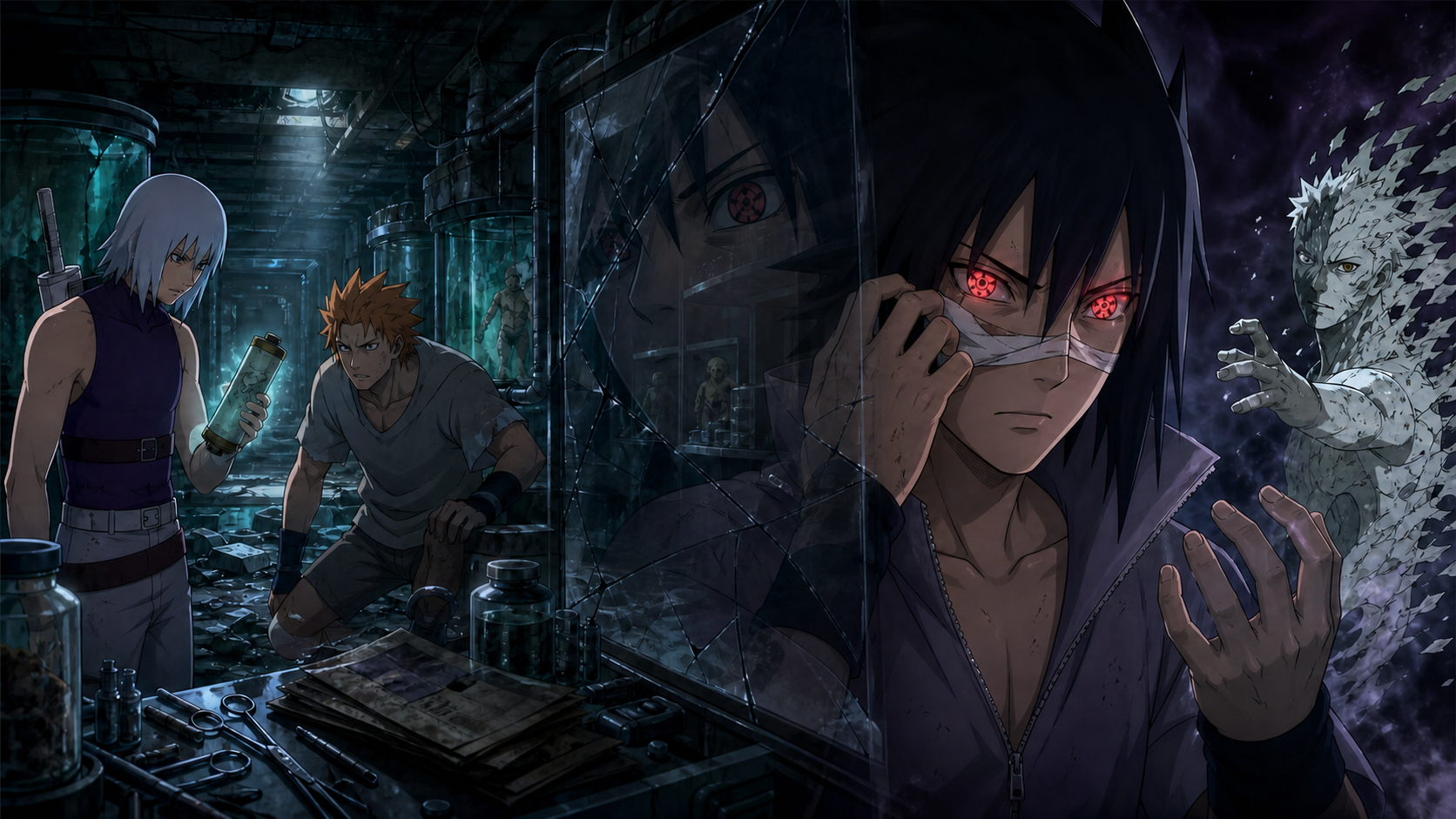
Eyes That See in the Dark
Suigetsu and Jūgo uncover research that could redirect the war while Sasuke gains clearer sight without escaping grief, revenge or isolation.
Bottom line
“Eyes That See in the Dark” follows two discoveries that could redirect the war. Suigetsu and Jūgo search an abandoned Orochimaru hideout, argue over whether finding Sasuke is worth the trouble, and uncover research important enough to change Sasuke’s next decisions. Elsewhere, Sasuke removes the bandages after Itachi’s eyes have settled into place, tests the Eternal Mangekyō Sharingan on White Zetsu, and walks toward the conflict with Naruto fixed in his mind. The episode refuses to equate clearer vision with wisdom. Suigetsu finds a document because curiosity leads him into neglected rooms; Sasuke gains extraordinary sight while continuing to interpret the world through grief, revenge, and isolation. What each person does with new information matters more than possession.
Suigetsu and Jūgo are separated from Sasuke
The collapse of Sasuke’s original team leaves Suigetsu and Jūgo moving without their chosen center. They know Sasuke survived, but they do not know his exact location or plan.
Their search begins with uncertainty rather than loyalty expressed through a clear mission.
Their reasons for following differ
Jūgo sees Sasuke as the person whose chakra and presence can calm the violent impulses tied to his condition. Finding him carries personal stability.
Suigetsu joined for access, opportunity, and his own ambitions involving the Seven Ninja Swordsmen. Their temporary alignment does not erase different needs.
Suigetsu complains because the risk is real
He questions why they should keep chasing someone who repeatedly pulls allies into lethal conflicts. The sarcasm covers an accurate assessment.
Sasuke has treated teammates as resources before. Loyalty without evaluating that history would become self-abandonment.
Jūgo remains direct
Jūgo’s commitment is less theatrical. Kimimaro chose Sasuke as Orochimaru’s next vessel, and Jūgo transferred part of that trust toward him.
The connection gives Jūgo purpose, but inherited purpose can also stop a person from asking what he wants beyond someone else’s choice.
Orochimaru’s hideout outlives its owner
The pair enters one of Orochimaru’s abandoned facilities. Rooms, records, experiments, and hidden compartments remain after the person directing them is gone.
Institutional harm often survives through infrastructure. Killing or sealing one operator does not automatically neutralize everything he built.
The laboratory treats lives as material
Orochimaru gathered bloodlines, bodies, techniques, and observations in pursuit of knowledge and immortality. The research environment records that extraction.
Useful information can come from unethical work. Later users still have to confront the cost embedded in the archive.
Suigetsu explores beyond the obvious route
Restlessness and curiosity send Suigetsu through areas Jūgo might have ignored. His lack of reverence for Orochimaru lets him disturb what was meant to remain hidden.
Discovery often depends on someone asking why a room, wall, or record was protected from ordinary view.
A concealed chamber rewards suspicion
The hideout contains information stored away from the main laboratory. Secrecy signals that the material had value even inside Orochimaru’s private network.
The hiding place does not certify truth. The document still requires interpretation, source awareness, and a decision about the proper recipient.
The scroll could influence the war
Suigetsu realizes that the research may provide a way to shift the conflict’s balance. A piece of paper suddenly carries strategic weight beside armies and tailed beasts.
Knowledge becomes power when the right person can act on the contents. Until then, the scroll is only potential.
Suigetsu wants the discovery to matter
Finding something valuable improves his leverage with Sasuke. He can return as the person carrying an answer rather than the subordinate who lost the group.
That motive does not make the discovery useless. Mixed motives are normal; transparency about them helps other people evaluate the messenger.
Jūgo sees a route back to Sasuke
The scroll provides a concrete reason to continue the search. Their movement gains purpose beyond vague reunion.
Information can reorganize a team before anyone reads the full content. Believing that Sasuke needs the document shapes their immediate direction.
The two men become couriers
Neither Suigetsu nor Jūgo can use every implication of Orochimaru’s research alone. Their next responsibility is preservation and delivery.
Courier work may look smaller than combat, but wars can pivot on whether knowledge reaches someone before a decision closes.
Sasuke waits through recovery
Sasuke has undergone the transplant of Itachi’s eyes after exhausting his own Mangekyō vision. Bandages and enforced stillness mark a rare period where power requires waiting.
The procedure joins physical restoration to another layer of grief. His brother’s eyes are now literally part of how Sasuke sees.
Eternal sight comes through inheritance
The Eternal Mangekyō Sharingan removes the blindness caused by repeated Mangekyō use. Sasuke gains durability through the eyes of the brother he killed and later mourned.
Calling the result an upgrade misses the emotional cost. The power is inseparable from family loss and Uchiha history.
Sight does not resolve contradictory truth
Sasuke knows Itachi loved him, served the Leaf, killed their clan under orders, and died protecting secrets. Better eyes cannot make those facts morally simple.
The darkness in the title is interpretive. Sasuke can perceive detail while choosing a frame built around revenge.
White Zetsu watches the recovery
A White Zetsu remains near Sasuke as surveillance and containment. The apparent attendant serves the masked man’s interests.
Sasuke’s private recovery is therefore not private. Akatsuki treats even an ally’s healing as a condition to monitor.
Sasuke removes the bandages
The reveal marks completion of physical recovery. His new eyes open with the combined pattern made possible by Itachi’s transplant.
The moment could signal reflection, but Sasuke immediately needs to test capability. Action remains easier than sitting with what the inheritance means.
The Eternal Mangekyō answers the blindness risk
Sasuke can use advanced ocular techniques without the same rapid collapse in vision. A limit that once threatened his revenge path has been removed.
Removing a consequence can make escalation easier. Power becomes more dangerous when the body no longer forces restraint.
Sasuke tests power on White Zetsu
White Zetsu becomes the target through which Sasuke confirms his restored sight and destructive control. The test is lethal rather than clinical.
The choice fits a world where bodies are constantly treated as proof-of-function. Sasuke has learned that habit from enemies and institutions around him.
Susanoo reflects a changed interior
Sasuke’s Susanoo develops alongside the eyes, offering greater offense and protection. The armored chakra form makes his emotional intensity physically enormous.
Defense and isolation grow together. Sasuke can shut out more of the world while striking farther into that world.
Amaterasu becomes easier to direct
The black flames that once strained Sasuke’s failing vision are available through renewed eyes. Precision increases the practical threat.
Technical mastery does not answer whether the chosen target deserves the attack. Capability and judgment remain separate disciplines.
White Zetsu’s death carries information
Sasuke demonstrates that the masked man’s surveillance cannot safely contain him. The watcher also confirms that Sasuke no longer intends passive recovery.
Destroying a monitor creates freedom of movement, but isolation means Sasuke receives less context about the war he is entering.
Sasuke chooses Naruto as the destination
His restored vision turns toward the unresolved bond that has defined much of his life. Naruto remains the person Sasuke believes he must confront.
The fixation gives him direction without giving him understanding. A target can organize movement while narrowing every other possibility.
Naruto represents the bond Sasuke cannot sever
Sasuke has abandoned the village, attacked former allies, and declared revenge against Konoha. Naruto continues treating their relationship as real.
That refusal makes Naruto both threatening and necessary. Sasuke cannot prove total isolation while one person keeps recognizing him.
Settling the score means more than winning
Their rivalry includes childhood loneliness, team competition, rescue attempts, ideological conflict, and promises neither can complete alone.
A physical victory would not automatically settle that history. Sasuke’s language reduces an emotional problem to combat because combat offers clearer rules.
The title belongs to Sasuke’s claim
Sasuke presents his eyes as capable of seeing through darkness. The confidence contains truth about his visual power and uncertainty about his moral interpretation.
Seeing in darkness can mean perceiving hidden facts. Seeing only darkness can mean filtering every fact through injury.
Itachi’s eyes carry another perspective
Itachi used those eyes while protecting Sasuke, serving the village, committing atrocity, and accepting hatred. Sasuke inherits the organs without inheriting a complete explanation.
The transplant cannot transfer judgment. Sasuke still has to decide what his brother’s choices require from him.
Suigetsu’s document may widen the frame
The research discovered in the hideout could provide information Sasuke does not yet possess. Reaching him before confrontation may change which questions he asks.
That possibility makes the search urgent. New evidence matters most before a person turns a provisional conclusion into irreversible action.
Jūgo may stabilize more than a body
Jūgo values Sasuke partly because Sasuke can suppress his violent transformations. His presence may also interrupt Sasuke’s emotional isolation.
Neither man is a therapist for the other. Companionship can still create pauses where solitary certainty becomes harder to maintain.
The war has created information gaps
Sasuke has been recovering away from the Alliance, Kabuto, and the Kage battle. He does not know the full current shape of the conflict.
Powerful decisions made with outdated context remain dangerous. Better eyes cannot see events nobody has communicated.
The scroll is an ethical test for its carriers
Suigetsu and Jūgo could hide, sell, destroy, or deliver the research. Choosing Sasuke gives him substantial influence over whatever the information enables.
Possession creates responsibility. The episode leaves open whether their chosen recipient will use the knowledge for repair, revenge, or another purpose.
Two searches move toward collision
Sasuke searches for Naruto while Suigetsu and Jūgo search for Sasuke. Each route is driven by incomplete knowledge.
The structure creates tension without requiring immediate combat. Whoever meets first may change the direction of the next meeting.
The episode returns agency to Team Taka
Suigetsu and Jūgo are not frozen because Sasuke left them behind. They investigate, argue, discover, and choose a next step.
Their agency remains imperfect because Sasuke still organizes much of their purpose. Movement at least prevents total reduction to absent leader’s accessories.
Knowledge competes with momentum
Sasuke’s new eyes and anger push him toward immediate action. The scroll moves more slowly through people trying to find him.
The episode asks whether information can arrive before momentum becomes destiny.
Suigetsu’s complaints function as risk reporting
He talks loudly about danger, abandonment, and the absurdity of searching Orochimaru’s hideouts without Sasuke. The tone is comic, but the conditions are genuinely unsafe.
Teams need people willing to say when leadership has disappeared and a mission lacks boundaries. Suigetsu’s self-interest does not make the warning useless. Motive and accuracy can be evaluated separately.
Jūgo gives the search a stable objective
He remains focused on locating Sasuke and interprets the scroll according to whether it can support that route. His directness prevents the pair from turning discovery into endless speculation.
Stability here is active work, not a passive personality trait. Jūgo tracks purpose while Suigetsu explores possibilities, and the search benefits from both modes.
Orochimaru’s laboratory remains dangerous after abandonment
Hidden rooms, research materials, biological evidence, and sealed documents continue to shape the war after the apparent owner is gone. A dead or missing researcher does not neutralize an institution.
Every former hideout needs containment, victim identification, hazardous-material review, and an archive protected from opportunistic reuse. Walking away leaves the experiment running through whatever the next visitor can carry.
The concealed chamber validates survivor suspicion
Suigetsu refuses to accept the obvious route as the whole truth and uncovers a space designed to escape ordinary inspection. His distrust comes from lived experience around Orochimaru.
Investigators should treat that knowledge as expertise without forcing survivors to revisit every site alone. Familiarity can locate danger, but institutions still owe protective equipment, independent witnesses, and control over exposure.
The scroll needs custody before interpretation
A document capable of changing the war can also contain traps, misinformation, names of victims, or research that should not be widely copied. Excitement is not a handling protocol.
Suigetsu and Jūgo should preserve where it was found, avoid alteration, limit duplication, and identify a trustworthy reviewer. Information becomes safer when provenance travels with content.
Team Taka members become couriers by choice
Without Sasuke directing them, Suigetsu and Jūgo decide the discovery matters and move toward him. The decision restores agency to people often treated as extensions of his mission.
They are not interchangeable followers. Suigetsu wants leverage and recognition; Jūgo wants connection and stability. A shared route can hold different motives without making one person’s choice false.
Sasuke’s new sight is built from Itachi’s body
The Eternal Mangekyō solves blindness through transplanted eyes carrying family history, grief, and a dead brother’s perspective. Calling the result a simple upgrade hides the bodily inheritance.
Sasuke consented to the transplant, but Itachi could not participate in that moment. The series should keep the ethical and emotional weight visible alongside the technique’s improved function.
Clearer vision does not produce clearer truth
Sasuke can see and control power more effectively while remaining caught between what Itachi told him, what Tobi claimed, and what Konoha concealed. Physical clarity intensifies the unresolved contradiction.
Information still needs corroboration, context, and sources outside the people manipulating him. Better eyes cannot perform the institutional investigation his grief requires.
White Zetsu’s surveillance turns recovery into exposure
Sasuke removes bandages under observation, meaning a private medical threshold immediately becomes enemy intelligence. White Zetsu’s presence confirms that recovery spaces were never secure.
Patients need controlled access, detection layers, and the right to learn who watched them. Medical vulnerability should not become free reconnaissance for whoever planted the observer.
Killing the observer does not recover the stolen information
Sasuke tests Amaterasu and Susanoo on White Zetsu, eliminating the body that witnessed him. The enemy network may already know what the observer learned.
Security response must include assumption of compromise, changed plans, and review of how surveillance entered the space. Destroying a messenger does not erase transmission.
Naruto is a relationship, not merely a target
Sasuke frames the next destination as settling a score, but Naruto represents belonging, rivalry, judgment, grief, and a bond Sasuke has never fully severed.
Reducing the encounter to winning avoids the harder question of what he wants the relationship to prove. Power can decide who remains standing. It cannot decide whose understanding was honest.
The scroll cannot become another secret monopoly
Suigetsu clearly wants the discovery to matter, and Jūgo sees a route toward Sasuke, but neither motive answers who should control information capable of shifting the war. Handing the scroll to one powerful person may be necessary for speed while reproducing the secrecy that allowed Orochimaru’s network to grow. The carriers need a second record of the find, protected outside Sasuke’s custody, with enough detail to prove provenance without spreading dangerous instructions. Any names of victims or experimental subjects should be separated from tactical content and preserved for later identification. A trustworthy review group would include medical, sealing, legal, and survivor perspectives rather than only commanders who want immediate advantage. If the scroll contains a way to stop Edo Tensei or expose hidden actors, withholding it could cost lives. If it contains coercive techniques, copying it widely could create the next abuse. The ethical answer is controlled access with accountability, not destruction or unrestricted circulation. Suigetsu and Jūgo also deserve credit as discoverers and the right to explain what they observed in the chamber. Their testimony should not vanish once Sasuke takes the document. Knowledge competes with momentum because war rewards whoever acts first. Responsible custody tries to preserve enough pause that urgent usefulness does not erase the people, risks, and evidence attached to what was found.
That pause matters for Team Taka too. Sasuke has repeatedly set direction while the others absorbed consequences and adapted around missing explanations. Arriving with evidence gives Suigetsu and Jūgo something more than a request for attention. They bring information Sasuke lacks and a decision he did not author. He can listen, reject, investigate, or exploit it, but the encounter should reveal whether he recognizes their independent judgment. A team cannot become mutual while every discovery belongs to its strongest member. The scroll creates a chance for the relationship to change before the war forces another shared destination.
RaeRae’s verdict
“Eyes That See in the Dark” works as a quieter hinge because physical sight and strategic knowledge develop on separate tracks. Suigetsu and Jūgo find research inside the ruins of Orochimaru’s exploitation, while Sasuke gains lasting vision through the eyes of the brother whose life he still cannot interpret cleanly.
The contrast keeps the power-up honest. Sasuke can see and fight better, but he remains isolated from current war context and fixed on Naruto as the answer to an emotional conflict. The document matters because new information may force him to widen the question before he decides that combat has already supplied the conclusion.
RaeRae’s call
Suigetsu and Jūgo recover agency by finding knowledge Sasuke did not order them to seek. Preserve the scroll’s custody, treat the abandoned laboratory as a live danger, and remember that Sasuke’s clearer eyes carry Itachi’s body without resolving one political lie. Sight improves; truth still needs witnesses.
Episode details and viewing routes
- Official episode reference: Naruto Official episode guide
- Licensed episode route: Crunchyroll licensed episode page
What I am carrying forward
Suigetsu and Jūgo have found concealed Orochimaru research they believe could affect the Fourth Great Ninja War. They are searching for Sasuke so they can deliver the discovery.
Sasuke has completed recovery from Itachi’s eye transplant, demonstrated the Eternal Mangekyō Sharingan against White Zetsu, and left to confront Naruto. Episode 332 returns to Ōnoki and the five Kage’s battle against Madara.