
Promise of Victory
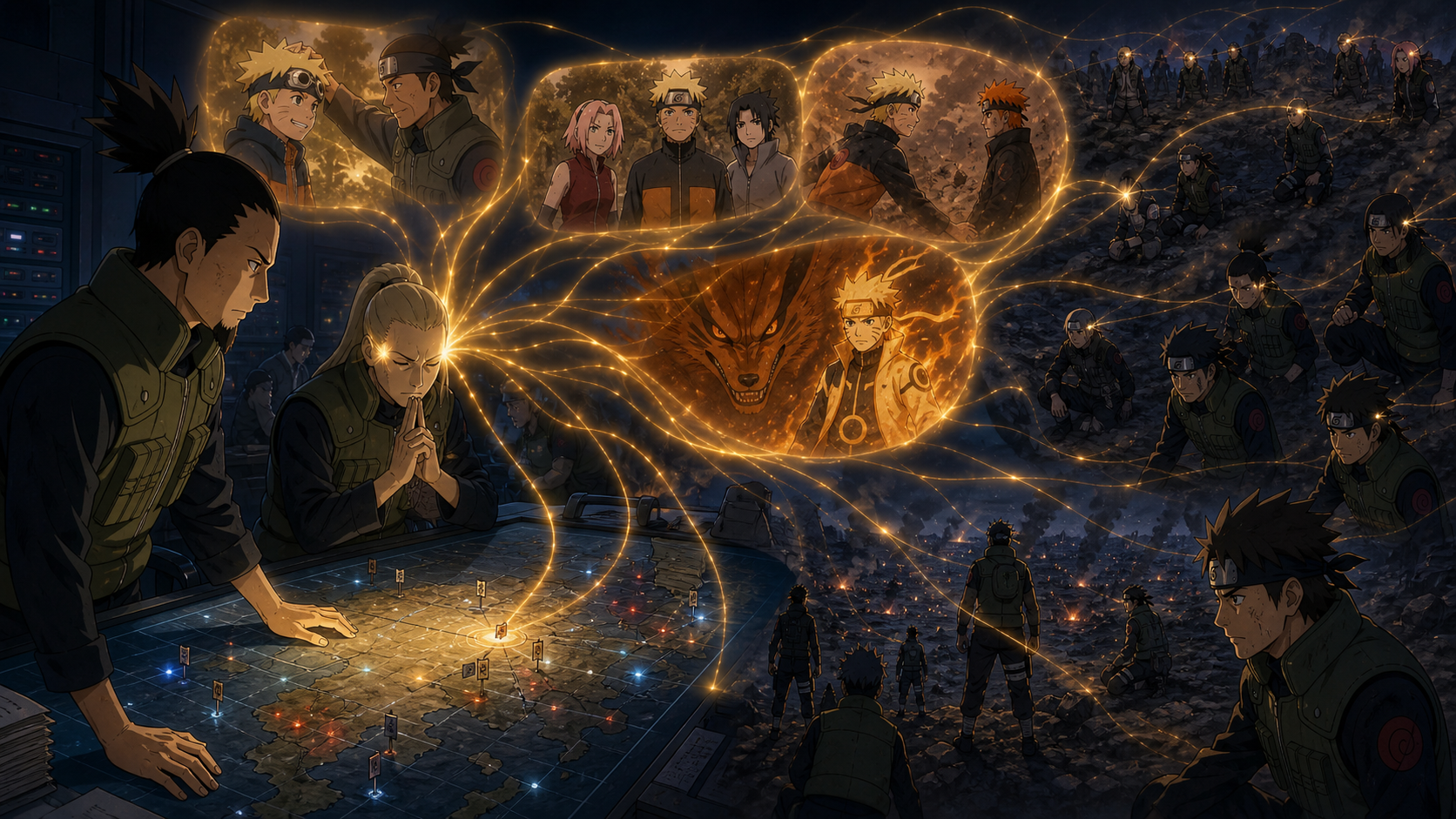
Shikaku and Inoichi answer war-wide fear with evidence, communication infrastructure and a promise every surviving soldier must help make true.
Bottom line
“Promise of Victory” asks what morale should mean after the Alliance has watched Madara drop meteors and turn an entire division into casualties. Shikaku does not answer with empty certainty. He asks Inoichi to connect the remaining forces and transmit Naruto’s history, effort, and present resolve across the battlefield. Soldiers receive evidence that Naruto has repeatedly survived isolation, accepted help, changed enemies into allies, and kept moving without pretending fear was gone. The episode makes communication infrastructure part of combat: headquarters gathers reports, strategy turns those reports into a message, and a telepath carries that message to thousands of people who need a reason to act together. Victory is a promise because everyone accepts responsibility for making the promise true, not because one hero guarantees the outcome.
The Alliance has momentum without certainty
Naruto and Kurama have broken the controlled-jinchūriki receiver network, and several fronts have improved. Those victories do not remove Madara or the masked man.
Soldiers can see progress while still doubting whether progress is enough. Honest morale has to hold both realities.
Madara has changed what fear means
The Fourth Division watched one reanimated fighter overwhelm an army, summon two meteors, regenerate, and create a forest through stolen Wood Release.
Fear after that display is not cowardice. Any command response that treats fear as a character flaw will lose the people carrying accurate information.
Headquarters receives fragmented reports
Sensors and field communicators send information from divisions separated by distance and terrain. No ordinary soldier can see the war-wide pattern.
Headquarters exists partly to assemble those fragments. Strategy begins by knowing where hope and collapse are actually occurring.
Shikaku reads morale as operational capacity
Shikaku understands that exhausted fighters cannot execute complex plans when they believe every action is meaningless. Morale affects timing, trust, and willingness to hold formation.
Treating morale seriously is not sentimental leadership. An army’s emotional state changes what the army can physically do.
A speech cannot substitute for evidence
Generic encouragement would sound insulting after the casualties already suffered. Soldiers know how much power the enemy has shown.
Shikaku needs a message grounded in events they can believe. Naruto’s record provides that evidence because many fronts have witnessed parts of his contribution.
Inoichi becomes the broadcast system
Inoichi can transmit thoughts and words across the Allied Forces through the communications network. His technique turns one strategic message into shared battlefield context.
The ability does not win through damage. Communication changes thousands of decisions at once, which can matter more than one attack.
The network carries responsibility
Broadcast power can spread panic, false certainty, or orders without context as easily as useful information. Shikaku and Inoichi have to choose content worthy of the reach.
Every person hearing the message is being asked to risk a life. Accuracy is part of respecting that risk.
Naruto is not presented as invulnerable
His history includes failure, loneliness, reckless choices, and dependence on teachers and friends. Removing those facts would turn him into propaganda rather than a person.
The useful example is not that Naruto never falls. The useful example is that falling has never been the final fact about him.
A lonely child becomes shared memory
Naruto began as a child isolated by adults who feared Kurama’s seal. He chased recognition because the village denied him ordinary belonging.
That origin matters to soldiers from outside the Leaf. The person now carrying war-wide hope was not born with universal approval.
Iruka supplied the first public belief
Iruka recognized Naruto as his student rather than the beast responsible for his parents’ deaths. One adult interrupted the village’s habit of transferring blame onto a child.
Naruto’s later strength grows from that relationship. Hope becomes credible when someone invests before public success makes investment easy.
Team Seven taught interdependence
Kakashi’s bell test forced Naruto, Sasuke, and Sakura to confront the limits of individual ambition. Sharing food and risk mattered more than obeying an isolating rule.
The Alliance now needs the same lesson at national scale. No village can hoard safety while expecting everyone else to absorb the war.
The Chūnin Exams made persistence visible
Naruto faced opponents whose status, bloodlines, or reputations made defeat appear predetermined. He kept adapting rather than accepting the hierarchy as fate.
That history does not promise easy victory over Madara. The history proves that an intimidating gap should trigger analysis and cooperation before surrender.
Neji changed through confrontation
Naruto challenged Neji’s belief that destiny fixed every person in place. Their fight mattered because Naruto’s words were supported by effort and Neji’s own buried desire for change.
The Alliance contains old political destinies too. Former enemy villages are already contradicting the future their history assigned them.
Gaara shows that enemies can become leaders
Naruto reached Gaara as another isolated jinchūriki instead of treating him only as a monster to defeat. Gaara later became Kazekage and commander of the Allied Forces.
That outcome is institutional evidence. A relationship once dismissed as naïve now helps hold five nations together.
The Sasuke mission records unfinished promises
Naruto did not bring Sasuke home after the first pursuit. The failure injured friends and left a promise unresolved for years.
His story cannot support morale by pretending every promise is quickly fulfilled. Persistence includes carrying unfinished responsibility without rewriting failure as success.
Jiraiya turned loss into inheritance
Jiraiya trained Naruto, investigated Pain, and died before seeing the peace he hoped his student might pursue. Naruto inherited knowledge and an ethical burden rather than a finished solution.
The war’s survivors face the same choice. Grief can become a reason to abandon the future or a demand to build one the dead were denied.
Pain tested Naruto’s answer to hatred
Naruto defeated Pain after the Leaf was devastated, yet he chose conversation over revenge when Nagato was vulnerable. The decision did not excuse mass killing.
Naruto interrupted the cycle by refusing to let justified anger choose the next victim automatically. That discipline matters in an alliance built from former enemies.
Nagato returned what he could
Moved by Naruto’s answer, Nagato used his remaining life to restore many people killed in the attack. The outcome came from strength, accountability, and dialogue working together.
The memory does not make every enemy persuadable. The memory proves that relationships can change the strategic field in ways force alone cannot predict.
Naruto accepted help against Kurama
Kushina’s chakra, B’s instruction, Yamato’s containment, and many earlier lessons shaped Naruto’s ability to face the Nine-Tails. He never reached control through solitary willpower.
The Alliance should not hear “be like Naruto” as “handle everything alone.” His life argues for accepting the people who make endurance possible.
Kurama’s partnership is new evidence
The beast once associated with the Leaf’s greatest recent disaster has chosen to work with Naruto. Their cooperation changes the meaning of Nine-Tails chakra on the battlefield.
Power feared across nations is now protecting those nations because a relationship changed, not because a stronger cage was built.
Naruto’s clones reached several fronts
Shadow clones identified White Zetsu infiltrators, supported divisions, and restored operational trust. Soldiers have direct local memories of Naruto arriving where help was needed.
Shikaku connects those isolated encounters into one pattern. The message lets each front understand that its rescue was part of a larger commitment.
One body still has limits
Every clone divides chakra and returns exhaustion. Naruto has nearly disappeared more than once while the war keeps demanding another intervention.
The Alliance cannot interpret his reach as permission to wait for him. His effort creates an opening for collective action.
Inoichi transmits more than words
The communication carries emotional context and memory strongly enough that distant fighters can feel the basis of Naruto’s resolve.
That intimacy increases the ethical burden. Headquarters is not sharing a mascot; headquarters is asking people to receive a person’s vulnerable history as common cause.
Soldiers recognize pieces of the story
Some fought beside Naruto, some opposed him, and others know him only through recent battlefield reports. The broadcast gives those perspectives a shared frame.
Unity does not require identical relationships with Naruto. Unity requires enough verified context to coordinate the next decision.
The message crosses village boundaries
Leaf, Sand, Cloud, Stone, and Mist shinobi hear the same account. Naruto’s biography is no longer useful only to the village that raised him.
The cross-border audience matters because every nation helped create the jinchūriki system that shaped his suffering and current power.
Hope becomes reciprocal
Naruto has been carrying confidence toward battlefields where soldiers were losing trust. The broadcast sends confidence back toward him.
Support should move both directions. A symbol remains human only when the community recognizes that he also needs reinforcement.
Shikaku does not promise an easy win
Madara remains overwhelming, and the masked man still controls the Demonic Statue. Nothing in Naruto’s history changes those facts.
The promise concerns commitment: the Alliance will keep creating the conditions where victory remains possible.
A credible promise includes a plan
Morale without deployment, communication, medical support, and coordinated attacks would be theater. Shikaku links the emotional message to continuing strategy.
People can act on hope when hope points toward roles they can perform together.
The ordinary shinobi matter
Most Allied fighters do not have tailed-beast chakra, dōjutsu, or a Kage title. They still hold lines, carry wounded people, relay information, and create openings.
The promise of victory belongs to them because large techniques cannot replace the infrastructure of thousands of smaller choices.
Fear can coexist with movement
The broadcast does not need every soldier to feel fearless. A frightened person can still follow a plan, protect a comrade, and refuse isolation.
Treating courage as the absence of fear would exclude the people seeing the danger most clearly.
Naruto becomes a relationship map
His history links Iruka, Team Seven, Gaara, Jiraiya, Nagato, B, Kurama, and fighters across the Alliance. No single relationship explains the person he has become.
The network is the point. Naruto’s strength is accumulated care, correction, rivalry, grief, teaching, and trust.
The episode pauses spectacle deliberately
After tailed-beast transformations and receiver removal, “Promise of Victory” spends time on memory and communication. The slower structure measures what the spectacle changed.
Battle consequences include morale, shared meaning, and decisions made far from the crater.
The next threat remains outside the message
Other actors continue moving while the Alliance regroups. Sasuke’s path, Orochimaru’s research, Madara, and the masked man will not wait for morale to stabilize.
The broadcast creates readiness for uncertainty rather than a sealed forecast of what comes next.
The title uses promise as obligation
A prediction claims knowledge of the future. A promise binds the speaker to help create a future.
Shikaku’s message works because the Alliance receives responsibility alongside hope. Victory becomes something they owe one another an honest effort toward.
Shikaku treats morale as a material battlefield condition
He reads exhausted reports and understands that fear is reducing movement, coordination, and the willingness to believe another order can matter. Morale is not decorative emotion beside strategy.
A credible message can restore operational capacity when it gives soldiers evidence, shared purpose, and a next action. Shikaku’s skill lies in connecting those elements rather than shouting confidence at people who have seen catastrophe.
The message begins with limits instead of invulnerability
Naruto has achieved extraordinary results, but the broadcast does not claim he cannot be hurt or that one transformation guarantees victory. His history includes fear, failure, rescue, and dependence on others.
That honesty makes hope usable. Soldiers can join a person who needs them. They cannot build a stable plan around a myth that erases exhaustion and turns every setback into betrayal.
Inoichi carries memory as infrastructure
His technique turns one strategic decision into a shared experience across distant divisions. The network carries emotional detail, chronology, and the sense of Naruto’s present resolve.
Transmission at that scale has a cost. Inoichi needs support, chakra monitoring, and clear limits on what memories command may distribute. Communication power does not remove privacy or make one operator an endless public channel.
Iruka’s belief belongs at the beginning
Before Kage, legends, and battlefields recognized Naruto, Iruka saw a grieving child and publicly chose relationship over village fear. That moment changed what Naruto believed was possible.
The memory keeps victory from becoming a bloodline story. An ordinary teacher’s decision created conditions that later power could build upon, and the Alliance should remember care as part of military history.
Team Seven taught Naruto that help is not humiliation
Sakura, Sasuke, and Kakashi challenged the isolation Naruto once performed as confidence. Their team was messy, competitive, and repeatedly fractured, yet interdependence became a language he could carry forward.
The broadcast should preserve all three teammates rather than reducing the lesson to Naruto’s self-improvement. Relationship changes because several people act, fail, and try again.
Neji and Gaara prove change moves in both directions
Naruto influenced them, but their choices also changed him. Neji forced confrontation with fatalism, while Gaara showed what another isolated child could become under different conditions.
Later, Gaara became a leader who defended Naruto publicly. Hope is reciprocal when people once reached by someone return strength to the relationship instead of remaining evidence in the hero’s biography.
The Sasuke promise remains unfinished evidence
Naruto’s commitment to bring Sasuke back shows endurance, but it also carries years of pain, disagreement, and choices Sasuke made for himself. The broadcast cannot turn an unresolved relationship into a completed triumph.
A promise gains credibility through continued responsibility, not guaranteed control over another person’s return. Shikaku uses the history because persistence matters while the outcome remains open.
Jiraiya’s inheritance includes grief and unfinished judgment
Naruto carries training, affection, political hope, and the wound of losing a mentor who also made serious choices about secrecy and the shinobi system.
Inheritance should not flatten Jiraiya into perfect wisdom. Naruto honors him best by continuing the work while examining where the older generation’s methods failed the people they meant to protect.
Nagato’s final action does not erase earlier victims
He returns lives after Naruto reaches him, creating a powerful example of change under impossible conditions. The people harmed before that decision still deserve names, mourning, and truthful records.
Hope can include accountability. Believing someone can choose differently does not require survivors to declare every consequence repaired by the final act.
Kurama’s partnership is evidence, not a miracle slogan
The Alliance can see a relationship once defined by extraction change through names, repeated choices, and chosen chakra. That history supports hope because it contains work.
No commander should promise that every conflict will resolve the same way. Kurama’s choice belongs to him, and the lesson is that different conditions can make new decisions possible.
Ordinary shinobi complete the promise
Naruto may connect the memory map, but soldiers still hold lines, carry wounded people, transmit orders, share water, and move despite fear. Victory cannot be outsourced to the symbol inspiring them.
The promise becomes collective when every person sees a role larger than waiting for rescue. Hope is strongest when it restores agency to the audience receiving it.
Broadcasting hope creates obligations after the battle
Headquarters carefully uses Naruto’s memories to move an army, which means leaders owe care to the people affected by that emotional strategy. Some soldiers may feel strengthened. Others may remember lost children, failed students, broken teams, or villages that never offered the support Naruto eventually received. The broadcast should not demand one approved reaction. Divisions need space to ask questions, report distress, and continue through smaller roles if the message overwhelms them. Naruto also deserves notice about how his history was shared and a record of what material entered the network. Inoichi’s ability cannot become permission for command to circulate private memory whenever morale falls. Consent during emergency may require later review and boundaries for future use. Shikaku’s strategy succeeds because the story is honest enough to create reciprocal commitment. Maintaining that credibility means telling the Alliance what happened next, naming losses, and acknowledging where the promised plan failed. Hope becomes manipulation when leaders borrow intimacy, demand sacrifice, and disappear after the response. A promise of victory must include a promise to remain accountable to everyone who believed it. That follow-through determines whether shared memory becomes solidarity or another command tool.
RaeRae’s verdict
“Promise of Victory” understands that morale after mass casualties cannot be manufactured through louder optimism. Shikaku and Inoichi use Naruto’s actual history because that history contains failure, help, grief, change, and repeated choices to continue. Soldiers are not asked to believe that Madara is weak. They are asked to recognize that the Alliance has already become capable of relationships the old world said were impossible.
The communication network is the episode’s quiet hero. Reports become context, context becomes strategy, and strategy becomes a shared emotional resource. Naruto inspires the message, but the promise belongs to everyone who receives the message and chooses to act.
RaeRae’s call
Shikaku does not sell a painless victory. He builds a credible promise from Naruto’s limits, Iruka’s care, Team Seven’s interdependence, changed enemies, unfinished commitments, Kurama’s choice, and thousands of ordinary people who still have work to do. Inoichi makes the connection possible, and the Alliance answers by moving.
Episode details and viewing routes
- Official episode reference: Naruto Official episode guide
- Licensed episode route: Crunchyroll licensed episode page
What I am carrying forward
Shikaku and Inoichi have transmitted an Alliance-wide message grounded in Naruto’s history and current partnership with Kurama. Morale has improved without removing the factual danger posed by Madara, the masked man, and the Demonic Statue.
The Allied Forces understand Naruto’s effort as an opening for collective responsibility rather than a guarantee that he will solve every front. Episode 331 shifts to Sasuke, Suigetsu, and Jūgo as new information begins moving toward the war.