
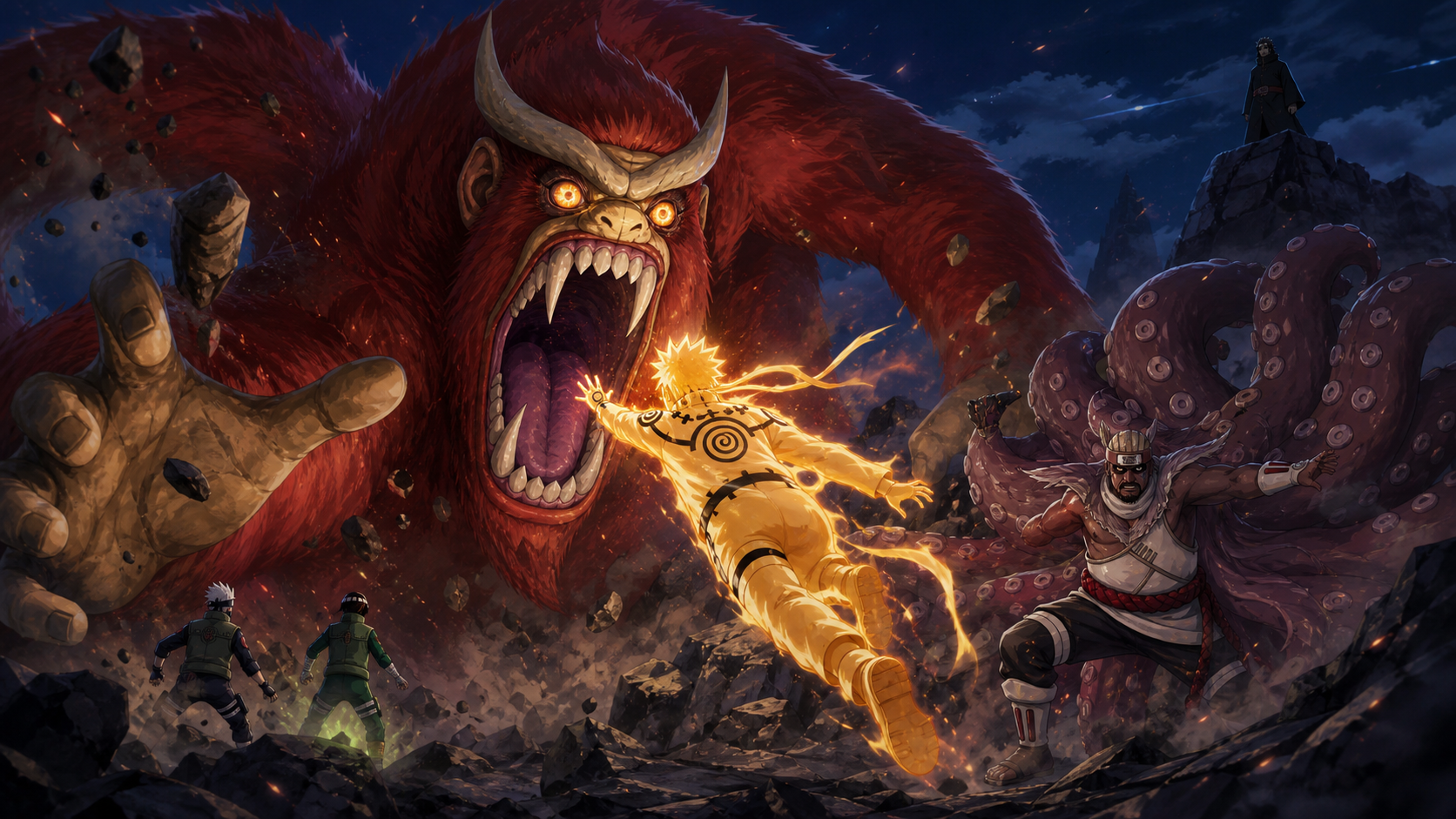
Four Tails, the King of Sage Monkeys
Kakashi and Guy arrive before forced tailed-beast transformations pull Naruto inside the Four Tails and open a conversation Obito never wanted.
Bottom line
“Four Tails, the King of Sage Monkeys” escalates the controlled-jinchūriki fight without losing the difference between transformation and partnership. Kakashi and Guy arrive with exactly the skills Naruto and Killer B need, but the masked man answers by driving several dead hosts into tailed-beast states. B can become Gyūki through conversation and consent. The reanimated hosts transform because black receivers and ocular control force bodies and beasts into service. Naruto is eventually swallowed by the Four-Tails and reaches the inner space where the being behind the title can finally be encountered as more than an enemy silhouette. The episode ends at the start of that conversation, with combat pressure creating a chance to hear the person the masked man has treated as equipment.
Kakashi and Guy break the trap
Kakashi and Guy arrive before the six controlled jinchūriki can complete Naruto and B’s capture. Their intervention restores options to a fight narrowing toward restraint.
Reinforcement matters because the enemy formation depends on dividing attention. Two additional veterans create threats the shared vision must process. Their arrival also tells Naruto that reaching every battlefield was never supposed to become his burden alone.
Kakashi brings knowledge of the masked man
Kakashi has already fought the masked man and observed his space-time intangibility. That experience lets the team begin beyond total ignorance.
The knowledge remains incomplete, but understanding that attacks pass through by timing rather than magic gives the group something measurable.
Guy reduces the ocular advantage
Guy has trained to fight Sharingan users by reading feet and body movement instead of staring directly into their eyes. His taijutsu also avoids absorption problems attached to chakra-heavy ninjutsu.
The approach does not disable shared sight. Guy simply gives that system a different kind of speed and pressure to answer.
The veterans protect Naruto’s recovery
Naruto has spent chakra across multiple fronts and entered this battle already exhausted. Kakashi and Guy create seconds where he can recover orientation and share what he learned.
Help should reduce the load on the depleted fighter. Reinforcement fails when newcomers merely ask the same person for a faster plan.
Naruto identifies the receivers
Naruto explains that black rods embedded in the jinchūriki connect them to the masked man’s control. Removing those receivers may disrupt the network.
The target gives four fighters a common objective. They are not trying to punish the dead hosts; they are trying to extract the operator from their bodies.
Shared sight forces shared planning
The enemy can observe attacks through several linked perspectives. Kakashi, Guy, Naruto, and B must coordinate pressure across more than one angle.
Individual brilliance becomes easier to predict when every defender sees the attempt. Team timing has to create simultaneous decisions the controller cannot answer cleanly.
The masked man escalates the hosts
Rather than expose himself to the expanded team, the masked man pushes the reanimated jinchūriki into stronger transformed states.
The escalation again places consequences on controlled bodies. He spends their power while preserving distance behind his mask and technique.
Transformation does not mean consent
Tailed-beast chakra covers the hosts, changing speed, reach, durability, and destructive power. The visual resemblance to Naruto’s earlier transformations is uncomfortable by design.
Naruto often lost control when Kurama’s chakra overwhelmed him. Here, another person deliberately imposes that loss of control as battlefield policy.
Three transformed hosts change the rhythm
Several jinchūriki enter tailed-beast states at once, forcing the team to answer attacks with greater scale and less warning.
The formation no longer needs ordinary openings. Enlarged limbs, chakra tails, and elemental force can pressure broad areas while shared eyes preserve coordination.
The direction keeps the transformed bodies in the same battlefield frame whenever scale matters. Naruto, B, Kakashi, and Guy look physically small beside the chakra masses, which makes every successful dodge feel planned instead of automatic. The composition also refuses to let viewers forget that Obito remains safely removed from the force he orders other bodies to spend.
Yugito’s feline power becomes faster
The Two-Tails host gains the speed and predatory movement associated with Matatabi. Claws and sweeping attacks threaten anyone trying to close on a receiver.
The body’s familiarity with the beast’s chakra survives death. The relationship that once shaped those movements has been replaced by command.
Han’s force becomes harder to absorb
Han combines tailed-beast chakra with steam-driven physical attacks. Each charge carries both transformed mass and Boil Release acceleration.
Blocking head-on becomes a losing calculation. The team needs redirection and timing rather than matching force with force.
Rōshi brings the Four-Tails forward
Rōshi’s transformation gives the Four-Tails a visible presence on the battlefield. Lava Release and immense physical strength create a threat beyond ordinary human range.
Naruto sees an enemy shape first. The episode will have to move him inside that shape before the person behind the power can speak.
Killer B chooses full transformation
B calls on Gyūki and takes the Eight-Tails form to meet the expanding threat. His transformation comes through established cooperation.
Scale now becomes useful without erasing judgment. Gyūki can protect allies, select targets, and communicate while occupying a body large enough to challenge other beasts.
Gyūki is a partner on the field
The Eight-Tails does not appear as a silent weapon summoned by B. Gyūki evaluates the opponents and participates in the plan.
That distinction is the episode’s moral measuring stick. Similar power can emerge from partnership or captivity, and the battlefield shows the difference in agency.
Giant bodies make collateral damage immediate
Tailed-beast limbs and blasts cover spaces where human-scale evasion offers little safety. Kakashi and Guy have to fight near impacts capable of reshaping terrain.
The surrounding war has already cost thousands of lives. Every escalation risks extending that cost beyond the people directly exchanging attacks.
Kakashi protects openings with precision
Kakashi uses lightning techniques and Sharingan timing to interrupt attacks aimed at Naruto and Guy. Precision matters more than producing the largest explosion.
His contribution helps convert Gyūki’s large-scale defense into smaller opportunities for receiver removal.
Guy treats size as a movement problem
Guy uses speed and taijutsu to navigate attacks from bodies much larger than his own. A giant opponent still shifts weight, commits limbs, and creates recovery windows.
His discipline keeps the spectacle grounded in readable choices. Physical scale changes timing without abolishing timing.
The team cannot ignore the masked man
The transformed hosts occupy most of the battlefield, but the operator remains the source of their coordination. Focusing exclusively on the beasts lets him preserve the network.
Kakashi tracks the masked man whenever possible. Someone has to keep the person giving orders inside the tactical picture.
Intangibility protects the controller
Direct attacks continue passing through the masked man when he phases. He can choose moments of contact for capture while avoiding ordinary retaliation.
The technique makes him appear detached from consequence. Kakashi understands that the defense must have timing and conditions, even before the exact mechanism is proven.
Naruto keeps aiming for release
The greater transformations could push Naruto toward simple destruction. He continues trying to reach the receivers and the beings under control.
That persistence is not softness. A tailed beast removed from the network would weaken the enemy more permanently than damage an immortal host can repair.
The Four-Tails closes distance
The transformed Rōshi attacks Naruto with enough reach and force to isolate him from immediate support. Shared vision helps the other bodies interfere with rescue routes.
The masked man converts the group fight into a capture opportunity. Naruto’s status as the Nine-Tails host remains the strategic prize.
Naruto is swallowed
The Four-Tails catches Naruto and pulls him inside. From the exterior, the action looks like a decisive removal from the battlefield.
The capture also moves Naruto past the weaponized surface. He is now close enough to encounter the consciousness the masked man cannot fully replace with a receiver.
The inner world changes the scale again
Outside, giant beasts exchange attacks across ruined terrain. Inside, Naruto faces a space shaped by the Four-Tails and the control binding him.
The shift reduces spectacle and restores the possibility of language. A body used as artillery contains someone capable of naming what has been done.
The title rejects a numbered label
“Four-Tails” describes the beast by a feature useful to human classification. “King of Sage Monkeys” points toward identity, pride, and history beyond a count.
Naruto has spent much of life being called by the beast inside him. He is now positioned to learn why reducing another being to a number repeats the same harm.
Rōshi and the Four-Tails are not interchangeable
Rōshi was the human host. The Four-Tails is the tailed beast sealed within him. Their forced battlefield form combines bodies without making their identities identical.
Clear naming matters because liberation requires understanding who is controlled, where the receiver sits, and what relationship existed before death.
The masked man depends on dehumanization
Control becomes easier to justify when hosts are called bodies and beasts are called weapons. The operator’s system collapses biography into function.
Naruto’s presence inside the Four-Tails creates a threat to that system. Conversation can reveal a will the controller needs everyone else to ignore.
Naruto enters without a guaranteed ally
Shared exploitation does not automatically make the Four-Tails trust Naruto. Humans created the jinchūriki system, and Naruto still belongs to that world.
He will need to listen before asking for cooperation. Being harmed by one structure gives him context, not ownership of another victim’s response.
Kurama observes the encounter
Kurama can see Naruto’s choices through their shared inner life. Naruto’s response to another tailed beast will carry evidence about whether his language of partnership is real.
Trust with Kurama has grown through actions that contradict control. The encounter with the Four-Tails becomes another test conducted without a prepared speech.
The battlefield team has to hold outside
Kakashi, Guy, B, and Gyūki cannot follow Naruto into the inner space. They must keep the remaining hosts and masked man from turning the capture into a complete defeat.
The episode divides responsibility cleanly. Naruto handles the possible conversation while his allies preserve the time and body required for that conversation.
Power cannot solve a control problem alone
Gyūki can match enormous force, Kakashi can analyze ocular techniques, and Guy can pressure bodies physically. None of those strengths automatically releases the Four-Tails.
The missing tool is cooperation from inside the controlled system. Naruto may gain that cooperation only by recognizing a person where the enemy sees inventory.
Kakashi turns prior failure into usable intelligence
He has fought the masked man before and brings knowledge of intangibility, timing, and visual deception into the new formation. Experience matters because the team cannot spend every exchange rediscovering the same rule.
Kakashi also needs room to state uncertainty. The enemy now controls jinchūriki and may have changed techniques, so an old pattern should guide testing rather than become unquestioned certainty.
Guy’s fighting style interrupts ocular prediction
Guy reduces reliance on direct eye contact and reads shoulders, hips, feet, and movement instead. His method offers the team a different sensory lane against Sharingan-supported opponents.
That contribution is not comic contrast to Kakashi’s intelligence. It is embodied expertise developed through years of training, and the battlefield benefits because no single visual system controls every answer.
The veterans protect Naruto’s decision-making space
Kakashi and Guy take pressure while Naruto recovers, studies the receivers, and chooses a release strategy. They do not merely guard his body; they protect the seconds needed for judgment.
Support becomes most valuable before the decisive move, when a fighter is still thinking. The episode lets experience create room rather than steal the younger character’s objective.
Forced transformation multiplies collateral risk
Yugito, Han, and Rōshi expand into tailed-beast forms under outside control. Their larger bodies increase reach, destructive force, terrain damage, and danger to everyone trapped between them.
Evacuation boundaries, medical staging, and communication routes need to move immediately. Transformation is not just a power escalation between named fighters. It changes what survival requires for every soldier and civilian nearby.
Yugito’s form should still be named as Matatabi
The Two-Tails is not an anonymous feline power attached to Yugito’s corpse. Matatabi has a name, memory, and history that the masked man also exploits through this transformation.
Battle reports should distinguish Yugito, Matatabi, and the control mechanism affecting both. Accurate language resists the habit of compressing two beings into one weapon label.
Han’s pressure technique threatens rescue timing
Steam-driven acceleration lets Han cross distance before a slower team can complete receiver removal. His role in the shared formation is disruption, not merely heavy impact.
Kakashi, Guy, and B need assigned interception rather than everyone chasing the Four-Tails. A rescue plan collapses if one host can break the team’s concentration whenever Naruto reaches an opening.
B’s full transformation requires Gyūki’s agreement
Killer B does not summon a giant body as equipment. He and Gyūki choose to enter a dangerous scale together because the enemy formation has changed.
The decision carries shared exposure to receivers, extraction, and control. Their partnership does not eliminate danger, but consultation ensures the risk is not imposed on one participant for the other’s glory.
Giant bodies make terrain part of the casualty map
Every tail sweep, fall, leap, and impact can crush shelters, destroy roads, and bury wounded shinobi beyond the immediate target. Size makes even defensive movement consequential.
The outside team needs to mark safe corridors and keep medics away from predicted collapse zones. Winning the exchange while losing the evacuation route is not a clean success.
Naruto’s goal is release rather than easy destruction
He keeps targeting receivers because killing reanimated bodies again would not end the controller’s system and would treat the hosts as obstacles instead of captives.
Restraint under attack is not softness. It is a strategy aimed at the actual mechanism. The harder objective recognizes personhood and improves the chance of breaking the formation permanently.
Being swallowed creates a contact without consent
The Four-Tails pulls Naruto inside during combat, and Naruto enters an internal space where ordinary battlefield rules no longer apply. He cannot assume invitation simply because communication becomes possible.
He needs to listen, identify who is speaking, and respect hostility formed through centuries of human control. Access to someone’s inner world does not grant ownership of the story found there.
The outside team must hold without knowing Naruto’s status
B, Gyūki, Kakashi, and Guy cannot see the conversation Naruto may be having. From their perspective, he has been swallowed by a controlled tailed beast while five other hosts remain active.
They need a time boundary, rescue trigger, and plan that avoids injuring Naruto or the Four-Tails unnecessarily. Trusting Naruto does not mean waiting without contingency.
Son Gokū deserves more than the title’s species label
The licensed episode title calls him the King of Sage Monkeys, but a grand description still is not the same thing as using the name he chooses. Son Gokū carries pride, anger, ancient memory, and a long history of humans reducing him to the Four-Tails. Naruto enters the conversation with habits formed inside that same system. He knows Kurama as the Nine-Tails for most of his life and initially approaches another tailed beast through a numbered category. Listening must begin with correction. If Son Gokū states his name, Naruto should repeat it accurately, ask how he wants Rōshi discussed, and avoid promising freedom he does not yet know how to deliver. Respect is not a password that guarantees cooperation. Son Gokū may distrust every human for reasons larger than this battle, and Naruto has to tolerate that distrust without making wounded feelings the center. The encounter also gives Kurama a reason to watch closely. Naruto’s behavior toward a being who cannot currently help him easily reveals whether his language of partnership extends beyond the relationship he needs at home. A name is the first boundary. Honoring it under pressure shows whether Naruto can build solidarity without turning another captive into the next source of power. That choice will matter after the battle, when villages decide whether tailed beasts enter treaties as participants with rights or return to sealed assignments written by leaders who still believe a respectful name can decorate the same old ownership system without changing it at all.
RaeRae’s verdict
“Four Tails, the King of Sage Monkeys” uses escalation to sharpen the story’s ethics. Kakashi and Guy bring skill, history, and needed relief, while Killer B and Gyūki demonstrate a full transformation rooted in mutual participation. Across the battlefield, the masked man forces dead hosts and tailed beasts into similar-looking forms without consent.
Naruto being swallowed works as more than a cliffhanger. The apparent capture takes him through the weaponized exterior and into the space where the Four-Tails can be encountered on his own terms. The next useful move may begin with a name rather than a stronger attack.
RaeRae’s call
The Four-Tails is not a numbered weapon, Yugito does not erase Matatabi, and full transformation does not erase consent. Let Kakashi and Guy hold the outside, let B and Gyūki choose risk together, and let Naruto enter the inner world prepared to listen before he asks another captive being to trust him.
Episode details and viewing routes
- Official episode reference: Naruto Official episode guide
- Licensed episode route: Crunchyroll licensed episode page
What I am carrying forward
Kakashi and Guy have joined Naruto, Killer B, and Gyūki against the masked man’s six controlled jinchūriki. Several hosts have entered tailed-beast states, while B has fully transformed through cooperation with Gyūki.
The Four-Tails has swallowed Naruto, placing him inside the tailed beast’s inner space. The black receiver and masked man’s control remain active. Episode 327 begins the direct conversation and Kurama’s reflection on Naruto’s history.