
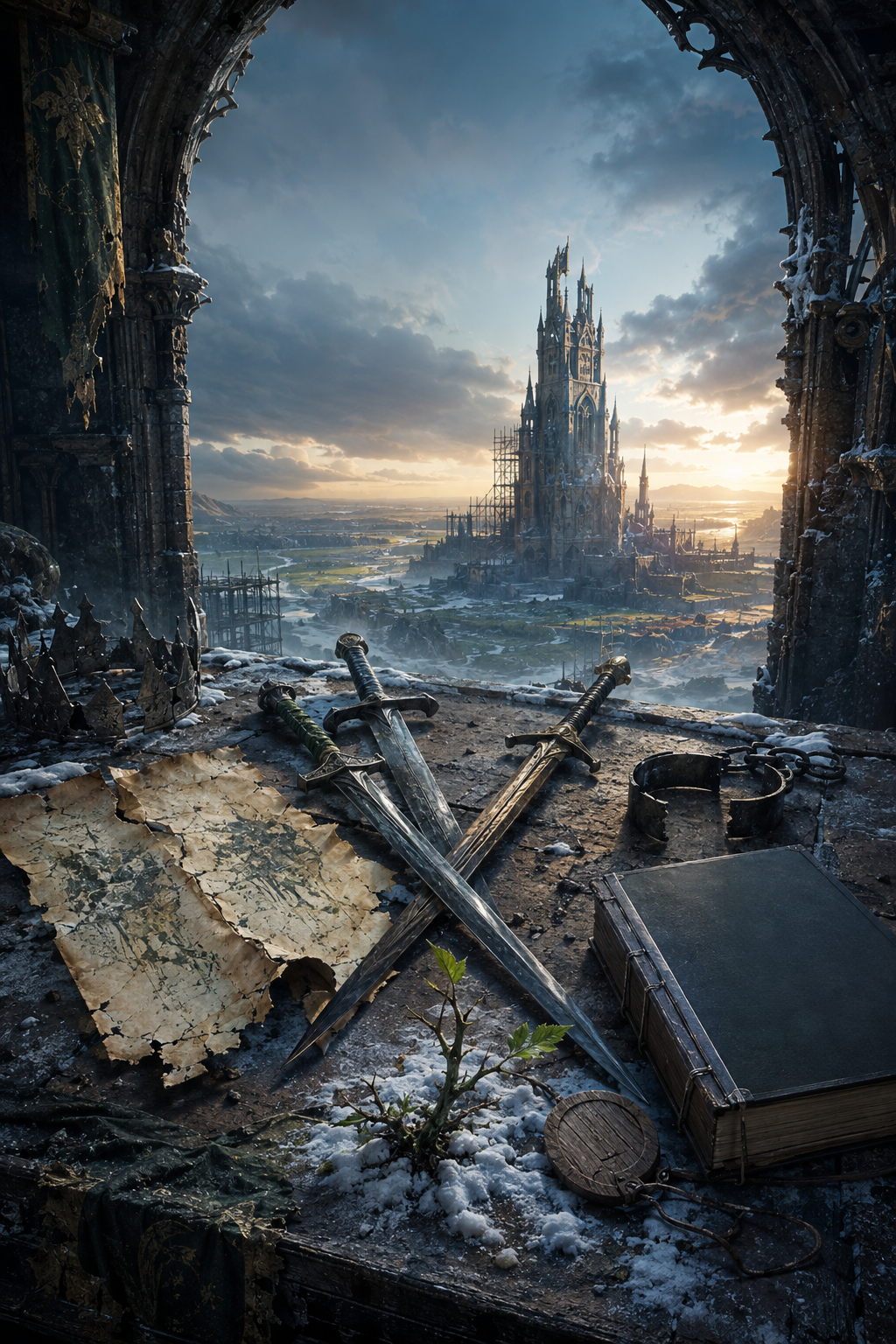
To Green Angel Tower, Part II: The Prophecy Was Never Your Friend
The finale takes fantasy’s favorite promises—chosen blood, magic swords, righteous vengeance, the last battle—and asks who benefits when desperate people mistake a mechanism for salvation.
How this page works
No trope bingo. We are checking the trapdoor beneath the label.
A false prophecy is not interesting because somebody mistranslated a line. A magic sword is not analysis because it glows dramatically. To Green Angel Tower, Part II pays off its devices by exposing the desires that made them persuasive. The heroes need the swords to mean rescue. Simon needs heroism to become simple. Elias needs sacrifice to excuse control. Ineluki needs memory to remain a legal claim on everybody alive.
The book keeps the old shapes—tower, king, lost heir, legendary blades, final confrontation—then relocates moral power. Survival comes through doubt, compassion, translation, caregiving, scholarship, refusal, and the deeply unglamorous work of deciding what happens the morning after the songs run out.
False prophecy
The words stay true. Hope supplies the lie.
The League’s rhyme promises that three swords will return and Fate will be altered. It does not promise that bringing Memory, Sorrow, and Thorn together will defeat the Storm King. The rescuing interpretation grows from need, repetition, partial records, and the authority of people who are usually careful. That is why the reversal bites: the prophecy does not fail. It performs exactly as engineered.
Ineluki and Utuk’ku use the swords as an access structure across the Road of Dreams. Thorn carries Sithi making and Amerasu’s blood. Sorrow carries Ineluki’s will through Elias. Minneyar—hidden as Bright-Nail—carries the mortal lineage required to complete the pattern. The heroes spend three books retrieving the components of their enemy’s return because a quest-shaped answer feels better than uncertainty.
The con is not “believing in prophecy.” It is believing interpretation arrives without politics.
Every archive has missing pages. Every translator has a position. Every desperate coalition prefers a sentence that tells it what to do next. The finale’s sharpest move is refusing to mock that hope while still making everyone answer for what hope helped assemble.
Magic swords
The legendary weapons are keys, appetites, and relationships—not answers
The familiar inheritance is the best disguise
John’s sword looks like mortal continuity: conquest passed from king to heir. Its older identity ties Simon’s ancestry, Eahlstan’s resistance, Morgenes’s guardianship, and Ineluki’s design together. The weapon that feels most human is precisely the missing ritual component.
Grief becomes governance when the ruler calls possession duty
Elias carries the blade as proof that his suffering is necessary. Sorrow magnifies the logic already available to him: isolation becomes sacrifice, criticism becomes betrayal, and control becomes the cost only a strong king can bear. Enchantment constrains him without erasing choice.
The quest object keeps charging interest
Thorn passes through Amerasu’s history, Camaris’s shame, Simon’s ascent, and the League’s plan. It is rescue, burden, wound, proof, and bait depending on who holds it. The sword’s meaning never stabilizes because objects cannot carry ethics for their bearers.
Completion is the catastrophe
The climactic image reverses the usual fantasy grammar. Bringing the sacred objects together does not solve fragmentation; it opens Unbeing. The heroes win only after the quest has technically succeeded and someone finally questions the emotional command built into its reward.
Memory, sorrow, and inherited grievance
Remembering is judged by what it asks the living to become
Ineluki has a legitimate history of invasion, dispossession, humiliation, family violence, and death. The book does not need that pain to be fabricated in order to reject his program. His memory preserves injury by recreating its structure: children inherit the war, bodies become instruments, difference becomes collective guilt, and annihilation becomes proof of fidelity to the dead.
Camaris offers the counterargument from inside his own guilt. He confesses betrayal rather than turning his public legend into innocence. In the sword-space, his call for forgiveness is not an order to forget Ebekah, Amerasu, Asu’a, John, or the dead of the war. It is a refusal to make endless repetition the only honorable memorial.
Simon’s compassion completes that refusal. He sees Ineluki’s suffering and answers sorrow with sorrow instead of the hatred expected from an enemy. The response does not acquit the Storm King. It breaks the mirror on which possession depends. Empathy matters here because it interrupts identification with vengeance, not because kindness magically removes consequence.
Kingship, blood, and coercive unity
The rightful king trope is put on probation
The finale reveals Simon’s descent from Eahlstan Fiskerne, and it would be very easy for secret royal blood to swallow the boy’s entire moral history. Williams refuses that cheap conversion. Blood explains why Simon can participate in the sword design and why frightened nobles can accept him. It does not explain why he rescued Jiriki, listened to Binabik, buried Guthwulf, mourned Morgenes, or refused Ineluki.
Elias presents unity as the reason no dissent can be tolerated. Josua’s coalition also needs unity, yet its best moments are argumentative and plural: Nabbanai, Hernystiri, Rimmersmen, Wrannamen, Qanuc, Sithi, dwarrows, scholars, priests, nobles, soldiers, and servants do not become one people before cooperating. The contrast is not strong king versus weak committee. It is enforced sameness versus negotiated solidarity.
Miriamele refuses to become the seal on someone else’s settlement
Her marriage has been proposed as royal strategy since the Hayholt. After the war, the pressure returns in more respectable clothes. She chooses Simon before his lineage can make the match convenient, insisting that intimacy—not dynastic accounting—comes first.
Josua’s refusal is allowed to remain a refusal
Rather than reward endurance with the crown he never wanted, the ending gives Josua anonymity, family, and continued service through the League. Stepping away from public rule is not moral failure when the throne has consumed generations of his family.
Small mercies, enormous consequences
The plot keeps being rescued by care that epic history would call incidental
Rachel feeds Guthwulf because she refuses to let a starving man remain only his crimes or disgrace. Guthwulf carries that care to Simon with water, companionship, and access to Bright-Nail. Qantaqa’s loyalty, Geloë’s guidance, Binabik’s translation, Tiamak’s scholarship, Strangyeard’s archives, and Cadrach’s final choice repeatedly move history through acts that do not look like battlefield supremacy.
This is not “kindness fixes everything.” Many merciful people die. Some recipients remain culpable. The point is structural: domination narrows people into uses, while care preserves the possibility of another choice. In a story built around instruments—swords, kings, bodies, prophecies—mercy is what keeps a person from becoming only a function.
Names, translation, and recovered meaning
The final battle is also a fight over what words are allowed to mean
Seoman becomes Simon in Rachel’s household, Snowlock among the Qanuc, and a knight in the language of Erkynland. Minneyar becomes Bright-Nail after its history is buried. Asu’a becomes the Hayholt after conquest. Those names do not cancel one another; each preserves a relationship, a political claim, or a partial memory. The catastrophe begins when one recovered meaning is treated as the only meaning that ever mattered.
Binabik, Strangyeard, Tiamak, Amerasu, Aditu, Cadrach, and the Scrollbearers all practice forms of translation, but the finale refuses the fantasy that scholarship produces a clean, neutral answer. Records are incomplete. Languages carry cultural assumptions. Even conscientious readers want the rhyme to promise victory. The ethical difference is willingness to revise: to admit that a trusted reading caused harm and act on the corrected knowledge before pride turns error into doctrine.
After the last battle
Rebuilding is not the epilogue’s housekeeping. It is the thesis.
The tower collapses, but the ending spends its attention on burials, marriages, books, homes, councils, children, embassies, crops, archives, and the Great Table. Tiamak completes a medical work that carries Wranna knowledge into the center of power. Strangyeard plans a memorial and library where the tower stood. Eolair returns to rebuild Hernystir. Binabik and Sisqi make cross-cultural relationship into diplomacy. Rachel receives authority over the Hayholt because domestic labor has always been governance with fewer songs written about it.
Most beautifully, the Dragonbone Chair is demoted. Simon and Miriamele do not stage themselves upon John’s black monument. Children play around it in the courtyard. The object that organized conquest, inheritance, rivalry, and nightmare becomes furniture in a living community.
The opposite of Unbeing is not merely being alive.
It is making room: for grief that does not demand obedience, for history that admits guilt, for knowledge from outside the court, for friends not yet known, and for children who can climb on yesterday’s sacred terror without being asked to inherit its war.
The earned happy ending
Joy is permitted to coexist with a casualty list
The weddings, reunions, jokes, and open doors do not declare the war worth its dead. Isorn, Maegwin, Geloë, Amerasu, Camaris, Cadrach, Guthwulf, Elias, and countless unnamed people remain absent from the feast. The survivors’ happiness is not payment for those lives, and grief is not proof they failed to heal.
The finale instead treats joy as a responsibility to the future. Simon and Miriamele choose each other without pretending love will govern for them. The Great Table names losses while gathering people who once could not have imagined sharing a hall. Hope becomes trustworthy only after it stops promising a painless script and starts asking what the living will build together.
On the record
Read front-to-back, then reconciled across the ending
Return to the To Green Angel Tower, Part II hub → · Read the complete Plot → · Follow the Character Arcs → · Open the series hub →