
To Green Angel Tower, Part II: Who They Choose to Be After the Prophecy Breaks
The swords dissolve. The inherited roles do not. The ending belongs to the people who decide which titles to keep, which debts to release, and what kind of home to build from the wreckage.
How the finale completes an arc
Not by making a person perfect—by making the decisive choice theirs
The finale refuses the neat equation that suffering plus revelation equals a finished adult. Simon remains vulnerable to Bright-Nail’s certainty. Miriamele reaches Elias without receiving the recognition she crossed the world to seek. Josua still turns conscience into self-punishment. Camaris cannot erase what he did to John and Ebekah. Cadrach cannot undo Pryrates. Rachel cannot bring back the kitchen child she mourned.
Completion comes when those people stop letting inherited scripts make the final decision. Simon refuses blood destiny and Ineluki’s hatred. Miriamele refuses another treaty-marriage. Josua refuses the crown. Elias rejects the immortality bargain long enough to act as a father. Cadrach rejects the identity Pryrates authored for him. Rachel takes authority over rebuilding because care has always been her political practice. The book closes arcs through agency, not spotless redemption.
Simon
The mooncalf wins by recognizing the heroic answer as coercion
Simon’s finale begins with failure that strips him below title. Swallowed beneath Swertclif, captured in the Hayholt, starved in Inch’s foundry, and tortured on the wheel, he loses reliable time, strength, equipment, and public identity. What remains is his ordinary name. “I am Simon” is not a lesser truth than Sir Seoman or Snowlock. It is the truth Bright-Nail cannot manufacture for him.
Rachel’s food saves his body. Guthwulf’s incomplete care gives him water, human presence, and eventually a route to the sword. Simon buries the former earl rather than reducing him to a delivery device. That choice matters because the entire enemy plan depends on turning people into routes for objects.
Bright-Nail’s song offers exactly what Simon has wanted: triumph, certainty, glory, and an end to confusion. He hears the difference between that voice and his own alarm but cannot escape its pull. His heroism is not immunity to manipulation. It is the ability to recover moral judgment inside it.
When the three blades open Unbeing, Simon sees Ineluki’s suffering and refuses hatred as the required response. He apologizes that Ineluki suffered. Compassion weakens the circuit because the Storm King’s survival depends on mirrored grievance. Afterward, Simon learns he descends from Eahlstan and immediately rejects ancestry as proof of worth. He accepts kingship only through public trust, partnership, and work—not because secret blood turns every earlier choice into destiny.
Miriamele
The princess crosses the world for her father and stops letting his failure define her future
Miriamele’s Hayholt mission combines agency, secrecy, love, and terrible risk. She leads Simon rather than becoming his protected passenger. When he disappears, grief makes his importance legible but does not cancel her purpose. She enters buried Asu’a with Binabik, survives possession, Norns, dwarrow conflict, and Cadrach’s unstable help, then converts Ys-fidri’s claimed helplessness into a community decision without pretending the cost is hers alone.
In Green Angel Tower, she finally stands before Elias and says she came because she loved him. He refuses to acknowledge her as daughter. That rejection completes the emotional argument earlier than his death does: Miriamele has already offered the truth. Her worth cannot depend on his capacity to receive it.
Elias later surfaces through Ineluki and makes one final paternal choice, expelling the Storm King at the cost of his life. The act matters without erasing years of coercion, abandonment, and political catastrophe. Miriamele can receive the choice without rewriting the father.
After the tower falls, barons treat Elias’s crimes, her disappearance, and Aspitis’s rumors as evidence she should be managed through marriage. She refuses to become another treaty. She tells Simon she wants him regardless of whether his father was a fisherman. Their union repairs succession, but the scene makes the personal choice first. Queenhood becomes something she enters beside a chosen partner, not the cage closing around her.
Fathers, kings, and inherited guilt
Elias, Josua, and Camaris take three different exits from the throne script
One true choice cannot erase a reign—and still remains true
Elias spends the volume defending coercive unity as sacrifice. Pain, sleeplessness, Sorrow, grief for Hylissa, Pryrates, and Ineluki constrain him; he also repeatedly chooses the explanation that turns everyone else into traitor or failed child. In the tower, he finally recognizes Miriamele too late and expels Ineluki from his body. Redemption is not a balance sheet. His last act saves his daughter and world without making the preceding harm disappear.
The prince survives and refuses to let survival draft him again
Josua commands the siege knowing every available path spends lives. Elias’s blow appears to kill him, but the old manacle absorbs it and Camaris carries him out. Official death creates an escape from the crown he never wanted. Josua chooses Vorzheva, their twins, hidden Scrollbearer work, and perhaps an inn whose door remains open. Withdrawal is not cowardice here; it is the first future he authors without his father’s throne.
The legend confesses the private wound beneath public virtue
Camaris’s history includes love for Ebekah, betrayal of John, Josua’s conception, Ebekah’s death, his own failed suicide, Amerasu’s sanctuary, and decades of diminished wandering. None fits the perfect knight others need. Yet his Canon remains real because he acts from mercy after admitting failure. Inside the sword circuit, his offer—let all be forgiven—helps break inherited hatred without claiming the injuries were imaginary.
Blood explains access; it does not manufacture character
Morgenes guarded a ring and lineage through fisherfolk descendants and the Scrollbearers. The reveal explains Simon’s resemblance to Eahlstan and political eligibility. It does not explain why he saved Jiriki, defended Stanhelm, buried Guthwulf, or refused Ineluki’s hatred. The finale gives secret ancestry its receipts and then refuses to let it steal credit.
Cadrach
“I am not the man I was” becomes action instead of another performance of shame
Cadrach repeatedly uses self-condemnation as both confession and hiding place. Calling himself ruined can sound truthful while postponing the next responsible choice. In Part II he returns to the people his betrayal endangered, opens the dwarrow road, shares knowledge of Pryrates and the prophecy, and keeps moving even when he believes the end is inevitable.
At the collapsing tower, he recognizes the riddle of stars at midday and identifies the impossible stair. Too weak to cross, he stays behind so the others can. His final statement does not ask Miriamele to forgive him or rename every previous act. It claims only the transformation he can prove in that moment. The rescue is not transactional repayment. It is his refusal to remain the instrument Pryrates made.
Women who make survival political
Rachel, Maegwin, Vorzheva, Sisqi, and Aditu move the ending beyond the tower
Rachel’s arc is the quiet demolition of fantasy’s usual hierarchy. She feeds Guthwulf because being neglected does not excuse neglect. The food reaches Simon. She hides, mourns, emerges, finds Jeremias, and reunites with the grown boy she raised. Simon appoints her Mistress of the Hayholt because she has always understood labor, discipline, people, and the difference between a castle and a home. “Rachel the Dragon” becomes rebuilding authority, not a cute callback.
Maegwin dies after recovering enough clarity to choose. Her sacrifice lets Eolair leave Hernysadharc and return to the northern fight. Simon later carries that truth to Eolair, converting guilt toward the home she protected. The explanation preserves agency without prettifying the delusion and trauma that preceded it.
Vorzheva survives childbirth with twins while the campaign moves around her, then reunites with the husband who chooses family over public crown. Sisqi and Binabik marry and translate their cross-cultural bond into an embassy between Qanuc and lowlanders. Aditu survives the loss of Geloë and Amerasu, helps expose Camaris’s hidden history, fights in the Gardenborn war, and begins a new relationship with mortals rather than pretending ancient debts are settled.
Eolair, Tiamak, and the people beside the “main” heroes
The aftermath rewards stewardship more than spectacle
Eolair takes Maegwin home, buries her, and commits to rebuilding Hernystir. He does not receive romantic consolation as compensation. His ending is grief translated into civic work and renewed friendship. Tiamak survives the tent attack, research, siege, and tower escape, then completes Sovran Remedies of the Wranna Healers. Knowledge once dismissed by drylanders returns to the rebuilt Hayholt as a book with an author.
Strangyeard turns Green Angel Tower’s absence into a memorial and archive. Jeremias survives to reunite with Rachel. Isgrimnur and Gutrun mourn Isorn while remaining connected to children, grandchildren, and friends. Binabik returns to Yiqanuc without abandoning Simon. These are not epilogue errands. They are the proof that victory produced obligations larger than who sat on the throne.
The final image
The Dragonbone Chair becomes furniture; hospitality becomes policy
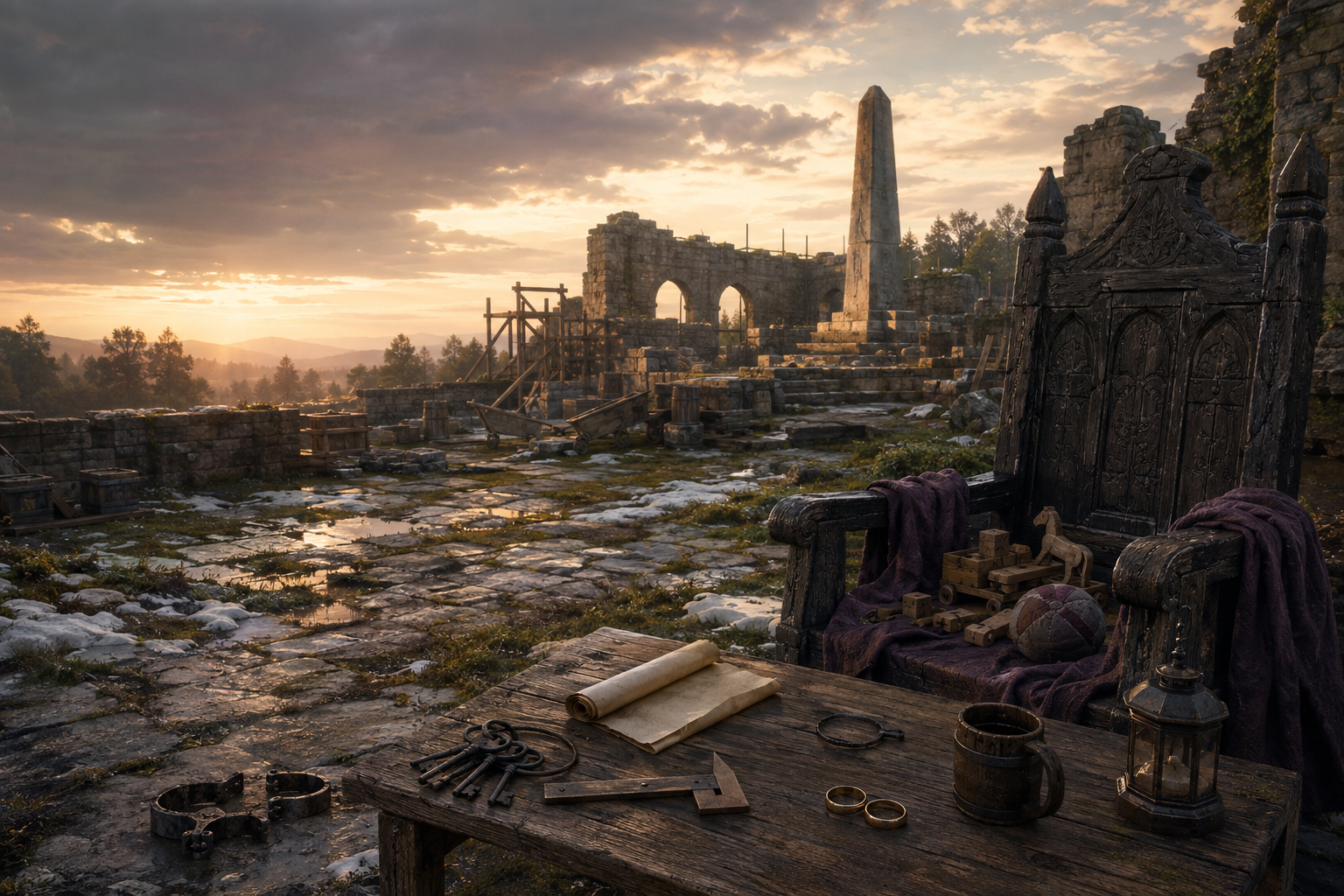
King Seoman and Queen Miriamele do not sit on John’s black chair. Children play on it in the courtyard. The royal couple governs elsewhere while the Great Table gathers survivors and names the dead. The symbol that once organized inheritance, rivalry, and coercion loses sacred distance.
The series ends by opening the door wider
Simon brings Eolair into the hall and promises room for friends already loved and friends not yet known. His final authority is not the power to exclude, inherit, or command silence. It is the power to make a home capacious enough for unfinished relationships. The mooncalf did grow up. He just did not have to stop being Simon.
On the record
Read front-to-back, then reconciled through final choices
Return to the To Green Angel Tower, Part II hub → · Read the complete Plot → · Open Tropes & Themes → · Open the series hub →