
The Dragonbone Chair: Every Familiar Piece, Assembled Properly
Ancient swords, hidden heirs, lost peoples, magical weather, and a castle with bones in the throne. Familiar pieces are where the argument begins.
RaeRae’s reading
Name the device. Then explain what the book does with it.
This is not trope bingo. Every mechanism below is tied to scenes, material cost, and complication. The book uses classic epic-fantasy furniture while asking who built the room, who was removed to make space, and whose work keeps the legends standing.
Complete Book 1 evidence
The rabbit-hole map
The floor belongs to somebody else
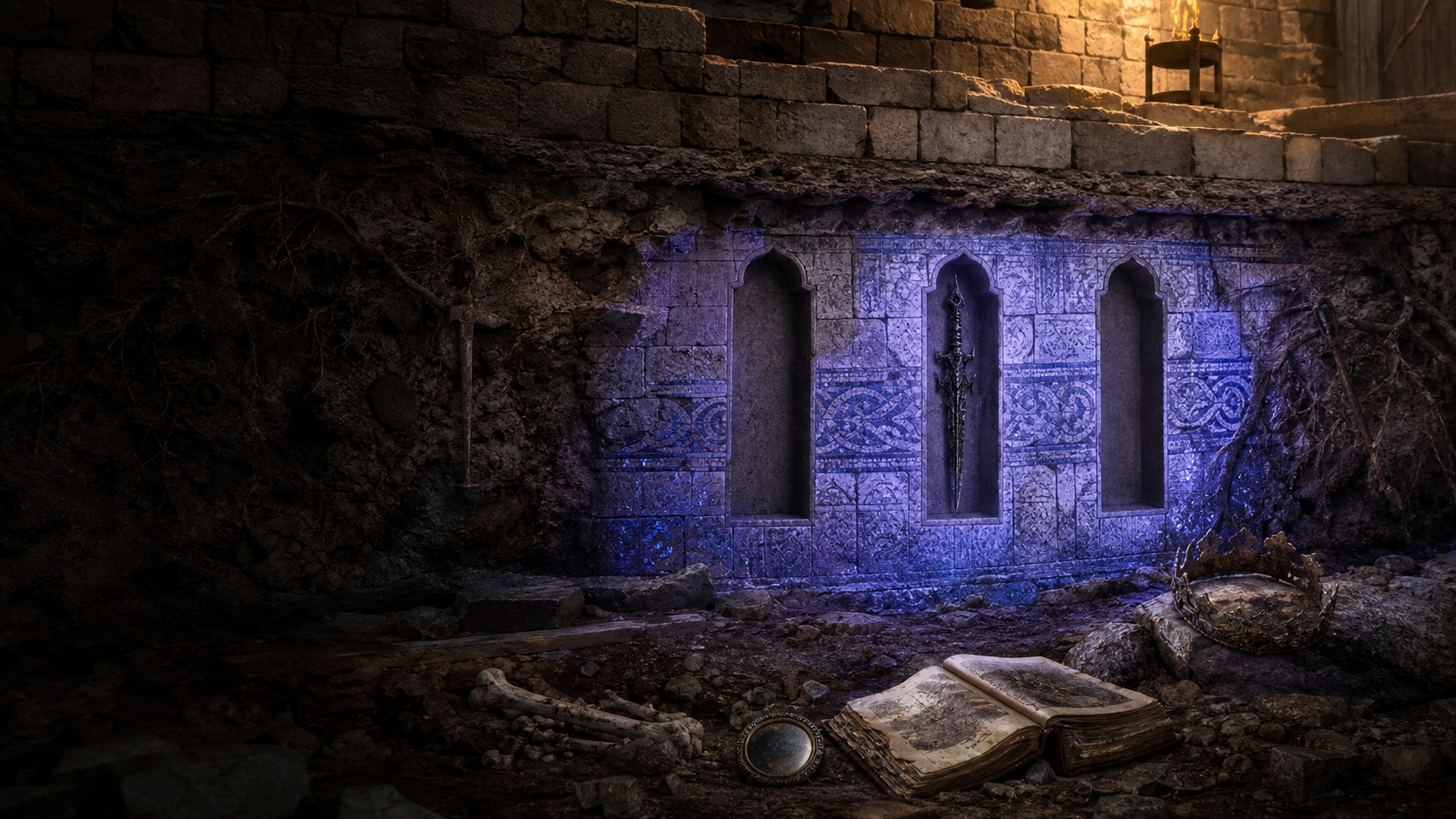
The Hayholt is Asu’a under another name. Human rule does not erase Sithi architecture; it inhabits it, misreads it, seals it, and eventually hears it answer. Conquest survives as a building people call home.
Receipt: Chs. 2, 5, 11–14, 42.
Simon matters without receiving a clean destiny certificate
Names, dreams, parentage gaps, magical objects, and survival marks surround Simon, but Book 1 refuses to let specialness replace work. He reads badly before he reads better, survives through friends, misjudges people, and defeats disappearance by remembering an ordinary name.
Receipt: Chs. 3, 7–18, 31–44.
Adulthood is responsibility witnessed by others
Simon wants a sword because it looks like escape from invisible labor. The novel gives him literacy, hunger, rescue work, guilt, training, command pressure, a mission, and finally a sword whose cost he cannot understand. Growth is conferred through what he carries, not a birthday.
Receipt: Chs. 2, 9–16, 31–44.
The title is a research problem before it is an arsenal
Memory, Sorrow, and Thorn are not interchangeable quest tokens. Their names, materials, custodians, injuries, and source traditions differ. The search works by comparing evidence types, and one sword’s recovery does not explain what the swords want or who should use them.
Receipt: Chs. 14, 34, 40–44.
Books are doors; doors need ethics
Morgenes’s “magic and traps” lesson governs manuscripts, rituals, Witnesses, dreams, and political testimony. Knowledge is not automatically virtuous. Custody, purpose, uncertainty, and willingness to pay the cost separate preservation from Pryrates’s appetite.
Receipt: Chs. 7, 10–14, 31–44.
Marya and Malachias are survival strategies, not fake people
Miriamele’s identities let her cross spaces the princess cannot safely enter. The reveal hurts because the intimacy under disguise was real. The trope exposes how rank controls which version of a person others believe they are entitled to know.
Receipt: Chs. 5, 20–21, 31–44.
Unnatural weather still has ordinary victims
Drought and winter may carry supernatural pressure, but kitchens, wells, refugees, livestock, roads, and harvests experience it materially. Elias’s court treats weather as spectacle until the weather refuses his command in front of an army.
Receipt: Chs. 7–10, 22–44.
The heroic story keeps leaving bodies outside the frame
John counts victories; Morgenes counts dead. Simon imagines battle as escape; Falshire burns. The crowd invents trophies for the Hunë; Simon cannot eat. The novel does not ban legends—it keeps asking who pays for their clean shape.
Receipt: Chs. 1–10, 30, 41–44.
Care travels farther than bloodline
Rachel chooses an orphan, Morgenes chooses an apprentice, Binabik chooses a stranded boy, and Jiriki turns ancestral obligation into friendship. The royal family’s bloodline magnifies mistrust while elective relationships repeatedly make survival possible.
Receipt: Chs. 3, 12–18, 39–44.
A mark can change the body without replacing the self
Igjarjuk gives Simon scar, white hair, expanded perception, and the temptation of scale beyond humanity. The climax is not that transformation proves greatness. It is that Simon refuses to let vastness erase the awkward person who loved particular people.
Receipt: Chs. 42–44.
Safety fails through the assumptions it cannot see
Naglimund’s iron field defeats an old idea of Sithi attack. Elias’s allies answer with Bukken inside, supernatural weather, fire-tubes, Hunën, and the Red Hand. The “impenetrable” fortress falls because history has changed the threat while defenders still inhabit inherited design.
Receipt: Chs. 30–31, 41–43.
Remembering is an action, not storage
Towser’s testimony moves the sword search; Jiriki’s mirror makes lost Asu’a emotionally present; Simon’s personal memories bring him out of dragon consciousness. Memory preserves, accuses, guides, and chooses what kind of future remains possible.
Receipt: Chs. 6, 11, 34, 42–44.
The larger argument
Familiar does not mean uncomplicated
The novel’s classic epic-fantasy machinery works because Williams neither apologizes for it nor treats recognition as analysis. A hidden past, a castle built over elder ruins, three magic swords, unnatural winter, prophecy, immortal peoples, a lost prince, and a young hero leaving home all deliver the genre pleasure promised on the cover. The deeper move is to make every device answer questions about custody, labor, conquest, and memory.
The Hayholt is the governing example. It is simultaneously Simon’s home, Prester John’s capital, Elias’s inheritance, Fingil’s conquest, and Asu’a’s occupied remains. None of those identities cancels the others. Simon’s love for kitchens and roofs is real; so is the violence that made the human castle possible. “Home” becomes ethically demanding because belonging does not erase prior belonging.
The Three Swords extend the same problem into objects. Each blade carries material history rather than generic magic: makers, substances, names, custodians, and political uses. The quest formula says locate and unite powerful things. The evidence model asks who named the formula, what the objects remember, and whether finding them is the same as understanding them. Book 1 lets the search succeed while preserving every dangerous question.
Weather prevents the supernatural plot from floating above ordinary life. Drought, cold, rain, failed harvests, empty wells, displaced families, sick animals, broken roads, and strained kitchens turn magic into governance. Elias wants weather to validate sovereign power; his subjects experience it as labor and hunger. The fantasy spectacle remains spectacular because the book also counts who has to carry water through it.
Books, dreams, songs, testimony, folklore, and architecture all function as knowledge systems. None is automatically reliable, and none is dismissed merely because an elite institution considers it unserious. Towser’s memories help locate Bright-Nail. Servant gossip preserves court truth. Scripture can illuminate or ratify power. A dream can warn, lure, distort, or connect. The Raed succeeds when different evidence types are compared rather than ranked by social prestige.
Disguise and hidden identity sharpen that epistemic problem. Miriamele’s aliases are lies and truthful expressions of a self royal title restricts. Simon’s unknown parentage invites the chosen-heir template, but the book repeatedly grounds worth in conduct rather than lineage. Binabik is misread through “troll” prejudice despite carrying essential expertise. Jiriki’s beauty encourages human projections that his culture immediately complicates. Seeing a face or hearing a name is never the same as knowing the person.
Finally, the coming-of-age story refuses to separate inner growth from political history. Simon does not mature in a neutral wilderness gym. He grows while fleeing a regime, depending on people his culture belittles, confronting conquest beneath his home, and discovering that beloved legends omit victims. His identity survives Igjarjuk not because he becomes the largest thing in the scene, but because particular relationships make one small life worth returning to.
That is the Book 1 contract: wonder stays. Swords remain cool, castles remain haunted by grandeur, and a red-haired boy can face a dragon. The novel simply refuses to let beauty, power, inheritance, or familiarity serve as moral alibis.
Where the themes collide
The fortress and the family answer the same question differently
Naglimund is brave, organized, historically informed, and still wrong about the shape of the attack. Its iron protection answers Sithi magic while Bukken enter below, siege engines burn above, and human armies exhaust the walls. Knowledge is necessary; confidence that knowledge is complete becomes another vulnerability.
Found family supplies the constructive answer. Rachel, Morgenes, Binabik, Qantaqa, Jiriki, and the people Simon remembers inside the dragon do not matter because blood secretly connected them. They matter because care was repeatedly chosen, often across rank and species. Relationship becomes the counterweight to systems that treat bodies as inheritance, tools, or proof.
The book never claims chosen bonds are invulnerable fortresses. Morgenes dies, Jiriki loses An’nai, and Simon repeatedly misunderstands Miriamele. Their strength is adaptability: care can apologize, revise, cross borders, and respond to the person actually present. The Hayholt and Naglimund defend inherited structures; the road’s improvised family survives by learning. That flexible care—not secret blood—is the book’s real inheritance.
And that flexible inheritance changes everything afterward.
The fantasy is not ashamed of being fantasy
The achievement is not “subverting” every familiar thing until pleasure disappears. The book lets swords sing, castles remember, wolves speak philosophy, and a red-haired boy face a dragon. It also insists that wonder has history, magic has cost, rule has logistics, and every glorious object changes meaning depending on whose hand reaches for it.
On the record
Read front-to-back, then reconciled
Return to The Dragonbone Chair hub → · Meet the complete Book 1 cast → · Open the series hub → · Meet Tad Williams →