
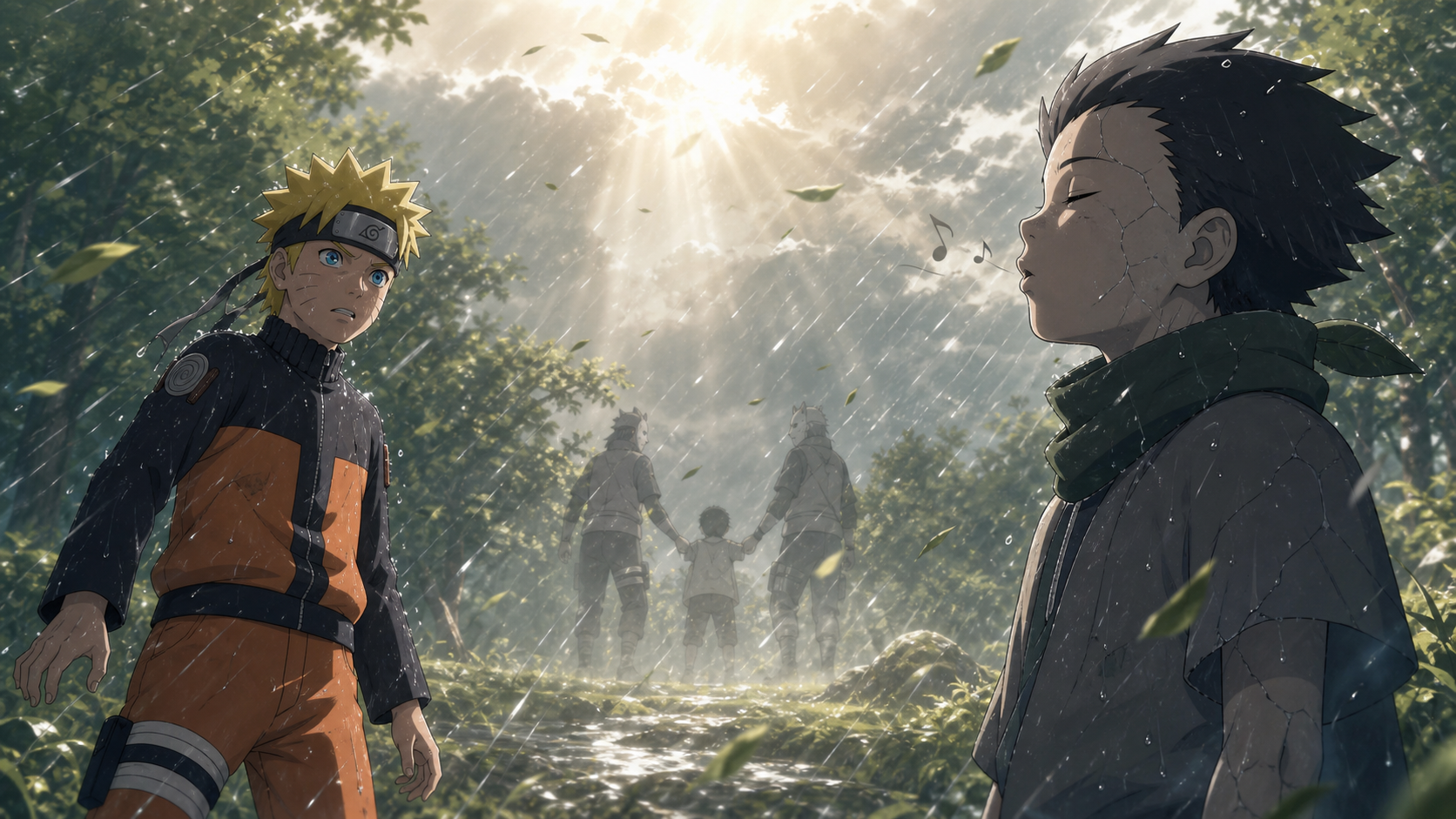
The Sad Sun Shower
Shared memories connect four Yotas, a captured child and the guilt Naruto carried without the full truth.
Bottom line
“The Sad Sun Shower” turns Episode 313's strange weather into a shared investigation. Ino asks Inoichi to connect the separated fighters and learns that Sakura, Kiba, and Akamaru are confronting Yota at the same time. Naruto then meets another Yota whose whistle creates violent wind. Their returning memories show a wandering child befriending Konoha's lonely young genin, only for ANBU to seize him as a suspected spy. Naruto ends the episode believing the children helped cause Yota's death. That guilt is emotionally real, but the responsibility belongs first to adults who criminalized a vulnerable child and left other children to improvise a rescue. Episode 314 deepens the bond without resolving which Yota is genuine or what happened after the capture.
The three battlefields remain unstable
Rain, snow, and lightning continue around the separate Yotas while Allied units dodge rather than attack decisively. Recognition has slowed the usual sealing response.
Delay is understandable, but each weather system threatens people beyond the childhood friends. Compassion needs a coordinated plan before environmental damage becomes another casualty source.
Ino recognizes an information problem
Ino understands that the fighters cannot solve simultaneous appearances while isolated. She reaches through the communications chain rather than treating her group's memory as the only truth.
That decision shifts the episode from nostalgia toward investigation. The central question is no longer how to defeat one child, but why several teams report the same child at once.
Inoichi becomes the bridge
Ino asks her father to connect the separated groups. Inoichi's network turns individual observations into a battlefield-wide picture.
Communication specialists rarely receive the spectacle of frontline fighters, yet their work prevents three units from making contradictory decisions based on incomplete evidence.
Sakura confirms the snowy Yota
Sakura reports that the Medical Division faces Yota inside an expanding snowstorm. Her confirmation removes the possibility that Shikamaru's group simply misidentified a White Zetsu.
The medical camp also supplies urgency. Snow loading the tents and chilling patients means the mystery cannot remain an academic debate.
Kiba and Akamaru confirm the lightning Yota
Kiba reports another matching child under electrical weather. Akamaru's presence adds sensory evidence, though reanimation and transformation can complicate scent.
Three locations now have matching faces, shared recognition, and distinct powers. Any plan built around a single body is inadequate.
Nobody should seal first and compare later
The groups know Edo Tensei victims normally require restraint and sealing. Multiple Yotas create a risk that one body is genuine while others are decoys designed to consume specialists.
The Alliance should synchronize timing, record each reaction, and keep sealing teams protected until the communication network identifies meaningful differences.
The friends remember before they understand
Childhood scenes return through sensory cues and emotion rather than orderly chronology. Familiar weather opens memories the adults could not access on command.
Trauma recall can arrive in fragments. Confidence about a face does not guarantee accuracy about sequence, responsibility, or cause of death.
Yota entered Konoha as a wandering child
The remembered Yota was a boy without a stable home who appeared near the village and connected with local children. His weather responded visibly to feeling.
Adults should have seen a child needing shelter, food, medical assessment, and a safe guardian. A security concern and a care obligation can exist together.
The Konoha children offer belonging
Naruto and the others play with Yota before institutional suspicion defines him. Their friendship begins through shared time, games, and curiosity rather than clan or mission assignments.
For Naruto especially, welcoming another isolated child reflects a need he understands without explanation. He offers the kind of companionship he wanted adults to help provide.
Yota’s weather makes feelings public
Happiness, sadness, anger, and fear change the sky around Yota. The children learn to read weather as part of communication.
That power can create closeness, but Yota loses privacy whenever emotion becomes climate. Friends may respond to a storm before asking what he wants to say.
A sun shower holds two truths at once
Rain falling under sunlight gives the title its contradiction. Warmth and sorrow can occupy the same scene without canceling each other.
The children remember joyful companionship through the pain of what followed. Nostalgia should not bleach the loss or make every happy moment a warning.
Naruto meets a fourth version
While moving across the war, Naruto encounters another Yota separate from the rain, snow, and lightning bodies. This version creates wind through whistling.
The fourth appearance expands the mystery beyond a three-way elemental division. Naruto now has direct evidence that the battlefield reports are connected to his own missing history.
Whistling becomes both voice and weapon
Yota's whistle once carried playfulness and communication. Under Edo Tensei conditions, the same sound drives gusts strong enough to obstruct Naruto.
Kabuto's violence often works through this conversion. A personal trait becomes a combat function, stripping context from the person who created that trait.
Naruto knows the sound before the story
The whistle reaches memory faster than a complete account. Naruto recognizes feeling and pattern while still struggling to name what happened.
That gap matters because Tobi and Kabuto both exploit emotional shortcuts. Naruto needs to trust recognition without letting recognition replace evidence.
The children kept Yota outside adult systems
Their friendship appears to grow in secret or at least without dependable adult supervision. Hiding Yota may have felt protective in a village trained to classify outsiders as threats.
Secrecy also left the children without food support, safe housing, medical care, or an advocate when authorities noticed him.
Konoha sees a possible spy
ANBU interprets an unknown child with unusual power as a security risk. During a period shaped by village conflict, suspicion is predictable.
Predictability does not make the response just. Risk assessment should distinguish a child from an adult operative and should include care professionals rather than only interrogators.
ANBU takes Yota for questioning
Masked officers seize Yota and remove him from his friends. The language of questioning hides the power imbalance: armed adults detain a child with no visible guardian or advocate.
Konoha's duty to investigate cannot erase due process, medical safety, or protection from coercion. A frightened weather-user may become more dangerous under confinement.
The masks intensify childhood fear
For adults, ANBU masks signal authorized covert personnel. For children watching a friend taken away, the masks remove every human cue that might invite trust.
Institutional anonymity protects operatives while making accountability harder for the people affected by their decisions.
Naruto interprets capture as personal failure
Naruto remembers that the children could not keep Yota safe and concludes that they caused his death. The belief matches a lifelong pattern of taking responsibility for losses adults created.
Guilt can feel like control. If Naruto caused the outcome, then a better choice might have prevented everything. That logic is emotionally compelling and incomplete.
The children did not design Konoha’s response
They may have revealed Yota, hidden information, attempted a reckless rescue, or misunderstood the danger. Those choices deserve honest review.
They did not write detention policy, deploy ANBU, deny Yota an advocate, or create a village culture where an unknown child became an enemy before becoming a patient.
Adult responsibility cannot disappear into tragedy
The episode leans toward collective childhood guilt because guilt creates a strong emotional cliffhanger. Editorially, the responsibility must stay with the adults holding authority.
Children need guidance after a mistake. Institutions must answer for foreseeable harm produced by trained personnel and formal power.
Ino’s network can also support memory
Connecting the friends allows them to compare what each person remembers, not only what each Yota is doing. Shared recall can expose contradictions before blame hardens.
Inoichi should facilitate without steering the account. The young adults need room to say uncertainty aloud rather than forcing one clean story across every mind.
Sakura can separate harm from blame
As a medic, Sakura understands that cause is not the same as moral responsibility. A chain of events may begin with a child's choice and still become lethal through adult negligence.
Her perspective could help the group move from “we killed him” toward specific questions about capture, treatment, escape, and weather-related risk.
Shikamaru needs a timeline
Shikamaru's strength is turning scattered facts into sequence. He should map when each child met Yota, what ANBU knew, and which memories are missing.
The impossible present-day bodies may connect directly to gaps in the past. A timeline can reveal where memory stops because someone deliberately changed the record.
The Alliance needs weather-specific evacuation plans
Each battlefield requires a different protective response while the friends compare memories. The rain unit needs drainage and stable footing near Dan's barrier. Sakura's camp needs tent supports, warm coverings, and cleared paths. Kiba's area needs distance from metal equipment and exposed high ground. Naruto's wind sector needs anchored supplies and protected eyes.
Treating every Yota as the same opponent would miss those immediate differences. Central communication should coordinate the identity investigation while local leaders retain authority over environmental safety.
Kiba’s senses cannot solve erased memory
Kiba and Akamaru can track bodies and weather across terrain. They cannot smell why several adults forgot a child or how separate versions share one face.
The arc respects sensory skill more when scent contributes one category of evidence rather than serving as automatic truth.
The Yotas still behave differently
Rain, snow, lightning, and wind versions do not create a single consistent emotional presentation. Their differences could reflect divided powers, copied behavior, or separate control.
Episode 314 should preserve those possibilities. Declaring every body equally genuine would ignore the evidence the communication link just assembled.
Sealing remains necessary but insufficient
The Allied units still need to stop the storms and protect their positions. Sealing any Edo Tensei body ends forced combat for that body.
The operation also needs to identify the real contract and prevent a decoy victory from hiding the person whose soul remains bound.
Naruto’s encounter changes the emotional center
The first episode distributed memory across several friends. Naruto's wind encounter concentrates the guilt because he has built his identity around never abandoning another isolated child.
Yota challenges that self-image from a time before Naruto had power, training, or adults who consistently believed him.
The episode earns its cliffhanger
Ending on Naruto's claim of responsibility creates a clear question for Episode 315: what actually happened between ANBU capture and Yota's death?
The cliffhanger works only if the next chapter corrects misplaced guilt rather than celebrating self-blame as proof of love.
The anime-original continuity remains difficult
A bond this significant should have shaped later conversations among Naruto's classmates. The story explains absence through damaged memory, but that device can feel designed to protect continuity after the fact.
Specific childhood scenes help. Emotional sincerity does not fully remove the structural seam.
Inoichi turns recognition into a command-level record
Four battlefields cannot keep treating Yota as a private memory. Inoichi gives the scattered witnesses a way to compare details while weather attacks continue, and that changes nostalgia into evidence the Alliance can act on.
His role matters because communication is not merely passing along conclusions. He must preserve who saw which Yota, what each child said, which weather appeared, and when every memory returned. A clean record protects the witnesses from being flattened into one convenient story.
The adults finally inherit the problem they missed
Naruto and his friends were children when Yota appeared, struggled, and vanished. They offered food and companionship because the village had not given them a safe adult structure for reporting a vulnerable outsider.
The present crisis should absolutely not become another lecture about what those children failed to do. Konoha’s adults controlled surveillance, medical care, visitor records, and detention. If every useful record disappeared while the children carried grief, institutional responsibility belongs in the center of the conversation.
ANBU suspicion needed a child-protection boundary
A stranger controlling weather near Konoha creates a real security concern. Questioning that concern would be irresponsible, but treating a frightened child like a conventional infiltrator creates its own danger and destroys the trust needed for reliable answers.
A child advocate, medic, and known civilian guardian should have been present. Questions needed breaks, food, plain language, and an explanation of what would happen next. Masks and confinement may produce compliance, yet compliance is not the same thing as truthful testimony.
Naruto remembers abandonment from both directions
He knows the pain of being left alone, so Yota’s capture lands as proof that Naruto failed someone who had briefly joined his circle. The guilt feels emotionally honest even when the responsibility is misplaced.
Naruto was not an official, guardian, or trained rescuer. He was another isolated child trying to build belonging with whatever he had. The healthier lesson is not that he should have controlled the outcome. Adults should have recognized what the children were trying to protect.
The sun shower makes grief visible without explaining it away
Rain under bright light holds joy and sorrow in the same frame. Yota’s weather turns feelings into public conditions, but the image does not reduce him to a mood-powered device.
The contradiction fits a child who found friends and lost safety almost at once. Warmth remains real even while danger arrives. The episode works best when the weather preserves both truths instead of asking viewers to choose whether the memory was happy or tragic.
Whistling gives Yota a voice that can be weaponized
The whistle first belongs to connection. Naruto recognizes sound before he can recover every fact, which shows how memory often returns through the body rather than an orderly timeline.
Kabuto’s control turns that intimate signal into a battlefield threat. The violation is larger than using Yota’s technique. An enemy has taken the sound friends associated with welcome and made everyone fear it. Rescue must account for that stolen meaning as well as the physical attack.
Different Yotas may be fragments rather than duplicates
Rain, snow, lightning, and wind carry different behaviors and emotional pressures. The Alliance should not assume four identical bodies merely because every witness recognizes the same child.
Each team needs to document vocabulary, memories, weather response, injuries, and moments of resistance. The differences could reveal divided chakra, manipulated recollections, or separate pieces of one resurrection. Careful comparison gives the sealers more than a target count.
Sealing plans must leave room for testimony
The Yotas remain dangerous, and protecting soldiers and medical tents cannot wait for a perfect explanation. Still, immediate sealing may erase the only witness capable of describing what happened after ANBU took him.
Teams should contain weather, establish communication, and record any lucid answer before completing the seal when conditions allow. That is not sentimental hesitation. Testimony may expose Kabuto’s method, confirm coercion, and prevent another resurrected person from being handled as disposable evidence.
Sakura holds the medical and emotional lines together
Sakura’s recognition does not cancel her duty to patients trapped under unnatural snow. Her strongest response is practical: protect medicine, warm the injured, monitor chakra signatures, and keep witnesses connected through Inoichi.
That discipline does not make her grief smaller. It shows adulthood as the ability to feel the childhood wound while refusing to abandon people in the present. The episode gives her care work the same narrative weight as direct combat.
The episode asks whether belonging survives missing records
Yota’s place in the group exists through shared food, games, arguments, weather, and loss, even when official history seems unable to hold him. Friendship does not become imaginary because an archive failed.
At the same time, memory needs corroboration when an enemy can manipulate bodies and minds. The humane answer is neither blind belief nor institutional dismissal. Let affection identify what deserves investigation, then let careful evidence protect everyone from exploitation.
A child deserves present-tense consent
Everyone remembers Yota through childhood affection, but memory cannot replace asking what he wants in the present. If Kabuto allows an opening, the shinobi should explain where Yota is, who controls the conflict, what sealing means, and what choices remain available. A frightened answer may be incomplete without becoming meaningless. Silence may reflect coercion rather than refusal. The response team needs to watch who speaks for him. Naruto can offer familiarity, Inoichi can carry communication, Sakura can assess distress, and sealers can manage danger, but none of them should turn expertise into ownership. The most respectful rescue keeps Yota informed while limiting harm. Childhood friendship gives them a reason to care. It does not give them a right to override the person that friendship is to protect.
RaeRae’s verdict
“The Sad Sun Shower” improves the Yota arc by letting communication reveal the impossible scale of the problem. Ino and Inoichi turn three isolated fights into a shared investigation, while Naruto's wind encounter adds a fourth piece.
The ANBU capture gives the memories institutional weight. Naruto's guilt lands, but the episode must not leave children carrying accountability that belongs to trained adults and village systems.
RaeRae’s call
Yota’s friends did not fail because they could not outmaneuver ANBU as children. Konoha failed to build a safe path for a vulnerable outsider, and Kabuto now exploits the silence that followed. Protect every battlefield, preserve each witness’s first memory, let Yota speak when he can, and stop treating childhood love like permission to decide his fate for him.
Episode details and viewing routes
- Official episode reference: Naruto Official episode guide
- Licensed episode route: Crunchyroll licensed episode page
What I am carrying forward
I am carrying forward four weather-linked Yotas, Inoichi's connection between battlefields, the children's recovered friendship, ANBU taking Yota for questioning, and Naruto believing their attempted protection led to his death.
I am also carrying forward the unanswered boundary: Episode 314 identifies the capture, not the full cause. The river, the missing memories, the false bodies, and Yota's final choice still require Episode 315.