
Power – Episode 1
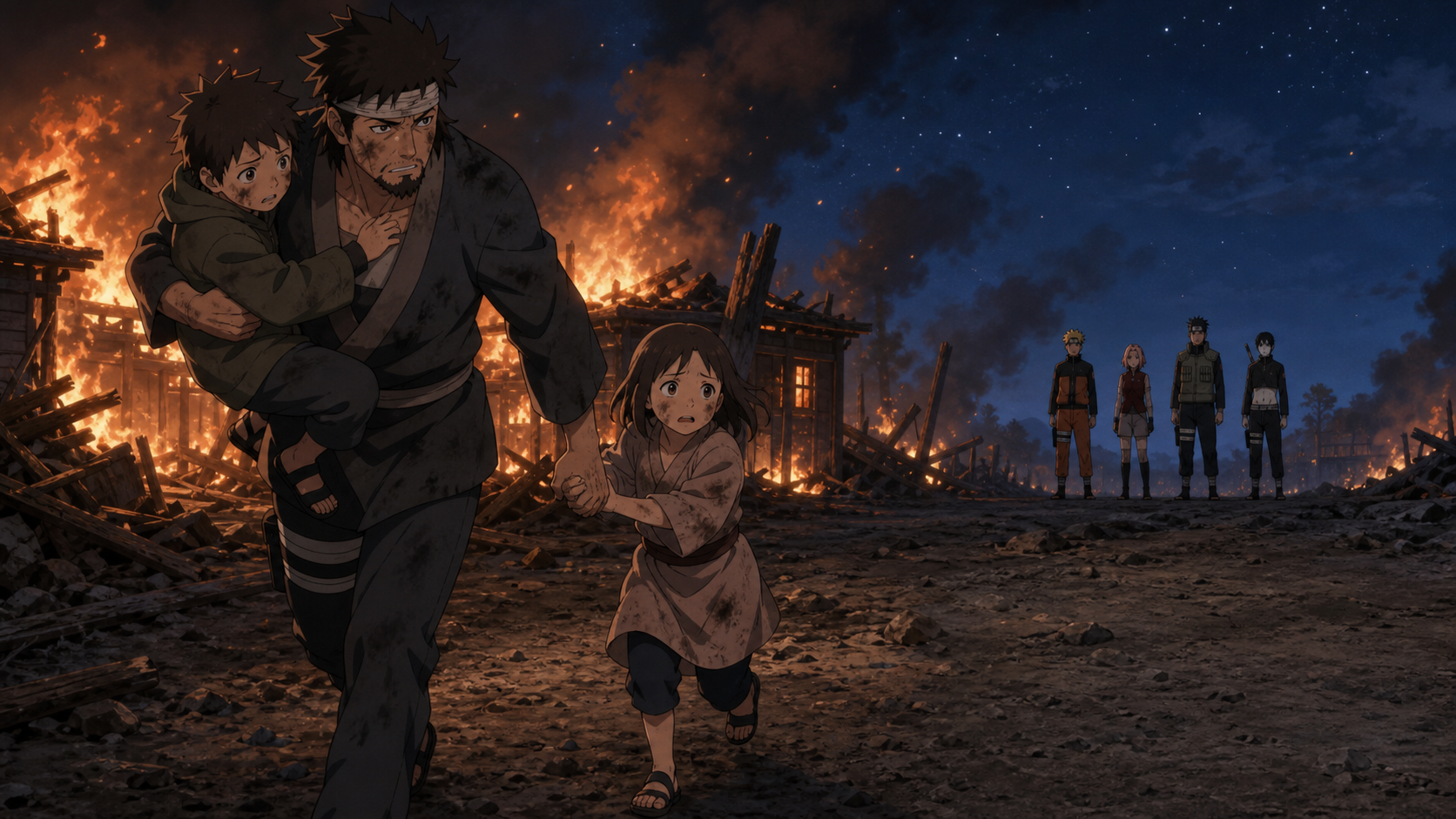
Dokku protects five children after Tonika’s massacre while Team Kakashi begins an investigation where survivor trust matters as much as pursuit.
Bottom line
“Power – Episode 1” opens with a village destroyed before the heroes arrive, which means the mission begins as recovery work rather than rescue fantasy. Dokku saves Leo and Miina from a burning home, returns for other children, and carries the impossible knowledge that many neighbors remain beyond reach. When Naruto, Sakura, Yamato, and Sai investigate Tonika Village, they enter a crime scene shaped by reanimation and institutional secrecy. The episode’s strongest question is not whether Naruto can catch the killer. The real question is whether survivors can trust another group of shinobi after headband-wearing attackers erased their home.
Tonika Village is introduced through ordinary life
The episode gives Tonika enough texture to make the massacre feel like the destruction of a community rather than a generic ruined set. Homes, paths, families, teachers, and children existed before violence rearranged the landscape.
That ordinary life matters. A casualty count cannot preserve what residents lost: routines, neighbors, shared meals, work, safety, and the assumption that tomorrow would resemble yesterday.
The official routes establish a six-part investigation
Naruto Official catalogs “Power – Episode 1” as record `01_734`, the opening entry in its Power sequence. Crunchyroll lists “Power – Episode 1” as Shippuden Episode 290 under watch ID `G6VNXMQWR`, released November 22, 2012. Both summaries identify Team Kakashi’s assignment to find whoever carried out the Tonika Village massacre.
The official archive uses an en dash while the licensed route uses a hyphen. The episode identity remains exact. This page follows the licensed display title and preserves both source routes.
Dokku runs toward the fire
Dokku rescues Leo and Miina from their burning home, places them outside the immediate danger, and returns to search for more survivors. His choice is brave, but the episode does not turn bravery into unlimited capacity.
One teacher cannot evacuate an entire village under attack by reanimated shinobi. The people he cannot reach will shape every later decision. Survivor guilt begins where responsibility and physical possibility separate.
Leo and Miina need safety before answers
The children have watched shinobi destroy their home. A new group wearing shinobi headbands cannot expect immediate trust simply because Konoha assigned the mission.
Adults should explain where the children are going, who will remain with them, what choices they still control, and when information will be shared. Protection without communication can feel like another abduction.
The other children create a new household
Dokku also protects Faz, Lando, and Sora, forming a family through emergency rather than blood. Each child will process loss differently. One may become quiet, another demanding, another eager to please.
Care cannot require matching grief. The household needs predictable meals, sleeping arrangements, private comfort objects, and adults who do not make the children compete for attention.
Naruto enters the mission too excited
Naruto is glad to receive an assignment after a period without ordinary field work. His energy is understandable, but a massacre investigation is not a chance to cure boredom.
The first correction should happen before meeting survivors. Mission excitement must give way to crime-scene discipline, cultural respect, and listening. Naruto’s warmth can help later, but only after he understands what the site requires.
Sakura should lead the immediate welfare assessment
Sakura brings medical skill, trauma awareness, and the ability to distinguish urgent injuries from delayed symptoms. Her first work should include survivors, investigators, and anyone exposed to smoke, explosions, or unfamiliar chakra.
Medical privacy matters even in a small temporary shelter. Children should not have to describe injuries or fear in front of every shinobi assigned to the case.
Yamato creates structure around a volatile team
Yamato’s leadership is useful because the mission contains several risks at once: unknown attackers, possible reanimation, displaced children, a neighboring village, and Naruto’s jinchūriki status.
He needs separate teams, scheduled check-ins, clear pursuit limits, and an emergency extraction route. Investigation cannot become an excuse for Naruto to chase Kabuto without support.
Sai can map what grief makes hard to describe
Sai’s ink creatures can survey routes, record terrain, and reduce the number of people walking through a contaminated site. Visual mapping helps survivors point to homes, gathering places, and last-known locations without repeatedly entering the ruins.
The maps should remain accessible to the community. Evidence collected from Tonika belongs partly to Tonika, not only to Konoha’s mission archive.
Reanimated attackers contaminate the witness record
Survivors may recognize faces from history, see impossible techniques, or describe people they know are dead. Investigators should not dismiss those accounts as confusion.
Reanimation changes what credible testimony looks like. The team already knows Kabuto can deploy the dead, so witness interviews need questions designed around that reality.
The Hole is a location and a warning
Tonika stands in a region called the Hole, a name that carries geological, historical, and political meaning. The setting should be mapped before anyone assumes the massacre targeted residents alone.
Attackers may want an artifact, sealed power, archive, body, or access route beneath the village. A complete investigation treats landscape as evidence.
Hachō Village controls the nearest official story
Yamato and Sai meet officers connected to neighboring Hachō Village and are escorted toward its leader, Disonasu. Cooperation is necessary, but proximity does not guarantee innocence.
The team should document who reported the massacre, when Hachō learned about the attack, which forces responded, and what records existed before Konoha arrived. An eager guide can still shape what investigators see.
Disonasu deserves verification, not automatic deference
Village leadership gives Disonasu access to archives, patrol reports, and local history. The same authority gives him power to hide inconvenient information.
Yamato should request source documents, interview multiple officials separately, and compare timelines. Respectful diplomacy does not require surrendering investigative independence.
Shiseru becomes a bridge with her own obligations
Shiseru helps connect the Konoha team to local officials and survivors. She carries knowledge of the region and relationships that outsiders lack.
Her work should not be reduced to escort duty. A local bridge often absorbs suspicion from both sides. Clear authority, compensation, and protection matter.
Kabuto’s presence changes the mission category
Evidence of reanimated shinobi makes Kabuto a likely operational threat. That raises the stakes beyond a local criminal hunt, but the massacre victims cannot become background once a famous villain appears.
The mission still needs body recovery, survivor support, property documentation, and community communication. Strategic intelligence and human recovery must run together.
The attack uses fear as misdirection
A spectacular massacre can hide a smaller objective. While every observer focuses on bodies and fire, an attacker can remove a relic, open an underground route, or test a technique.
Investigators should list what is missing, what remained strangely untouched, and where the attackers spent time beyond killing. Absence can be evidence.
Children should not become involuntary informants
Leo and Miina may have seen Kabuto, reanimated shinobi, or unusual objects. Adults will want those details quickly. Repeated questioning can force children to relive the attack and can distort memory.
One trained interviewer should lead, with a trusted caregiver present and permission to stop. Other teams can use the same recorded account instead of demanding new performances of trauma.
Dokku needs help carrying responsibility
Dokku saved five children, but his mind returns to everyone he could not reach. Praise alone can deepen isolation because “hero” may sound like a demand to feel proud.
He needs practical relief, sleep, medical screening, grief support, and another adult who can take over without making him fear abandonment. Caregivers become casualties when systems treat endurance as endless.
Naruto can connect through shared displacement
Naruto understands what living under suspicion and loneliness feels like. That experience can help him meet the children without demanding instant gratitude.
He should offer consistency rather than a speech about overcoming pain. Showing up for meals, keeping promises, and accepting rejection would build more trust than insisting that everybody can become strong.
The team needs a recovery ledger
The ledger should record confirmed survivors, missing residents, recovered bodies, damaged homes, cultural sites, evidence locations, and temporary placements. Each entry needs status, responsible person, and next action.
Public and restricted versions can protect sensitive details while preventing families from searching through rumors. Documentation is a form of care when a community has been scattered.
Tonika’s dead deserve names
The massacre should not remain a title attached to a plot arc. Investigators need to identify the dead, preserve belongings, notify relatives, and ask survivors how memorial practices should proceed.
Anonymous destruction serves the attacker by making loss feel interchangeable. Names return specificity.
Identification work should not depend only on visual recognition. Fire and structural collapse can make that impossible or distressing. Dental records, medical notes, household inventories, mission files, and family-provided details can support a careful process. Every uncertainty should remain labeled as uncertainty rather than being resolved for administrative convenience.
The ruins need controlled access
Survivors may want to retrieve medicine, photographs, clothing, tools, or religious objects. Investigators may need the same buildings preserved as evidence. A controlled-access plan can serve both needs.
Teams should inspect structures, mark hazards, escort residents, photograph items before removal, and record who received each possession. Telling families to wait indefinitely while outsiders control their homes would reproduce helplessness.
Temporary shelter must preserve family choice
The five children should stay together when safety allows because the group already functions as a stabilizing unit. Officials should not separate them into convenient placements without assessing relationships and asking what each child wants.
Dokku also needs formal support if he becomes their caregiver. Food, housing, schooling, medical care, and legal authority cannot rest on affection alone. A chosen family still deserves institutional resources.
Information should return to survivors on a schedule
Investigations often extract testimony and then disappear behind secrecy. Tonika’s survivors need regular briefings even when no breakthrough exists. Silence encourages rumor and makes cooperation feel one-sided.
A liaison should explain what has been confirmed, what remains uncertain, which details cannot yet be shared, and when the next update will happen. Predictability can restore a small measure of control.
The arc must resist making children symbols
Leo, Miina, Faz, Lando, and Sora are not proof that hope survives. They are children with different needs and futures. A hopeful ending will mean more if the story allows anger, fear, play, silence, and disagreement along the way.
Survival should not create a debt to inspire adults.
The children should also have room for ordinary activities that do not serve the investigation. Lessons, games, chores, and quiet routines are not distractions from recovery. They are part of recovery because trauma should not become the only organizing fact of childhood.
The mission needs an exit condition
Kabuto’s involvement could pull Team Kakashi far beyond the original site. Yamato should define when pursuit requires reinforcement, when survivor protection takes priority, and who remains behind if the team splits.
Without an exit condition, Naruto’s determination can expand the assignment until every person depends on one exhausted unit. Good leadership knows when to widen the response.
Dokku becomes a caregiver before anybody grants authority
He pulls children from fire, gathers the separated group, and starts making decisions because delay would leave them exposed. The emergency recognizes his responsibility before paperwork does.
That gap can become dangerous later. Dokku needs legal standing, supplies, another trusted adult, and a way to consent to help without fearing officials will scatter the children. Love begins the household. Support makes the household sustainable.
Saving five children does not answer everyone he could not reach
Survivor stories often reward the person who rescued somebody and move past the bodies outside the frame. Dokku knows exactly where his reach ended.
Praise may sound like accusation when every compliment reminds him of another door. Care should let pride, grief, anger, and helplessness coexist. Calling him heroic cannot become a demand that he stop mourning the village.
The children know shinobi as the people who brought fire
Naruto’s headband means protection to him. To Leo and Miina, a headband may belong to the attackers. Good intention cannot control what the symbol communicates after trauma.
Team Kakashi needs introductions, visible boundaries, and repeated consent around proximity. Trust begins when the newcomers accept that fear of shinobi is evidence from experience, not disrespect requiring correction.
Sakura’s medicine must include smoke and shock
Burns are visible. Smoke inhalation, dehydration, concussion, hearing damage, and acute stress may appear later. Children who say they feel fine may be protecting adults or unable to name symptoms.
Sakura should schedule repeat checks and explain each examination before touching anyone. Clinical competence becomes trustworthy when the children retain choices inside a situation that stole nearly every other choice.
Naruto’s enthusiasm needs somewhere useful to go
He is relieved to act after waiting. That energy can carry supplies, clear hazards, maintain a perimeter, or keep a promise to return at a specific time. It cannot set the emotional pace for survivors.
Naruto grows when determination stops demanding an audience. The mission tests whether he can be steady in somebody else’s story rather than immediately becoming its loudest center.
Sai can record the village without claiming the village
Ink birds and maps let the team document dangerous areas from a distance. The resulting images remain part of Tonika’s history, not merely Konoha intelligence.
Survivors should receive accessible copies and decide which cultural or private sites require restricted handling. Evidence collection becomes extraction when outsiders take every record and leave the community with memory but no archive.
Yamato must separate investigation from pursuit
A clue pointing toward Kabuto can tempt the full team away from the ruins. Somebody still needs to protect survivors, preserve bodies, control access, and communicate with neighboring villages.
The mission needs branches with named responsibility. Pursuit cannot be called progress if the route leaves children alone with an unsecured crime scene and no trusted information.
Disonasu benefits from appearing helpful first
Local office gives him records, escorts, and the authority to explain regional history. Cooperation may be genuine. The position also lets him select which facts outsiders encounter.
Yamato should compare documents, physical evidence, witness timing, and independent accounts before treating hospitality as verification. Suspicion does not require rudeness. Respect does not require surrendering the investigation.
The Hole should be read as infrastructure
Geology, buried ruins, water routes, old seals, and transport access may explain why Tonika was chosen. Calling the setting ominous is not analysis.
Investigators need maps across time, including excavation, construction, restricted areas, and recent visitors. A massacre can terrorize residents while also clearing people away from the smaller objective hidden beneath their homes.
Reanimated witnesses complicate identification without invalidating survivors
A child may report seeing someone known to be dead. Under ordinary assumptions, adults might classify that account as shock. Kabuto has changed the ordinary assumptions.
Interviewers should record descriptions precisely, ask open questions, and compare known reanimations without feeding names. Respecting testimony means neither automatic belief nor reflexive dismissal. It means investigation built for the world where the attack occurred.
Body recovery is part of stopping the attacker’s control
The dead deserve names, belongings, and memorial practice. Their bodies may also carry evidence about jutsu, direction, timing, and what the attackers sought.
Recovery teams need medical, cultural, and investigative guidance together. Treating bodies only as evidence repeats dehumanization. Treating evidence as disrespect may leave the perpetrators’ method available for another village.
Temporary shelter should preserve the children’s existing bonds
Officials may see five placements and one exhausted teacher. The children may see the only people left who understand the same night. Separation for administrative convenience can become another loss.
Assessment should begin with relationships, safety, and each child’s wishes. Dokku needs relief without disappearing. Shared care can expand the household rather than dismantle the emergency family that helped everyone survive.
The arc owes Tonika a future beyond solving Kabuto
Finding the villain will not rebuild homes, restore records, reopen school, or decide where survivors live. A mystery resolution is not community recovery.
The six-part story should keep returning information, resources, and decisions to Tonika’s people. Otherwise the village becomes an expensive opening image used to launch Team Kakashi toward a more important plot.
Power begins by asking who gets counted as powerful
Reanimated fighters destroy. Kabuto manipulates. Naruto carries enormous chakra. Dokku carries children through fire and builds routine after everything familiar disappears.
The arc title can hold all those meanings if the story lets care, testimony, restraint, and survival matter beside jutsu. Power is not only what creates the crater. Power is also what keeps five children from being swallowed by it.
Tonika is not a prologue that Team Kakashi owns. Every clue remains attached to homes, names, and surviving people who deserve answers before the investigators leave for the next battlefield or assignment.
RaeRae’s verdict
“Power – Episode 1” succeeds as an opening because the visual ambition serves a painful community-scale event. Dokku’s rescue gives the massacre a human center before Team Kakashi arrives.
The episode also establishes necessary suspicion. Shinobi committed the attack, another shinobi team investigates, and a village leader controls key information. Trust has to be earned through process.
RaeRae’s call
Team Kakashi arrives after Dokku and the children have already done the impossible work of surviving. The mission earns trust by protecting that household, returning evidence to Tonika, and refusing to let Kabuto’s importance make the people he harmed disappear.
Episode details and viewing routes
- Official episode reference: Naruto Official episode guide
- Licensed episode route: Crunchyroll licensed episode page
What I am carrying forward
I am carrying forward Dokku’s five-child household, Tonika’s recovery ledger, and the need to keep the massacre visible even after Kabuto becomes the central threat.
I am also carrying forward a rule for Naruto: enthusiasm belongs to preparation, not to somebody else’s disaster. The team’s power will be measured by how carefully they protect survivors while uncovering why Tonika was targeted.