
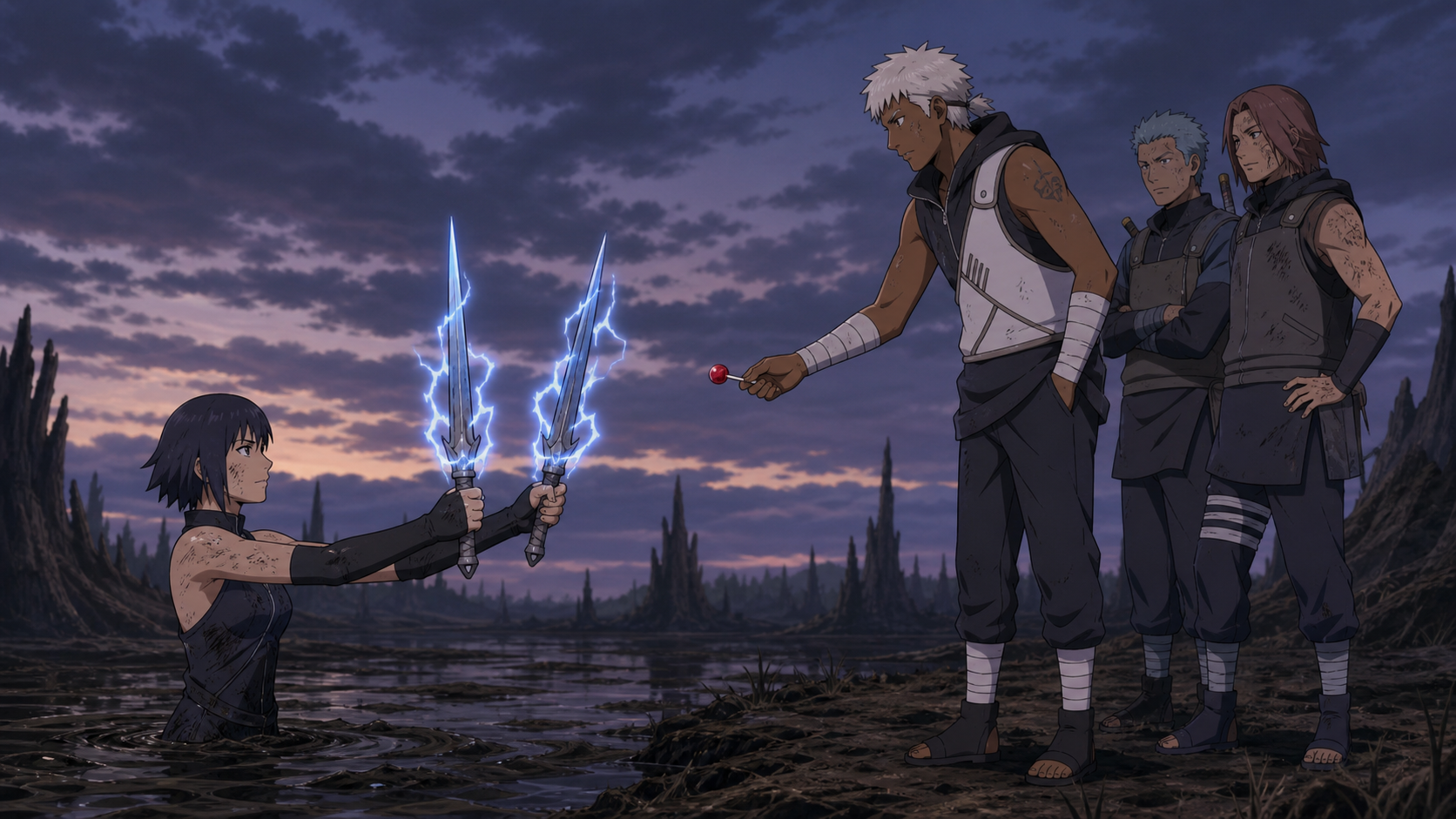
Lightning Blade: Ameyuri Ringo!
Omoi turns grief and anxious planning into a marsh trap, then shares an unexpected farewell with Ameyuri Ringo.
Bottom line
“Lightning Blade: Ameyuri Ringo!” gives Omoi a fight where imagination stops being a joke and becomes tactical preparation. Ameyuri’s paired Kiba blades turn weather, ground, and distance into lightning conductors. Nurui orders retreat because the unit is being erased one person at a time. Omoi wants to avenge Yurui, but his best choice is neither blind pursuit nor permanent flight. He uses teammates, substitution, terrain, and Ameyuri’s appetite for a worthy battle to lure her into a bottomless marsh. The final exchange of a lollipop for Kiba gives the episode an unexpectedly tender ending without pretending the deaths no longer matter.
The unit loses people before Omoi can answer
Ameyuri Ringo attacks a large Allied unit with the confidence of someone whose weapon changes the whole environment. Soldiers fall while the survivors try to maintain distance. Yurui’s death becomes the point Omoi cannot file under ordinary battlefield loss.
Grief arrives during movement. Omoi has no protected room, no complete report, and no time to decide what kind of response would honor his comrade. The enemy remains close enough to punish hesitation.
The official routes establish Omoi’s conflict
Naruto Official catalogs “Lightning Blade: Ameyuri Ringo!” as record `01_733` in the Seven Ninja Swordsmen sequence. Its summary contains the typo “average” where the sentence clearly means “avenge.” Crunchyroll lists the episode correctly as Shippuden Episode 289 under watch ID `GRNQ1JW9R`, released November 15, 2012.
Both official routes identify the unit’s loss and Nurui’s retreat order as the emotional and tactical conflict. Preserving the verified sources while correcting catalog typos in the editorial keeps the episode record usable.
Kiba makes lightning feel personal
Ameyuri carries the paired blades Kiba, two pronged swords built to channel Lightning Release. The weapons let her call and direct lightning with a reach that ordinary sword defense cannot answer.
A blade exchange becomes dangerous before metal touches metal. Wet ground, exposed weapons, armor, trees, and clustered bodies can all extend the attack. The unit must read conductivity as carefully as range.
Ameyuri enjoys the chase
Ameyuri does not move like a detached puppet. Reanimation controls the mission, but her personality remains vivid. She pursues opponents who interest her and responds to courage with genuine enthusiasm.
That pleasure is frightening because retreat can become entertainment. The more clearly fear shapes the unit, the more confidently she controls the pace. Omoi eventually changes the relationship by offering a fight on terms designed around her attention.
Nurui orders retreat for a reason
Nurui sees the casualty pattern and understands that continued engagement will destroy the remaining unit. Retreat is not cowardice when the formation lacks a viable countermeasure. Preserving survivors also preserves intelligence about the swordswoman’s weapon.
The order needs a destination, spacing rules, rear security, and a reinforcement route. Running without structure only gives lightning a longer line of targets.
Omoi hears retreat as abandonment
Omoi cannot separate withdrawal from Yurui’s body left behind. His imagination fills the gap with every terrible consequence: Ameyuri killing more allies, his comrade’s death going unanswered, and future shame over choosing safety.
Those fears are not irrational, but they are incomplete. Revenge can create another corpse without protecting anyone. Omoi has to turn grief into a plan that changes the casualty pattern.
Kayui tries to hold the team together
Kayui stands between Nurui’s command and Omoi’s refusal. Mediating during pursuit is dangerous work because disagreement slows movement and exposes everyone to attack.
Her role deserves more than background credit. Teams need someone who can translate intent before conflict becomes a split. Kayui understands that Omoi’s anger comes from loyalty, while Nurui’s withdrawal comes from the same desire to keep comrades alive.
Omoi chooses a stand that still needs support
Omoi turns back because endless retreat will not stop Ameyuri. The choice creates an opportunity, but courage alone does not make the decision safe. He needs Nurui and Kayui to draw pressure, preserve alternate routes, and help shape the lure.
Their return matters. They do not abandon command discipline so much as revise the plan around new information. A teammate willing to stand alone can still be protected from having to do so.
The marsh converts strength into capture
Omoi cannot overpower Ameyuri’s lightning blades through a straightforward duel. He uses terrain instead. The bottomless marsh offers a restraint that regeneration cannot easily solve because every movement pulls the body deeper.
This is exactly the kind of thinking reanimation requires. Damage resets. Position can persist. A trap that controls movement creates time for sealing or removes the enemy from immediate combat.
Substitution keeps the lure believable
Omoi uses substitution and deception to survive attacks that appear decisive. His anxious mind has already rehearsed failure from several angles, so he can prepare exits before committing.
The trait other people tease becomes operational strength. Catastrophic imagination is exhausting in daily life, but disciplined contingency planning can save a unit. Omoi’s growth comes from deciding which fears deserve a response.
Ameyuri recognizes a worthy opponent
As the trap closes, Ameyuri does not respond only with rage. She appreciates Omoi’s nerve and technique. The recognition does not erase the people she killed, but the moment restores a measure of personal agency inside Kabuto’s deployment.
She can choose how to meet defeat even if she could not choose resurrection. That distinction gives the ending emotional weight.
The lollipop is an offering, not absolution
Omoi gives Ameyuri one of his lollipops as she sinks. The gesture is small, personal, and slightly strange, which makes the exchange feel honest. He does not deliver a grand speech or declare the conflict forgiven.
Food becomes a final courtesy between two people who met under impossible conditions. Omoi acknowledges the fighter without excusing the killings. Respect and accountability remain separate.
Ameyuri returns Kiba as recognition
Ameyuri gives Omoi her paired blades. The gift recognizes the person who defeated her through nerve and strategy. Kiba is also a hazardous military artifact with history beyond this one encounter.
Omoi should not carry the swords away as private trophies. The weapons need documentation, secure custody, and a record of Ameyuri’s transfer. Her gesture belongs in that record even if the blades later return to Mist authority.
The exchange does not complete the mission
Ameyuri sinking into the marsh removes the immediate threat, but reanimated bodies require sealing. The unit needs to mark the location, call specialists, secure the perimeter, and monitor for escape.
Victory language should wait until containment becomes verified sealing. Episode 288 made that rule explicit, and Episode 289 should preserve the same standard.
Yurui’s death needs a separate record
The episode’s graceful ending could pull attention away from the Allied shinobi who died. Yurui deserves a casualty report that records the attack, recovery status, witnesses, and notification chain.
Omoi’s lollipop exchange with Ameyuri is not Yurui’s memorial. Grief for a comrade and respect for an opponent can coexist without being folded into one gesture.
Retreat doctrine should learn from this failure
Nurui’s original order was reasonable, but the route still allowed Ameyuri to pick off stragglers. Future lightning-threat withdrawals need wider spacing, nonconductive equipment where possible, decoy routes, ground inspection, and clear regroup points.
A retreat plan should also identify who watches the rear and when that person rotates. The same shinobi cannot absorb every pursuit risk.
Weather belongs in the mission briefing
Lightning weapons gain different advantages depending on clouds, rain, terrain moisture, and elevation. Environmental information should be distributed before units enter a region where Ameyuri has been sighted.
Battlefield weather is not decoration. The sky can become part of Kiba’s attack system.
Command should also track artificial changes in conductivity. Broken water lines, flooded trenches, metal wire, discarded weapons, and medical equipment can create paths that did not exist on the original map. Units need permission to abandon gear when carrying metal becomes more dangerous than losing supplies. An inventory can be replaced. A person cannot.
Lightning injuries require delayed monitoring
Survivors who appear stable may still face burns, disrupted heart rhythm, nerve damage, hearing loss, or muscle injury. Medics should screen everyone within the strike zone, including shinobi who never lost consciousness.
The unit also needs a record of where each person stood during major discharges. Distance and ground contact can explain symptoms that emerge later. Treating only visible wounds would repeat the same mistake as judging Ameyuri’s range by the length of her blades.
Repeat checks should continue after sleep because delayed weakness or confusion may appear only when the immediate battle adrenaline fades.
Omoi’s anxiety needs care after the fight
Winning does not switch off the mental pattern that showed Omoi every possible disaster. After the mission, those images may intensify around Yurui’s death and the moment he chose to turn back.
Debriefing should separate useful contingency analysis from guilt loops. Omoi can keep the skill of imagining risk without carrying responsibility for every outcome he pictured.
Nurui and Kayui deserve credit for returning
Omoi lands at the center of the episode, but the trap depends on teammates who refuse to let his stand become a solitary sacrifice. Their choice creates distraction, rescue options, and emotional proof that loyalty survives disagreement.
The report should name their actions precisely. “Omoi defeated Ameyuri” is true only in the narrowest sense.
Kayui’s effort to cool the argument deserves particular attention because emotional mediation can preserve tactical cohesion. Nurui’s willingness to revise his retreat order also matters. Command strength includes recognizing when a subordinate has identified an opportunity that the original plan did not anticipate.
Kiba’s custody should involve the Hidden Mist
The paired blades belong to a history shaped by Kirigakure, previous wielders, and the violent institution of the Seven Swordsmen. Allied command should notify Mist representatives immediately, record Ameyuri’s gift, and agree on secure temporary storage.
Returning the weapons without documentation would erase Omoi’s encounter. Keeping them without consultation would convert battlefield necessity into appropriation. A transparent transfer protects both truths.
Ameyuri’s history belongs beyond the swords
The Seven Ninja Swordsmen title can reduce every member to a weapon silhouette. Ameyuri’s humor, appetite for battle, recognition of skill, and final gift show a person beyond Kiba.
A complete profile should document her life, illness, service, violence, and relationship to the blades without turning a complicated kunoichi into collectible lore.
The end of this mini-run feels earned
Episodes 284 through 289 give several reanimated specialists enough space for personality, tactics, and unfinished history. Sai, Pakura, Tsunade’s past, Jinpachi, Kushimaru, and Ameyuri all reveal different ways institutions use people.
Ameyuri’s ending closes the sequence with an exchange rather than a simple defeat. The next episode moves into the Power arc, so preserving this boundary helps the directory remain readable.
Omoi’s imagination becomes useful when he chooses a boundary
He can picture endless disasters, and each possibility competes for attention. The marsh plan works because he stops treating every fear as equally urgent. He selects the risk the team can change.
That is the difference between anxiety running the mission and anxiety informing the mission. Omoi does not become fearless. He converts one forecast into positioning, signals, substitution, and a containment route.
Retreat and resistance are not moral opposites
Nurui orders withdrawal because the formation is dying. Omoi turns back because Ameyuri can keep hunting the retreat. Both choices begin in responsibility toward comrades.
The conflict is tactical, not a contest between cowardice and courage. A mature unit can revise withdrawal when new terrain creates an opening without humiliating the leader who protected survivors long enough for that opening to exist.
Yurui’s death cannot be repaid through another death
Omoi wants an answer large enough to match the loss. Killing Ameyuri might feel proportionate for one moment, but reanimation makes ordinary revenge mechanically useless and emotionally incomplete.
The marsh trap honors Yurui better by stopping further casualties. Grief receives a job without pretending the job settles grief. Omoi still has to mourn after strategy succeeds.
Kayui holds disagreement before disagreement splits the unit
She recognizes the loyalty beneath Omoi’s anger and the care beneath Nurui’s command. Translating those motives keeps each man from reducing the other to coward or reckless fool.
Mediation is battlefield labor because cohesion affects who survives. Kayui does not merely calm personalities. She preserves enough relationship for the revised plan to become shared action rather than three isolated responses.
Ameyuri’s pleasure creates the opening and the danger
She wants a fighter worth pursuing. That preference lets Omoi shape her movement, but attention from a delighted swordswoman remains lethal. He has to appear committed without letting performance replace escape planning.
Her personality survives Kabuto’s control strongly enough to become tactically relevant. The alliance can use that evidence while remembering she still lacks the freedom to leave the battlefield entirely.
The marsh contains a body that can regenerate
Damage would reset. Mud changes position and consumes leverage. Omoi selects a solution aligned with Edo Tensei’s actual problem rather than attempting a more impressive sword exchange.
Containment still needs monitoring and sealing. A reanimated enemy under the surface is delayed, not automatically finished. The team must mark depth, perimeter, and approach routes before specialists arrive.
The lollipop restores ordinary personhood for one moment
Omoi offers something associated with habit, comfort, and daily life rather than war. The smallness matters. He does not turn Ameyuri’s sinking into a ceremony designed to explain her.
The gesture says two people occupied the encounter beneath weapon titles and uniforms. Courtesy does not erase responsibility. It refuses to let violence become the only language available at the end.
Ameyuri’s gift is testimony before it is property
Passing Kiba to Omoi records her recognition of his strategy and nerve. The act has meaning even if alliance custody later returns the blades to Kirigakure.
Documenting the transfer protects that meaning. Without a witness record, the weapons become loot and Ameyuri’s choice disappears. With a record, personal gesture and institutional ownership can be handled separately.
Legendary blades require boring custody to remain safe
Kiba can channel lightning through weather, ground, and nearby metal. Storage therefore needs insulation, access control, condition inspection, and a chain of custody agreed with Mist representatives.
Calling the swords legendary does not exempt them from inventory. Myth makes theft more attractive and mishandling more likely. Respect for the artifact begins with preventing another body from paying for casual fascination.
Weather intelligence should travel with casualty intelligence
Cloud cover, wet soil, elevation, and conductive debris change Ameyuri’s effective range. Future units need those conditions attached to reports of each strike.
A map showing only where casualties fell may suggest random power. Environmental detail reveals the attack system. Learning how the sky and ground participated gives later soldiers something more useful than fear of a famous blade.
Omoi’s victory does not prove anxiety was secretly a gift
Worst-case thinking helps him prepare substitutions and traps. The same pattern can exhaust him, magnify guilt, and make rest feel unsafe after the battle.
The episode should not romanticize distress because one plan worked. Omoi deserves care that preserves his analytical strength while helping him separate possible catastrophe from personal responsibility for preventing every catastrophe.
Nurui’s revision is command competence
He ordered retreat from evidence available at the time. When Omoi identifies a viable containment approach, Nurui returns and supports the change. That flexibility is not loss of authority.
Command becomes trustworthy when subordinates can bring new information without turning every update into a challenge for status. Nurui helps transform Omoi’s solitary impulse into a team operation.
The report should keep three endings separate
Ameyuri is contained and must be sealed. Yurui is dead and deserves recovery, notification, and memorial. Omoi survives and needs medical and emotional follow-up.
One graceful exchange cannot finish all three stories. Separating them protects each person from becoming a symbol inside somebody else’s closure. Battlefield completion requires different work for the enemy, the dead comrade, and the living survivor.
The mini-run ends by making respect complicated
Omoi can respect Ameyuri’s skill and final choice without forgiving the deaths. Ameyuri can recognize him while remaining a dangerous historical figure forced back into war.
That complexity is better than a sudden friendship or a faceless defeat. The episode lets mutual recognition exist in the narrow space between accountability and dehumanization, then leaves the living responsible for the record.
The cleanest proof of Omoi’s growth is that the plan makes room for other people. Nurui can command, Kayui can mediate, the sealers can finish, and the Mist can receive a documented weapon transfer. Omoi remains central without becoming solitary. Grief changes his judgment but does not make every teammate disappear from the victory. That balance gives courage a structure sturdy enough to outlast the episode’s beautiful farewell.
RaeRae’s verdict
“Lightning Blade: Ameyuri Ringo!” is one of the strongest anime-original war episodes because Omoi wins through character-specific thinking. His anxiety, loyalty, sword training, and taste for lollipops all matter.
Ameyuri receives enough personality to make the last exchange memorable without softening the danger she created. The episode holds grief, respect, and accountability together.
RaeRae’s call
Omoi does not honor Yurui by becoming the next body Ameyuri leaves behind. He turns anxious forecasting into a shared containment plan. The lollipop recognizes a person. Kiba records Ameyuri’s answer. Neither gesture erases the dead or completes the sealing work.
Episode details and viewing routes
- Official episode reference: Naruto Official episode guide
- Licensed episode route: Crunchyroll licensed episode page
What I am carrying forward
I am carrying forward Omoi’s ability to turn worst-case thinking into a controlled lure. Courage becomes useful only after planning gives courage somewhere to go.
I am also carrying forward the lollipop and Kiba exchange as a record of mutual recognition, not forgiveness. Yurui still deserves mourning. Ameyuri still deserves a complete history. Omoi deserves credit shared with Nurui and Kayui.