
Ah, My Hero Lady Tsunade!
Tenten admires Tsunade without becoming her copy. Her own scrolls, weapons, aim, and preparation make the kunoichi.
Bottom line
Naruto Shippuden Episode 237 finally gives Tenten an interior life beyond standing beside Neji and Lee with a scroll. She grew up wanting to become a legendary kunoichi like Tsunade. Tenten first reads that goal as a checklist: monstrous strength, medical ninjutsu, and a powerful summoning contract. She struggles with every copy. Guy eventually notices the ability that belongs to her, not Tsunade. Tenten can summon, organize, and launch ninja tools with precision that nobody else on Team Guy matches.
The lesson is simple without being soft. Failing to become Tsunade does not mean Tenten failed to become exceptional. The sad part is that Shippuden rarely lets her specialization shape major events after making such a good case for the craft. Episode 237 shows the discipline, field support, sealing knowledge, and weapon control that should have made Tenten indispensable. Then the broader series keeps treating her like spare equipment.
Lee falls into the river and opens Tenten’s memory
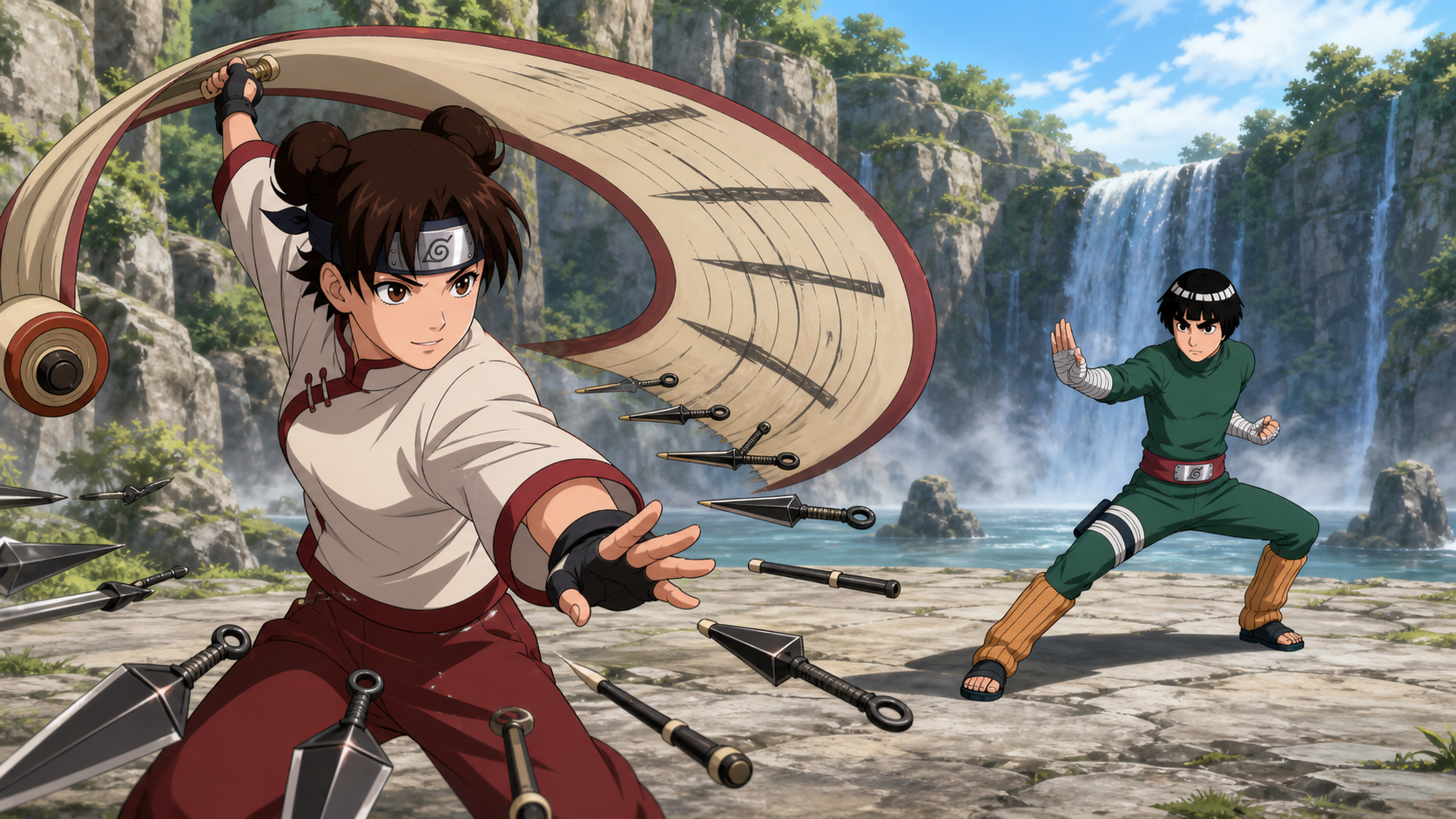
Present-day Tenten helps Rock Lee train to improve his use of the Eight Inner Gates. Their practice takes place near a waterfall, where she summons a metal training doll and Lee grabs the wrong target at the wrong moment. The weight pulls him into the river.
While waiting for Lee to surface, Tenten remembers how her own training began. The framing fits their friendship. Lee pursues one dangerous specialty with total commitment. Tenten spent years believing a great kunoichi needed somebody else’s specialty before recognizing her own.
Tsunade is a reasonable hero for a young kunoichi
Tsunade is one of the Legendary Sannin, a peerless medical ninja, a survivor of multiple wars, and a woman strong enough to reshape a battlefield with one strike. Young Tenten sees proof that a kunoichi does not have to remain support for male teammates.
Admiration makes sense. The problem begins when adults explain Tsunade through visible achievements instead of the choices, losses, and years behind them. Tenten receives traits to imitate without a map for discovering what kind of fighter she is.
Tsunade’s public image also hides how separate her skills really are. Medical mastery came through study, control, and years of treating bodies damaged by war. Her strength uses that same control in a different application. Katsuyu is a long relationship with an intelligent summon. Tenten sees one legendary woman, but the legend contains several careers layered across decades. Expecting a child to reproduce the package is absurd.
Guy starts with Tsunade’s strength
When Tenten asks what makes Tsunade legendary, Guy points to her extraordinary physical strength. Tenten tries to reproduce the result through effort. She hits targets, trains her body, and waits for a wall-breaking punch to emerge.
Chakra-enhanced strength requires precise control and timing, not only muscle. Tenten’s inability to copy Tsunade’s strike is not laziness. The technique depends on a chakra application that does not match her natural control. Hard work cannot guarantee every body and chakra system will produce the same result.
“Train harder” cannot be the only coaching answer
Naruto often celebrates effort, which can blur the difference between persistence and fit. Tenten persists. More repetitions do not turn her into Tsunade. A teacher has to notice when practice is building skill and when practice is only repeating mismatch.
Guy’s eventual success comes from observation. He sees how Tenten handles tools and redirects training toward that evidence. The episode would be weaker if another round of effort magically unlocked Tsunade’s strength. Redirection respects the work she already did.
Medical ninjutsu becomes the second borrowed path
Tenten learns that Tsunade is also legendary for medical ninjutsu. She tries to heal a fish, following the type of chakra-control exercise associated with medical training. The attempt fails.
Medical ninjutsu requires delicate, sustained control, anatomical knowledge, and the ability to act under pressure. Tenten’s poor result does not make her less intelligent or compassionate. The skill is specialized. The series sometimes treats medical training as the respectable route for any kunoichi who cannot dominate combat, which makes Tenten’s failure feel harsher than the failure needs to be.
A team does not need every woman to become the medic
Tsunade’s doctrine values a medical ninja on every squad, but that policy does not require every female shinobi to fill the position. Gender and role become tangled across Naruto’s teams. Sakura and Ino develop medical skills, Hinata receives anime-only medical moments, and Tenten gets measured against the same track.
Team Guy already has distinct needs. Neji offers Byakugan reconnaissance and Gentle Fist. Lee supplies close combat and speed. Tenten’s ranged control, storage, and equipment support cover territory neither teammate can. Forcing her into medicine would shrink the team’s range.
The slug summon attempt turns aspiration into comedy
Tenten next tries to form a summoning contract like Tsunade’s connection with Katsuyu. Instead of discovering a ready-made slug path, she clashes with Ningame. The attempt fails and becomes another comic mark against her hero checklist.
Summoning contracts are relationships with specific creatures, not prizes earned by admiration. Naruto’s bond with the toads depends on Jiraiya, Mount Myōboku, and repeated encounters. Tenten cannot recreate Tsunade’s network through desire alone. Her actual summoning affinity appears through objects and scrolls.
Guy finally notices what her hands already know
Tenten handles weapons naturally. She understands weight, balance, release angle, distance, storage, and timing. Guy recognizes that pattern and begins training her as a weapons specialist.
This is the first answer based on Tenten rather than Tsunade. The shift matters. A good teacher does not lower expectations after a student struggles. A good teacher changes the route so the expectations measure the student’s real potential.
Weapon mastery is more than throwing sharp objects
Tenten’s craft involves far more than aim. Scrolls let her store large arsenals, deploy equipment quickly, vary attack angles, and support a squad without carrying every tool openly. She can prepare the battlefield before an opponent understands the inventory available.
Weapons also require maintenance, procurement, sealing knowledge, and tactical choice. A blade is useful only when the user understands range, armor, movement, terrain, and recovery. Episode 237 gives the origin but could spend much longer showing the labor behind her precision.
Storage changes logistics too. Tenten can move food, medicine, ropes, traps, replacement blades, and survival equipment in forms a squad can carry across difficult terrain. That ability should matter enormously during a war involving five national forces. The same scroll knowledge that makes an exciting weapon barrage can keep a unit supplied after roads fail. Combat and support are not separate worlds in her specialty.
Tenten becomes herself without rejecting Tsunade
Finding her specialty does not require Tenten to decide that Tsunade was the wrong hero. Tsunade’s example opened the category of “legendary kunoichi” in her mind. Tenten later learns that the category can include more than one kind of woman.
Healthy admiration should expand possibility, not demand duplication. Tenten can respect Tsunade’s medicine, strength, leadership, and survival while building a career around weapons. The hero remains important after the imitation ends.
Present-day training shows what Tenten contributes
Tenten’s metal doll gives Lee a controlled target for Eight Gates practice. Her scrolls create training conditions that normal sparring cannot safely reproduce. She monitors him near dangerous water and understands the risks of his body-intensive technique.
That support is not passive. Lee’s growth depends on somebody capable of setting the challenge, adjusting equipment, and recognizing when the exercise goes wrong. Tenten participates through preparation and specialized tools.
Lee and Tenten understand being the non-genius
Neji entered Team Guy as the celebrated prodigy. Lee could not use ninjutsu or genjutsu. Tenten could not reproduce the strength, medicine, or summoning style she admired. Both had to build identity through narrower craft and relentless repetition.
Their friendship works because neither needs the other to pretend struggle is glamorous. Tenten can mock Lee, rescue him, equip his training, and respect the discipline underneath the green jumpsuit. Lee can admire her weapons without calling the specialty a backup plan.
The episode exposes how little the series used her
Tenten’s origin creates obvious story routes. She could manage battlefield logistics, identify rare tools, develop sealing methods, maintain village arsenals, train squads in equipment use, or investigate how legendary weapons moved between nations. Shippuden uses only fragments of that potential.
The problem is not that weapon specialists lack spectacle. Sasuke’s shuriken work, the Seven Ninja Swordsmen, Kankurō’s puppets, and the Sage tools prove equipment can carry history and strategy. Tenten lacks narrative investment, not a viable specialty.
Her Chūnin Exams loss to Temari should have opened another route. Wind exposed the limits of a direct projectile barrage. A developing specialist could answer through wire control, anchored traps, heavier tools, terrain use, explosive tags, close-range backup weapons, and sealing combinations. Instead of evolving that tactical rivalry, the series largely files the defeat under “Temari was stronger” and moves on.
Tsunade’s actual legacy includes helping people find another path
Tsunade becomes important to Lee because she repairs the injuries that threatened his entire career. She also changes Konoha medicine and leads the village through catastrophe. Her legacy is not one punch or one slug.
Tenten follows that legacy in an indirect way. Her tools help Lee keep training after Tsunade gave him the chance to return. One woman’s medicine and another woman’s equipment support the same shinobi at different stages. A village needs both.
Admiration becomes restrictive when adults translate it into imitation
Tenten sees Tsunade and imagines a future in which a kunoichi can be legendary. That inspiration should open possibilities.
Coaching turns it into a checklist of Tsunade’s most visible abilities, making difference feel like evidence that Tenten is falling short of her own dream.
Tsunade’s public image hides decades of specialized development
Her strength, medicine, summoning relationship, leadership, and battlefield survival did not arrive as one natural package. Each rests on training, knowledge, experience, and personal history.
Asking a child to reproduce the whole legend ignores the long process that made the legend possible.
Failure can identify fit without defining capacity
Tenten’s unsuccessful strength and medical exercises show that these applications do not align with her current chakra control. They do not prove she lacks intelligence, discipline, compassion, or potential.
A narrow test produces a narrow answer. Guy improves as a teacher when he stops extending that answer to her entire future.
Medicine should not become the default respectable role for women
Medical shinobi are essential and deserve serious expertise. Assigning the path by gender still limits both the person and the team.
Tenten can value healing without becoming a medic. Her logistics and weapons work can prevent injuries, protect medics, and keep treatment supplies available.
Summoning a creature is relationship, not aesthetic resemblance
Katsuyu is not an accessory completing Tsunade’s image. The slug is an intelligent partner with distinct abilities, judgment, and a long working relationship.
Tenten cannot select a similar contract like matching equipment. Her own summoning practice develops through prepared objects and scroll systems.
Guy succeeds when observation replaces motivational volume
More effort was never the missing ingredient. Tenten already worked. Guy finally watches how she handles tools, measures distance, and organizes deployment.
Redirection is not lowering expectations. It places high expectations where practice is producing meaningful growth.
Weapon expertise combines craft, mathematics, and logistics
Precision requires knowledge of weight, rotation, balance, trajectory, timing, material condition, target movement, and environmental interference.
Scroll deployment adds sealing, inventory design, retrieval order, maintenance, and planning for what a team may need before the need becomes visible.
Preparation is an active combat contribution
Tenten shapes possible outcomes before anyone exchanges blows. The right tool, stored accessibly and maintained correctly, changes which terrain and defenses a squad can answer.
Her work looks quiet because successful preparation prevents the dramatic failure viewers would otherwise notice.
War should make her specialty institutionally essential
Five national forces require standardized equipment, resupply, recovery, transport, storage security, and replacement weapons across unstable routes.
A sealing specialist who can move large inventories should influence operational planning, not wait behind prodigies for a brief projectile sequence.
Supporting Lee does not make Tenten secondary
She creates a controlled target, monitors dangerous training, and can intervene when his Eight Gates exercise goes wrong. Lee’s progress depends on that environment.
Support describes how abilities interact, not whose life deserves narrative attention. Tenten remains a practitioner with goals beyond managing her teammates.
Tenten’s path needs progression the audience can witness
A specialty earns respect through development, not one origin flashback. Viewers should see Tenten refine sealing capacity, solve counters to wind, choose different materials, and create deployment systems shaped by previous failures.
Her defeat by Temari could become a technical beginning. Anchored wires, weighted tools, terrain traps, redirected trajectories, or cooperative formations would show a practitioner learning why the original barrage failed.
Instead, the series repeatedly presents polished competence without giving her discoveries enough consequence to form an arc.
Legendary tools should carry history through her hands
Ninja weapons are not neutral objects. Swords, fans, puppets, scrolls, and Sage treasures carry makers, owners, conflicts, and political claims.
Tenten is positioned to ask where equipment came from, how it should be stored, who can use it safely, and whether recovering a famous weapon creates an obligation to its victims.
Those questions could connect her craft to world history without inventing a bloodline or abandoning the practical personality already established.
Logistics can become a source of moral authority
The person controlling supplies influences which units remain armed, which patients receive material, and which missions can continue. Efficient storage therefore creates power that needs accountability.
Tenten could help design transparent inventories, prevent commanders from hoarding equipment, and ensure support reaches less prestigious squads. Preparation is not politically innocent merely because it happens before battle.
Giving her those decisions would turn background competence into leadership rooted in the specialty itself.
Guy’s better lesson is permission to stop copying
Tenten has enough discipline. What she lacks is evidence that changing direction does not betray the girl who admired Tsunade.
Guy finally provides that permission by recognizing what her hands already understand. A teacher can honor persistence while admitting the original plan measured the wrong outcome.
The shift lets effort become responsive rather than punitive. Training serves growth instead of proving how long a student can endure mismatch.
Tsunade remains a hero because influence can exceed resemblance
Tenten does not need medical chakra, monstrous strength, or Katsuyu to inherit something meaningful. Tsunade showed that women could occupy power, survive war, direct institutions, and remain complicated.
The next step is widening that image. A weapons and sealing specialist can become legendary through a different combination of craft, judgment, service, and leadership.
Admiration matures when it stops asking for duplication and begins protecting the possibility of difference.
RaeRae’s final word on Tenten’s hero
Tenten tries strength, medicine, and a slug-adjacent summoning plan because adults hand her Tsunade’s résumé instead of helping her read herself. That was never going to be fair.
Guy improves the moment he watches. Precision, inventory, sealing, preparation, and terrifying quantities of sharpened metal are already her language.
Tenten found the specialty. Shippuden owed her the sustained story.
Her craft does not need borrowed greatness. It needs space, consequence, and a story willing to remember that preparation can be as decisive as impact when somebody finally looks closely. Tenten already did the work.
What landed and what did not
The strongest choice is letting Tenten fail repeatedly without calling her lazy. Guy eventually recognizes evidence and redirects the training. The present-day Lee framing proves that her specialization contributes to another teammate’s growth.
The weak point is how neatly the story turns multiple disappointments into one answer. Finding a specialty rarely removes grief over abandoned goals. Tenten could still want medical knowledge, resent the limits of her chakra control, or question whether weapons receive equal respect. The episode reaches acceptance quickly because Tenten has only one installment to carry years of development.
Final reaction
“Ah, My Hero Lady Tsunade!” works because Tenten does not become great by discovering a secret version of Tsunade inside herself. She becomes more capable when Guy stops comparing the result to Tsunade and starts watching what Tenten actually does well.
Her scrolls, weapons, aim, preparation, and field support form a complete shinobi path. The frustration comes from knowing how much story that path could support. Tenten finds her answer. Shippuden should have trusted the answer enough to give her more than one afternoon by a waterfall.
The episode still gives her a foundation worth keeping. She does not need a bloodline, a giant chakra reserve, a romantic storyline, or somebody else’s techniques to justify screen time. A working shinobi who knows every tool, prepares for changing conditions, and keeps reckless teammates alive is already interesting. The missing ingredient was never Tenten. The missing ingredient was sustained attention from the story around her.
Tenten’s confidence also has room for humor. She can be proud of Lee and still call his training ridiculous. She can admire Guy while refusing to match the volume of his speeches. Those reactions make her the practical center of a team built around two men who treat self-imposed punishment as a daily schedule. Her weapons are not the only balance she brings.
RaeRae’s call
Tenten does not fail because she cannot duplicate Tsunade. Guy finally recognizes the precision, sealing, preparation, and logistics already in her hands. Her specialty was always worthy; the series failed to sustain its attention.
Episode details and viewing routes
Naruto Shippuden Episode 237, “Ah, My Hero Lady Tsunade!,” first aired in Japan on November 24, 2011. The anime-original episode belongs to the Paradise Life on a Boat stretch and remains in Konoha through Tenten’s memories while Naruto continues traveling.
- Official episode reference: Naruto Official episode guide
- Licensed episode route: Crunchyroll licensed episode page