
Friends You Can Count On
Shino fears becoming Team 8’s weak link. Kiba and Hinata answer with training, trust, and a place beside them.
Bottom line
Naruto Shippuden Episode 236 gives Shino the kind of character work the main plot often forgets to provide. He is intelligent, loyal, and brutally effective at range, but one close-combat defeat convinces him that Team 8 would be safer without him. Kiba and Hinata answer that fear by helping him train rather than agreeing with his worst conclusion. When Suika traps them later, Shino returns with the exact skill he once lacked and finally understands that teammates are not liabilities to outgrow. They are the people who cover each other while everybody keeps learning.
The episode also refuses to let Shino become entirely solemn. Naruto finds a ladybug on the ship and remembers “that insect guy” without remembering the name. Shino somehow senses the disrespect from Konoha and gets annoyed. The joke is funny because recognition matters deeply to a character who pretends not to care. Shino’s fear of being forgotten has shaped more of him than the dark glasses ever reveal.
A ladybug brings Shino into an episode without him
Naruto is still traveling toward the Land of Lightning when a ladybug lands on the ship. The insect reminds him of a Konoha teammate, but Shino’s name will not come. Naruto can remember hundreds of enemies, techniques, promises, and ramen preferences, yet the boy covered in insects remains “what was his name again?”
That framing connects the flashback to Shino’s long-running frustration. He missed the Sasuke Recovery Mission, Naruto failed to recognize him after returning from training, and his quiet presence makes him easy for louder teammates to overlook. The episode uses comedy to expose a real insecurity before Shino even begins telling his story.
Shino teaches fear without pretending courage feels easy
At the Ninja Academy, younger students ask about the coming war. Shino admits that he feels afraid. He does not tell children that a capable shinobi should feel nothing. He says he is not worried because he has comrades he can trust.
That answer is more responsible than empty hero talk. War deserves fear. Confidence comes from preparation, shared responsibility, and knowing who will stand behind you. Shino teaches the lesson through an early failure because polished success would not explain how trust was built.
Team 8 begins with specialized strengths
Kurenai’s Team 8 combines tracking and information skills. Kiba and Akamaru follow scent. Hinata’s Byakugan extends sight through obstacles and across distance. Shino’s kikaichū insects scout, drain chakra, surround targets, and attack from angles an opponent may never notice.
The team’s design rewards coordination. None of them needs to become a copy of another. Their first mission against Suika goes wrong because Shino interprets specialization as shame once the enemy reaches his weak range. He confuses having a gap with being useless.
Suika attacks the gap Shino already knows
Suika is a wanted rogue with strong close-range taijutsu and Fire Release techniques. He gets inside Shino’s preferred distance, defeats him physically, and mocks insect users as weak once an opponent closes the gap.
The insult lands because Shino believes part of the argument. His insects make him dangerous, but he has relied on controlling space rather than enduring direct pressure. Suika turns a tactical weakness into a verdict on Shino’s worth. One failed exchange becomes proof that everything else Shino contributes does not count.
That verdict also misunderstands specialization. A tracker, sensor, medic, ranged fighter, and close-combat specialist do not become useless because another role can beat them under ideal conditions. Suika engineers the range that favors him and then calls the result universal truth. Shino’s growth should give him another option, but Team 8 should never accept the enemy’s narrow definition of strength.
Failure hurts more because Shino already feels replaceable
Shino locks himself away after the mission. Kiba recognizes that the defeat is not the only wound. Naruto rarely remembers Shino, and the Sasuke Recovery Team left without him because he was away on another assignment. Shino knows the circumstances, but feelings do not always respect logistics.
Missing that mission meant missing the moment when Kiba, Chōji, Neji, Naruto, and Shikamaru tested their bonds at enormous cost. Shino imagines that a true teammate would have been present. Suika’s insult gives that old absence a new explanation: perhaps nobody needed him because he was never strong enough.
Kiba uses teasing to reach the truth
Kiba does not approach Shino with delicate language. He pokes the exact sore spots, jokes about Naruto forgetting him, and forces Shino to admit that pride has been hit. That method works because Kiba knows him well enough to ignore the formal denial.
The teasing could sound cruel from somebody outside Team 8. From Kiba, the challenge carries an invitation. Stop hiding, come train, and let the team respond to the weakness instead of treating the weakness as a secret reason to leave.
Hinata offers help without turning Shino into a project
Hinata joins Kiba and Akamaru in helping Shino improve close combat. She does not pity him. Gentle Fist training requires precise distance, timing, footwork, and awareness, which makes her a valuable partner for the skill he needs.
Her support also shows how far Team 8 operates from the loud competition found elsewhere. Hinata understands what public defeat can do to confidence. She trains with Shino because teammates share knowledge, not because she expects him to stop being an Aburame fighter.
Kurenai’s order gives Shino permission to accept
Shino initially refuses their offer. Kiba says Kurenai ordered the training, which gives Shino a formal reason to participate without openly admitting he wants help. Kurenai understands the pride involved and builds an exit from the defensive position.
Good leadership sometimes means making support easier to accept. Telling Shino to “believe in himself” would leave him alone with the same skill gap. Kurenai arranges teammates, practice, and oversight. Confidence follows repeated evidence.
Training improves the skill but not the fear
Shino works on taijutsu and develops Iron Mountain Leaning, a close-range body strike that uses his frame and timing rather than replacing his insects. The technique gives him an answer when an opponent enters his space.
Skill improvement does not immediately repair his thinking. Shino still considers leaving Team 8 because he fears failing to protect Kiba and Hinata. He has learned a movement but has not yet learned that protection moves in both directions.
Leaving the team feels responsible only from inside the fear
Shino frames departure as protection. If he is the weak link, removing himself should make Kiba and Hinata safer. That logic sounds selfless while placing all authority in his private judgment. He decides what his teammates need without letting them answer.
The choice would also take away their chance to support him. Fear often disguises escape as sacrifice. Shino would avoid another humiliating failure, then call the absence a gift to the team. Episode 236 forces him to test that story against a real emergency.
Kiba and Hinata face Suika without him
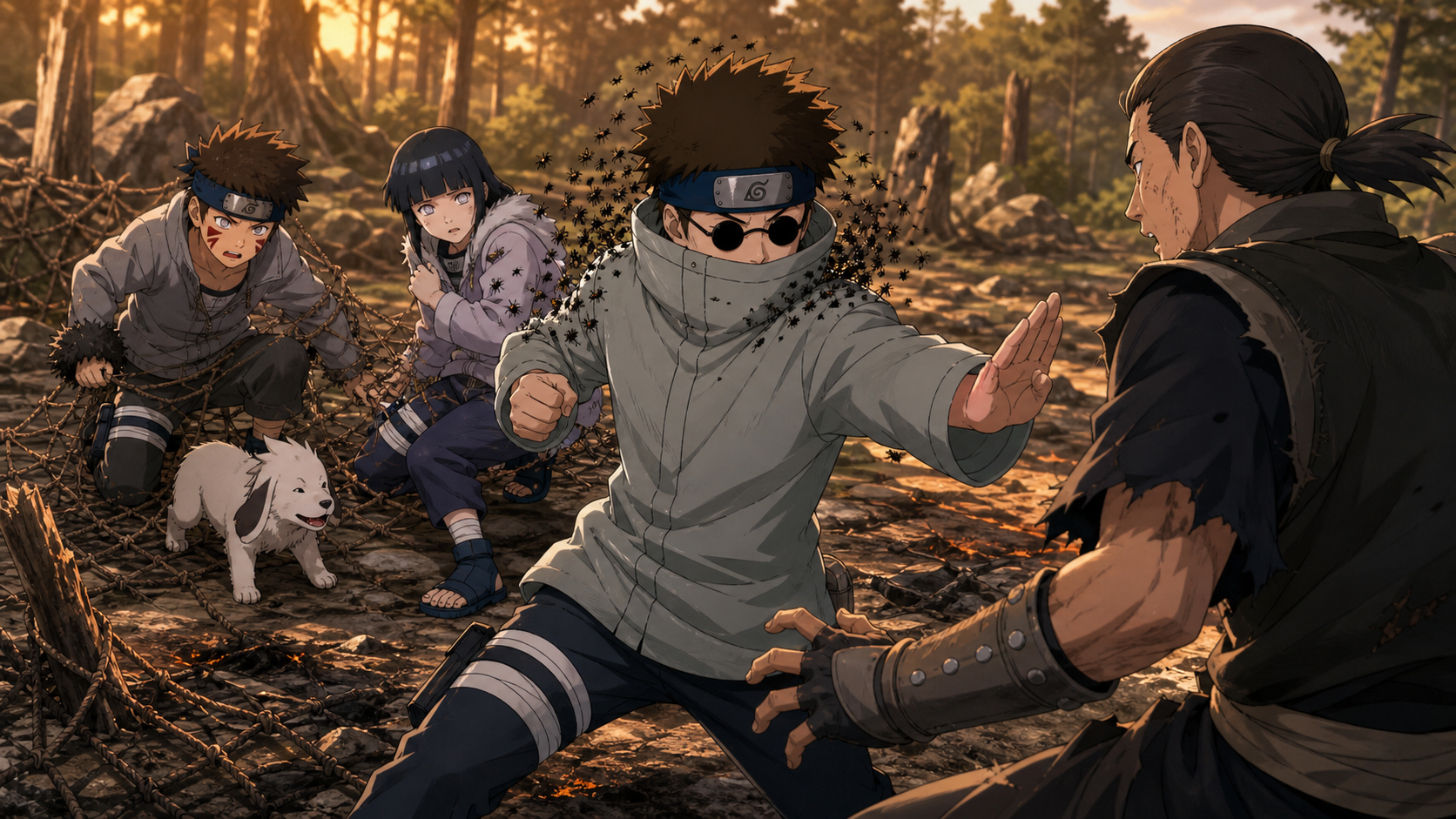
Kiba, Hinata, and Akamaru track Suika and engage him. Their combined tracking gets them to the target, but Suika’s techniques and trap overwhelm them. The danger creates the situation Shino feared: his teammates need protection and he is not beside them.
Their trouble does not prove Shino was right to leave. Their trouble proves his role matters. Teams are built around overlapping strengths because any pair can meet a problem that favors the missing member.
Shino returns before shame can make the decision permanent
Shino arrives before Suika’s attack hits Kiba and Hinata. He places himself between the enemy and his teammates, engages at close range, and uses the training he almost refused. Iron Mountain Leaning overwhelms the opponent in the exact range that caused the first defeat.
The moment works because success is specific. Shino does not receive a mysterious power boost. Kiba, Hinata, Akamaru, and Kurenai helped him practice a known weakness. The rescue is the result of trust converted into work.
Team 8 finishes as a team
Shino creates the opening, but Hinata frees herself and Kiba. Gentle Fist and Fang Passing Fang complete the capture. No single member owns the whole victory.
That structure answers Shino’s original fear. Protecting teammates does not mean preventing every danger alone. He saves them when his skill fits the moment. They finish when theirs fits the next moment. Dependability is a pattern of returning, communicating, and covering gaps.
Kurenai was watching without stealing the lesson
The episode reveals that Kurenai observed the mission. She allowed Team 8 enough space to struggle and make choices while remaining close enough to prevent catastrophe. Her distance is deliberate teaching, not abandonment.
Kurenai knows Shino needs evidence from his own actions. If she defeats Suika immediately, he remains the student who failed and was rescued by the jōnin. By monitoring rather than dominating, she lets the genin discover how their team actually functions.
The hot-spring joke remembers that insects are still insects
After the mission, the team reaches a hot spring. Shino’s pores open in the heat and release kikaichū into the water. Kiba reacts with complete horror while Shino treats the event as normal biology.
The gag cuts through the emotional lesson before the episode becomes too polished. Team friendship includes the strange, inconvenient reality of living beside an Aburame colony. Trust does not require pretending every detail is pleasant.
Naruto forgetting his name lands differently after the story
Back on the ship, Naruto still cannot retrieve Shino’s name. Shino finishes telling the Academy students about dependable comrades and somehow senses the failure from far away. His irritation becomes the closing joke.
The joke also leaves a small sting. Shino has proven his value to Team 8, but broader recognition remains uneven. The important change is that Naruto’s memory no longer decides whether Shino belongs. Kiba, Hinata, Akamaru, and Kurenai already know exactly who stands behind them.
Shino mistakes one matchup for a complete evaluation
Suika reaches the range where his taijutsu dominates and then declares insect techniques weak. The claim ignores every condition Shino normally controls through scouting, chakra drain, concealment, and distance.
A failure identifies a tactical gap. Shame turns that gap into a verdict about the entire person.
Specialization is why Team 8 exists
Hinata sees through barriers, Kiba and Akamaru track scent and apply close pressure, and Shino gathers information through insects while controlling space. Their differences create coverage.
If every member had to master every range independently, the team would be three redundant solo fighters standing near one another.
Training expands options without erasing identity
Iron Mountain Leaning gives Shino a response when an enemy breaches his preferred distance. It does not replace kikaichū or turn him into Kiba.
Useful growth protects a specialist from one predictable counter while preserving the expertise that made his contribution distinct.
Kiba’s teasing carries a relationship outsiders cannot copy
He names Naruto’s forgetfulness and Shino’s pride because indirect politeness will let Shino keep hiding. The method works through years of trust.
The same words from a stranger could deepen humiliation. Care includes knowing which challenge a particular friend can hear.
Hinata shares technique without claiming authority over recovery
She can offer footwork, timing, and close-range perception because Gentle Fist requires exact control within danger. She does not diagnose Shino’s entire emotional life.
Practical support respects him as a teammate capable of turning instruction into his own solution.
Kurenai makes accepting help compatible with Shino’s pride
Framing training as an order gives him formal permission to participate before he can admit vulnerability. The face-saving device opens a door rather than trapping him inside denial.
A leader sometimes changes how support is offered so the person can receive it without first performing emotional fluency.
Leaving would remove consent from the teammates being protected
Shino decides Kiba and Hinata will be safer without him, but he never lets them weigh the loss of his skills, presence, or trust.
Self-removal appears sacrificial because it concentrates pain in him. It remains controlling when he privately chooses what everyone else is allowed to need.
The rescue succeeds because Shino returns before feeling ready
Confidence does not arrive first. He moves while shame and doubt remain active, then uses training under the conditions that once defeated him.
Courage here is not certainty. It is refusing to let fear make absence permanent.
The combined finish corrects the solo-hero interpretation
Shino blocks the immediate attack and creates an opening. Hinata escapes restraint, and Kiba and Akamaru help complete the capture.
No member proves complete independence. The victory demonstrates reliable sequence: one person covers the moment until another can act.
Kurenai’s observation needs a clear safety threshold
Allowing students to struggle can create learning, but Suika remains a dangerous rogue capable of lethal harm. Monitoring is responsible only if intervention can arrive before irreversible consequence.
The episode implies Kurenai maintained that boundary. Good mentorship should make the boundary explicit rather than romanticizing unsupervised danger.
Being forgotten turns tactical failure into social evidence
Recognition remains the quiet pressure underneath Shino’s fear. Naruto forgetting his name, missing the Sasuke Recovery Mission, and Suika’s insult combine into a story that says absence and weakness explain why people overlook him.
None of those events proves he lacks value. They feel connected because insecurity builds patterns from experiences that arrived for different reasons.
Team 8 interrupts the pattern through specific memory. Kiba knows which wound to tease, Hinata knows which skill can help, and Kurenai knows how to make support acceptable.
Adult Shino teaches fear as information
The Academy children do not need a legend who claims war produces no fear. They need an adult who can name fear without letting it dictate isolation.
Shino’s story explains that anxiety can identify a skill to train, a teammate to consult, or a risk requiring preparation. It becomes dangerous when interpreted privately as proof that everyone else would benefit from one’s disappearance.
His honesty offers students a model the younger Shino did not yet possess.
The Aburame body complicates ordinary intimacy
The hot-spring release is played for disgust, but it points toward the daily reality of carrying a living insect colony. Shino’s abilities do not switch off when a mission ends.
Teammates must understand boundaries, hygiene, communication, and environments where kikaichū behavior affects shared space. Acceptance does not require Kiba to enjoy insects in the bath.
The joke works because familiarity survives discomfort. Team 8 can be close without pretending every part of one another is convenient.
Dependability is repeated presence, not permanent invulnerability
Shino cannot promise he will never lose close range again. Kiba cannot promise scent will always find the target. Hinata cannot guarantee the Byakugan will reveal every trap.
They can return, report what failed, practice, and trust someone else to cover the next opening. Reliability grows from that pattern rather than from any fantasy of complete self-sufficiency.
The team becomes safer when weakness can be shared early enough to plan around it.
RaeRae’s final word on friends you can count on
Naruto forgetting Shino’s name from another location is disrespect with supernatural range. Shino sensing it immediately is entirely fair.
The real episode belongs to Team 8. Kiba challenges, Hinata trains, Kurenai creates room, Akamaru participates, and Shino returns before shame can decide his future.
Iron Mountain Leaning helps him survive close range. Trust teaches him why surviving alone was never the assignment.
Shino does not become dependable because he erases every weakness. He becomes dependable because failure no longer sends him away from the people who can help. Team 8 remembers what he contributes, notices what he needs, and expects him to return the same attention. That mutual memory is stronger than Naruto’s forgetfulness, louder than Suika’s insult, and practical enough to carry frightened students toward war without lying about fear. That is recognition he has already earned.
What landed and what did not
The best material treats close-combat weakness as a trainable skill rather than a reason to discard Shino’s insect style. Kiba and Hinata provide practical support, Kurenai creates a learning boundary, and the final capture requires everybody. The Academy framing also lets adult Shino turn embarrassment into useful teaching.
Suika remains a basic opponent built to expose one weakness. His mockery is effective, but his motives and history barely matter. The episode also risks suggesting that a teammate must conquer every vulnerability to deserve the team. The better lesson appears in the combined finish: growth matters, but nobody becomes complete alone.
Final reaction
“Friends You Can Count On” gives Shino something rarer than a flashy win. The episode lets him admit fear, accept training, return after shame, and understand that his teammates choose him with full knowledge of what he cannot do.
Kiba and Hinata do not carry him. Shino does not replace them. They make each other more capable. Naruto may still forget the name, and Shino will absolutely keep being offended. Team 8 remembers the person, the skill, the failure, and the rescue. That is the recognition Shino can actually count on.
Adult Shino gives the story to frightened students because the memory has stopped being private evidence against him. He can now use the failure to explain why war does not have to be faced through individual bravado. Fear names the danger. Training changes what can be changed. Trusted people carry the rest together.
RaeRae’s call
Shino’s close-range failure was a skill gap, not a verdict. Kiba, Hinata, Akamaru, and Kurenai help him train, then Team 8 proves dependability by covering one another rather than demanding completeness.
Episode details and viewing routes
Naruto Shippuden Episode 236, “Friends You Can Count On,” first aired in Japan on November 10, 2011. The anime-original episode belongs to the Paradise Life on a Boat stretch and uses Shino’s Academy story to revisit an early Team 8 mission.
- Official episode reference: Naruto Official episode guide
- Licensed episode route: Crunchyroll licensed episode page