
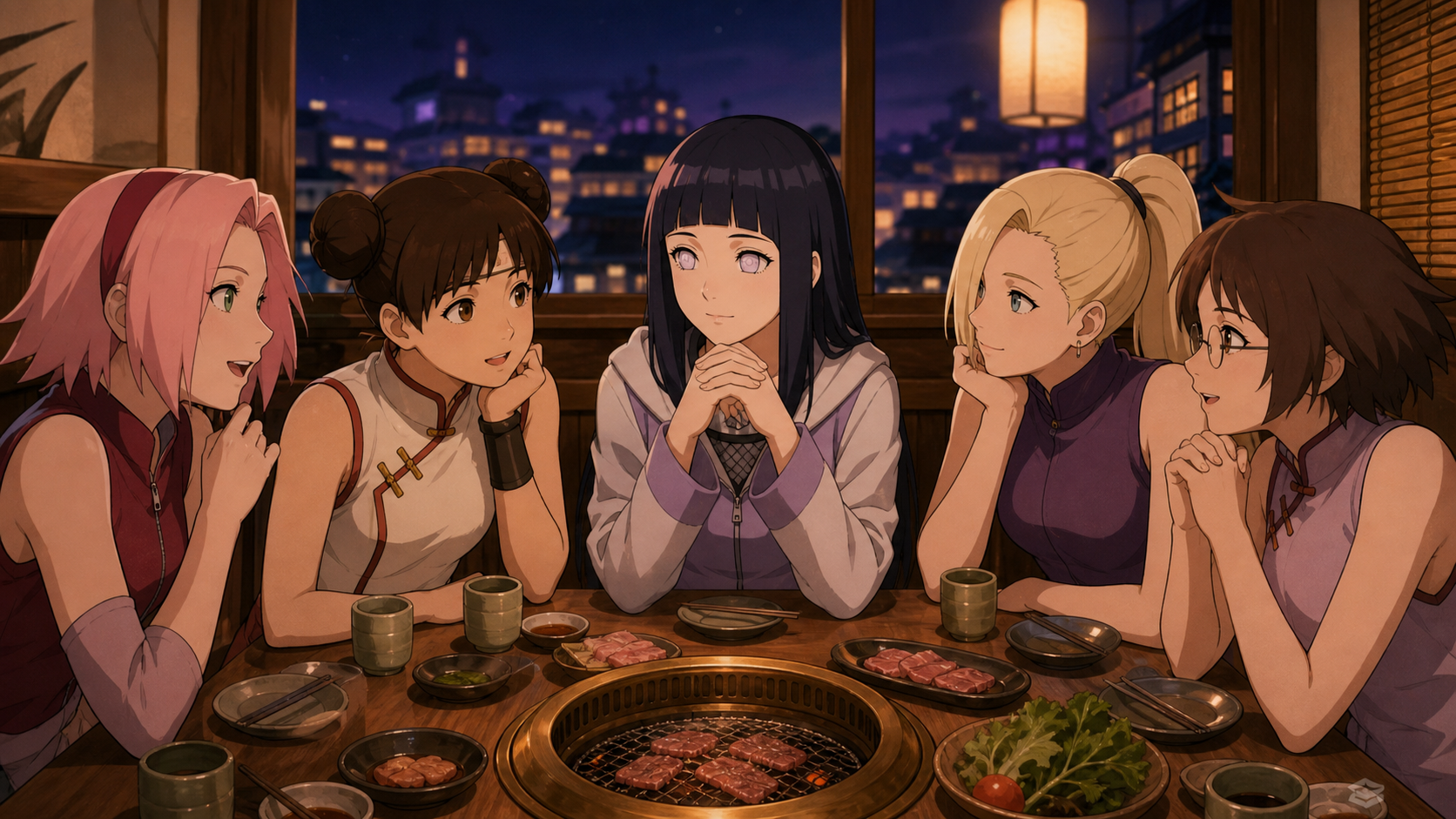
The Girls’ Get-Together
Hiashi chooses Neji to lead. Hinata stops treating the decision as a verdict on her worth.
Bottom line
Naruto Shippuden Episode 232 gives Hinata a quiet problem that the series rarely lets her name: loving Naruto does not automatically tell her what kind of shinobi she needs to become. Hiashi chooses Neji to command the Hyūga fighters on the front line, and Hinata hears the decision as proof that her father still does not trust her strength. The episode could have settled for another round of shy Naruto jokes. Instead, a table full of women, a second table full of men, and one very irritated Hokage help Hinata separate comparison from purpose.
The result is a small prewar character episode with more value than the “girls’ night” title suggests. Tenten, Sakura, Ino, Shiho, Shizune, and Tsunade do not hand Hinata a speech about believing in herself. They talk about old exams, old mistakes, Naruto’s growth, and the work waiting ahead. Hinata reaches her own answer. Neji can lead the clan. Her responsibility is to protect the people she has chosen, including Naruto, without waiting for Hiashi to certify her worth.
Hiashi turns a war assignment into a family verdict
The Hyūga meeting opens with practical business. The Fourth Great Ninja War is coming, clan fighters must join the Allied Shinobi Forces, and somebody needs to command them on the front line. Hiashi selects Neji. That choice makes military sense. Neji is a jōnin with battlefield experience, proven judgment, and the respect of other shinobi. The room still reacts because a branch-family member has received authority that Hyūga tradition once tried to deny him.
Hinata does not object to Neji’s ability. Her pain comes from the contrast. Hiashi’s explanation suggests that he does not believe his daughter can carry the same burden. Years of family judgment rush back into one formal appointment. Hinata remembers training with Neji and starts asking whether she has truly grown. The scene works because no villain needs to insult her. Old damage can return through an ordinary decision, especially when a parent’s doubt has shaped a child for years.
Neji’s promotion means more than Hinata’s disappointment
Neji becoming the Hyūga field commander quietly reverses the clan’s old hierarchy. The boy marked for service now leads members of the main house into war. Part I Neji believed fate had locked every Hyūga into a permanent place. Hiashi’s appointment proves that Naruto’s challenge during the Chūnin Exams did not vanish after the arena cleared. Neji changed, Hiashi changed, and the clan has been forced to live with those changes.
Hinata cannot see that full victory while she is measuring herself against Neji. Her reaction is human. Somebody else’s earned success can still press on an old bruise. Episode 232 does not make Neji smaller to comfort her, which is the correct choice. Hinata needs a purpose that does not depend on outranking him. Neji’s command and Hinata’s resolve can both matter without turning their lives into another family competition.
One rumor about Naruto sends Hinata across Konoha
Hinata meets Kurenai and learns from Shikamaru that several friends have crossed paths with Naruto since his secret departure. Then Tenten tells her that Tsunade has been asking for her. Hinata immediately hopes the Hokage has a mission that might take her to Naruto. The hope is transparent, sweet, and a little painful because Naruto has been kept away under the cover story of an important assignment.
Her search through the village also exposes how little information ordinary shinobi receive before war. Leaders move Naruto for his protection, allies prepare in separate rooms, and friends build theories from scraps. Hinata wants to help, yet nobody has given her a clear route. By the time she finds Tsunade near the meeting with the Fire Daimyō, the imagined mission disappears. Tsunade dismisses her quickly because political pressure has already pushed the Hokage toward fury.
Tsunade’s bad moment lands on the wrong person
Tsunade is not angry with Hinata. The Hokage is heading into a meeting where nobles and elders can discuss war from a safe room while shinobi carry the physical cost. Her patience is gone before Hinata arrives. Hinata receives the edge of that frustration and retreats, embarrassed that she expected a personal assignment.
The later apology matters because authority does not erase responsibility. Tsunade could have blamed stress and moved on. Instead, she comes to the restaurant, acknowledges that she brushed Hinata aside, and tries to repair the moment. Hinata says she understands. Their exchange stays brief, but the brevity fits both women. Tsunade is direct even while drinking, and Hinata has already begun solving the deeper problem for herself.
Tenten builds the room Hinata actually needs
Tenten invites Hinata, Sakura, Ino, and Shiho to Yakiniku Q. That guest list is specific. Sakura and Ino know Naruto’s history closely. Shiho brings a quieter intelligence-division perspective. Tenten understands the sting of watching a teammate receive recognition while wondering where her own path leads. None of the women needs to announce those credentials. Their shared history sits under the conversation.
This gathering also gives Tenten useful social agency. She notices that Hinata is unsettled and creates a place where nobody must perform as a clan heir or wartime officer. Food, teasing, and memory give Hinata enough room to think. Tenten does not “fix” her friend. She changes the conditions around her, which is often what real support looks like.
The Chūnin Exams still define their generation
The women return to the first Chūnin Exams because that event connected nearly every friendship, rivalry, and wound in their generation. Sakura and Ino fought through a relationship neither knew how to explain. Hinata faced Neji despite knowing the gap between them. Tenten met Temari’s overwhelming force. Naruto challenged the village’s assumptions in public and refused to let Hinata’s defeat become proof that she was weak.
Those memories are not random nostalgia. War has forced everyone to ask what kind of shinobi they became after that exam. Promotions tell only part of the story. Some learned leadership, some learned medical work, some carried intelligence duties, and some kept training without receiving the narrative attention they deserved. The restaurant conversation lets the women measure growth through choices rather than rank alone.
Naruto is absent and still changes the whole conversation
Naruto never enters the restaurant, but every memory bends toward him. The loud boy who once begged for attention is now Konoha’s hero, hidden because enemy forces want the Nine-Tails. Sakura remembers his stubborn loyalty. Hinata remembers the courage he gave her before the Neji fight. The others remember a teammate who kept inserting himself into impossible situations until the village could no longer pretend he did not belong.
That absence explains why Hinata’s feelings matter beyond romance. Naruto represents a way of choosing one’s own value after a community has assigned something smaller. Hinata admired him before most of Konoha did because she recognized the same loneliness in a louder form. Protecting Naruto means protecting the person who taught her that inherited judgment does not have to become destiny.
The boys prove that nostalgia is not gendered
Chōji is disappointed that Tenten’s invitation excludes the men, so he organizes a separate gathering at the same restaurant. Kiba, Shino, Lee, Shikamaru, and the others revisit their own missions, including the Sasuke Retrieval Mission. Shino remains annoyed that he missed that operation, which is both a familiar joke and a genuine statement about belonging. He wants his absence remembered because the mission helped define the rest of the group.
The parallel tables keep the episode from reducing friendship to a feminine cure for insecurity. Everybody needs a final ordinary night before the war changes their lives. The men compare missions, failures, and responsibilities just as the women do. Chōji’s wounded reaction starts as comedy, but his solution creates another space for people who are carrying fear without saying the word.
Tsunade crashes the gathering and improves the episode
Shizune arrives with an intoxicated Tsunade after the Hokage’s brutal political meeting. Tsunade’s entrance could have become a broad drinking gag. The comedy is there, but frustration gives the scene weight. She has spent years watching young shinobi inherit wars created by older leaders. Now another generation is preparing to bleed while officials debate strategy and resources.
Tenten’s childhood admiration for Tsunade also hangs over the table. The legendary kunoichi is not polished, distant, or perfectly composed. She is exhausted, angry, powerful, and willing to apologize. That messy presence gives the younger women a more honest model than a statue ever could. Strength does not prevent doubt or bad behavior. Strength includes returning to the person who received the damage.
Hinata stops asking the wrong question
Hinata begins the episode asking whether she can match Neji. By the end, she understands that comparison cannot choose her wartime duty. Neji’s command concerns the Hyūga formation. Hinata’s choice concerns the people she refuses to abandon. She can train harder, fight beside the alliance, and protect Naruto without copying Neji’s route.
This realization does not erase Hiashi’s history with her. One dinner cannot undo years of dismissal. The episode wisely leaves that wound present while giving Hinata control over her next action. Her father may still doubt her. She no longer needs that doubt to supply the terms of her life.
The filler label misses the character work
Episode 232 sits inside the anime-original boat journey and pauses the main plot. Viewers who only track manga events can skip the gathering without losing a battle mechanic or mission objective. Calling the episode disposable still misses what Shippuden often lacks: time for Konoha’s supporting women to exist together outside combat and romance triangles.
The writing is not flawless. Shiho receives little room, several memories repeat information longtime viewers already know, and the women deserve stories that do more than circle Naruto’s influence. Even so, the episode gives Hinata an interior conflict tied to family, rank, love, and war. Tenten initiates the answer. Tsunade accepts fault. The men receive a parallel emotional function. Those choices make the pause useful.
Hiashi recognizes Neji without repairing what Hinata heard
Choosing a branch-family jōnin to lead Hyūga fighters represents real institutional change. The decision can still reopen every moment Hinata was described as inadequate.
Progress for the clan does not automatically become repair inside the family. Hiashi can make the correct appointment and remain responsible for how years of judgment shaped his daughter’s interpretation.
Neji’s success should not require Hinata’s failure
The old Hyūga system trained both cousins to understand advancement as proof about the other. Neji’s authority once threatened main-house ideology; Hinata’s weakness once justified the hierarchy.
The episode begins loosening that equation. His command can honor earned skill while her path develops through different responsibilities, relationships, and forms of courage.
Hinata needs an ambition larger than proximity to Naruto
Her love matters because Naruto recognized courage she could not yet name. The writing too often allows that love to substitute for every other desire.
Protecting Naruto can be one chosen purpose, but Hinata also belongs to a clan, a team, a village, and herself. A fuller story would let her articulate what kind of leader or shinobi she intends to become beyond him.
Tenten performs care by designing a social environment
She does not interrogate Hinata in a hallway or demand immediate disclosure. She gathers people, food, shared memory, and enough ordinary noise for difficult feelings to enter without becoming spectacle.
That work is leadership. Tenten notices what a teammate needs and changes the conditions before trying to change the person.
The women deserve conversation not organized around men
Naruto, Neji, Hiashi, and old rivalries remain central because those relationships genuinely shaped the group. The imbalance appears when the women’s ambitions receive less time than their responses to male characters.
A prewar gathering could ask what commands they want, which techniques they fear, how medical labor will be valued, or what village structures should change if they survive.
Sakura and Ino carry expertise the evening barely names
Both trained within Tsunade’s medical system. Ino also supports sensory and intelligence work, while Sakura understands field medicine at an exceptional level.
Their professional preparation deserves space beside Chūnin Exam memories. Nostalgia explains how they arrived; competence explains why the alliance needs them now.
Shiho’s quiet presence exposes a wider Konoha workforce
War depends on analysts, code specialists, communications staff, medics, logistics teams, and researchers who may never receive a dramatic battlefield entrance.
Giving Shiho more than a chair would let the gathering connect friendship to invisible institutional labor. Her perspective should not require a romance subplot to become relevant.
Tsunade’s apology models accountable authority
Stress explains why she snapped at Hinata, but explanation does not erase impact. Returning to acknowledge the moment shows that rank cannot make repair unnecessary.
Hinata accepts the apology without being asked to comfort the Hokage for offering it. The exchange remains small, which helps it feel sincere rather than ceremonial.
The parallel men’s table reveals a shared need for witness
Chōji, Shino, Kiba, Lee, and Shikamaru revisit missions because memory confirms they belonged to one another before the alliance reorganizes their lives.
Shino’s recurring grievance about exclusion is funny because it is precise. He wants the absence remembered, not dismissed as proof the mission never mattered to him.
Ordinary dinner becomes prewar infrastructure
No strategy is decided at Yakiniku Q. The gathering restores connection, distributes fear, and reminds everyone which lives make survival worth pursuing.
Armies need weapons and plans. People entering war also need rooms where they are more than assignments, heirs, medics, or anticipated casualties.
Hinata claims purpose without receiving a new title
Hinata’s final resolve matters because nobody grants it to her. Hiashi does not reverse the command decision, Tsunade does not assign a special mission, and Naruto never appears to validate her feelings.
She listens, remembers, and decides what her strength is for. That internal authority is modest compared with a promotion, but it directly challenges a childhood built around waiting for family judgment.
Her next actions will still need to prove the choice under pressure. The dinner supplies orientation, not instant transformation.
The Hyūga family needs conversations the episode postpones
Hinata should not have to process Hiashi’s history only through friends while her father remains outside the emotional work. Neji’s appointment creates an opportunity for honest discussion about trust, succession, branch-family power, and the damage inherited inside training.
The episode uses the appointment as Hinata’s trigger without asking Hiashi to recognize what his words revive. Personal resilience cannot become an excuse for parental avoidance.
Neji also deserves space to describe what commanding the clan means after growing up under its curse mark and fatalism.
Shared memory should lead toward shared demands
The Chūnin Exams remind the group how far they have come, but memory can do more than provide comfort. It can reveal which academy, clan, and mission structures repeatedly failed them.
Sakura and Ino know how rivalry was shaped by limited expectations. Hinata knows inherited hierarchy. Tenten knows what being overlooked feels like. Tsunade knows political rooms where leaders discuss bodies as resources.
The table has enough experience to imagine changes after survival. The script stops before their solidarity becomes that ambitious.
RaeRae’s final word on The Girls’ Get-Together
Tenten invites people to dinner and quietly does more emotional leadership than half the village manages through formal meetings. Give that woman her credit and another plate.
Hinata’s love for Naruto is real, but her worth cannot remain a satellite orbiting his story. She chooses protection because it matches the shinobi she wants to be, not because romance magically supplies an identity.
Tsunade apologizes. Neji keeps the command he earned. Hinata leaves without defeating either fact. That is growth sturdy enough to carry into war.
What landed and what did not
The strongest material connects Neji’s appointment to the Chūnin Exams. That line turns an old defeat into evidence of long change across the Hyūga clan. Tenten’s quiet care also lands because she acts before Hinata explains everything. Tsunade’s apology keeps the Hokage human without pretending stress excuses her dismissal.
The weaker material comes from the episode’s safe framing. A “girls’ get-together” could have explored how kunoichi are treated inside the village, how their teams divide labor, or how war preparation affects them differently. The script touches insecurity and camaraderie but avoids a harder institutional conversation. Naruto remains the main reference point even when the women finally receive a room of their own. I enjoyed the warmth, but I also wanted the table to belong to their ambitions for longer.
Final reaction
“The Girls’ Get-Together” works because Hinata does not leave Yakiniku Q with a promotion, a mission, or a promise from Naruto. She leaves with a clearer reason to act. Neji can carry the Hyūga command. Tsunade can carry the political fight. Hinata can carry her own decision into the war.
That conclusion is modest and earned. The episode remembers that courage rarely arrives as one giant transformation. Sometimes courage grows while friends argue over old exams, Chōji complains about an invitation, Shino nurses a years-old grievance, and a drunk Hokage admits she handled a conversation badly. Hinata walks in measuring herself against Neji. She walks out ready to protect the people who helped her become stronger.
RaeRae’s call
Hinata does not need to defeat Neji’s achievement to claim her own purpose. Tenten creates the room, Tsunade repairs a mistake, and friendship helps Hinata carry courage into war without waiting for Hiashi’s approval.
Episode details and viewing routes
Naruto Shippuden Episode 232, “The Girls’ Get-Together,” first aired in Japan on October 13, 2011. The episode belongs to the anime-original Paradise Life on a Boat stretch and takes place while Naruto remains away from Konoha ahead of the Fourth Great Ninja War.
- Official episode reference: Naruto Official episode guide
- Licensed episode route: Crunchyroll licensed episode page