
The Closed Route
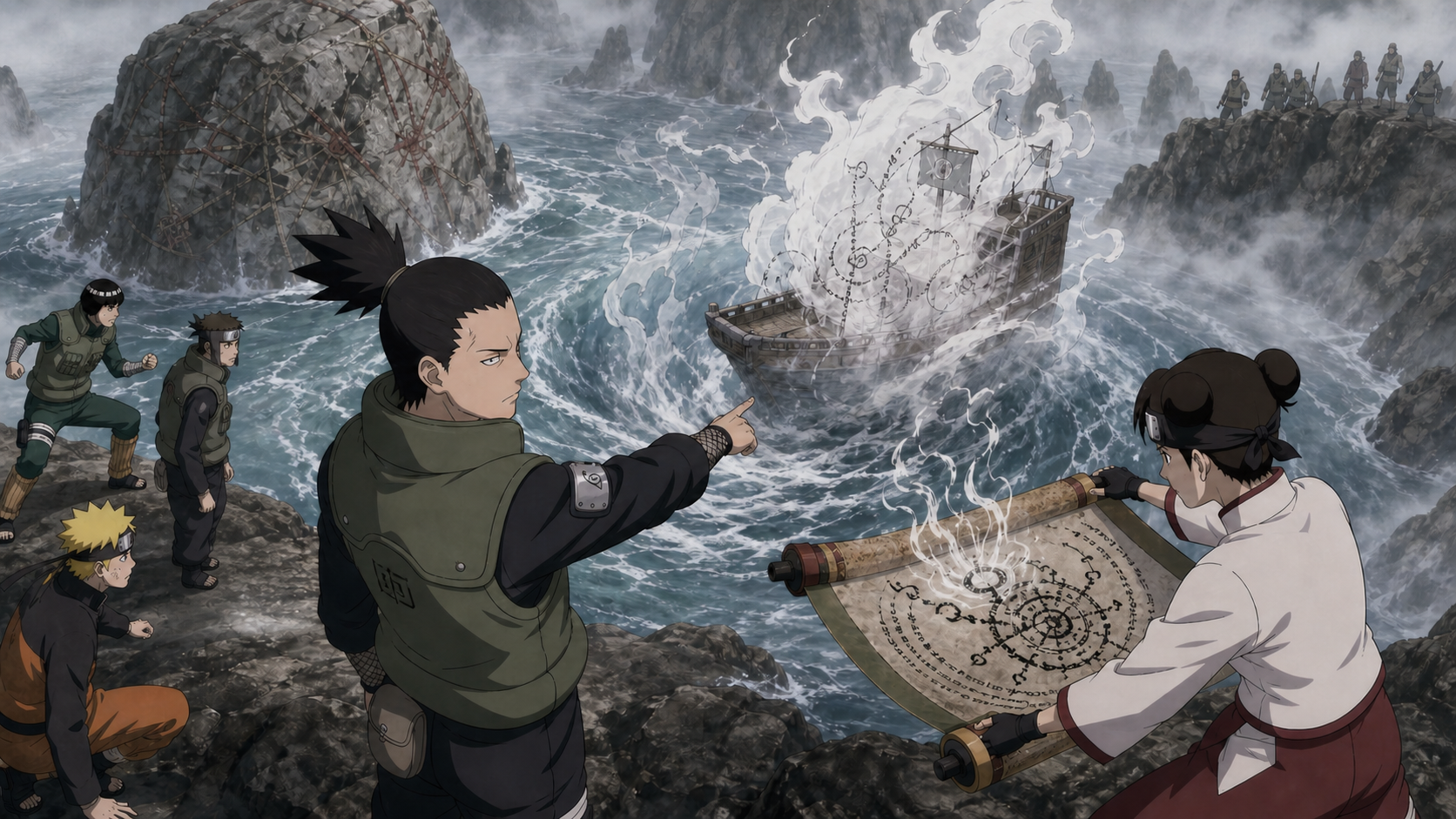
Naruto cannot punch open a circular current. Shikamaru sees the loop, and Tenten makes the ship disappear.
Bottom line
Naruto Shippuden Episode 231 gives Shikamaru a sea trap, no reliable compass, an exhausted Naruto, and one Tenten-sized answer nobody else could provide. "The Closed Route" looks like another pirate-adjacent detour, but the episode uses the trap to test the exact pressure bothering Shikamaru before the war. Leading friends means recognizing when their strength has become part of the enemy's plan. Naruto can destroy reefs all day. Shikamaru wins by telling him to stop.
The episode also remembers that Tenten's sealing skills solve logistical problems other ninja cannot touch. She stores the entire ship in a scroll, lets the whirlpool swallow nothing, and helps turn Mozuku's ambush back on the thieves. Shikamaru identifies the pattern. Tenten makes the risky plan physically possible. The victory belongs to intelligence and preparation, not the loudest jutsu in the bay.
Shikamaru is afraid of carrying people into war
Shikamaru feels the coming Fourth Shinobi World War as a leadership burden rather than an abstract event. He knows strategy will place friends in positions where someone may die. Intelligence does not protect him from that fact. Intelligence makes him more aware of every consequence a commander must choose.
Shikaku sees the pressure and sends his son with Tenten on a supply mission to Mokuzu Island. The assignment looks small beside a world war, but the scale is deliberate. Shikamaru needs practice making decisions around real people without waiting for a battlefield to force the lesson.
His father's response avoids empty reassurance. Shikaku does not promise everyone will survive or tell Shikamaru to stop worrying. He gives him work. The mission creates a contained problem where judgment, delegation, and trust matter.
Tenten is the right partner for a supply mission
Tenten specializes in weapons, scrolls, storage, and deployment. A supply mission fits her skills better than another background position in a group fight. She can carry large quantities without forcing a small team to drag carts across rough terrain.
The assignment also places her beside Shikamaru as a tactical partner rather than decoration. He brings pattern recognition and command judgment. She brings a technique that changes what the group can transport, hide, and deploy.
Shippuden routinely underuses Tenten even though sealing storage has obvious military value. Armies need weapons, medicine, food, documents, tents, and replacement equipment. A person who can move those resources through scrolls should matter long before anyone throws a kunai.
Mokuzu Island reunites them with Naruto too easily
Shikamaru and Tenten meet Naruto's group at Mokuzu Island while replenishing supplies. The reunion gives Shikamaru an immediate field team and lets the boat arc borrow familiar Leaf chemistry.
The travel logic remains questionable. Naruto's voyage has lasted through storms, pirates, ghost ships, fungal starvation, and several islands. Shikamaru and Tenten reach his route for one supply errand, then can return to Konoha without the same ordeal. Anime-original continuity asks viewers not to inspect the map too closely.
The convenience still serves the character story. Naruto trusts Shikamaru's judgment, and Shikamaru needs to test leadership around someone powerful enough to ignore ordinary limits. Tenten gives the plan an option the standing crew lacks.
Fog removes the easiest source of certainty
After departure, dense fog surrounds the ship and the compass becomes unreliable. The crew encounters an unmarked reef system, a huge rock, and a whirlpool. They survive, continue sailing, then meet the same hazards again.
Fog shrinks the battlefield to whatever appears directly ahead. A captain cannot compare distant landmarks or confirm direction. The bad compass removes the second check. Mozuku's gang depends on trapped crews reacting to each hazard as a new emergency.
The route weaponizes uncertainty rather than force. Nobody attacks the ship directly. Currents, terrain, tide, and visibility make the crew spend chakra until the sea can finish them.
Guy's stomach becomes evidence
Guy does not feel seasick inside the bay. That absence seems like a joke after so many episodes built around his nausea. Shikamaru recognizes the clue. Calm water inside a large enclosed bay keeps the ship steady even while the route appears dangerous.
The observation connects a character gag to navigation. Guy's body provides information the broken compass cannot. Outside the bay, motion makes him sick. Inside the loop, the surface stays calm enough to hide the larger circular current.
Good strategy uses whatever evidence exists. Shikamaru does not dismiss nausea as irrelevant because the source sounds embarrassing. He asks why a recurring condition changed at the exact moment their route became impossible.
The marked rock proves they are sailing in circles
The crew repeatedly passes a huge rock. A fresh scrape or mark reveals that the ship has rubbed the same surface more than once. Shikamaru combines that evidence with the calm bay, narrow entrance, spring tide, fog, and unreliable compass.
The ship is not progressing through a series of similar hazards. The current is carrying the vessel around one enclosed system. Mozuku's trap makes repetition feel like movement. Every escape attempt returns the crew to the same decision under worse conditions.
That design works because exhausted people trust effort. If the crew keeps breaking rocks and steering away from whirlpools, progress should follow. The marked rock proves effort has produced a loop instead.
Naruto spends chakra solving the wrong problem
Naruto attacks obstacles with Rasengan and burns through chakra. His power removes immediate danger, but each destroyed reef or rock does nothing to change the circular current. The trap benefits every time he treats a repeated obstacle as a separate enemy.
Shikamaru has to stop him before exhaustion becomes the real weapon. Naruto's instinct is not stupid. Breaking a collision hazard normally protects the ship. The strategy fails because Mozuku's gang designed the route around predictable survival responses.
Leadership here means telling the strongest person that more strength will not help. Shikamaru does not need to compete with Naruto. He needs Naruto to trust a plan that looks worse than the obstacle in front of them.
The whirlpool is natural and the crime is human
Shikamaru identifies the spring tide and narrow bay entrance as conditions that form the whirlpool. Mozuku's gang did not create ocean physics. The thieves learned when and how the bay becomes lethal, then used fog, route confusion, and observation to prey on ships.
That distinction makes the trap more believable than a random water jutsu. Criminals exploit a natural hazard because the hazard leaves fewer witnesses and requires less direct fighting. Their main investment is patience.
The route also explains why wreckage and survivors disappear. A whirlpool can drag a vessel down while the gang waits outside the danger zone. The thieves collect whatever resurfaces and call the loss an accident.
Shikamaru chooses the whirlpool on purpose
Once he understands the loop, Shikamaru orders the crew to sail directly toward the whirlpool. Everyone reacts like he has lost his mind. The choice looks suicidal because earlier decisions focused on avoiding the same hazard.
The plan changes the objective. They no longer need the ship to survive the surface impact as a ship. They need Mozuku's gang to believe the vessel sank. Tenten can remove the ship from the water before the whirlpool destroys anything.
Shikamaru accepts the risk only after identifying an execution method and assigning the critical role. He does not gamble on luck. He uses the enemy's expected outcome as camouflage.
Tenten seals the ship and erases the wreck
Tenten stores the vessel in her scroll as the whirlpool swallows the crew's apparent position. The technique removes the ship, cargo, and obvious target from the current. No debris rises because no wreck occurred.
The moment gives her the decisive action. Naruto could create clones, Yamato could build wood, and Guy could strike rock, but none of those answers can instantly remove a full ship from the sea. Tenten's storage method fits the exact geometry of Shikamaru's plan.
Her role also proves why commanders need to know teammate capabilities in detail. Shikamaru can imagine the feint because he knows Tenten can make the vessel disappear. A brilliant plan without the correct specialist would become a drowning.
Mozuku sees treasure before he checks for bodies
Mozuku and his gang watch the apparent sinking and rush toward the site to collect shinobi valuables. They interpret the lack of debris as heavy treasure sinking rather than evidence that the trap failed.
Greed closes the ambush. The thieves wait for currents to exhaust victims, but their own impatience makes them approach before confirming death. Shikamaru knows the expected reward will pull them into reach.
The Leaf team emerges rested enough to fight, and Tenten deploys weapons from her scroll. Mozuku's group loses the advantage of terrain once the targets choose the meeting point.
Shikamaru learns that leadership can mean trusting specialists
The mission does not erase Shikamaru's fear about war. One captured gang cannot prepare anyone for casualties across several divisions. The episode gives him a smaller truth: command does not mean personally solving every part.
He reads the route, stops Naruto's wasted attacks, explains the risk, and asks Tenten for the ability only she can provide. The plan works because everyone accepts a role. Shikamaru carries responsibility, but he does not carry the entire team alone.
Naruto tells him that his sharp mind is reliable. The praise matters because Naruto will soon become one of the most important people Shikamaru may need to advise. Their trust begins long before either man holds an official office beside the other.
Shikaku gives anxiety a scale where learning remains possible
A world war is too large for Shikamaru to practice leadership without catastrophic stakes. The supply mission creates a bounded responsibility with real people, cargo, uncertainty, and consequences.
Shikaku does not trivialize his son’s fear. He chooses an assignment where judgment can become evidence stronger than reassurance.
Leadership begins by admitting strength can worsen a trap
Naruto’s attacks protect the ship from each immediate collision, so asking him to stop feels irresponsible until Shikamaru understands the loop. The same successful response is steadily exhausting their best fighter.
Command requires separating visible activity from progress. More effort can strengthen the enemy’s design when the crew keeps solving the wrong level of problem.
The closed route depends on manufacturing false novelty
Fog, damaged navigation, and repeated hazards prevent the crew from recognizing that each new emergency is the previous emergency returning. Repetition feels like distance because nobody can compare the wider landscape.
The marked rock breaks the illusion by carrying memory outside tired human perception. Physical evidence proves the route has not advanced.
Guy’s body becomes an instrument nobody planned to use
His missing nausea measures the water’s unusual calm more reliably than the compromised compass measures direction. A recurring vulnerability becomes data once Shikamaru asks why it changed.
Good intelligence does not demand prestigious evidence. It notices any consistent relationship capable of ruling out a false explanation.
Tenten’s sealing ability turns absence into strategy
The plan cannot defeat the whirlpool through greater force, so she removes the object the whirlpool is expected to destroy. The sea receives no ship, cargo, or wreckage.
Her technique produces convincing absence while preserving everything needed after the feint. That is logistics functioning as battlefield control.
Specialist knowledge expands what a strategist can imagine
Shikamaru’s intelligence alone cannot store a vessel. He can conceive the maneuver because he knows Tenten’s capacity and trusts her execution under pressure.
A commander who treats specialists as interchangeable bodies loses entire categories of possible plan. Knowing people precisely is part of strategy.
Tenten carries war readiness inside ordinary storage work
Scrolls can preserve weapons, food, medical supplies, documents, shelter materials, and transport capacity while reducing the burden placed on conventional caravans.
The series often frames her skill through projectile spectacle. Episode 231 proves the larger value: she can alter what an army is physically able to move, hide, and recover.
The thieves monetize exhaustion without creating the hazard
Mozuku’s gang studies tide and terrain until natural danger becomes a predictable extraction system. The sea damages victims while the criminals avoid direct risk.
The distinction matters for prevention. Capturing one gang will not make the route safe unless sailors also receive reliable charts, markers, warnings, and support during dangerous tides.
Sailing into the whirlpool is calculated surrender of appearances
The crew stops trying to look safe. Shikamaru allows observers to see the exact catastrophe they expect because their confidence will pull them close.
He risks the ship’s apparent loss only after Tenten provides a controlled alternative. Boldness follows preparation, not faith that clever people deserve lucky outcomes.
Mozuku verifies reward before he verifies death
The gang interprets missing wreckage through greed, imagining valuable shinobi cargo beneath the surface. Their desired explanation prevents them from testing whether the victims survived.
Shikamaru uses that bias as the final current in the trap. The thieves approach because profit makes uncertainty feel settled.
Shikamaru fears responsibility because he understands uncertainty
Shikamaru’s fear is not that he lacks answers. He knows even a strong plan can meet missing information, delayed communication, weather, injury, or an enemy’s unexpected choice. Friends may die after he makes the most defensible decision available.
The bay offers a smaller version of that burden. He must act before every variable is proven, explain why the obvious response is failing, and ask teammates to accept a route that looks lethal.
Success cannot promise the war will be manageable. It proves that uncertainty does not make responsible command impossible.
Naruto demonstrates trust by surrendering action
Following Shikamaru requires more than helping with the plan’s exciting part. Naruto must stop using the attack that has repeatedly saved the ship from immediate impact.
Restraint feels passive, especially to someone whose identity was built through refusing to quit. Here, restraint becomes a contribution. Naruto protects the team by allowing another person’s analysis to overrule his strongest instinct.
The moment strengthens their future political relationship. Shikamaru can advise Naruto only if Naruto accepts that listening may require doing less.
Tenten’s decisive action should change how command sees her
Storing an entire vessel under lethal timing is not support in the dismissive sense. It is the central operation on which every life and all mission cargo depend.
The episode understands her value for twenty minutes, then the wider series often returns her to the edge. A war preparing vast divisions should be competing for sealing specialists capable of transforming transport and resupply.
Competence deserves continuity. One excellent solution should not vanish from institutional memory because the character lacks a famous clan plot.
The route needs public repair after the gang is defeated
Fog and spring tide will remain after Mozuku is captured. Future crews can still become trapped without criminals waiting to loot them.
Authorities should chart the circular current, mark the entrance, publish tide guidance, repair navigation references, and investigate earlier wrecks. Safety requires separating the natural hazard from the exploitation layered over it.
Shikamaru’s insight opens one voyage. Shared knowledge should open the route for everyone else.
RaeRae’s final word on The Closed Route
Guy’s stomach becomes navigational equipment, Naruto’s Rasengan becomes part of the trap, and Tenten casually removes an entire ship from the ocean. Finally, this voyage understands everybody’s assignment.
Shikamaru wins by noticing repetition and trusting a specialist. He does not become ready for every wartime death. He becomes willing to lead without pretending leadership means carrying every solution alone.
Tenten owns the climax. Put respect on the scroll.
Shikamaru does not defeat uncertainty; he gives every teammate a useful place inside it, then trusts their work enough to let the dangerous plan become shared.
What works and what feels thin
The repeating hazards create a clean mystery. Guy's missing seasickness, the marked rock, spring tide, and calm bay all become evidence rather than random details. Tenten's scroll gives the solution a specific team dependency.
The thieves remain shallow, and the route to Mokuzu Island strains the travel map. The episode also solves Shikamaru's war anxiety too neatly for a single supply mission. He gains confidence, not an answer to mortality.
The strongest achievement is restraint. Naruto stops attacking. Shikamaru stops treating every burden as his alone. Tenten gets to solve the physical problem. The episode lets strategy look like coordination rather than a magic speech from the smartest person.
Filler status and watch value
"The Closed Route" is anime-original material in the "Paradise Life on a Boat" arc. Manga-only viewers can skip Episode 231 without losing a main war development. Shikamaru and Tenten fans have a reason to watch because both characters receive useful, complementary roles.
The episode also supplies one of the arc's better nautical problems. The trap depends on geography, tide, fog, navigation, exhaustion, and criminal timing. Ninja powers help only after somebody understands the water.
That sequence makes the sea feel like terrain instead of painted background, which the boat arc desperately needs.
Final verdict: Shikamaru wins when Naruto stops fighting the sea
Episode 231 makes brute force part of the trap and gives Shikamaru the authority to call a stop. He recognizes the loop, uses Guy's nausea as evidence, trusts Tenten with the decisive move, and turns a whirlpool into cover for an ambush.
The war pressure does not disappear, but Shikamaru leaves with proof that command can distribute responsibility. Tenten stores the ship. Naruto follows the plan. The team survives because the smartest decision is not another attack. Sometimes the route opens only after everyone agrees to sail straight into the thing they spent the whole episode avoiding.
RaeRae’s call
Shikamaru opens the route by recognizing that Naruto’s strength is feeding the loop and Tenten’s specialist skill can remove the ship entirely. Leadership works because responsibility is distributed, not performed alone.
Sources and watch routes
- Official episode reference: Naruto Official episode guide
- Licensed episode route: Crunchyroll licensed episode page