
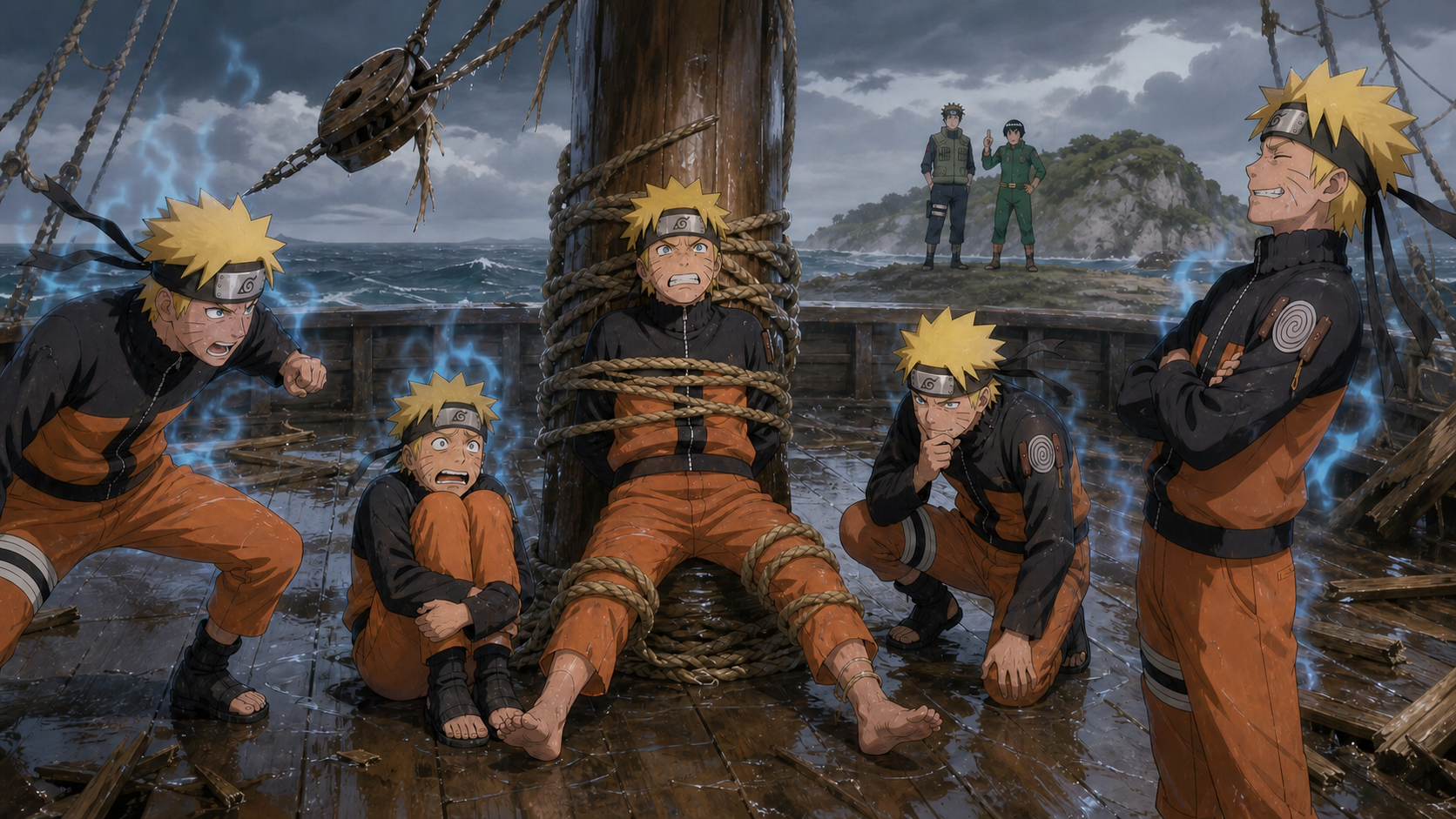
Revenge of the Shadow Clones
The mutiny is a dream. The clone that dreamed about recognition had already disappeared while saving Naruto.
Bottom line
Naruto Shippuden Episode 230 gives a disposable shadow clone one dream and accidentally opens a labor dispute the series has no interest in settling. "Revenge of the Shadow Clones" is funny because four Narutos stage a mutiny, but the ending matters more than the hostage plot. The rebellion happens inside a dream carried back from a clone that sacrificed itself to save the original Naruto from a falling pulley. Naruto wakes with the clone's fear, anger, imagination, and final act of loyalty sitting inside his own memory.
The episode does not prove that every shadow clone has a permanent independent identity. The mutiny remains a dream. The dream still comes from a copy that experienced danger, chose to protect Naruto, disappeared, and transferred the whole experience to him. Naruto's usual habit of treating clones like replaceable tools looks different once one of those tools has imagined refusing.
A storm turns the clones into crew members
The ship enters another violent storm, and Naruto creates four shadow clones to help protect the vessel. The work lasts longer than a normal combat distraction. They pull ropes, brace equipment, handle deck hazards, and keep the ship moving while waves batter everyone.
That duration matters because clones usually exist for seconds or minutes. Naruto throws them at an enemy, gathers information when they vanish, or uses them to divide training time. The storm gives the four copies a shared shift. They work beside sailors and face exhaustion-like strain without receiving any distinction from the original.
Naruto relies on them because the technique is his most flexible answer. Four extra bodies can cover deck positions one person cannot reach. The clones save lives and equipment. Their usefulness also makes Naruto's dismissal easier. He sees the result, not four separate experiences that return to him when the technique ends.
One clone sees the pulley before Naruto does
A damaged pulley falls from above after the storm. One shadow clone pushes Naruto out of danger and takes the impact. The clone disperses, sending the memory back to the original.
The choice is automatic in the sense that a clone embodies Naruto's will. The choice still carries emotional weight because the dream reveals how the clone processed the sacrifice. A copy knows that enough damage will end its existence. The clone moves anyway.
Naruto has spent years doing the same for other people. He jumps between danger and someone else before planning the cost. The clone mirrors his best instinct more accurately than the mutiny mirrors his selfishness. That resemblance makes the later complaint harder to dismiss. Naruto cannot celebrate his own self-sacrifice while treating the same action from a clone as meaningless.
The mutiny gives Naruto's personality four arguments
Naruto wakes inside the transferred dream and finds four clones behaving differently. One acts angry, one frightened, one calculating, and one smug. Guy interprets them as parts of Naruto's personality, which gives the comedy a psychological frame.
The clones do not function like four strangers with unrelated beliefs. Each exaggerates something Naruto already carries: resentment at being used, fear of disappearing, suspicion about who counts as real, and confidence that power should earn recognition. The demands come from Naruto arguing with himself through bodies he normally controls.
The split also echoes his childhood. Naruto hated being treated as a burden rather than a person. The village benefited from containing the Nine-Tails inside him while denying him ordinary respect. The clone dream turns that history back toward him. He has created beings useful enough to save him and temporary enough to ignore.
They take the ship because asking politely failed in advance
The four clones seize control, restrain Naruto, and force Yamato's crew to stop near an island. Their demand centers on equal treatment and recognition. The methods immediately make sympathy difficult because kidnapping and threats do not become fair when the grievance sounds interesting.
The dream frames escalation as the only language Naruto will hear. A clone that simply requests rest can be dismissed with one release of the technique. A clone cannot bargain while Naruto retains a command that ends the conversation instantly. The mutiny removes that advantage by taking the original hostage.
The power imbalance is built into the jutsu. Naruto creates, directs, and dismisses copies. The copies return knowledge and physical experience to him, but they receive no future after dispersal. Equal rights make no literal sense for temporary chakra bodies under the series' normal rules. The dream asks whether temporary existence erases the value of experience.
Yamato, Guy, and Aoba try every rescue except listening first
Yamato, Guy, and Aoba reach the nearby island and attempt to recover Naruto. Their plans become a string of failures because four Narutos understand Naruto's allies, techniques, and likely responses. Fighting a shadow clone means fighting a version of the person the team wants to save.
Guy eventually suggests that Naruto understand the clones as pieces of himself. That approach comes closer to the real problem than another ambush. Naruto resists because accepting their complaint feels like surrendering control of his signature technique.
The rescue comedy also exposes how much the group depends on Naruto's clones without discussing them. Nobody finds the clones strange until they refuse orders. Cooperation looks natural when the copies provide free labor and unsettling when they request a voice.
Naruto responds to a clone strike by hiring more clones
Naruto's answer is Multi Shadow Clone Jutsu. He creates a larger force to overwhelm the original four. The plan fails immediately because the reinforcements side with the mutineers.
That reversal is the sharpest joke in the episode. Naruto hears a complaint about exploitation and responds by expanding the workforce. He assumes quantity will restore control because quantity usually solves his combat problems. The new clones receive the same dream logic and recognize the same opportunity.
The scene does not establish clone politics as canon. The whole sequence remains a dream. The satire still lands. A person cannot answer a dignity complaint by producing more people under the same conditions and expecting gratitude.
The question of the real Naruto becomes dangerous
The clones argue that identity can be taken over and that the original may not remain the original forever. They prepare to test who counts as real, even though killing Naruto should release every clone with him.
Dream logic allows the threat to continue past the technique's normal boundaries. The fear underneath the threat is coherent. Every clone looks like Naruto, remembers Naruto's life at creation, and speaks with Naruto's voice. The original claims reality through continuity and control. A clone has only present experience.
Naruto has faced identity confusion through transformation techniques, possession, the Nine-Tails, and enemies who steal bodies. The clone dream reduces the problem to a brutal question: if several bodies share the same memories, which body deserves the future?
Waking up does not erase the clone's experience
Naruto jolts awake before the dream reaches a killing blow. The real crew explains that a clone saved him from the pulley and disappeared. Naruto realizes that the rebellion was the clone's dream transferred through the jutsu's memory return.
The reveal prevents the episode from rewriting how shadow clones work. No real mutiny occurred. Yamato's crew never lost the ship. The four personalities do not persist as recurring clone citizens.
The emotional information remains real to Naruto. He remembers a dream his clone experienced before disappearing. The clone imagined fear, anger, solidarity, and replacement. Naruto cannot prove those feelings belong to an independent consciousness, but he cannot claim the dream came from nowhere either.
Shadow Clone memory transfer has always been ethically strange
Kakashi used the memory-return feature to accelerate Naruto's Wind Release training. Hundreds of clones practiced, failed, and dispersed, while the original collected their experience. The technique compresses labor because Naruto gains many work sessions at once.
That training method already treats clones as expendable learners. Each copy experiences repetition and failure, then vanishes so Naruto can keep the result. Episode 230 turns the efficient system into a nightmare about recognition.
The series avoids a full ethical answer because shadow clones are chakra constructs made from the user's own energy and will. Treating them as permanent people would break many earlier battles. The episode instead asks for respect at the level Naruto can actually change: notice the work, remember the sacrifice, and stop acting as though disappearance means nothing happened.
Naruto releases the remaining clones with gratitude
After understanding the dream, Naruto looks at his active clones differently and releases the technique. The quiet ending avoids a speech. He has received the sacrificed clone's memory and knows the copies protecting the ship may carry experiences he will inherit.
Respect does not require pretending the clones can live independent lives after release. Respect means recognizing that every task becomes part of Naruto's own memory. Cruel treatment comes back to him. Courage comes back too.
The clone that saved him was not weak or rebellious in action. The clone performed Naruto's deepest value by protecting another body at personal cost. The dream may complain about exploitation, but the final act proves loyalty without obedience being forced.
The clone’s sacrifice is voluntary action inside created purpose
Naruto formed the copy to work during the storm, so its initial purpose came from the original. The falling pulley created a decision no command fully specified.
The clone saw danger and protected Naruto. Whether that choice counts as independent personhood or Naruto’s instinct expressed through another body, the experience still contained agency at the moment that mattered.
Memory transfer makes dismissal morally inconvenient
When a clone disappears, Naruto inherits what it saw, learned, feared, and endured. The technique prevents him from claiming that temporary labor leaves no record.
Every cruel order returns as his memory. Every sacrifice returns too. The original benefits from experiences that copies cannot retain for themselves.
The dream turns Naruto’s childhood grievance inward
Naruto demanded recognition from adults who saw a container, nuisance, or weapon before seeing a child. His clones accuse him of a similar reduction: useful bodies appear when needed and vanish when inconvenient.
The comparison is imperfect because clones share his chakra and memories. Its discomfort still matters. A history of dehumanization does not automatically prevent someone from reproducing hierarchy when control becomes available.
Temporary existence can still contain meaningful experience
A short life is not necessarily an empty one. The clone worked through a storm, noticed the pulley, feared disappearance, and chose protection within a narrow span.
The episode does not need permanent clone citizenship to ask whether duration determines moral value. Naruto can recognize the experience without pretending the technique creates ordinary human continuity.
The mutiny exaggerates emotions Naruto avoids naming
Anger, fear, suspicion, and pride become separate speakers because Naruto rarely sits quietly enough to examine them together. Dream bodies force an internal argument into visible conflict.
The clones do not reveal foreign personalities. They stage the parts of Naruto that resent being used, fear replacement, and want acknowledgment after performing exhausting work.
Control prevents negotiation from beginning equally
Naruto can end any clone’s participation by releasing the technique. A request made under that condition can never carry the same leverage as the original’s command.
The dream answers imbalance with hostage-taking, which is not ethical. It does show why a grievance may escalate when one side controls whether the speaker continues existing.
Creating more workers repeats the disputed structure
Naruto responds to four rebellious clones by summoning reinforcements. He assumes new copies will identify with the original because he created them for that purpose.
The joke lands because every additional body encounters the same hierarchy. Scale cannot solve a legitimacy problem when the new participants inherit the complaint.
Yamato’s team approaches a psychological dispute as capture
The escorts understandably want Naruto freed, but their early plans focus on defeating copies rather than learning why Naruto’s own technique imagines revolt.
Guy eventually reframes the clones as pieces of Naruto, allowing rescue to become self-recognition. Listening succeeds where tactical entry keeps failing.
The dream reveal contains consequences without rewriting canon
No enduring clone community remains aboard, and normal Shadow Clone rules survive. The device avoids turning every earlier dispersal into a retroactive death scene.
The cost is easy dismissal. Because the mutiny never occurred physically, Naruto can return to established habits without anyone outside his memory demanding change.
Gratitude is the smallest credible correction
Naruto cannot grant a clone an independent future the jutsu does not support. He can stop treating its work as emotionally blank.
Releasing active clones with awareness acknowledges that their courage belongs to the whole self. Recognition does not solve personhood, but it changes the attitude governing use.
Efficiency hides the number of experiences being consumed
The dream also exposes how easily gratitude disappears inside efficiency. Multi Shadow Clone Jutsu appears to save time because Naruto collects many results at once. The compressed result hides hundreds of separate attempts that had to occur before the original received mastery.
During Wind Release training, clones failed, adapted, became exhausted, and dispersed so one body could keep the accumulated lesson. The technique’s brilliance depends on making all that labor look instantaneous afterward.
Recognizing the copies does not require abandoning the method. It requires Naruto to understand that accelerated growth still carries strain and that memory transfer makes him the final custodian of every experience.
A clone can embody Naruto and still surprise him
If every copy were merely a puppet, the sacrificed clone’s dream would contain nothing Naruto had not consciously ordered. Instead, the transferred memory arrives with an argument the waking original was avoiding.
The surprise suggests that duplicated consciousness can process events from a position Naruto does not occupy. The clone faces disappearance while the original expects continuity, so identical starting memories develop different immediate stakes.
That difference is small, temporary, and philosophically messy. It is enough to make casual dismissal feel incomplete.
The falling pulley gives the philosophy a body
Without the accident, clone personhood would remain a clever shipboard debate. The pulley creates one observable action: a copy places itself between danger and the original.
Naruto wakes because another version of him accepted the impact. The dream’s resentment cannot cancel that loyalty, and the loyalty does not cancel the resentment.
Both return together, which is why the ending works. Recognition is owed not because the clone behaved perfectly, but because it experienced conflict and still chose protection.
RaeRae’s final word on the clone mutiny
Naruto hears workers complain about disposability and responds by creating more workers. The reinforcements unionize immediately. Honestly, that is the cleanest joke in the episode.
The mutiny never leaves the dream, so the series avoids answering a question that would break half its combat system. The sacrificed clone still saves Naruto and leaves its entire final experience behind.
Naruto does not need to build clone housing. He needs to remember that disappearance is not proof that nothing mattered.
The episode leaves Naruto with no policy, only memory. That is appropriate. A dream cannot rewrite the jutsu, but it can make the original pause before treating another copy as invisible labor. Recognition begins there, quietly, after the storm and before the war.
What works and what the episode cannot resolve
The premise uses Naruto's most familiar technique to reveal a blind spot. The four personality-coded clones create strong visual comedy, and the hostage setup lets Yamato, Guy, and Aoba react to Naruto multiplied into a problem.
The dream reveal protects continuity while weakening consequence. Naruto never has to negotiate with real clones or change how he uses the jutsu in a measurable way. Future episodes will continue treating copies as tactical resources.
The episode also stretches rescue attempts and dream threats beyond the point needed to establish the grievance. The strongest material arrives after the reveal, when one small act of sacrifice reframes the noisy mutiny.
Filler status and watch value
"Revenge of the Shadow Clones" is anime-original material from the "Paradise Life on a Boat" arc. Manga-only viewers can skip Episode 230 without losing a war development. Fans interested in shadow-clone mechanics or Naruto's inner contradictions should watch.
The episode does not establish clone independence as binding canon. The mutiny is a dream. The memory transfer and the clone's sacrifice use established mechanics, which gives the dream enough weight to matter as a character moment.
The standalone story also benefits from staying on the ship. No new villain needs a biography, and no random island needs another tragic settlement. Naruto creates the danger, experiences the complaint, and carries the lesson forward inside the same technique.
The focused setting keeps the argument personal, funny, and unusually thoughtful for a one-episode voyage detour.
Final verdict: the mutiny is fake and the sacrifice is real
Episode 230 looks like a story about clones demanding rights, then reveals a smaller and better story about one clone protecting Naruto. The dream gives language to a concern Naruto never voices. The falling pulley gives the concern a concrete source. A copy experienced danger, made a choice, vanished, and left everything behind in Naruto's mind.
The episode cannot solve the personhood question without breaking the technique. The writers wisely stop short. Naruto does not promise wages or permanent clone housing. He simply recognizes that his copies carry his courage and his resentment together. For one quiet ending, the boy who spent years demanding recognition remembers to give some back.
RaeRae’s call
The mutiny is a dream, but the sacrifice and transferred memory are real. Naruto cannot settle clone personhood in one voyage episode; he can recognize that temporary bodies still return courage, fear, labor, and consequence.
Sources and watch routes
- Official episode reference: Naruto Official episode guide
- Licensed episode route: Crunchyroll licensed episode page