
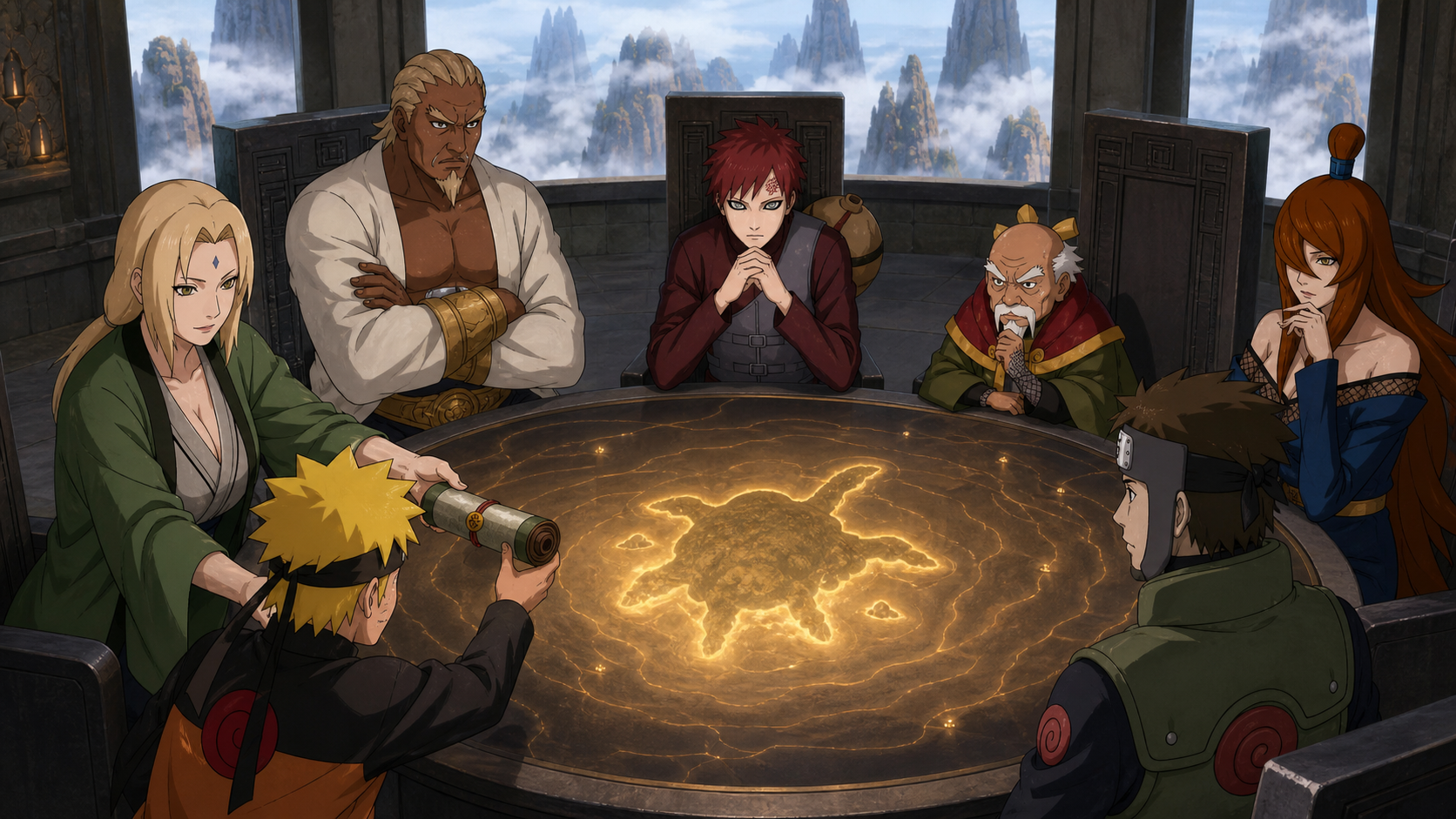
The Five Kage’s Decision
The Kage choose strategic concealment, and Tsunade turns Naruto’s hidden island into a training ground while withholding the war.
Bottom line
Naruto Shippuden Episode 222, "The Five Kage's Decision," turns an alliance slogan into choices that can hurt real people. The Five Kage agree to keep Naruto and Killer B away from the battlefield because Akatsuki needs the final two jinchūriki to complete its weapon. That strategy is sensible. Presenting Naruto's confinement as an S-rank mission is still a lie.
Tsunade adds one crucial improvement behind the political decision. She asks the Fourth Raikage to let B teach Naruto how to control the Nine-Tails. Naruto will not merely wait on an island while other people fight. He will train with the only living jinchūriki who has built a working partnership with his tailed beast.
The episode also gives Konoha's younger shinobi time to understand that war has stopped being a distant adult problem. Sakura studies medical realities. Shikamaru and Chōji discuss what mobilization means. Naruto receives a mission scroll without the truth written inside. Everyone prepares, but not everyone receives the same information or freedom.
The alliance chooses to protect its final two targets
Akatsuki has captured seven tailed beasts. Naruto and B are the remaining hosts standing between the organization and completion of the plan behind the Gedo Statue.
Sending both jinchūriki into open war would satisfy pride and create an intelligence officer's nightmare. Enemy strategy can ignore most battlefield objectives and concentrate on two bodies. A single successful capture could matter more than thousands of ordinary victories.
The Kage therefore choose concealment. Their decision treats Naruto and B as people worth protecting and strategic assets the alliance cannot replace. Both descriptions are true, and the tension between them shapes every later argument.
Keeping Naruto out of war is not the same as keeping Naruto safe
An island can reduce exposure to Akatsuki, but distance does not erase danger. The enemy has space-time techniques, infiltration networks, Zetsu copies, intelligence gathered through years of hunting jinchūriki, and Kabuto's new reanimated forces.
Concealment also creates a fixed destination. Once the location leaks, the safe place becomes a concentrated target with Naruto, B, guards, and limited escape routes.
The Kage need layered security, false routes, sensory barriers, transport plans, and honest contingency planning. Calling a place secret does not make secrecy durable.
Tsunade refuses to waste the protected interval
Tsunade privately asks A to have B teach Naruto. Her request understands Naruto better than a plan built around passive confinement would.
Naruto reacts to helpless waiting by looking for a way to act. If leaders lock him away without purpose, he will investigate, resist, or leave. Training gives him a goal connected to the prophecy and the seal key he just accepted.
More importantly, B possesses knowledge no conventional teacher can replace. Yamato can suppress chakra. Kakashi understands seals and battle. Fukasaku understands Sage Mode. B understands what daily cooperation with a tailed beast feels like from inside the bond.
A agrees because the island is also a training ground
The Fourth Raikage does not surrender his brother to an abstract alliance request. He knows B's strength, B's independence, and the political value of keeping both hosts under Cloud security.
The island offers terrain and systems already used for jinchūriki training. Choosing that location lets A accept the concealment plan without pretending B needs to become a helpless package.
A also understands that B may ignore a simple confinement order. Framing the trip around training gives his brother a reason to cooperate, even if neither jinchūriki receives the full wartime explanation.
The Five Kage meeting tests whether the alliance is real
The villages have spent generations competing for territory, missions, weapons, and status. A joint force cannot function if each Kage hides useful intelligence whenever cooperation becomes uncomfortable.
Their discussion requires decisions about command, jinchūriki security, battlefield roles, and the risk of Akatsuki exploiting national self-interest. A warns that selfish maneuvering could give the enemy an opening.
That warning matters because cooperation under fear often collapses into old habits. Every leader wants protection for home first. The alliance survives only if each village believes shared planning offers more safety than private advantage.
Gaara brings the perspective of a former target
Gaara knows what Akatsuki capture means. Deidara attacked his village, forced him to defend civilians, extracted Shukaku, and left him dead until Chiyo traded her life for his.
His support for protecting Naruto and B comes from experience rather than theory. Jinchūriki are not interchangeable containers. Capture destroys bodies, communities, and the trust leaders claim to defend.
Gaara also knows Naruto will resist being excluded from other people's danger. Their friendship grew because Naruto recognized the lonely child beneath a military label. Hiding the war from him protects his location while risking that trust.
Tsunade tells Sakura, Shikamaru, and Kakashi the war is coming
The briefing moves the conflict from summit diplomacy into Konoha's working structure. Kakashi brings field command experience. Shikamaru brings strategy. Sakura brings medical training and direct knowledge of Naruto and Sasuke.
Tsunade does not soften the threat. Akatsuki has declared war, and Sasuke now operates within the enemy structure even if his personal aims remain distinct.
These three need facts because each will carry responsibility. Information is not a reward for rank. Information lets people prepare other people without improvising around rumors.
Sakura confronts the medical shape of war
Sakura studies the injuries medical teams will face and thinks about Naruto and Sasuke on opposing paths. Her training under Tsunade means war arrives as bodies before war arrives as glory.
Medical planning requires triage, evacuation, antidotes, supply chains, field hospitals, chakra management, and choices about who receives limited attention first. A medic cannot treat every casualty at once.
Sakura's personal fear does not make her professionally useless. The episode gives her the painful task of holding emotional history beside medical duty. She will have to act before every feeling reaches a clean resolution.
Shikamaru understands that strategy becomes funerals
Shikamaru discusses the coming war with Chōji because their generation can no longer assume older shinobi will absorb the worst decisions.
Asuma's death already taught both men that a mission roster can become a family loss in one afternoon. A world war multiplies that risk across every clan and team.
Shikamaru's intelligence makes him valuable, but intelligence does not protect him from grief. Strategy means deciding where people stand, which units receive support, and which risks the alliance accepts. Every clever diagram eventually touches a body.
Chōji's concern keeps mobilization human
Chōji does not approach war as a chance to prove strength. He thinks about friends, family, and the people who may not return.
That response belongs in war planning. Shinobi institutions praise sacrifice so often that fear can sound like weakness. Fear is evidence that the person understands the cost.
Chōji's compassion will become a battlefield strength only if commanders stop treating compassion as hesitation to be shamed away.
Konoha prepares while reconstruction remains unfinished
The village is still rebuilding after Pain's attack. Workers, families, medics, and shinobi now have to prepare for another large conflict before ordinary life fully returns.
War preparation competes with reconstruction for labor, timber, food, medicine, transport, and attention. A repaired home and a fortified supply depot may need the same materials.
The episode's quieter village scenes make that pressure visible. Mobilization is not only uniforms marching through a gate. Mobilization changes kitchens, clinics, training grounds, and who remains available for daily work.
Naruto receives an S-rank mission instead of the truth
Tsunade tells Naruto he will travel to an island in the Land of Lightning with Yamato as captain. The assignment sounds important enough to match his new status and urgent enough to keep him moving.
The mission is also a containment story. Leaders believe Naruto may reject exclusion from the war, so they give him a purpose that conceals their real purpose.
The lie may produce short-term cooperation. Discovery can damage trust at the exact moment the alliance needs Naruto to believe its leaders.
Yamato becomes escort, safeguard, and participant in the deception
Yamato accompanies Naruto because Wood Release can suppress Nine-Tails chakra and because he has already supervised dangerous training.
That practical choice also places him between Naruto and the leaders withholding information. Yamato must keep Naruto safe, support his training, and maintain a cover story he did not design.
Escort duty therefore carries emotional labor as well as combat responsibility. Naruto trusts Yamato enough to ask direct questions. Every evasive answer increases the cost when the truth surfaces.
Calling confinement a mission uses Naruto's best quality against him
Naruto wants to help. Giving him an S-rank assignment turns that desire into a control mechanism.
Leaders can argue that operational secrecy saves lives. Naruto has also repeatedly defeated enemies because people trusted him with information others considered too dangerous or complicated.
The ethical problem is not that every military plan must be public. The problem is that Naruto's own body creates the strategic risk, yet leaders exclude him from deciding how that risk will be managed.
B is teacher, target, and brother before he is an asset
The alliance discusses B as one of two jinchūriki to hide. A sees a brother beneath that category, even when his protective instincts become controlling.
B has already demonstrated that he will stage an escape from escort duty when confinement feels unbearable. Any plan that ignores his autonomy will fail through predictable resistance.
As Naruto's future teacher, B brings another lesson beyond chakra control. He can show Naruto how a jinchūriki builds identity when villages, enemies, and relatives keep defining the host through strategic value.
The island decision contains a useful contradiction
The Kage hide Naruto and B because they consider the pair too valuable to risk. Tsunade simultaneously prepares Naruto to become strong enough for a battlefield everyone claims he will never enter.
That contradiction is practical rather than foolish. Plans fail. Locations leak. Enemies move faster than councils expect. Training creates a fallback if concealment collapses.
Tsunade also knows Naruto will not remain outside the war forever if people he loves are dying. Preparing him acknowledges the person beneath the official plan.
The episode marks the end of ordinary team boundaries
Earlier missions centered on Team 7, village squads, or a specific pursuit. World war reorganizes relationships around divisions containing shinobi from former enemy nations.
Kakashi may command people he has never met. Sakura may treat Stone or Cloud casualties. Shikamaru may plan movements for Sand and Mist units. Naruto will train under a Cloud jinchūriki.
The alliance becomes real when characters accept responsibility beyond the village symbols sewn onto their clothes.
The Japanese performances keep politics personal
Tsunade's Japanese performance carries command without hiding exhaustion. She has returned from a coma into a war briefing and speaks as someone who knows hesitation will be read as institutional weakness.
A's forcefulness sounds protective and territorial at once. B is his brother, his village's power, and an alliance target. Those roles collide in every decision.
Naruto's enthusiasm for the S-rank mission makes the deception sting. He hears trust and responsibility where the audience hears containment.
Protection becomes control when the protected person cannot answer
The Kage are not wrong to recognize the extraordinary risk attached to Naruto and B. Akatsuki has already converted seven captures into a weapon, and pretending the final hosts are ordinary soldiers would be reckless.
The ethical failure begins when necessity is used to close every conversation. Naruto can understand classified information, accept restrictions, and help design safeguards. Denying him that chance makes protection something done to him rather than with him.
Tsunade negotiates inside a compromise she did not fully choose
Tsunade supports concealment because the threat is real, but she refuses to let the island become a decorative prison. Asking A for B’s instruction gives Naruto meaningful work and creates a stronger defense if secrecy fails.
That adjustment is classic Tsunade. She cannot erase the council’s strategic limits, so she searches for the opening where care, preparation, and respect can still enter the policy.
The mission scroll turns trust into borrowed currency
Naruto believes an S-rank assignment means his leaders recognize his usefulness. Tsunade knows that belief will secure cooperation more reliably than an order to disappear while everyone else risks death.
Borrowed trust works until the hidden terms appear. Then Naruto must decide whether the original danger justified the deception and whether future instructions deserve the confidence already spent.
Operational secrecy does not require emotional dishonesty
No commander owes every soldier a complete map of alliance intelligence. Naruto does not need every deployment, code, or supply route to understand that Akatsuki has declared war and that his capture would determine its outcome.
Leaders could tell him enough to make consent meaningful without broadcasting the island’s location. The cover story solves an argument by avoiding it, which is efficient now and expensive later.
B’s instruction can change what jinchūriki policy means
Most villages developed jinchūriki systems around containment, deterrence, and obedience. B’s success comes from a lived relationship with Gyūki and an identity too loud to shrink into military equipment.
If Naruto learns from him, the alliance gains more than a sharper weapon. It encounters evidence that partnership can produce stability where coercion repeatedly created rage, isolation, and escape attempts.
Gaara knows secrecy cannot substitute for belonging
Gaara survived a childhood in which adults treated his existence as a village security problem. Formal protection did not prevent assassination orders, loneliness, or the belief that violence was his only proof of being alive.
His connection with Naruto should make the council wary of repeating that structure under kinder language. A safe location matters, but so does knowing the people outside still regard you as family rather than dangerous cargo.
The young shinobi inherit decisions made above their heads
Sakura, Shikamaru, and Chōji do not vote on the war declaration, alliance structure, or jinchūriki policy. They will still treat the wounds, calculate deployments, and carry friends home when those choices meet resistance.
The episode understands hierarchy without pretending responsibility stays at the top. Political decisions travel downward until younger bodies become the place where policy succeeds or fails.
Preparation reveals whose knowledge leadership values
Kakashi and Shikamaru receive information because command recognizes tactical expertise. Sakura receives it because medical readiness cannot begin after casualties arrive. Naruto receives a cover story despite possessing unique knowledge about Akatsuki, Pain, and being hunted.
That uneven distribution exposes an institutional habit. Leaders welcome specialized knowledge when it supports their plan, then withhold agency when the specialist is also the person they intend to manage.
Production choices turn preparation into the action
Episode 222 has little conventional combat. Meetings, briefings, photographs, conversations, and mission assignments carry the movement.
The lack of a battle does not make the episode empty. War begins through paperwork, placement, supply decisions, concealment, and the first lie told to the people leaders claim to protect.
Cross-cutting between Kage strategy and young shinobi reactions prevents the alliance from becoming a map with colored arrows. Political choices land inside friendships, bodies, and families.
The alliance begins with paperwork before it earns loyalty
Declarations and command charts can establish a joint army, but they cannot instantly erase generations of suspicion. Loyalty will develop through shared meals, rescued strangers, honest briefings, and commanders who refuse to spend another village’s soldiers cheaply.
Episode 222 wisely keeps that work unfinished. Agreement among five leaders is a beginning, not proof that thousands of shinobi already experience one another as allies.
The island plan contains the seed of its own failure
Naruto’s curiosity, B’s independence, Akatsuki’s intelligence network, and Kabuto’s new leverage all make perfect concealment unlikely. The audience can see pressure gathering around a policy designed as if information will remain still.
Tsunade’s training provision is therefore the episode’s most practical decision. It prepares Naruto for the moment when the official plan meets the characters who were never consulted by it.
The cover story creates a communications problem
The council also creates a communications problem for everyone assigned to Naruto. Yamato must answer questions without exposing the war. Island personnel must preserve a fiction while preparing for attack. B may understand the real purpose and decide whether to participate in deceiving another jinchūriki.
Every additional keeper increases exposure. Naruto notices people. He reads grief, fear, and avoidance even when he misses formal clues. The plan assumes he will accept the mission label without examining why so many adults suddenly need him somewhere remote.
Honesty would not remove operational risk, but it would distribute responsibility. Naruto could protect the destination because he chose the boundary, instead of discovering that everyone around him was performing agreement on his behalf.
RaeRae’s final word on The Five Kage’s Decision
The Five Kage finally agree on something, and naturally the agreement is to hide the two loudest men in the shinobi world on one secret island. Subtlety has left the meeting.
The military logic is solid. Akatsuki cannot finish its plan without Naruto and B, so protecting them is not cowardice. It is the alliance refusing to hand the enemy the only victory that matters.
The lie is where my patience ends. Naruto has survived enough manipulation to deserve the truth about why his body is being moved. Calling confinement an S-rank mission weaponizes his desire to help.
Tsunade earns credit for insisting that the trip include real training. She cannot make the decision clean, but she makes sure Naruto gains something that belongs to him: greater understanding of his own power.
RaeRae’s call
Protecting Naruto and B is necessary. Excluding them from the decision is not. Tsunade’s training plan gives strategic concealment a purpose, but the alliance is borrowing trust it will have to repay.