
Storage
Naruto accepts dangerous custody with consent while Kabuto turns five dead people into leverage for war.
Bottom line
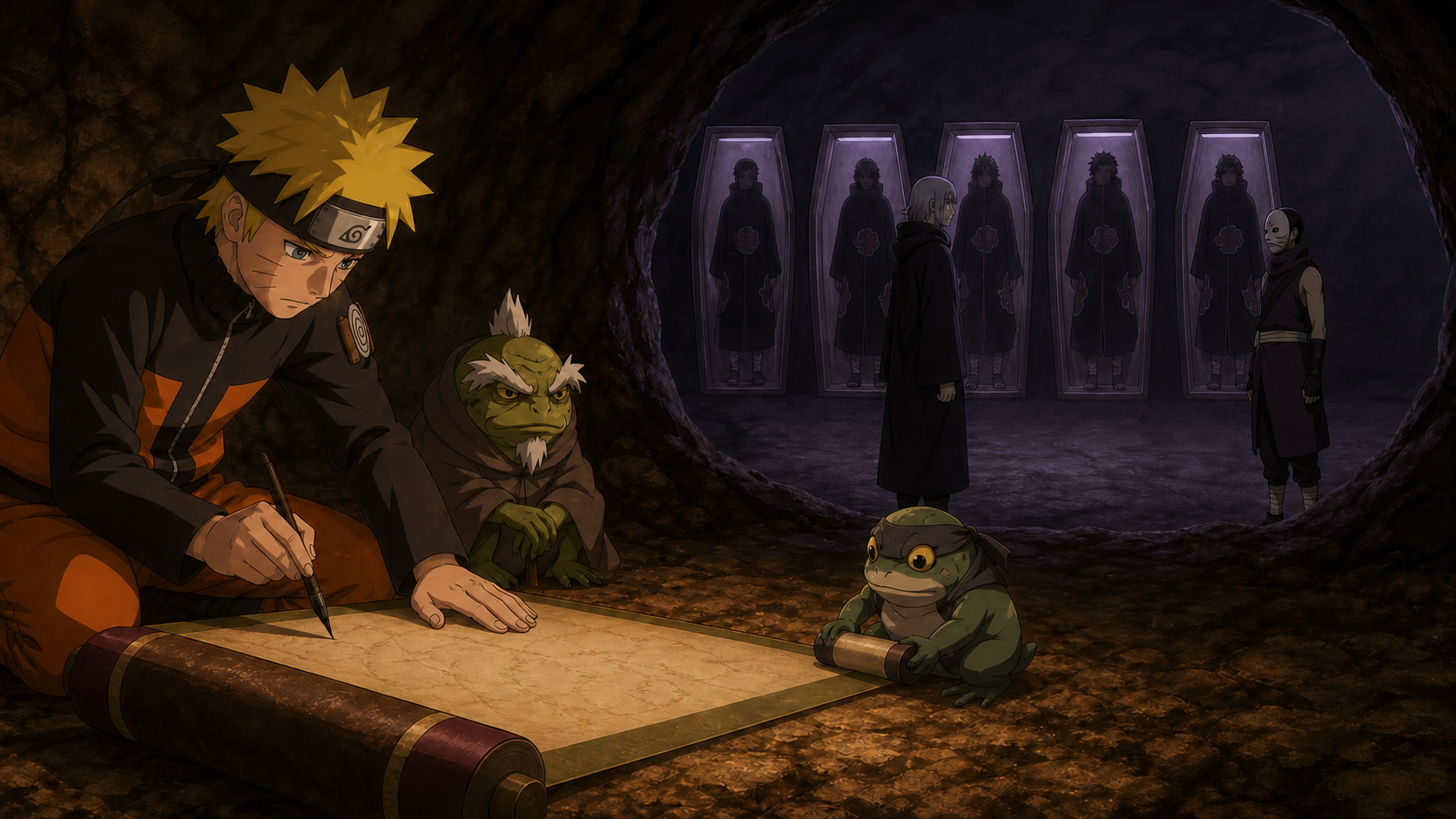
Naruto Shippuden Episode 221, "Storage," puts two forms of stored power beside each other and dares viewers to miss how ugly the second one is. Naruto signs a contract and accepts Gerotora inside his body because controlling the Nine-Tails requires knowledge of the seal. Kabuto walks into the masked man's hideout and opens five coffins containing dead Akatsuki members because controlling the dead gives him political leverage.
Naruto hesitates, remembers who could get hurt, and consents after hearing the risk. Kabuto treats bodies as proof of purchase. That contrast is the whole episode. Greater power does not reveal character through scale alone. The method, consent, and consequences reveal who a person has chosen to become.
Kabuto's return also changes the coming war before the alliance finishes organizing. He is no longer Orochimaru's assistant waiting beside somebody else's ambition. Kabuto has refined the Reanimation Jutsu, collected dangerous remains, and built enough leverage to approach the man claiming Madara's name as a negotiating partner. The masked man does not welcome him. He calculates whether murder or cooperation costs less.
Naruto's hesitation is the correct response
Naruto pauses before signing Gerotora's contract because the seal key can loosen the Eight Trigrams Seal and release more Nine-Tails chakra. He has already seen the cost of losing control. Four tails injured Jiraiya. Six tails attacked Pain without recognizing allies. Eight tails nearly broke the seal before Minato's remaining chakra stopped the final collapse.
A reckless hero would call doubt cowardice and grab the next power-up. Naruto remembers the bodies attached to previous transformations. That memory gives his consent moral weight.
Fukasaku does not shame him for hesitating. The toads explain the mechanism and wait for his answer. A jinchūriki finally receives information about the system governing his own body before another adult changes the rules.
Gerotora explains the real technical problem
Naruto cannot master the Nine-Tails by opening a door and borrowing chakra politely. He must separate the fox's chakra from the fox's will. Kurama's hatred enters the exchange, and that hatred can overwhelm the person trying to take the power.
The distinction turns "control the Nine-Tails" from a slogan into a dangerous process. Chakra is not neutral fuel sitting in a tank. Kurama is a conscious prisoner with anger, memory, and the ability to resist.
Gerotora carries the key to the seal, not a guarantee of success. Training still requires a method, a teacher, safeguards, and enough self-knowledge for Naruto to face hatred without pretending his own anger disappeared.
Signing the contract makes Naruto an informed participant
Minato selected Naruto as a jinchūriki at birth. Konoha classified information about the Nine-Tails, punished public discussion, and allowed Naruto to grow up without a full explanation of why adults feared him.
The contract cannot repair that childhood. Signing does mark a change. Naruto reads the danger, asks questions, considers past failures, and gives an answer as the person who will carry Gerotora.
Consent under inherited pressure is complicated. War is coming, Akatsuki hunts him, and Sasuke's path points toward another lethal clash. Naruto does not have the luxury of treating the Nine-Tails as somebody else's problem. Even so, choosing with knowledge is different from being used without knowledge.
Fukasaku's solution is effective and wonderfully undignified
After Naruto agrees, Fukasaku uses Frog Kata to kick Gerotora down Naruto's throat. The sequence turns a solemn contract into physical comedy without erasing the risk.
Naruto's hero journey regularly includes techniques delivered through absurd bodily inconvenience. Toad oil, giant scrolls, reverse summoning, and now internal scroll-toad storage refuse to let mystical power become too elegant.
The joke also makes the title literal. Naruto becomes storage for the keeper of a seal already stored across his abdomen, protecting a tailed beast stored inside his body. Shinobi institutions have been stacking secrets inside this child for sixteen years.
Gerotora joins a crowded interior life
Naruto already carries Kurama, Minato's remaining chakra, Kushina's remaining chakra, the seal structure, and years of other people's expectations. Adding Gerotora sounds almost routine only because the series normalized an outrageous amount of internal custody.
Every layer exists because an adult anticipated a future crisis. Minato expected Naruto to need the Nine-Tails. Jiraiya expected him to need the key. The toads expect prophecy to move him toward an octopus and a powerful pair of eyes.
Naruto still has to turn those plans into a life rather than become a hallway where dead mentors leave emergency equipment.
The episode cuts from consent to corpse display
Kabuto's arrival changes the visual and ethical temperature. Naruto's storage scene includes warning, hesitation, and agreement. Kabuto summons coffins because the people inside can frighten the masked man into negotiation.
The five bodies are Itachi, Sasori, Deidara, Kakuzu, and Nagato. Each person had a history, ideology, death, and relationship to Akatsuki. Kabuto reduces those differences to combat inventory.
Reanimation does more than revive useful techniques. The jutsu captures a dead person's mind and binds that person to an operator's commands through another living sacrifice. The military value comes from repeated violations.
Kabuto no longer enters as Orochimaru's subordinate
Kabuto greets the masked man with controlled confidence and references the identity of Madara Uchiha. He knows enough to make the room uncomfortable and arrives prepared for an attack.
Earlier Kabuto survived by serving powerful institutions and changing masks: orphanage child, Root operative, village spy, Orochimaru's right hand, medical ninja, and infiltrator. Those identities left him unsure where performance ended and self began.
Episode 221 shows his answer, and the answer is alarming. Kabuto has built a self from stolen cells, stolen techniques, stolen corpses, and the belief that possession proves identity.
The masked man recognizes leverage before partnership
The masked man initially treats Kabuto as a traitor connected to Sasori. Violence remains his first available answer because Akatsuki relationships have always depended on utility and intimidation.
Kabuto's coffins interrupt that response. Reanimated Akatsuki members could strengthen the war, reveal information, or become enemies if Kabuto chooses another buyer. Killing him without understanding the jutsu might waste a strategic resource.
Their cooperation begins without trust. Each man expects betrayal and believes he can manage the other. That structure is not an alliance between equals so much as two predators sharing a battlefield while watching for an exposed throat.
Five coffins rewrite the war's manpower problem
The Allied Shinobi Forces can count living troops, assign divisions, calculate supplies, and plan around known village techniques. Kabuto introduces soldiers who do not tire normally, recover from ordinary injury, and carry specialized abilities from the dead.
Itachi brings the Sharingan and Mangekyō techniques. Nagato brings the Rinnegan's paths. Deidara brings explosive clay. Sasori brings puppet mastery and poison knowledge. Kakuzu brings multiple elemental hearts and a body built for survival.
The alliance does not yet know those assets have returned. Kabuto gains the advantage every intelligence officer fears: a new force exists before opponents update their model of the war.
The dead Akatsuki are not interchangeable weapons
Kabuto presents five matching coffins, but the people inside did not share one motive. Nagato died after rejecting the destruction he caused and trusting Naruto. Itachi died after arranging Sasuke's survival around a brutal private plan. Sasori chose death in a final opening. Deidara destroyed himself while trying to kill Sasuke. Kakuzu died fighting Leaf shinobi.
Reanimation drags each person past the boundary of the death that ended his story. Kabuto can suppress personality, but the returning consciousness still remembers.
That cruelty will matter when the war asks living shinobi to fight mentors, relatives, former leaders, and enemies whose deaths already carried emotional consequences.
Kabuto weaponizes Orochimaru's research without copying him
Orochimaru pursued immortality by moving himself between bodies. Kabuto incorporates Orochimaru's remains and builds a technique portfolio around adaptation, medical knowledge, and corpse control.
The difference is not moral. Kabuto has improved parts of Orochimaru's system and made the improvements serve his own hunger for proof. He wants the masked man to see capability, not loyalty.
Technical independence becomes frightening because Kabuto kept Orochimaru's contempt for bodily boundaries while losing the need for Orochimaru's approval.
Anko's team follows a trail Kabuto wanted found
Anko and her squad track bodies toward the hideout. Their pursuit looks like successful reconnaissance because Kabuto left evidence they could follow.
Kabuto therefore controls information on two fronts. He shows the masked man enough reanimated power to secure a bargain, and he guides Leaf trackers toward a location for reasons they do not understand.
Anko's connection to Orochimaru makes her presence especially dangerous and valuable. She recognizes methods, habits, and traces other shinobi might miss. Kabuto also knows her history can be exploited.
Intelligence without context can become a trap
Following corpses provides a physical route, but a route does not explain why the evidence exists. Anko's team needs to ask whether the target fled carelessly, staged the trail, or wants pursuit.
The episode does not make the trackers foolish. Shinobi work often requires moving with incomplete information. Refusing every suspicious lead would make counterintelligence impossible.
The danger lies in assuming discovery equals control. Kabuto has spent most of his life deciding what other people are allowed to discover about him.
Storage becomes the episode's political language
Naruto stores Gerotora. His seal stores Kurama. Kabuto's coffins store dead fighters. The masked man's hideout stores war plans, collected eyes, and secrets about his identity.
Storage sounds passive, but custody always creates power. The person holding a key decides access. The person holding a body can protect, exploit, hide, trade, or destroy what remains.
Naruto accepts custody as responsibility. Kabuto accumulates custody as leverage. The same practical concept reveals opposite moral directions.
Naruto and Kabuto both inherit dangerous teachers
Jiraiya and Orochimaru shaped students through knowledge, secrecy, affection, manipulation, and risk. Naruto inherits a key Jiraiya believed he would need. Kabuto inherits research Orochimaru pursued without ethical limits.
Naruto does not honor Jiraiya by becoming a copy. He questions the danger and carries Jiraiya's faith into a choice made with other teachers present. Kabuto tries to surpass Orochimaru by absorbing more of the man's body and methods.
One student turns inheritance into a relationship with community. The other turns inheritance into ownership.
The Japanese performances make confidence sound different
Naruto's Japanese performance gives hesitation room before resolve. His concern does not sound like a ceremonial pause inserted to make acceptance dramatic. Naruto genuinely remembers losing himself.
Kabuto speaks with a steadiness that separates this return from his old subordinate role. The politeness remains, but deference has disappeared. The masked man's response stays guarded because surprise cannot become visible weakness.
Fukasaku's delivery carries practical elder energy through both explanation and the kick, keeping Mount Myōboku serious without becoming stiff.
Naruto’s contract creates an accountable record of consent
The writing cannot make inherited pressure disappear, but it marks the point where risk is explained and Naruto gives an answer. Authority becomes visible enough to question.
Gerotora, Fukasaku, and Naruto all know what custody means and why transfer occurs. Their agreement can be revisited because nobody needs uncertainty to preserve leverage.
Kabuto’s coffins create consent’s complete opposite
The reanimated people did not agree to return, fight, reveal techniques, or become evidence in a negotiation. Another living sacrifice also pays for each resurrection.
Kabuto calls technical success mastery while removing every person whose refusal might challenge the claim. Control appears perfect because the controlled bodies are denied authority over themselves.
Reanimation steals the meaning death previously carried
Nagato chose trust in Naruto before dying. Itachi arranged a complicated end around Sasuke. Sasori stopped avoiding a final opening. Kabuto pulls each person past that conclusion for military use.
The jutsu does not merely recover abilities. It interrupts endings and forces the dead to participate in stories their final choices may have rejected.
Five matching coffins hide five incompatible lives
Uniform containers make Akatsuki members look like one category of weapon. Their motives, loyalties, regrets, and relationships vanish beneath inventory presentation.
Kabuto gains leverage from flattening difference. The masked man is asked to calculate combined technique value rather than confront whose consciousness must be enslaved for the bargain.
Kabuto builds identity from possession because service erased his own
Orphanage separation, Root assignments, spy roles, and Orochimaru’s mentorship trained him to become whatever another institution required. Accumulation now feels like proof that a self exists.
The tragedy is that every borrowed cell and controlled corpse repeats the violation. Kabuto answers being used by becoming the person who decides how every other body will be used.
The masked man recognizes another manipulator with independent supply
Kabuto does not request admission through loyalty. He arrives with techniques, information, and bodies valuable enough to make immediate murder strategically expensive.
The partnership begins as mutual hostage logic. Each man cooperates because the other controls something desired and because neither yet knows how to seize it without unacceptable risk.
Power changes the negotiation before trust enters it
The coffins secure Kabuto a hearing, not belief. Akatsuki’s coming war gains soldiers while its leader accepts an operator whose hidden demands remain dangerous.
Cooperation without trust can function temporarily through leverage. Every shared plan also becomes a place where betrayal is expected and therefore prepared in advance.
Anko’s trail may be intelligence Kabuto deliberately authored
Corpses and physical traces feel objective because they exist outside testimony. A skilled infiltrator can still decide where evidence appears and which route the tracker reconstructs.
Anko must follow because abandoning evidence would surrender counterintelligence. The danger is confusing a discovered trail with a route the target failed to control.
Naruto’s body remains crowded with other people’s plans
Kurama, the seal, parental chakra, Gerotora, prophecy, and dead teachers’ expectations all occupy an interior life he did not design from the beginning.
Consent to the newest layer matters and cannot retroactively authorize the rest. Naruto’s growth requires turning inherited architecture into a relationship he can ethically own.
Kurama’s will makes extraction morally different from cooperation
Gerotora explains how to separate chakra from hatred as a technical task. The phrasing risks treating the fox’s power as property contaminated by inconvenient emotion.
Naruto will need strength, but genuine mastery cannot remain one prisoner learning how to take more efficiently from another prisoner inside him.
Production choices reveal the episode's two contracts
Naruto signs an explicit document before accepting Gerotora. Kabuto and the masked man form an unwritten bargain after demonstrating threats. Both agreements concern access to power that belongs partly to other beings.
The warm Mount Myōboku scenes leave faces open and readable. The hideout uses darkness, distance, masks, and coffins. Visual design tells viewers which agreement can survive honest questions and which agreement depends on concealed weapons.
Cutting between those spaces prevents Naruto's new access from feeling like uncomplicated triumph. Somewhere else, another man is increasing power through methods Naruto would reject.
Storage always creates an ethical relationship
Holding a key, body, secret, or conscious being gives the custodian power over access. The moral question begins with how that power recognizes the thing being held.
Naruto accepts responsibility with warning and witnesses. Kabuto creates inventory by erasing consent. Similar containers reveal opposite understandings of custody.
The war gains soldiers before the alliance knows the dead enlisted
Living troop counts, supplies, and formations cannot anticipate opponents who recover from ordinary injury and carry emotional significance for the people ordered to fight them.
Kabuto’s advantage is psychological as well as tactical. Every reanimated mentor or relative can turn grief into hesitation while the controller remains outside the bond.
Inheritance becomes character through method
Naruto questions Jiraiya’s request, remembers danger, and accepts the key with community present. Kabuto absorbs Orochimaru’s research and demonstrates advancement through controlled corpses.
Neither student begins from nothing. Who they become appears in whether inherited knowledge leaves room for another person’s humanity.
Consent changes what preparation means
Naruto accepts Gerotora because the coming war, Akatsuki’s pursuit, and Sasuke’s power make avoiding Kurama impossible. Pressure limits the freedom surrounding his choice, yet the conversation still gives him warning, questions, witnesses, and the right to hesitate. Those conditions do not make the original sealing fair. They make the next step more accountable than the first.
Kabuto removes every comparable safeguard. Reanimated minds cannot decline deployment, living sacrifices cannot withdraw consent, and the masked man receives no complete explanation of Kabuto’s private objective. The agreement works because both negotiators believe they can control the betrayal already expected from the other.
The contrast matters for the alliance preparing outside these rooms. War creates urgency that leaders can use to bypass permission, classify knowledge, and treat bodies as available resources. Naruto’s contract offers another model: explain danger to the person carrying it, allow doubt to remain visible, and record who accepted which responsibility. That standard will not make power safe. It makes power answerable when safety fails.
Storage therefore describes a relationship, not a location. Whoever holds another being, secret, or mechanism acquires duties alongside access. Kabuto recognizes only access. Naruto begins recognizing the duty.
Consent matters.
RaeRae’s final word on Storage
Fukasaku solves solemn seal transfer by kicking a scroll toad down Naruto’s throat. Mount Myōboku continues protecting cosmic responsibility from ever becoming dignified.
Naruto’s hesitation is the mature part. He remembers who got hurt before accepting greater access, which means power has not erased consequence from the decision.
Kabuto arrives with five dead people in matching boxes and treats desecration like a résumé presentation. Technical confidence does not make those bodies his.
The title asks what custody means. Naruto stores a key and accepts responsibility. Kabuto stores people and assumes permission. That difference is the entire moral battlefield.
RaeRae’s call
Naruto’s contract includes warning, hesitation, and consent. Kabuto’s reanimation erases refusal from dead and living bodies, turning storage into leverage rather than accountable custody.