
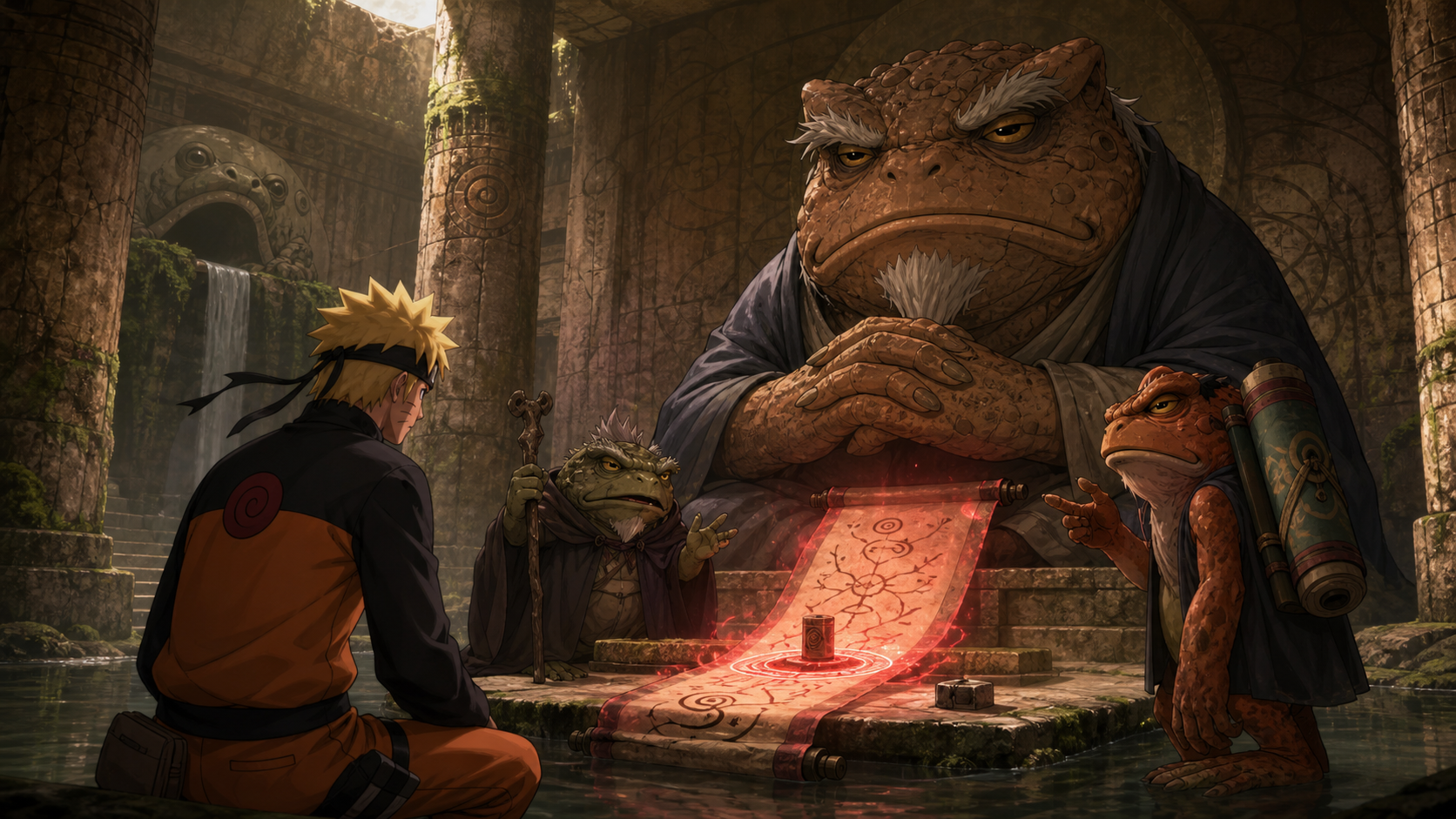
Prophecy of the Great Lord Elder
Naruto receives a prophecy and must decide whether inherited faith justifies opening a more dangerous relationship with the Nine-Tails.
Bottom line
Naruto Shippuden Episode 220, "Prophecy of the Great Lord Elder," gives Naruto two pieces of information that sound like destiny and one decision that remains completely his. The Great Lord Elder predicts an encounter with an octopus and a battle against a young man whose strength lives in powerful eyes. Naruto recognizes Sasuke immediately. Nobody orders Naruto toward that confrontation. He confirms the path he already chose at the Samurai Bridge.
The more dangerous inheritance comes from Jiraiya. Gerotora carries the key to the Eight Trigrams Seal, which can open access to the Nine-Tails chakra and can also make a catastrophic loss of control easier. Jiraiya believed Naruto would need that key. Minato built the seal around the hope that his son could someday master the power forced into him. The toads now have to decide whether inherited faith justifies present risk.
Meanwhile, Tsunade wakes up, eats like a woman reclaiming borrowed chakra by the plate, and resumes the Hokage office before Kakashi can be formally installed. Konoha moves from succession anxiety into war planning without receiving a peaceful interval between crises. The episode ties those political and personal transfers together. Tsunade takes back authority. Naruto accepts custody of a weapon inside his own body. Both choices demand more than confidence.
Gerotora asks the question Jiraiya left behind
Gerotora does not arrive with a convenient power-up and a cheerful instruction manual. The scroll toad brings a disputed final request from Jiraiya: place the seal key inside Naruto so Naruto can eventually control the Nine-Tails completely.
That request carries weight because Jiraiya knew the seal, trained Naruto, and saw the Fourth Hokage's intention more clearly than most people. Jiraiya also nearly died when Naruto reached four tails during training. Personal faith did not protect Jiraiya from the physical reality of uncontrolled chakra.
Gerotora's hesitation therefore deserves respect. Refusing to hand a teenager the key to an internal weapon can look cautious because caution belongs in this decision. Jiraiya's death makes his judgment important, not infallible.
Minato's seal was a plan built around future consent
Minato placed half of the Nine-Tails inside his newborn son and designed the Eight Trigrams Seal to leak chakra gradually. That decision gave Konoha a defender and gave Naruto a childhood defined by fear, isolation, and danger he never chose.
Episode 220 cannot undo that lack of consent. The seal key creates the first meaningful chance for Naruto to decide how far he will engage with the power Minato left him. Accepting Gerotora does not make the original burden fair. Acceptance changes Naruto from a container managed by adults into a young shinobi preparing to understand and control his own body.
The distinction matters. Naruto has spent years being told when the Nine-Tails makes him valuable, frightening, forbidden, or useful. The key places knowledge closer to the person paying every consequence.
The Great Lord Elder refuses to decide before hearing Naruto
The Great Lord Elder responds to the disagreement by summoning Naruto. That choice sounds obvious, yet the shinobi world regularly makes enormous decisions about jinchūriki without consulting them.
Naruto's answer cannot remove every safety concern. He has lost control before, injured allies, and nearly released the Nine-Tails during the battle with Pain. Still, any responsible decision must include his understanding of the danger and his willingness to carry the training.
The toad elder asks before commanding Gerotora forward. For once, prophecy does not erase a person's voice. The vision starts a conversation rather than replacing one.
Tsunade wakes up hungry and returns to work immediately
Tsunade's recovery arrives through food, impatience, and practical urgency. The humor works because her appetite has a job. Maintaining her transformed appearance and restoring depleted chakra require energy after the coma.
Kakashi visits and admits relief that he will not have to become Hokage. His reaction keeps Episode 219 honest. The nomination was never a secret ambition finally rewarded. Kakashi prepared to serve because Konoha needed continuity, then gladly steps back when the sitting Hokage can resume her authority.
Tsunade barely receives time to celebrate survival. The Five Kage alliance, Danzō's death, Sasuke's attack, and Madara's war declaration are waiting beside her bed. Recovery becomes another form of labor before her body has finished recovering.
Kakashi's interrupted appointment reveals institutional flexibility
Danzō's monument face stopped before completion. Kakashi's appointment stops before formal installation. Tsunade returns to an office that never legally became his.
The rapid changes could make Konoha look unstable, because Konoha is unstable. Pain destroyed the village. Tsunade spent nearly all her chakra protecting residents. Danzō exploited her coma, died after the summit, and left allies questioning Leaf leadership.
Allowing Tsunade to resume power is still the strongest available choice. She already holds public legitimacy, knows the village's reconstruction needs, and has experience coordinating other nations. Kakashi's willingness to support her matters more than forcing a ceremony for appearances.
Karin's interrogation turns survival into intelligence
Karin sits with the Intelligence Division after Sasuke sacrificed her during his attack on Danzō. Konoha needs information about Sasuke, Taka, and recent events, but Karin remains a wounded person before she becomes a file of usable answers.
Her performance during questioning mixes calculation, attraction, and self-protection. Karin notices an interrogator and tries to redirect attention with flirtation. The move does not mean her injury stopped mattering. Survival has taught her to read power quickly and use whatever leverage remains.
The scene also reminds viewers that Sasuke's choices now affect people beyond Naruto's promise. Karin can provide evidence because she stood close enough to watch his methods change.
Konohamaru's pursuit supplies comedy with a real boundary
Konohamaru and his teammates chase Naruto for a demonstration of the technique Naruto taught him. The sequence offers comic relief after succession politics and prisoner interrogation, but the joke also shows how Naruto's influence travels.
Naruto once treated attention from older shinobi as precious because so few adults acknowledged him. Now younger shinobi pursue him as a teacher and model. That growth comes with the awkward discovery that students remember every ridiculous lesson too.
Naruto escapes rather than turning the street into a public demonstration. A small refusal shows more judgment than his younger self would have managed.
Shikamaru treats Naruto as someone who also needs protection
Shikamaru remembers Hinata describing Naruto's transformation after Pain appeared to kill her. Hinata could no longer sense Naruto beneath the Nine-Tails chakra. Her testimony gives the danger a personal witness rather than an abstract warning.
Shikamaru reaches a mature conclusion: their group must protect Naruto from Akatsuki and protect Naruto from the beast inside him. Neither responsibility cancels the other.
That position rejects two easy mistakes. Naruto is not merely a weapon to guard, and the Nine-Tails is not a problem Naruto should solve alone. Friends can respect his resolve while preparing safeguards he may not appreciate in the moment.
War planning begins before Konoha finishes rebuilding
Shikamaru joins Shikaku as Tsunade and the council begin organizing for the Fourth Shinobi World War. The father and son represent different levels of the same work: field relationships, strategic planning, intelligence, and the ugly math of keeping people alive.
An alliance announcement does not create an army by magic. Villages need command structures, medical systems, communication routes, supplies, unit assignments, and rules for shinobi trained to distrust one another.
Tsunade returns at the exact moment institutional knowledge becomes critical. Her medical background and command experience give the alliance something more useful than symbolic toughness.
Ramen almost gives Naruto one ordinary celebration
Sakura finds Naruto at Ichiraku and tells him Tsunade has awakened. Teuchi offers a free bowl, giving Naruto a simple community celebration after days of grief, confrontation, and political disaster.
Naruto does not get the first bite. The reverse summoning pulls him away before the meal begins. The timing is funny, but also painfully familiar. Large responsibilities keep interrupting the ordinary care Naruto spent childhood wanting.
Ichiraku remains important because the offer still happened. Teuchi's generosity confirms Naruto has a home waiting after prophecy, war, and training finish making demands.
The octopus prediction points toward a teacher Naruto has not met
The Great Lord Elder predicts that Naruto will meet an octopus. Naruto has no useful context for that image, which keeps the prediction strange rather than immediately actionable.
Viewers can understand the direction toward Killer B, the Eight-Tails jinchūriki whose tailed beast carries octopus-like limbs. Naruto cannot build a plan from audience knowledge. He can only remember the clue and recognize the encounter when reality catches up.
The prophecy works best as orientation, not a script. Naruto still has to travel, listen, train, fail, and earn whatever Killer B may teach him.
The young man with powerful eyes does not need explanation
Naruto identifies Sasuke as soon as the elder mentions a young man whose power lies in his eyes. The Sharingan makes the clue clear, but Naruto's certainty also comes from the encounter at the Samurai Bridge.
Their clash communicated what conversation could not. Naruto believes another battle will decide whether both survive, and Sasuke has chosen eyes, vengeance, and power as the route toward destroying Konoha.
Prophecy does not create their conflict. Family murder, state secrecy, manipulation, friendship, abandonment, and repeated choices created the conflict. The elder merely confirms that the road has not ended.
Naruto's answer preserves choice inside prophecy
Naruto says his resolve will not change. The line can sound fatalistic if prophecy receives too much credit. Naruto made the decision before arriving at Mount Myōboku, based on what he felt when Rasengan met Chidori.
The Great Lord Elder tests whether the vision terrifies Naruto away from that decision. Naruto answers that he understands the person and accepts the confrontation.
Acceptance does not guarantee wisdom. Naruto still withholds too much from friends and still treats shared danger as a private burden. His answer shows courage, while the surrounding episode keeps asking whether courage can mature into collective preparation.
Accepting Gerotora means accepting a relationship with the Nine-Tails
Gerotora is not simply a key-shaped object. Housing the scroll toad gives Naruto access to the mechanism governing the seal. The arrangement makes future training possible and future failure more dangerous.
Naruto hesitates because he remembers what uncontrolled chakra has done. Four tails nearly killed Jiraiya. Six tails emerged during the Pain battle. The Eighth Tail nearly broke the seal before Minato's remaining chakra intervened.
That history makes hesitation healthy. A hero who grabs greater power without remembering injured people has learned nothing. Naruto accepts because avoiding the Nine-Tails cannot prepare him for Akatsuki or Sasuke.
Jiraiya and Minato can leave faith, not immunity from consequences
Both men believed Naruto could master the Nine-Tails. Their belief offers emotional support and technical direction, but neither man remains alive to manage the training or absorb the cost of failure.
Naruto therefore inherits more than confidence. He inherits unfinished work from adults who made enormous decisions on his behalf. Honoring them cannot mean obeying every assumption without question.
The strongest version of their faith gives Naruto room to become more careful than they were. Mastery should include safeguards, teachers, witnesses, and respect for Kurama as a conscious being rather than a tank of chakra behind a lock.
The Japanese performances keep prophecy grounded
Naruto's Japanese performance moves from comic frustration at the lost ramen to concentrated seriousness before the elder. The shift preserves his ordinary appetite without making the prophecy scene sound like a different character walked in.
Tsunade sounds forceful during recovery because command returns before comfort. Kakashi's relief lands through restraint rather than celebration, fitting a shinobi who was prepared to serve but never wanted the title for personal glory.
The toad elders carry distinct attitudes. Gerotora's concern feels practical, Fukasaku weighs Jiraiya's intention, and the Great Lord Elder speaks with the slow certainty of someone who sees fragments but still needs Naruto's answer.
Prophecy supplies direction without moral permission
The elder sees an octopus and a young man with powerful eyes. Neither image tells Naruto what treatment those people deserve or which methods become acceptable.
Prediction can name an encounter while leaving ethics untouched. Naruto must still choose how to learn from B, oppose Sasuke, protect others, and respond when the vision becomes reality.
Naruto recognizes Sasuke because the decision already exists
The prophecy does not create their final confrontation. Years of friendship, abandonment, state secrecy, attempted murder, and the bridge clash have already made another meeting unavoidable.
Naruto answers calmly because the future confirms a choice he made with open eyes. Fate arrives after agency rather than replacing it.
The octopus remains useful because Naruto cannot decode it yet
Audience knowledge points toward Killer B, but Naruto receives an image without instructions. The gap prevents prophecy from becoming an itinerary he can mechanically follow.
Recognition will require encounter, attention, and willingness to learn. A clue becomes meaningful through relationship rather than through the elder controlling every step.
Gerotora represents a key and an independent warning
Jiraiya’s request gives the seal transfer emotional authority, but Gerotora remembers the four-tailed attack and refuses to treat the teacher’s confidence as immunity from danger.
His resistance improves the inheritance. Loyalty to Jiraiya includes examining the consequences Jiraiya could not guarantee from beyond death.
Naruto’s hesitation is evidence of readiness
A younger version might accept greater power because power promised faster recognition or victory. This Naruto remembers bodies endangered when the Nine-Tails escaped control.
Fear does not disqualify him. Fear shows that consent includes knowledge of what failure can do to friends, teachers, and the village around him.
The seal key moves knowledge toward the body paying for it
Adults decided Naruto would carry Kurama, how much chakra would leak, and when suppression became necessary. Gerotora gives him access to the mechanism governing that imposed relationship.
Control is still incomplete, but information reduces the distance between decision and consequence. Naruto can begin participating in how his own body is managed.
Kurama cannot remain equipment behind inherited faith
Minato and Jiraiya imagined mastery because Naruto would need the power. Their plan still describes a conscious being primarily as energy inside a lock.
Responsible training must eventually become relationship. A seal can regulate access, but domination alone cannot resolve hatred accumulated through generations of human ownership.
Tsunade returns before recovery receives a private meaning
Waking, eating, and reclaiming the office occur almost together because war has already entered the council room. Her body is treated as national continuity before it has finished becoming hers again.
Tsunade accepts that labor, but acceptance should never hide its cost. Leadership survives partly because exhausted people keep returning faster than institutions learn to support them.
Production choices join comedy, government, and myth
Episode 220 moves between Tsunade's food, Karin's questioning, Konohamaru's pursuit, Ichiraku, the war council, and Mount Myōboku. Those settings could feel scattered, yet each scene asks who gets to control dangerous knowledge and power.
Konoha needs Karin's intelligence. The council needs alliance information. Naruto's friends need knowledge about the Nine-Tails. Gerotora holds the seal key. The elder holds a prophecy. Information changes relationships depending on who shares, withholds, or acts on the truth.
The lost ramen keeps the episode human. Prophecy may point toward world-changing events, but Naruto remains a hungry teenager getting dragged away from lunch.
Kakashi’s relief confirms service without ambition
He was prepared to accept the title because Konoha needed a trusted leader, not because the monument represented a personal prize. Tsunade’s recovery releases him from an office he never pursued.
That relief strengthens rather than weakens his credibility. Leadership can be a duty someone performs without requiring desire for permanent authority.
Ramen keeps ordinary belonging beside destiny
Teuchi’s offered bowl contains no prophecy, inherited technique, or military strategy. The gift says Naruto is home and somebody wants to feed him after a difficult return.
Reverse summoning interrupts the meal, but not the care. Mythic obligation keeps taking Naruto away from ordinary life; ordinary life remains the reason returning matters.
Power becomes responsible through limits, witnesses, and labor
Naruto accepts a seal key, Tsunade resumes office, and the alliance begins preparation. Each transfer can look like recognition while actually creating more work and risk.
Faith matters when it supports the person carrying that burden. Faith becomes dangerous when admiration replaces safeguards or assumes the chosen person cannot fail.
Naruto inherits a prophecy, a seal, and the confidence of dead teachers, but inheritance does not eliminate his right to question the design. Minato chose the architecture, Jiraiya chose faith, and Gerotora carries the mechanism. Naruto must decide what mastery means when the power has a voice, history, and hatred of its own. If training treats Kurama only as a weapon, success could reproduce the same domination Akatsuki, villages, and seal makers imposed for generations. The key opens more than chakra. It opens responsibility for the relationship behind the lock.
RaeRae’s final word on the Great Lord Elder’s prophecy
Naruto finally gets a free ramen bowl and destiny summons him away before the first bite. Apparently saving the world includes a strict no-lunch policy.
The prophecy works because the elder still asks Naruto what he intends to do. Seeing a future does not give anybody ownership over his answer.
Gerotora’s hesitation is love with practical memory. Jiraiya believed in Naruto, and Jiraiya almost died when uncontrolled chakra proved belief was not a safety plan.
Naruto accepts the key because avoidance cannot prepare him. The next growth must involve Kurama as more than dangerous fuel inherited from adults who decided first.
RaeRae’s call
Prophecy names Naruto’s future encounters without choosing his ethics. Accepting Gerotora gives him agency over the seal, while remembered harm keeps inherited faith accountable to real risk.