
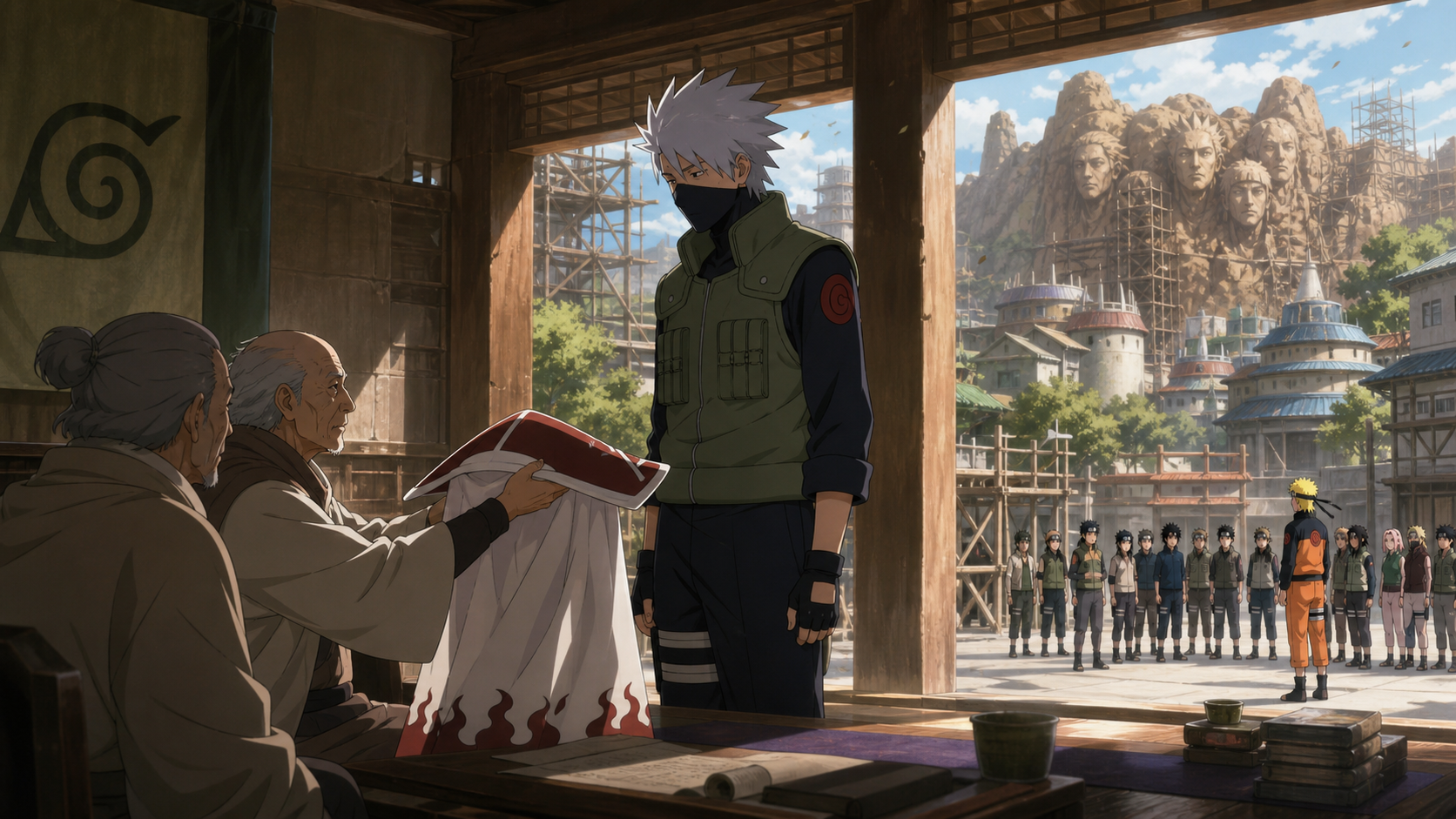
Kakashi Hatake, the Hokage
Naruto asks his peers to trust a private burden while Kakashi faces a public office too large for any one person to carry alone.
Bottom line
Naruto Shippuden Episode 219, "Kakashi Hatake, the Hokage," places two leadership decisions beside each other. Naruto gathers his peers and says he will defeat Sasuke alone, asking them to trust a conclusion he refuses to explain. Elsewhere, Homura and Koharu support the Sand's recommendation that Kakashi become the next Hokage after Danzō's death leaves Konoha without an active leader.
Both men accept responsibility, but neither can treat responsibility as solitary ownership. Naruto's friends are angry because Sasuke's danger affects all of them. Kakashi walks through a rebuilding village knowing the Hokage title will change every relationship and place the coming war on his desk.
Guy gives Kakashi one familiar interval before that future closes around him. Their race is funny, competitive, and quietly tender. Kakashi wins by a narrow margin, and Guy congratulates the rival he expects to lose to public duty. The episode understands leadership as a transition felt by communities, not a title placed on one impressive person.
Naruto finally gathers the people affected by his promise
Shikamaru brings the young Leaf shinobi together because Naruto asked for a meeting. The gathering corrects one part of the secrecy that defined Sakura's failed assassination plan and Kakashi's attempt to handle Sasuke as a teacher's private burden.
Naruto stands in front of people who have fought beside him, worried over him, and made their own decision that Sasuke had become too dangerous to leave unresolved. They deserve to hear what happened at the Samurai Bridge from him rather than through rumor.
Calling the meeting is growth. What Naruto says during the meeting reveals that growth remains incomplete.
“I will defeat Sasuke” protects and excludes at the same time
Naruto announces that he will face Sasuke alone. The statement is technically honest, but he withholds the recognition exchanged through Rasengan and Chidori and the prediction that both could die in a final battle.
His motive is protective. Naruto does not want his friends pulled into the fatal bond or forced to carry the choice between killing Sasuke and watching him destroy Konoha.
The method repeats an old mistake. Naruto decides what other people can bear and asks for trust without enough information for meaningful consent. Protection becomes exclusion when the protected people lose the ability to judge a danger that belongs to their village too.
The Konoha 11 have earned more than reassurance
Shikamaru, Ino, Chōji, Kiba, Hinata, Shino, Lee, Neji, and Tenten are not spectators in Naruto and Sasuke's history. Their teams joined the retrieval mission, faced Akatsuki, rebuilt after Pain, and prepared for consequences created by Sasuke's summit attack.
Their frustration is not a failure to understand Naruto's friendship. They understand that friendship has already moved armies, injured allies, and changed political decisions. A private promise now intersects with public security.
Naruto asks them to trust his judgment because he cannot yet translate the bridge encounter into language that sounds survivable. The request deserves empathy, but empathy does not erase their right to question him.
Their disagreement is also evidence that Naruto is no longer isolated in the way he was as a child. People care enough to challenge him, expect answers, and refuse to watch him disappear into a fatal plan without protest. Community can feel uncomfortable when community stops offering unconditional agreement.
Karin enters Konoha as witness, prisoner, and survivor
Kakashi brings Karin to the Intelligence Division because she witnessed Sasuke's battle with Danzō and carries valuable knowledge about his recent actions. The village needs information before war planning hardens around assumptions.
Karin also arrives as someone Sasuke used and discarded. Her injury records the difference between his stated devotion to the Uchiha and his treatment of living allies. Interrogation must not reduce her to another container of useful facts.
The episode gives Kakashi a practical responsibility before the Hokage discussion becomes official. Leadership already looks like protecting the village, processing an enemy associate, and recognizing that a witness may also need protection.
Danzō's monument face stops before completion
The stone carver begins adding Danzō to the Hokage Monument and receives word that the acting Hokage has died. The unfinished work turns political instability into a visible interruption.
Konoha carves leaders into the mountain as though office naturally becomes permanent memory. Danzō's brief, contested succession exposes how much uncertainty exists between nomination, service, and legacy.
Stopping the carving is also a small act of historical accuracy. A monument should not outrun what the village has actually confirmed. In an arc shaped by misinformation, even stone must wait for verified news.
Homura and Koharu choose continuity after Danzō
The elders support Kakashi as the next Hokage, aligning with the Sand's recommendation. Their choice returns to the candidate Shikaku advanced before Danzō seized the opening created by Tsunade's coma.
Kakashi offers military experience, international credibility, and a leadership lineage connected to Minato, Jiraiya, and Hiruzen. More importantly, he has just represented the Leaf during the summit aftermath and understands the alliance's immediate stakes.
The nomination is not a reward for popularity. Konoha needs someone other villages can trust while the village itself remains damaged and its previous acting leader has died at Sasuke's hand.
Kakashi's appointment would also communicate a change in governing style. Danzō defended secrecy as strength. Kakashi has just responded to the alliance by distributing verified information through his ninken. The contrast gives partner villages a practical reason to expect a different relationship with Konoha.
Kakashi looks at Minato before accepting the future
Walking through Konoha, Kakashi pauses at Minato's face on the monument. The image places the possible Sixth Hokage beneath the teacher who became Fourth and died protecting the village.
Minato's legacy is personal for Kakashi. The title does not arrive as an abstract promotion. The office carries memories of a mentor, a failed team, and every person Kakashi believes he could not save.
That history may make him cautious, but caution is not refusal. Kakashi has spent years learning that leadership cannot guarantee rescue. The lesson can become humility rather than paralysis.
The rebuilt village makes the nomination feel immediate
Scaffolding, temporary structures, and damaged landmarks surround Kakashi's walk. The next Hokage will not inherit a peaceful office with time for ceremony. He will inherit reconstruction, war mobilization, alliance obligations, and a population still grieving.
Physical repair also provides a standard for leadership. Konoha does not need a symbol who only looks strong on the mountain. The village needs someone able to coordinate ordinary recovery while preparing for extraordinary danger.
Kakashi's career has repeatedly placed him between field detail and larger strategy. The damaged streets make that practical experience more relevant than a grand speech about destiny.
Guy's challenge gives Kakashi one familiar measure
Guy interrupts Kakashi's reflection with another competition. Their rivalry has always created a space where achievement can be measured through absurdly specific challenges rather than trauma, rank, or political expectation.
The race lets Kakashi move before he must decide how to sit inside the Hokage office. For a few minutes, the future leader is simply Guy's eternal rival, irritated and engaged by a contest whose rules both understand.
That familiarity is a gift. Guy does not ask Kakashi to perform certainty about the nomination. He offers the relationship they already know how to inhabit.
Winning the race does not make Kakashi ready for office
Kakashi wins narrowly, preserving the competitive balance that keeps Guy returning. The result is satisfying, but the race is not an exam proving he deserves to lead Konoha.
The distinction matters because skill tests can simplify responsibility. Hokage decisions will not offer a finish line, one opponent, or a clean declaration of victory. Kakashi can be faster than Guy and still feel uncertain about governing.
The race prepares him emotionally rather than administratively. Movement clears space for thought, and a trusted rival confirms that Kakashi will not enter the next role completely alone.
Guy congratulates the friend he expects duty to take away
Guy says Kakashi will be too busy for their challenges after becoming Hokage. The joke carries grief because their competitions have survived youth, war, loss, and adulthood.
Public office changes access. Kakashi's time will belong to briefings, diplomacy, security, and thousands of village needs. Guy understands that a title can create distance even when affection remains.
His congratulations therefore sound like pride mixed with farewell. He celebrates Kakashi while mourning the ordinary freedom their rivalry represented.
Naruto and Kakashi mirror each other's isolation
Naruto claims Sasuke as a burden only he can resolve. Kakashi accepts a nomination that may place the entire village's burden on him. Both are tempted to translate leadership into carrying pain alone.
Their histories explain the temptation. Naruto learned to protect bonds through personal refusal. Kakashi survived teammates whose deaths became private responsibility. Neither instinct is malicious.
The episode places communities around them as a corrective. Naruto has peers demanding inclusion. Kakashi has Guy, advisers, shinobi, and allied leaders whose participation will determine whether the Hokage can function.
Neither man loses courage by sharing responsibility. Naruto's promise becomes more credible when friends understand the stakes and can protect the village around him. Kakashi's leadership becomes stronger when trusted people preserve the relationships, information, and honest disagreement that prevent authority from becoming another form of isolation.
The title belongs to a role Kakashi almost occupied before
Kakashi was previously considered for Hokage when Tsunade remained unconscious, but Danzō redirected the succession toward himself. Episode 219 returns to that interrupted possibility under worse conditions and with greater international urgency.
The repetition shows that institutional leadership is contingent. Talent alone did not decide the earlier outcome. Reputation, ideology, political maneuvering, and timing shaped who received authority.
Kakashi's renewed nomination is therefore not destiny finally arriving. The choice is a response to current needs, and another change in Tsunade's condition could alter the path again.
The Japanese performances balance restraint and affection
Kakashi's Japanese performance keeps the nomination inward. His response carries thought rather than triumphant ambition, matching a character who understands the office through people he lost.
Guy's energy does not erase the seriousness. The familiar volume and competitive rhythm create affection through contrast, offering Kakashi a relationship untouched by council formality.
Naruto sounds resolved during the peer meeting, but the gaps in his explanation remain audible. His friends answer with frustration because certainty without disclosure no longer reassures them.
Naruto corrects secrecy with a meeting and repeats it in the speech
Gathering the rookies acknowledges their stake after Sakura’s private plan collapsed. Naruto then gives them a conclusion while withholding the fatal promise that explains its weight.
The contradiction is recognizable growth. He understands conversation is necessary but still believes protection means controlling which truth other people must carry.
Trust without information becomes another assignment
Naruto asks friends to believe he can handle Sasuke alone. They are expected to organize their safety around a decision whose consequences he has not fully described.
Trust should allow uncertainty, not replace consent. People who fought in Sasuke’s retrieval and survived his political fallout need enough knowledge to decide how their own responsibilities change.
The Konoha 11’s anger is evidence of belonging
Childhood Naruto longed for people who cared whether he disappeared. Their refusal to accept a vague fatal mission proves he now has the community isolation once denied him.
Being loved means being challenged when sacrifice becomes a private identity. Agreement would feel easier, but protest is the relationship refusing to let Naruto become expendable.
Karin’s arrival tests whether Konoha can see more than usefulness
She possesses valuable information about Sasuke, Taka, Danzō, and the summit. She also arrives injured by the person whose actions interrogators will ask her to reconstruct.
A village preparing for war may prioritize intelligence. Ethical custody must keep the witness visible as a survivor whose body is not another container the institution owns.
Danzō’s unfinished face interrupts automatic memorial
Stone would convert a disputed acting leader into permanent public lineage before the village examined what his authority contained. News of death stops the process mid-carving.
The interruption is almost administrative and politically profound. Konoha’s monument cannot responsibly make legitimacy faster than verified history can answer whether the title was ever fully held.
Kakashi receives office through relationships Danzō tried to manufacture
The Sand recommends him because cross-village conduct created credibility before the crisis. Advisers accept him because military experience and professional history can be examined.
Danzō used Shisui’s eye to force confidence he had not earned. Kakashi’s nomination demonstrates how trust accumulates through actions other people remain free to judge.
International confidence becomes part of domestic succession
Konoha cannot choose a leader as though allied expectations remain outside the village. The next Hokage must commit forces, share intelligence, and repair damage created by Danzō’s summit conduct.
Sovereignty continues, but wartime interdependence changes what competence requires. A leader untrusted abroad can endanger citizens at home by weakening the coalition they now need.
Minato’s monument makes office personal before it becomes prestigious
Kakashi sees a teacher who led, died, and left consequences still shaping Naruto and the Nine-Tails. The stone carries affection, institutional memory, and a standard impossible to approach neutrally.
He does not imagine the title as recognition alone. Leadership means entering a lineage where every decision may become another student’s unresolved history.
Guy offers identity that office cannot absorb
Before Kakashi becomes a title, Guy calls him a rival and proposes rules they both understand. The relationship recognizes a person council language would quickly turn into function.
Competition preserves ordinary access: movement, irritation, laughter, and a history that does not require Kakashi to perform command. That space becomes emotional infrastructure for leadership.
The race allows uncertainty without demanding confession
Guy does not ask whether Kakashi feels worthy, afraid, or trapped by Minato’s legacy. He offers companionship through a familiar form where both men can be present without explanation.
Care does not always require extracting every feeling. It can provide a temporary world where the person remains larger than the burden waiting nearby.
Production choices connect monument, street, and council
The episode repeatedly moves between public symbols and unfinished human decisions. Danzō's face is interrupted in stone. Kakashi sees Minato's completed monument while wondering about his own nomination. Naruto addresses friends in the village those leaders are supposed to protect.
The race provides motion through spaces still being rebuilt, letting Konoha's physical condition remain present during comedy. Leadership is not discussed in a sealed ceremonial room alone.
That geography keeps the Hokage title grounded. The office belongs to streets, workers, teammates, children, and damaged homes before the office belongs to a carved face.
Naruto and Kakashi mistake isolation for responsible leadership
Naruto reserves Sasuke’s fate for himself. Kakashi prepares to inherit a village as though reluctance and personal need should disappear beneath office. Both translate care into private endurance.
The people around them offer the correction. Friends need information, rivals preserve identity, advisers share judgment, and communities carry outcomes no leader can contain alone.
Winning provides no answer to the office
Kakashi crosses the finish line first because a race has visible rules and an agreed measure. Hokage decisions will involve competing harms, incomplete intelligence, and no neutral observer declaring success.
The narrow victory refreshes him without pretending athletic proof settles political fitness. Guy gives encouragement, not coronation.
Leadership begins before the formal title arrives
Kakashi has already distributed news, protected Karin, represented Konoha’s credibility, and returned students from a lethal conflict. Responsibility exists in practice before ceremony confirms authority.
Naruto also leads when he gathers his peers, then falters when he asks them to follow without the truth. Office and aspiration both require participation from people affected by the choice.
A title cannot replace the relationships that made trust possible
Kakashi becomes a credible candidate because people have watched him act across missions, villages, failures, and alliances. The office may formalize that trust, but the office did not create it. If leadership separates him from every person capable of reminding him who he is, authority will consume the very foundation supporting the appointment.
Guy’s rivalry matters in that context. Their contests preserve a space where Kakashi can lose, win, complain, and be known without performing institutional certainty. A Hokage needs advisers who challenge policy, shinobi who report reality, allies who question promises, and friends who recognize exhaustion before the leader turns silence into virtue.
Naruto’s meeting reveals the same requirement from below. His peers do not owe him agreement because he has suffered or because he may become Hokage someday. Their trust grows when Naruto treats them as participants in the danger instead of an audience for his resolve. Sharing the whole bridge promise would frighten them, and that fear belongs in the plan. Leadership cannot mean removing difficult reactions until everybody appears united.
RaeRae’s final word on Kakashi Hatake, the Hokage
Naruto finally calls the meeting everybody deserved and then gives them the edited trailer for a promise involving mutual death. Sir, those are your friends, not a press embargo.
Their anger is love refusing to become applause. Naruto spent childhood wanting people to notice him, and now they notice when he tries to disappear into responsibility.
Kakashi’s side is quieter. The monument, scaffolding, elders, and alliance make Hokage feel like work arriving before anybody has repaired the office.
Guy understands the person beneath that work and offers one ridiculous race before public duty changes their access. That friendship is not a distraction from leadership. It is part of what may keep leadership human.
RaeRae’s call
Naruto and Kakashi both equate responsibility with carrying everything alone. Their communities answer with questions, rivalry, memory, and shared work, proving leadership depends on people who refuse exclusion.