
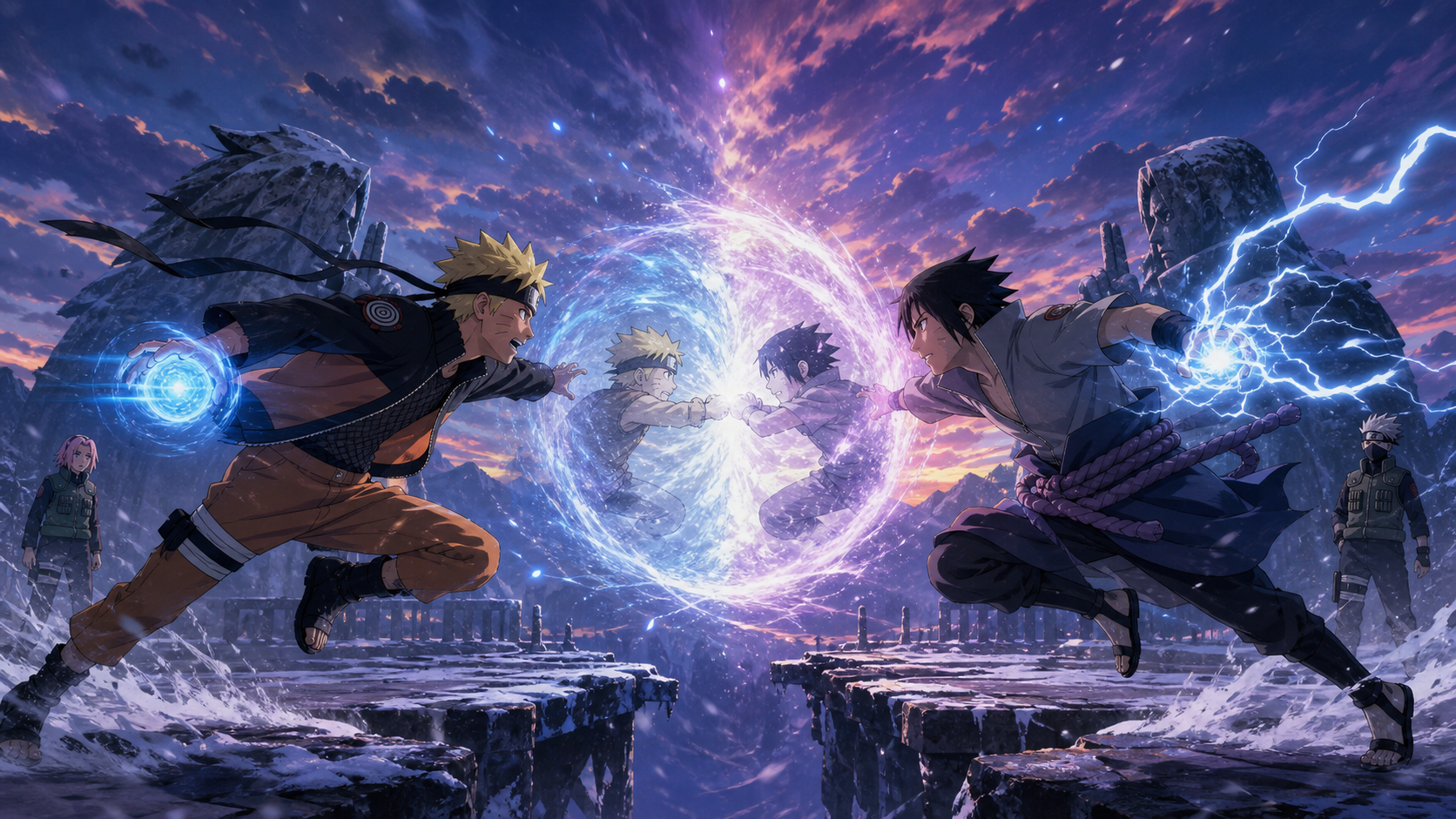
Two Fates
Naruto and Sasuke collide once more, understand each other through the impact, and name the fatal bond neither one has managed to sever.
Quick reaction
“Two Fates” brings Naruto and Sasuke face to face after the Five Kage Summit and refuses to soften what either of them has become. Naruto has just saved Sakura from Sasuke’s hand. Sasuke has killed Danzō, abandoned Karin, tried to murder Sakura twice, and declared his intention to destroy Konoha. Naruto still says he will save him, but this promise does not require pretending the damage is smaller than the truth.
Their Rasengan and Chidori collide as they did at the Valley of the End, and the impact lets them understand each other without the usual defenses. Naruto sees where Sasuke’s hatred is taking him. Sasuke sees that Naruto will not step aside. The two fates in the title are not separate paths anymore. Naruto tells Sasuke that if their final fight ends in death, they will die together.
Naruto stands between Sasuke and Sakura
Naruto arrives at the exact moment Sasuke turns Sakura’s own poisoned kunai against her. He pulls her out of danger and lands beside Kakashi, completing a Team 7 reunion that feels nothing like home. Sakura is shaken because Sasuke truly intended to kill her. Kakashi is prepared to fight his student. Sasuke looks at all of them as obstacles between himself and revenge.
Naruto does not begin by attacking. He asks Sasuke to turn back and insists that he is still there to save him. That language sounds familiar, but Naruto is speaking with new information. He knows the truth about Itachi, the Uchiha massacre, and Danzō’s role. He understands that Sasuke’s anger is not a childish obsession invented in a vacuum.
The knowledge surprises Kakashi and Sakura. Naruto has carried Tobi’s account by himself, just as everyone else has been carrying private pieces of the crisis. Now he puts the truth into the open. He cannot excuse Sasuke’s choices, but he refuses to argue with a false version of Sasuke’s pain.
Sasuke’s version of purification
Sasuke answers that he does not need rescue. Killing Danzō has made him feel as though the Uchiha name is being cleansed, and destroying Konoha has become the next step. The laughter of villagers who benefited from his clan’s destruction feels obscene to him. He wants to erase the home built over their graves.
This is revenge expanded into identity. Sasuke no longer seeks one guilty man. He treats the entire village as an enemy and every remaining bond as contamination. Karin’s loyalty, Sakura’s history, Kakashi’s teaching, and Naruto’s persistence all threaten the purity of his hatred because they remind him that his life contains more than the massacre.
Sasuke insists Naruto cannot understand because Naruto never had parents or siblings to lose. The accusation cuts toward Naruto’s oldest wound. He did grow up without family, but that absence is exactly why he recognizes the terror of losing the first bond that felt like brotherhood. Their loneliness came from different events, yet both boys built themselves around what was missing.
A clash that becomes a conversation
Naruto and Sasuke charge with Rasengan and Chidori, repeating the image that defined their separation at the Valley of the End. The techniques are more powerful now, but the emotional question has not changed: can one of them force the other to accept his answer?
At the instant of impact, the fight becomes communication. Sasuke once told Naruto that high-level shinobi can read each other through exchanged blows. Their clash strips away the speeches. Naruto feels the depth of Sasuke’s resolve, and Sasuke feels that Naruto’s promise is not empty optimism.
The Valley of the End echoes inside the moment because neither has escaped the first battle. Sasuke won and left, but he failed to erase Naruto. Naruto lost and remained, but he never accepted that defeat as the end. Every encounter since then has made the bond more painful and more undeniable.
Naruto chooses neither offered ending
Sasuke frames their future as a simple choice: Naruto can kill him or be killed. From Sasuke’s perspective, that is what opposing paths demand. One will survive, and the survivor’s will becomes truth.
Naruto rejects the structure of the choice. He does not promise to defeat Sasuke and return alone as a hero. He says that if they fight at full strength, both of them will die. More importantly, he is willing to accept that fate rather than abandon Sasuke to hatred.
This is not a death wish dressed as friendship. Naruto is explaining the cost he will personally carry. He will not ask Sakura to kill Sasuke, let Kakashi do the killing, or allow the shinobi world to settle the matter without him. If Sasuke insists on walking toward mutual destruction, Naruto will meet him there and make sure he is not alone even at the end.
The answer unsettles Sasuke because dismissal as weakness no longer works. Naruto is not begging from safety. He is placing his own life beside Sasuke’s and refusing to rank one as more valuable. That equality is what Sasuke has always recognized in him, even while denying the bond.
Sakura and Kakashi hear the real promise
For Sakura, Naruto’s declaration clarifies why her confession and assassination plan could never release him. His pursuit of Sasuke is not a debt owed to her. The promise became part of Naruto’s own understanding of who he is. Sakura could not cancel that promise because she did not create the bond.
Kakashi also hears Naruto take on the burden he tried to reserve for himself. As teacher, Kakashi wanted to protect both students by ending the threat. Naruto refuses protection that requires exclusion. Team 7 cannot return to its innocent beginning, but its members are finally speaking in the same place rather than making separate plans behind one another’s backs.
That does not produce agreement. Sakura is horrified, Kakashi understands the danger, and Sasuke remains committed to revenge. The scene matters because the central conflict is no longer hidden beneath retrieval orders or childhood promises. Naruto has stated the fate he is prepared to share.
What this episode changes
“Two Fates” marks the transition from trying to bring Sasuke home to preparing for a final reckoning. Naruto knows persuasion alone will not stop him. He also knows killing Sasuke as an enemy would betray the bond he is trying to protect. His solution is characteristically impossible: become strong enough to meet Sasuke completely and refuse every ending built on abandonment.
Sasuke leaves the clash knowing Naruto has understood him more clearly than anyone else on the bridge. That understanding does not redeem him, but the recognition prevents him from reducing Naruto to an ignorant obstacle. Their next full battle will carry this knowledge.
The episode also restores Naruto’s agency after several chapters of other people deciding what he should know and where he should stay. He arrives, sees Sasuke at his worst, and makes his choice with open eyes. Hope here is not innocence. Hope becomes the decision to remain connected after innocence is gone.
Sakura’s poisoned kunai exposes the cost of secrecy
Sakura’s weapon carries poison prepared from Shizune’s supplies, which means her private mission has already crossed several lines before Naruto enters the bridge. She has borrowed medical knowledge for an execution, concealed her purpose from her teammates, and tried to convert guilt into solitary responsibility. The plan fails physically when her hand hesitates, but the deeper failure began when she decided nobody else could be trusted with the truth.
Naruto’s rescue does not turn Sakura into a helpless bystander. The moment exposes how thoroughly Team 7 has learned to protect one another through concealment. Sakura lies about her feelings because she wants Naruto released from his promise. Kakashi tries to claim Sasuke as a teacher’s burden. Naruto withholds Tobi’s account while deciding what Sasuke’s pain means. Every person arrives carrying a private solution, and every private solution leaves somebody else unprepared.
The poison also refuses to remain symbolic. Naruto was cut by Sakura’s kunai during the scramble, so the weapon intended for Sasuke enters Naruto’s body instead. A plan designed to end one bond literally injures the person Sakura hoped to protect. That consequence is painfully direct, and the episode does not need a speech to explain the irony.
Kakashi cannot solve Team 7 through rank
Kakashi approaches Sasuke as a missing-nin and a former student, but those identities demand opposite instincts. The jōnin has a professional duty to stop a dangerous criminal. The teacher still sees the child who learned teamwork through two bells and a forbidden lunch. Kakashi’s willingness to kill Sasuke grows from responsibility, not indifference, which makes Naruto’s interruption more complicated than a student disobeying an order.
Team 7’s original survival test taught the children that abandoning a teammate was worse than breaking a rule. Years later, Kakashi faces the ugliest possible extension of his own lesson. Sasuke has become dangerous enough that loyalty can no longer mean automatic rescue, yet treating him as disposable would betray the moral foundation Kakashi gave the team. Naruto does not offer a clean answer. He forces Kakashi to admit that procedure alone cannot settle a relationship built before any of them understood the cost.
Kakashi also hears how far Naruto has grown beyond the boy who shouted promises first and planned later. The death pledge remains frightening, but the reasoning comes after Naruto has heard the political truth, witnessed Sasuke’s violence, and measured the strength behind Sasuke’s hatred. Naruto is still emotionally reckless. He is no longer uninformed.
The Japanese performances make recognition feel physical
Junko Takeuchi gives Naruto less bounce than the character usually carries. His voice stays grounded because Naruto is not selling hope to a doubtful room; he is telling Sasuke what Naruto has already decided. The restraint matters. A louder performance could make the pledge sound like another boast. Takeuchi lets exhaustion, grief, and certainty occupy the same sentences.
Noriaki Sugiyama answers with a Sasuke whose contempt keeps cracking around recognition. His laughter after Danzō’s death sounds sharpened past relief, while his exchanges with Naruto carry an attention he refuses to offer Sakura or Kakashi. Sasuke may reject Naruto’s conclusion, but Sugiyama never plays him as bored. Every denial sounds aimed at the one person whose judgment still reaches him.
Chie Nakamura gives Sakura very little emotional shelter. Shock follows determination because Sakura has finally seen the result of the role she assigned herself. Kazuhiko Inoue keeps Kakashi controlled, though the control feels costly rather than calm. Together, the four performances make the bridge reunion sound like a family argument after the word family has become dangerous.
Naruto sees Sasuke clearly before choosing hope
He arrives after Sasuke attacked Karin, attempted to kill Sakura twice, fought the Kage, and declared Konoha his next target. No innocent version remains available.
Naruto’s promise therefore changes moral weight. Hope is not the absence of evidence; it is the decision that accountability and possible transformation must remain in the same frame.
Sasuke wants pain to grant exclusive authority over meaning
He tells Naruto that an orphan cannot understand losing parents and a brother, using difference in biography to close the conversation. Only Sasuke may define what the massacre permits.
The wound is uniquely his, but consequences are shared. Personal suffering deserves recognition without becoming sole ownership over every life revenge now threatens.
Naruto’s loneliness answers without claiming equivalence
He did not lose the family Sasuke remembers because he was denied that family from birth. Their griefs cannot be measured as matching events.
Naruto understands the terror of losing a first brotherly bond precisely because connection arrived late. Recognition does not require identical history; it requires refusing to make difference an excuse for indifference.
The clash creates communication neither speech could secure
Sasuke rejects Kakashi’s authority and Sakura’s attempted deception. Naruto’s physical equality reaches him because their rivalry has always carried emotional information through force.
That language remains dangerous. The impact creates recognition, not agreement, and bodies still pay for every truth the boys cannot express outside combat.
Mutual death is a promise and a failure of imagination
Naruto refuses to survive by abandoning Sasuke, making his own life the cost rather than assigning the killing to Sakura or Kakashi. The willingness is radically equal.
It is also tragic that he can imagine companionship in death before a workable life after accountability. Devotion has found an honest price but not yet a sustainable future.
Sasuke recognizes the one person he cannot reduce to ignorance
Tobi told Naruto about Itachi, and the clash confirms Naruto has absorbed the scale of Sasuke’s hatred. Dismissing him as a naïve outsider no longer works.
Sasuke still rejects rescue, but rejection now addresses someone who understands enough to remain morally inconvenient. Naruto’s witness threatens the purity revenge requires.
Sakura hears that the old promise was never hers to cancel
Her confession attempted to release Naruto by withdrawing the request that began his pursuit. Naruto stands before Sasuke because the bond became his own chosen responsibility.
The realization does not excuse how his choices affect Sakura. It returns ownership accurately: she can challenge the bond, but she cannot rewrite its meaning through a romantic transaction.
Kakashi witnesses his lesson become an impossible standard
Team Seven learned that abandoning comrades was worse than breaking rules. Sasuke now harms comrades, while Naruto refuses abandonment even when the comrade has become the danger.
The lesson needs accountability to survive adulthood. Loyalty without boundaries protects abuse; duty without memory reduces a former child to a target. Kakashi must hold both failures open.
The poisoned cut makes private planning public consequence
Sakura prepared the weapon for Sasuke and concealed the mission to protect Naruto. During the rescue, Naruto receives the poison through his own body.
The accident turns emotional structure into physical fact. A plan built around excluding him still injures him because love cannot control where the consequences of secrecy travel.
Production choices turn repetition into evidence
The Rasengan and Chidori collision deliberately recalls the hospital rooftop and the Valley of the End, but the repetition does more than provide a familiar image. Earlier clashes asked which boy was stronger and whether Sasuke would leave. This collision asks whether either boy can still imagine a future untouched by the other. The answer arrives through mirrored force: neither technique erases the opposing one, and neither speaker walks away unchanged.
The broken bridge and cold landscape strip the scene of Konoha’s warmer visual memory. Team 7 reunites without a classroom, training ground, or village monument capable of pretending they remain children. Snow and stone leave the characters exposed, while Tobi and White Zetsu wait near the edge as reminders that private grief has already become material for a larger war.
The episode also controls movement carefully. Sakura’s failed strike is abrupt. Kakashi’s intervention carries professional precision. Naruto’s arrival breaks the execution rhythm, then the central clash slows the story long enough for recognition to replace tactics. The direction understands that the emotional exchange is the action scene.
Two fates are being chosen, not merely inherited
Tobi frames Naruto and Sasuke as descendants repeating an ancient opposition. Their bond has historical echoes, yet each response remains active choice.
Sasuke chooses purification through destruction. Naruto chooses shared consequence. Fate describes pressure and pattern, but it cannot absolve either boy from what he decides under that pressure.
Understanding refuses both denial and surrender
Naruto does not answer Sasuke by saying the massacre should be forgotten. He also refuses the conclusion that truthful history makes Konoha’s destruction inevitable.
His position is unfinished because repair has not been designed. The moral advance is keeping wound, agency, victims, and relationship visible without sacrificing one truth for a cleaner speech.
The reunion becomes honest only after every fantasy breaks
Sakura cannot pretend she has stopped loving Sasuke. Kakashi cannot treat the conflict as a teacher’s private burden. Naruto cannot imagine ordinary retrieval. Sasuke cannot claim his bonds were meaningless.
Nobody receives comfort from that honesty. The bridge finally contains the real people and the real danger, which is where any different future would have to begin.
Naruto’s declaration matters because it refuses every convenient transfer of responsibility. Sakura cannot kill Sasuke on his behalf. Kakashi cannot turn a teacher’s guilt into sole authority over the ending. The villages cannot demand safety while ignoring how Konoha helped produce the threat. Sasuke cannot make suffering a license to destroy everyone outside his grief. Naruto places himself inside the conflict, but shared death remains only the beginning of an answer. If their bond is truly different from the inherited rivalry Tobi described, it must create a future where both boys live long enough to face what they chose, repair what can be repaired, and accept consequences that friendship cannot erase.
Hope without accountability would repeat the cycle.
RaeRae’s final word on Two Fates
Naruto arrives after Sasuke has done everything possible to make hope look embarrassing, then refuses to build hope from a lie. He sees the attempted murders and stays.
The Rasengan and Chidori collision is their terrible shared language. They understand each other through impact because ordinary conversation still cannot carry what both boys refuse to surrender.
I cannot call mutual death a healthy plan. I can understand why it reaches Sasuke: Naruto finally places his own body inside the consequence instead of volunteering somebody else.
The bond survives innocence, but survival is not absolution. Their next fate must answer every person already hurt, or it becomes another private promise paid by strangers.
RaeRae’s call
Naruto chooses Sasuke after seeing the full danger, but he does not choose innocence. Their bond can matter only if recognition grows large enough to include accountability and every life caught between them.