
RaeRae Reacts · One Piece Episode 98
Desert Pirates
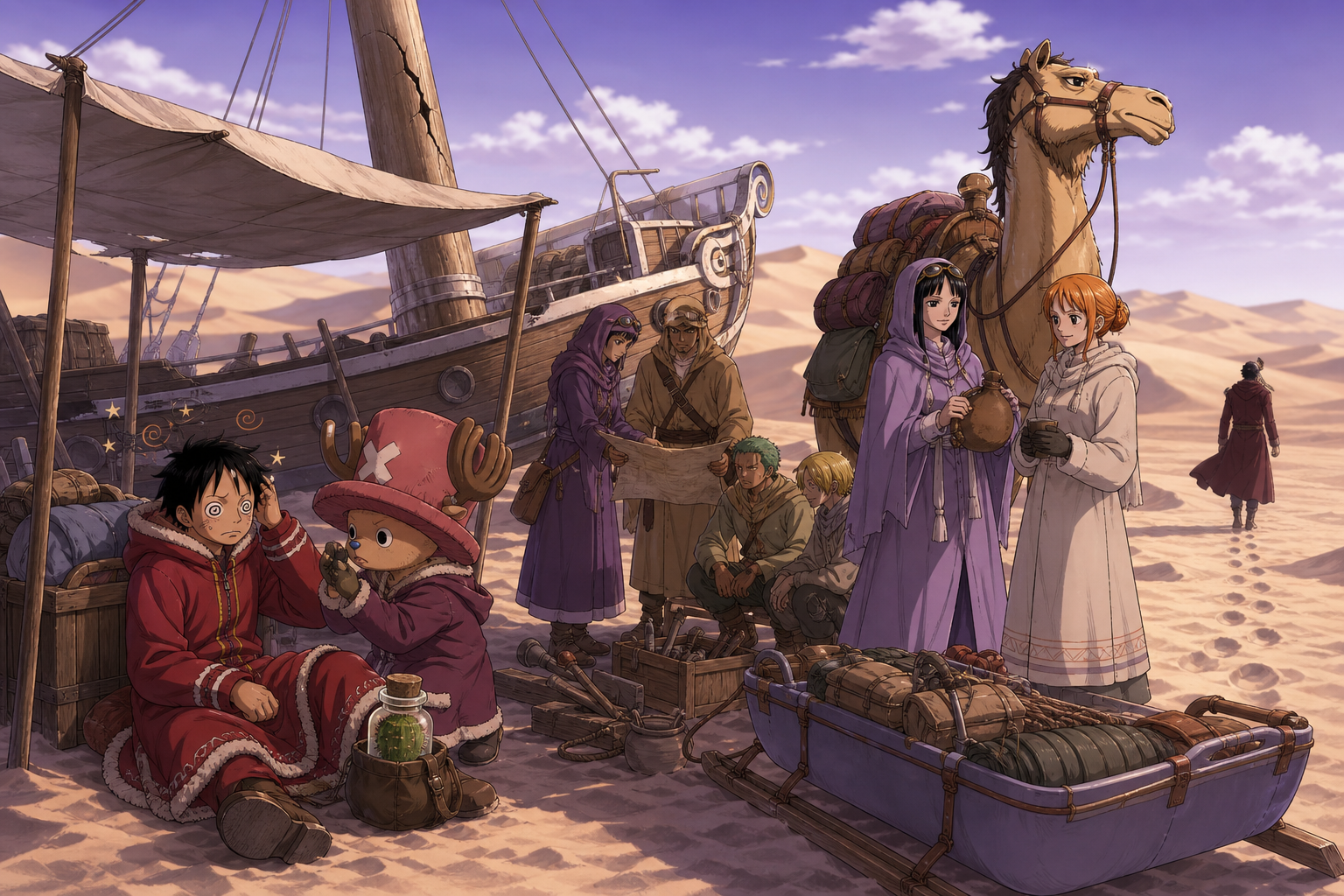
One Piece Episode 98 introduces the Barubaru desert pirates after Luffy eats hallucinogenic cactus, damages their mast, and joins the repair trip.
Quick reaction
One Piece Episode 98 lets Luffy eat the wrong cactus, hallucinate his way into somebody else’s transportation system, and leave the Straw Hats owing a desert pirate crew a new mast. The comedy is broad, but the repair matters. Luffy does not get to shrug off damage because the cactus changed his behavior. The Barubaru crew still has a broken vessel in a desert where mobility can decide who reaches water.
The episode also introduces Rasa and the men who live freely on the sand. Their sail-powered ship gives Alabasta another form of piracy that cannot be understood by copying ocean rules inland. These travelers know dunes, timber routes, settlements, and survival practices the Straw Hats do not. Their freedom depends on environmental knowledge and a working vessel, not only a flag and a loud declaration.
RaeRae’s bottom line: accidental intoxication explains why Luffy loses control, but his crew still owes repair. The timber trip works because Vivi and Luffy travel with Zaba and Rasa instead of treating the damaged group as a colorful stop on their own journey. The episode becomes more useful when the cactus joke leads to responsibility, local knowledge, and a conversation about what freedom looks like away from the sea.
A desert crossing makes small mistakes expensive
Nami and Vivi ride ahead on Eyelashes while the others continue on foot. The arrangement gives them relief from heat and keeps the camel’s refusal to carry men as part of his established personality. The wider problem is separation. Dunes, dust, and uneven pace can break line of sight quickly, especially when the group is already stressed by missing supplies.
The travelers lost three days of provisions in the previous episode. That shortage should change every decision. Water reserves, travel speed, shade stops, and the distance between group members matter more after a theft. Nobody can assume Eyelashes carries an endless replacement supply or that Ace’s strength makes a missed rendezvous harmless.
Chopper also has more than human patients to consider. Eyelashes recently escaped a carnivorous plant and may be sore, dehydrated, or frightened even if he remains willing to move. Rescue does not automatically make an animal ready for work. A gait check, water, rest, and attention to tack would protect the camel and the people relying on him.
The series plays desert travel for visual variety, but Alabasta keeps teaching the crew that land changes the meaning of ordinary pirate habits. On the Merry, someone can wander to another part of the deck. In the dunes, a few minutes of distraction can separate an entire search party.
Luffy treats an unknown cactus like free lunch
Luffy eating an unfamiliar plant is completely in character. He is hungry, impulsive, and confident that his body will survive consequences everybody else respects. The mescal cactus punishes that confidence by changing his perception. Once hallucinations begin, he cannot reliably distinguish friends, threats, routes, or fragile equipment.
The joke works because the mistake is so preventable. Vivi knows Alabasta. Chopper is a doctor. Local travelers may recognize dangerous plants. Luffy asks none of them before putting the cactus in his mouth. His appetite becomes a crew problem within minutes.
Chopper should take the lead on care, but he cannot manage Luffy’s unusual strength and elastic reach alone. The crew needs shade, calm voices, a cleared area, and enough people to prevent wandering without turning treatment into punishment. Heat illness, dehydration, injury, and intoxication can overlap, so every strange behavior should not be blamed on the plant without checking the rest of his condition.
Luffy’s altered behavior may look funny to people who know he will recover. He still cannot consent to being challenged for entertainment or pushed toward more stimulation. Protecting his dignity matters alongside protecting everyone from the damage he can cause while confused.
Ace disappears while everyone watches the loudest emergency
The crew focuses on Luffy because his crisis is visible. Ace becomes separated during that response. The contrast exposes a common group failure: one dramatic emergency can hide a quieter missing-person problem until distance has grown.
Ace has his own search for Blackbeard and may choose to leave the Straw Hats’ route, but absence without a handoff does not prove an intentional departure. The group should check his last known position, tracks, signals, and any fallback point before assuming he resumed his private mission.
His power makes concern easy to dismiss. Ace can fight, travel, and survive conditions that would endanger most people. Desert navigation can still defeat a strong traveler who lacks water or a reliable direction. The same roster check should cover everyone, including the brother who looks least likely to need help.
The episode uses Ace’s separation to move him toward Ido and the next part of the story. Within the crew, the mistake shows why emergency roles matter. Somebody treats the patient. Somebody secures the route. Somebody keeps count.
The Barubaru crew proves piracy belongs to an environment
The Barubaru desert pirates travel by sail across sand. Their vessel looks familiar enough for the Straw Hats to recognize masts, rigging, and crew labor, but the environment changes every operating rule. Sand navigation depends on wind, terrain, water, salvage, and relationships with settlements rather than ocean currents and ports.
Calling both groups pirates does not guarantee shared values. The Straw Hats should learn how the Barubaru members identify themselves, what territory means to them, where they obtain supplies, and how their presence affects nearby communities. Freedom can describe mutual independence, predation, resistance, or a romantic story people tell about their own work.
Rasa’s local knowledge gives the encounter depth beyond the vehicle. She understands the desert and may recognize Vivi from earlier history. That connection belongs to Rasa as much as to the princess. She decides what to disclose and how her memories enter the conversation.
The Barubaru group also reminds viewers that Alabasta contains people who do not fit neatly into royal and rebel categories. A civil war map can flatten independent communities into routes, resources, or obstacles. The episode briefly restores their separate lives.
The broken mast turns slapstick into a debt
Luffy damages the Barubaru ship’s main mast while intoxicated. His medical impairment changes how we judge intent. The broken mast still strands people and exposes them to heat, attack, and supply loss. Repair cannot wait until Luffy feels embarrassed enough to apologize.
The Straw Hats understand ships. Nami knows navigation, Usopp handles repairs, Sanji understands supplies, and the crew depends on a vessel for survival. They should immediately recognize that a mast is not decorative property. A cracked central support can injure people after the first impact if sail tension, rigging, and loose timber remain unsecured.
Practical responsibility belongs to the whole crew while Luffy recovers. They can stabilize the structure, clear the fall zone, confirm what replacement timber is required, and negotiate compensation. Later, Luffy can hear a truthful account and take part in the repair. Nobody needs to pretend he chose the damage for him to owe participation.
Anger from the Barubaru crew is reasonable. Striking or abandoning an intoxicated patient would not restore mobility. Safety comes first, followed by accountability that actually repairs what was lost.
The timber trip puts local expertise beside Straw Hat responsibility
Replacement wood in Melias creates a concrete repair route. Luffy, Vivi, Zaba, and Rasa leave together on a sand sled. The group composition matters. The people who caused the problem do not disappear while the injured party solves the damage alone.
Zaba and Rasa know the environment and the vessel’s needs. Vivi can help with Alabasta geography and political context. Luffy brings strength, but strength should follow the repair specification instead of deciding what timber looks big enough. A mast needs compatible grain, size, flexibility, and sound joinery.
The trip should begin only after Chopper confirms that Luffy’s acute hallucinations and heat risk have passed. Moving a confused patient across more desert could create another emergency. The ship also needs enough people left behind to stabilize the mast, protect supplies, and watch for worsening damage.
Melias cannot become a free warehouse merely because the story needs wood. Local authorization, ecological limits, and the source of the timber matter. The episode’s repair becomes stronger when restitution respects the next community instead of moving the cost from one group to another.
Rasa brings an Alabasta life that does not revolve around the palace
Vivi’s presence often pulls local stories toward royal history, especially because viewers know her identity and mission. Rasa gives the episode another center. She has her own relationship to the desert pirates, her own knowledge, and her own reasons for understanding freedom on land.
If Rasa recognizes Vivi, the discovery can reveal how a princess is remembered outside official spaces. Recognition does not entitle Vivi to private history or automatic trust. Rasa may hold affection, disappointment, suspicion, or a mixture shaped by experiences Vivi never saw from the palace.
Their conversation can also prepare Vivi for Koza. She needs to hear how people adapted while the kingdom failed to stop drought and instability. Desert piracy may be one answer to economic and political abandonment. Mobility can offer independence while also creating new conflicts over water, trade, and protection.
Rasa should remain more than a witness who confirms that Vivi is good. Her choices, competence, and relationships tell us what Alabasta asks from people living far from royal authority.
The production team lets comedy carry consequence
Junki Takegami’s script builds the episode around a familiar Luffy mistake and refuses to leave the damage behind when the gag ends. The cactus creates chaos, but the broken mast gives that chaos a material cost. The repair trip then opens a route into Rasa’s history and Alabasta’s desert communities.
Daisuke Nishio’s episode direction has to keep the hallucinations funny without losing the danger of heat, separation, and heavy equipment. Luffy’s distorted perception creates movement and surprise. The Barubaru crew’s reaction anchors the scene in what actually happened to their vessel.
Masayuki Takagi’s animation direction can make Luffy’s altered body language distinct from his ordinary recklessness. His movement should feel poorly controlled rather than simply more energetic. The mast damage needs enough weight for viewers to understand why the group cannot wave goodbye and keep walking.
Miyuki Sato’s art sells the desert ship as working technology rather than a single joke image. The sails, timber, dunes, and route toward Melias connect environment to labor. Alabasta feels larger when people have developed different ways to move through the same harsh country.
What Episode 98 changes
The Straw Hats gain contact with the Barubaru desert pirates and a path into Rasa’s past. Luffy also creates a debt that requires the group to stop, cooperate, and repair instead of treating every encounter as momentum toward Yuba.
Ace’s separation remains unresolved inside this episode, pushing his route toward Ido. The split adds another moving piece to the crew’s already difficult desert travel and prepares the reunion that follows.
Vivi sees another form of freedom inside Alabasta. The desert pirates do not wait for royal or rebel permission to define their lives. Their independence still depends on equipment, resources, local relationships, and the labor required to repair a mast.
The episode also reinforces a useful Straw Hat rule: Luffy may create the crisis, but the crew’s character appears in how they respond. Protect the patient, repair the harm, listen to local expertise, and do not make the people with the broken ship chase you for restitution.
Episode details
Japanese title: Sabaku no Kaizokudan Toujou! Jiyuu ni Ikiru Otoko-tachi
English title: The Desert Pirates Appear! The Men Who Live Freely
Japanese broadcast: January 27, 2002
Saga: Alabasta
Script: Junki Takegami
Episode direction: Daisuke Nishio
Animation direction: Masayuki Takagi
Art: Miyuki Sato
The official One Piece episode guide supplies the title, broadcast record, and production credits. RaeRae’s analysis treats Luffy’s cactus exposure as medical impairment while keeping the Barubaru crew’s repair claim, Rasa’s local knowledge, and the material importance of the mast in view.
Final verdict
Episode 98 turns a ridiculous snack choice into a useful lesson about responsibility. Luffy does not mean to break the Barubaru mast. His intention cannot move their ship. The crew does the right thing by joining a repair route instead of using his intoxication as an excuse to leave.
Rasa and the desert pirates expand Alabasta beyond the royal-versus-rebel conflict. Their freedom rests on specialized labor and a vessel adapted to the dunes. Damage that vessel and the philosophy has to wait while somebody finds timber.
RaeRae rating: 8.6/10. Keep the cactus chaos, protect the patient, count every traveler, and pay for the mast. Freedom sounds romantic until the main support beam cracks. Then freedom needs tools, local knowledge, and people willing to finish the repair.